
The penalty for Fighting in Saudi Arabia is not determined by one fixed prison term or fine that applies to every case. The legal outcome depends on the nature of the assault, the injuries caused, the role of each person involved, any weapon or object used, the available evidence, the effect of settlement or waiver, and the procedural stage of the case.
For that reason, simply describing an incident as a “fight” is not enough to predict the outcome. One incident may involve a minor confrontation with no serious injury, while another may involve physical harm, the use of an object, or several participants.
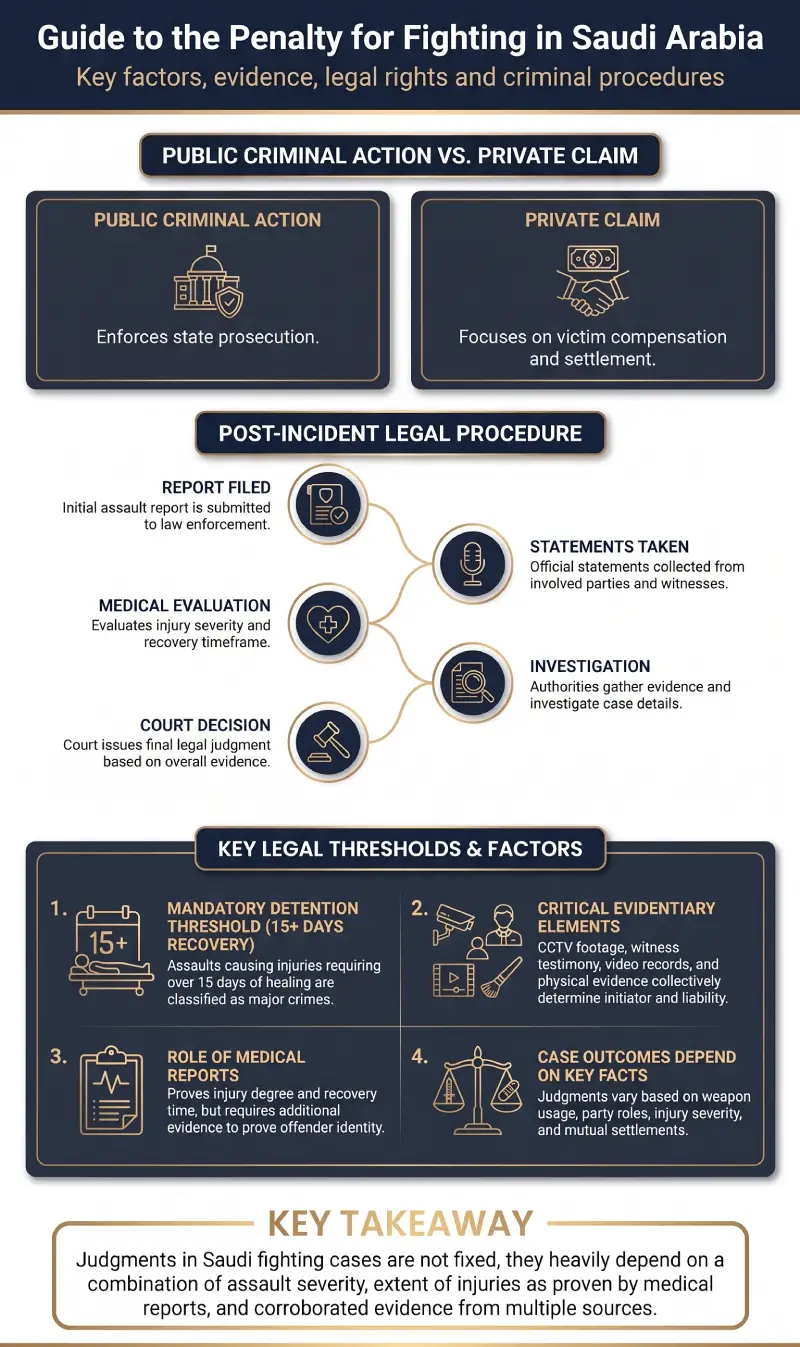
The Penalty for Fighting in Saudi Arabia varies from one case to another and is not based on a single fixed punishment. The outcome depends on the nature of the assault, the seriousness of the injury, any weapon or object used, each party’s role, the evidence, any settlement or waiver, and the procedural stage of the case.
What Is the Penalty for Fighting in Saudi Arabia?
The legal consequences depend on the conduct that actually occurred and how it is legally classified, not merely on the common description of the incident as a “fight.”
If a fight involves bodily harm or physical injury, rules relevant to the penalty for physical assault in Saudi Arabia may also become relevant. Responsibility in a fight, however, still depends on what each person did, the harm caused, and the evidence available.
Seven factors are especially important when assessing a fighting case:
| Factor | Why It Matters |
|---|---|
| Nature of the assault | Identifies the conduct attributed to each party |
| Injury | Shows the level of harm caused |
| Weapon or object used | May affect the seriousness of the incident |
| Role of each party | Helps determine responsibility |
| Evidence | Supports or weakens each party’s account |
| Settlement or waiver | May affect certain claims |
| Procedural stage | Determines what happens next |
Is There a Fixed Penalty for Fighting?
No single sentence can be given to everyone asking about the penalty for fighting in Saudi Arabia because the outcome depends on the proven conduct and the legal provisions that apply to it.
A fight that causes no serious injury is not assessed in the same way as an incident involving a fracture, significant injury, or the use of an object. CCTV footage, witnesses, medical evidence, and the surrounding circumstances may also affect the legal assessment of each participant.
Can a Fighting Case Lead to Imprisonment?
Imprisonment may be a possible outcome in some assault cases where the applicable legal classification and provisions allow it, but there is no general prison term that applies to every fight.
The Saudi Law of Criminal Procedure regulates arrest, detention, release, investigation, trial, and other stages of criminal proceedings.
For this reason, a question such as “How long is the prison sentence for fighting in Saudi Arabia?” cannot be answered accurately without first examining the facts, injuries, evidence, and procedural status of the case.
What Is the Difference Between the Public and Private Rights?
A fighting incident may give rise to both a criminal aspect concerning the conduct itself and a personal claim belonging to the injured party.
In Saudi legal practice, these are often described as the public right and the private right. For an English-speaking reader, they can be understood more clearly as the public criminal action and the private claim.
Public Criminal Action (Public Right)
The public right concerns the criminal proceedings pursued by the competent authorities when the incident requires prosecution.
The case may begin with information gathering and preliminary investigation, then move to a formal investigation, after which the competent authority decides how the file should proceed. It may ultimately be referred to court if the legal requirements for referral are met.
The Law of Criminal Procedure and its Implementing Regulations govern investigation, arrest, detention, witness testimony, and decisions concerning the criminal case.
Private Claim (Private Right)
The private right concerns claims arising from harm suffered by the injured person.
Saudi Arabia’s Civil Transactions Law addresses liability for harm and compensation and distinguishes civil liability from criminal liability.
This means that a fighting case should not be viewed only through the question of punishment. Depending on the circumstances, the injured party may also have a separate claim for compensation.
Does a Waiver or Settlement End a Fighting Case?
A waiver or settlement may affect the claim covered by it, but it does not automatically mean that every legal aspect of the case comes to an end.
Its effect depends on the right being waived, the wording of the settlement, the stage reached in the proceedings, and whether a public criminal aspect continues independently.
For that reason, a person should not assume that signing a waiver automatically means that “the case is over.” What matters is exactly what was waived, what remains outside the settlement, and how the agreement affects the existing case.
How Do Injuries and Medical Reports Affect the Case?
In cases involving the Penalty for Fighting in Saudi Arabia, a medical report can be an important technical document because it helps establish the nature and seriousness of the injury.
For example, a report may establish the existence of a wound or fracture, while linking that injury to a particular person may require additional evidence such as video footage, witness statements, the sequence of events, and physical evidence.
Proven harm may also give rise to a compensation claim under the rules of the Civil Transactions Law governing material and non-material damage.
If a fight results in death, the legal position changes significantly. The penalty for killing during a fight in Saudi Arabia depends on the legal classification of the death, intent, the object or weapon used, each participant’s role, and the causal link between the conduct and the fatal result.
Accordingly, the penalty for fighting in Saudi Arabia cannot be determined from the injury or death alone; the complete case file must be considered.
Who Is Responsible If One Party Started the Fight?
Determining who initiated the assault can be important, but responsibility is not established solely by one person’s account.
The competent authority considers the sequence of events, the conduct of each participant, and whether each version of events is consistent with the available evidence.
Relevant evidence may include:
- CCTV recordings.
- Original video footage.
- Eyewitness testimony.
- Medical reports.
- Physical evidence.
- Messages directly connected to the incident.
If a person claims that they acted in self-defence, that claim must be assessed in light of the danger they faced, the nature of their response, and the evidence supporting their account.
The Civil Transactions Law also addresses civil liability in cases of lawful defence, including whether the response exceeded what was necessary to repel the attack.
What Happens After a Fight Is Reported?
Reporting the incident is only the beginning of the process, and the Penalty for Fighting in Saudi Arabia cannot be determined merely because a report has been filed.
The case may change significantly after statements are taken, evidence is collected, and medical reports or other records are reviewed.
A fighting case may move through the following stages:
- Receiving the report and recording the initial information.
- Taking statements from the parties.
- Collecting evidence and relevant reports.
- Investigation where required.
- A decision on how the case should proceed.
- Referral to court if the legal requirements are met.
The Law of Criminal Procedure regulates criminal investigation, witness examination, interrogation, detention, release, and decisions concerning prosecution.
If you receive a summons, it is advisable to preserve reports, original recordings, witness details, and any documents connected with the incident. Organising these materials from the outset can make the legal position easier to assess.
What Evidence Matters in a Fighting Case?
A fighting case rarely depends on one item of evidence alone. What matters is how the evidence fits together and whether it is consistent with the sequence of events.
| Evidence | What It May Help Establish |
|---|---|
| Medical report | Nature and seriousness of the injury |
| CCTV footage | Sequence of events and conduct of the parties |
| Witness testimony | What the witness directly observed |
| Relevant messages | Context connected to the incident |
| Official records | What was formally recorded during the proceedings |
A medical report may confirm an injury, while CCTV footage may help show how it occurred or who initiated the assault.
The Implementing Regulations of the Law of Criminal Procedure also govern evidence-gathering measures, inspection, seizure of items connected with an offence, and witness examination.
Original recordings and messages should be preserved without editing or cropping them in a way that changes their context.
Is Fighting a Criminal Case, and Does It Create a Criminal Record?
If the fight involves conduct that gives rise to criminal liability, it may proceed through the criminal justice process depending on the legal classification adopted by the competent authorities.
However, it is important to distinguish between:
report → investigation → charge → judgment
These are separate stages. The existence of a police report does not by itself mean that an offence has been proven or that a conviction has been entered.
Whether a particular fighting case creates a criminal record cannot be answered by one rule applicable to every incident. The answer depends on the final judgment, its legal nature, and the consequences attached to it under Saudi law.
When Should You Consult a Criminal Lawyer About a Fighting Case?
Legal assessment becomes more important when a fight develops from a temporary dispute into a case involving a report, investigation, medical evidence, or a private claim.
At that stage, the issue is no longer simply the possible penalty. It becomes necessary to understand your legal position, what the evidence actually supports, and how each procedural step may affect the case. This is where consulting a criminal lawyer in Jeddah may become particularly relevant.
A legal review may be especially important where there is:
- An official summons.
- An injury or medical report.
- Disagreement over who started the assault.
- CCTV footage or witnesses.
- A proposed settlement or waiver.
- A compensation claim.
- Referral to court or an appeal stage.
Frequently Asked Questions About Penalty for Fighting
What Is the Penalty for Fighting in Saudi Arabia?
The penalty for fighting in Saudi Arabia depends on the nature of the assault, the injury caused, any weapon or object used, the role of each participant, the available evidence, and the legal provisions that apply.
Can Fighting Lead to Imprisonment?
Yes, imprisonment may be possible in some cases, depending on the legal classification of the incident and the applicable provisions.
Does a Waiver End a Fighting Case?
A waiver may affect the particular claim it covers, but it does not necessarily end every criminal aspect of the case. Its effect depends on its wording, the rights waived, and the procedural stage reached in the proceedings.
.
Is a Medical Report Enough to Prove Assault?
A medical report helps establish the existence and seriousness of an injury, but it does not necessarily prove who caused it.
Are Both Parties Automatically Detained After a Fight?
No. A fight does not automatically mean that both parties will be detained.
What Should I Prepare Before Consulting a Lawyer?
Collect any available reports or notices, medical records, original recordings, witness details, and messages directly connected with the incident.
Penalty for Fighting in Saudi Arabia: 7 Key Factors, the nature of the assault, the seriousness of the injury, the object or weapon used, the role of each party, the strength of the evidence, the effect of settlement or waiver, and the procedural stage of the case.
A fight may remain a relatively limited assault case, become more serious because of injury, or move into a fundamentally different legal category where death occurs. In every situation, the facts, evidence, and legal classification remain the proper starting point.
In cases like these, clients usually need more than a general answer. They need to understand their current position, the evidence that matters, and the next legal step. BMS Legal for Law Firm and Legal Consultations, as a law firm in Jeddah, begins by reviewing the facts and documents before identifying the most appropriate legal course, without assuming an outcome before the case has been assessed.