
Resignation under Article 77 of the Saudi Labor Law is a phrase commonly searched in Saudi Arabia, but it can cause confusion between resignation as a means of ending employment and compensation arising from termination for an unlawful reason. Article 77 does not itself regulate the submission of a resignation; rather, it sets out compensation for the party harmed by an unlawful termination where its conditions apply.
At the same time, the Saudi Labor Law recognizes resignation as one of the ways an employment contract may end, while Article 79 bis regulates the resignation request, acceptance, postponement, and withdrawal. The legal effect therefore depends on the type of employment contract, who initiated the termination, the reason for termination, and whether the contract contains a compensation clause.
Does Resignation Under Article 77 of the Saudi Labor Law Exist?
The expression does exist in administrative use. The General Organization for Social Insurance lists “Resignation pursuant to Article 77 of the Labor Law” among the reasons for excluding a contributor from insurance coverage. The same list distinguishes resignation from dismissal and other reasons for ending employment. General Organization for Social Insurance
However, the existence of this administrative label does not mean that Article 77 regulates the procedure for submitting a resignation. Saudi labor law distinguishes between resignation, termination of an indefinite-term contract, and compensation for unlawful termination.
This distinction is important when determining whether an employee or employer may be entitled to compensation.
Accordingly, the question “Can an employee resign under Article 77?” cannot be answered solely by reference to the exclusion reason recorded administratively. The contract and the actual reason the employment relationship ended must first be examined.
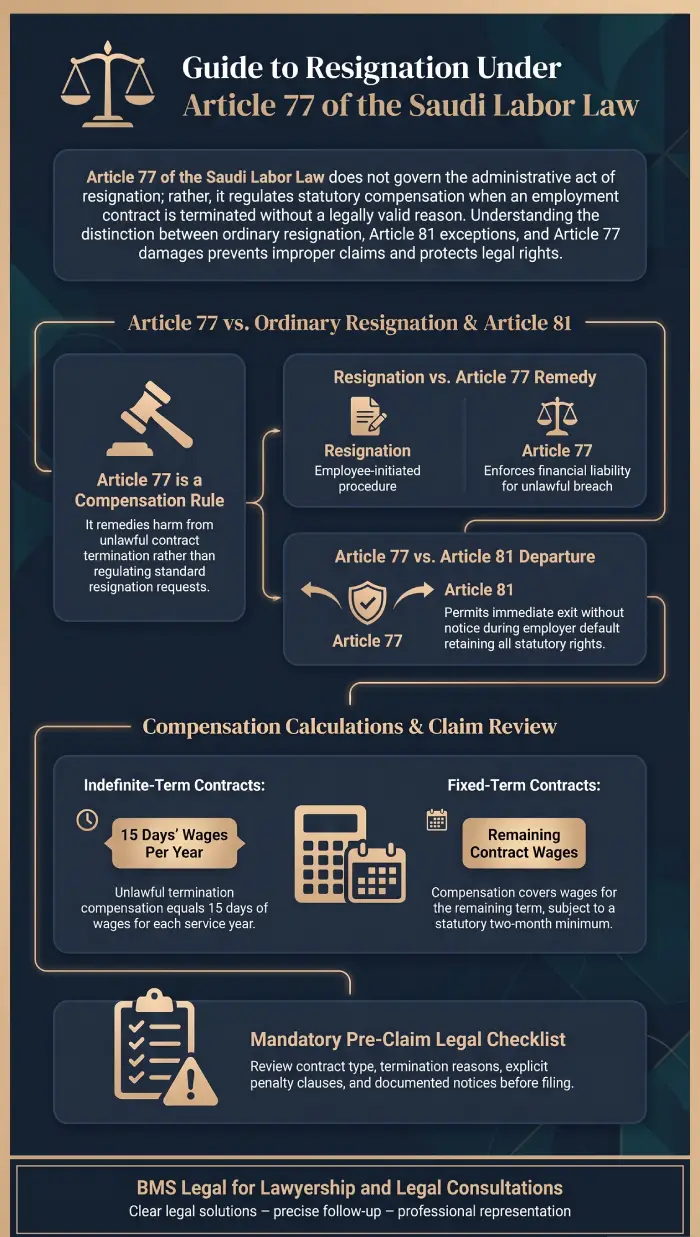
What Is the Difference Between Resignation and Article 77?
The key difference is that resignation concerns how and why the employment relationship ends, while Article 77 concerns compensation where a contract is terminated for an unlawful reason and the contract does not already specify compensation for that situation. Ministry of Human Resources and Social Development
The distinction can be summarized as follows:
| Issue | Resignation | Article 77 |
|---|---|---|
| Legal function | A means of ending the employment contract | Determines compensation for unlawful termination |
| Main question | How and when did the employment relationship end? | Is the harmed party entitled to compensation? |
| What should be reviewed? | Resignation request, applicable periods, and contract type | Reason for termination, contract terms, and compensation clause |
| Who may benefit? | The employee retains rights granted by law | The harmed party where the legal conditions are met |
Termination of an Employment Contract by Mutual Agreement in Saudi Arabia is different from resignation because it is based on an agreement between the employee and employer to end the employment relationship, whereas resignation originates from the employee under the rules governing it.
When Is Compensation Under Article 77 Payable?
Compensation may become payable to the harmed party when one party terminates the employment contract for an unlawful reason, unless the contract itself specifies compensation for such termination.
It is therefore not enough to establish that the employment relationship has ended. The legal basis for the termination and the terms of the contract must first be identified. Ministry of Human Resources and Social Development
This is particularly important when considering employee rights under Article 77 or whether an employer may claim compensation, because the provision refers to the “harmed party” rather than limiting compensation to employees only.
What If the Contract Specifies Compensation?
The employment contract should be reviewed first. If it contains a specific compensation provision for termination without a lawful reason, that clause becomes relevant before applying the general statutory calculation under Article 77.
As a result, two apparently similar employment disputes may produce different compensation outcomes if one contract contains a specific compensation clause and the other does not.
How Is Article 77 Compensation Calculated If the Contract Does Not Specify an Amount?
Where the contract does not specify compensation, the calculation depends on the type of employment contract:
- Article 77 compensation for an indefinite-term contract: 15 days’ wages for each year of service.
- Article 77 compensation for a fixed-term contract: wages for the remaining period of the contract.
- In both cases, compensation must not be less than two months’ wages. Ministry of Human Resources and Social Development
Accordingly, it is incorrect to say that Article 77 compensation is limited to “two months’ salary.” Two months’ wages represent the statutory minimum, not the maximum.
This compensation is also separate from the end-of-service award. Article 84 of the Saudi Labor Law governs the basis for calculating the end-of-service award in the situations covered by that provision.
Is an Employee Who Resigns Entitled to Article 77 Compensation?
Resignation under Article 77 of the Saudi Labor Law does not mean that every employee who resigns is automatically entitled to compensation. Article 77 compensation depends on an unlawful termination and on identifying the party harmed by that termination.
A resignation itself has separate legal consequences under the Saudi Labor Law. Ministry of Human Resources and Social Development
Article 79 bis provides that an employee whose contract ends by resignation remains entitled to the rights granted under the Labor Law. Those rights must, however, be distinguished from compensation under Article 77.
Resignation may also affect the employee’s end-of-service award, and Article 85 of the Saudi Labor Law sets out the applicable entitlement levels according to the employee’s length of service.
For this reason, the question “Does resignation eliminate Article 77 compensation?” cannot be considered separately from the actual circumstances. If there is a dispute over who truly ended the employment relationship or why it ended, that issue must first be resolved.
What Are the Rules for Resignation Under Saudi Labor Law?
Article 79 bis directly regulates the procedure and timing of resignation. This provision is therefore essential when considering resignation under Article 77 of the Saudi Labor Law, because it prevents confusion between the resignation process itself and compensation that may arise in a different legal situation. Ministry of Human Resources and Social Development
The employment contract remains in force while the resignation request is pending, and both parties continue to perform their obligations until the employment relationship ends in accordance with the applicable rules.
When Is a Resignation Accepted, and Can It Be Postponed or Withdrawn?
A resignation request is deemed accepted if 30 days pass from the date of submission without a response from the employer.
The employer may postpone acceptance for up to 60 days where the interests of the business require it, provided that the employer gives the employee a written and reasoned explanation before the initial 30-day period expires. The postponement period begins from the date on which that written explanation is provided. Ministry of Human Resources and Social Development
The employee may also withdraw the resignation within seven days of submitting it, unless the employer has already accepted the resignation before the withdrawal.
What Is the Notice Period for an Indefinite-Term Contract?
For an indefinite-term contract where wages are paid monthly, Article 75 of the Saudi Labor Law requires an employee who terminates the contract for a lawful reason to give at least 30 days’ written notice.
Where the employer terminates the contract, the notice period is at least 60 days.
If wages are not paid monthly, the required notice period is at least 30 days for the party terminating the contract.
When Is Resignation Different From Leaving Work Under Article 81?
An employee’s departure from employment may arise from circumstances that are legally different from an ordinary resignation.
Article 81 permits an employee to leave work without notice while retaining statutory rights where one of the situations listed in the provision is established.
These circumstances include failure by the employer to fulfil essential contractual or statutory obligations, certain cases involving fraud, assault, unfair treatment, or conduct by the employer that effectively causes the employee to appear as though they voluntarily ended the employment relationship.
For that reason, expressions such as “resignation under Article 77” should not replace an assessment of whether the facts may instead fall within one of the situations covered by Article 81 of the Saudi Labor Law.
What Should You Review Before Claiming Article 77 Compensation?
Before assessing whether termination gives rise to compensation under Article 77, the factors that directly affect the legal outcome should be reviewed first. This helps avoid basing a claim solely on the administrative label used for the termination.
| What to Review | Why It Matters |
|---|---|
| Type of employment contract | The compensation calculation differs |
| Reason the employment ended | Determines whether the termination may be lawful or unlawful |
| Who initiated the termination | Helps identify the potentially harmed party |
| Compensation clause | May apply before the general statutory calculation |
| Length of service or remaining contract term | Directly affects the compensation calculation |
| Resignation request and notices | Establishes the sequence and applicable periods |
| Relevant correspondence | Helps clarify the facts where the reason for termination is disputed |
Article 77 compensation should not be confused with the end-of-service award or compensation relating to notice requirements. Each entitlement has a separate legal basis.
Where the reason for ending employment is disputed, the contract contains a compensation provision, or the correspondence does not match the recorded reason of “resignation,” a legal review by a Labor Lawyer in Jeddah at BMS Legal can help identify the appropriate next step before a claim is submitted or a final settlement is signed.
Frequently Asked Questions About Resignation Under Article 77 of the Saudi Labor Law
هل يحق للموظف الاستقالة بموجب المادة 77؟
المادة 77 ليست إجراءً يقدمه الموظف للاستقالة، وإنما تنظم تعويض الطرف المتضرر من إنهاء العقد لسبب غير مشروع. والاستقالة لها أحكام مستقلة في نظام العمل، لذلك يجب أولاً تحديد طبيعة العقد وطريقة انتهاء العلاقة قبل معرفة ما إذا كان تعويض المادة 77 يدخل في الحالة. الموارد البشرية
هل يستحق المستقيل تعويض المادة 77؟
لا تنشئ الاستقالة بذاتها حقاً تلقائياً في تعويض المادة 77. يستحق التعويض عند تحقق شروط الإنهاء غير المشروع ووجود طرف متضرر، مع مراعاة أي تعويض محدد في العقد. أما حقوق العامل الناتجة عن انتهاء العقد بالاستقالة فتخضع للأحكام الأخرى ذات الصلة في نظام العمل.
هل تعويض المادة 77 راتب شهرين فقط؟
لا. أجر الشهرين هو الحد الأدنى الذي نصت عليه المادة 77 عند تطبيق طريقة الحساب النظامية. ففي العقد غير محدد المدة يحسب التعويض بأجر 15 يوماً عن كل سنة خدمة، وفي العقد محدد المدة يكون بأجر المدة الباقية، ما لم يتضمن العقد تعويضاً محدداً. الموارد البشرية
هل يحق لصاحب العمل مطالبة العامل بتعويض المادة 77؟
يمكن أن يكون صاحب العمل هو الطرف المتضرر؛ لأن المادة 77 لم تحصر التعويض بالعامل. لكن الاستحقاق لا يفترض لمجرد أن العامل أنهى العلاقة، بل يجب تحديد نوع العقد، وسبب الإنهاء، وشرط التعويض، وما إذا كان الإنهاء غير مشروع وفق وقائع الحالة.
ماذا يحدث إذا لم يرد صاحب العمل على طلب الاستقالة؟
يعد طلب الاستقالة مقبولاً بعد مضي 30 يوماً من تاريخ تقديمه دون رد. ويجوز لصاحب العمل تأجيل القبول لمدة لا تتجاوز 60 يوماً وفق إيضاح مسبب ومكتوب يقدم خلال المدة النظامية، وتحتسب مدة التأجيل من تاريخ تقديم ذلك الإيضاح للعامل. الموارد البشرية
ما الفرق بين المادة 77 والمادة 81 من نظام العمل؟
المادة 77 تتناول التعويض عن إنهاء العقد لسبب غير مشروع، أما المادة 81 فتحدد حالات يجوز فيها للعامل ترك العمل دون إشعار مع احتفاظه بحقوقه النظامية. لذلك لا تعد المادة 81 نوعاً من «الاستقالة بالمادة 77»، بل لها شروط وأثر نظامي مختلفان. الموارد البشرية
Resignation under Article 77 of the Saudi Labor Law cannot be understood from the termination label alone. Article 77 addresses compensation for the party harmed by unlawful termination, while resignation is governed by separate provisions. Indefinite-term contracts also have specific notice rules, and Article 81 addresses separate circumstances in which an employee may leave employment while retaining statutory rights.
A proper assessment therefore begins with the employment contract, the actual reason for termination, the party who initiated it, and any compensation clause. Only after those elements are established can any potential entitlement under Article 77 be assessed accurately.