In Saudi Arabia, wills are governed by the Saudi Personal Status Law. The Ministry of Justice also provides an official will notarization service through Najiz. A properly drafted will must therefore identify the intended assets and beneficiaries, respect the legal limits on bequests, and avoid provisions that could unlawfully affect inheritance rights.
If your will concerns inherited property or outstanding estate obligations, understanding the broader rules covered in our Saudi inheritance and estate guide can help you assess the document before finalizing it.
Key Points Before Using a Will Template
Before using a ready-made will, treat it as a starting point for organizing information rather than a final legal document suitable for every situation.
A properly prepared will should clearly identify the testator, the beneficiary, the property or right being bequeathed, the amount or proportion involved, and the intended method of execution.
The more precisely these elements are described, the lower the likelihood of disagreements when the will is implemented.
Additional review is especially important if the estate includes property, company interests, debts, minor heirs, or beneficiaries who are already entitled to inherit.
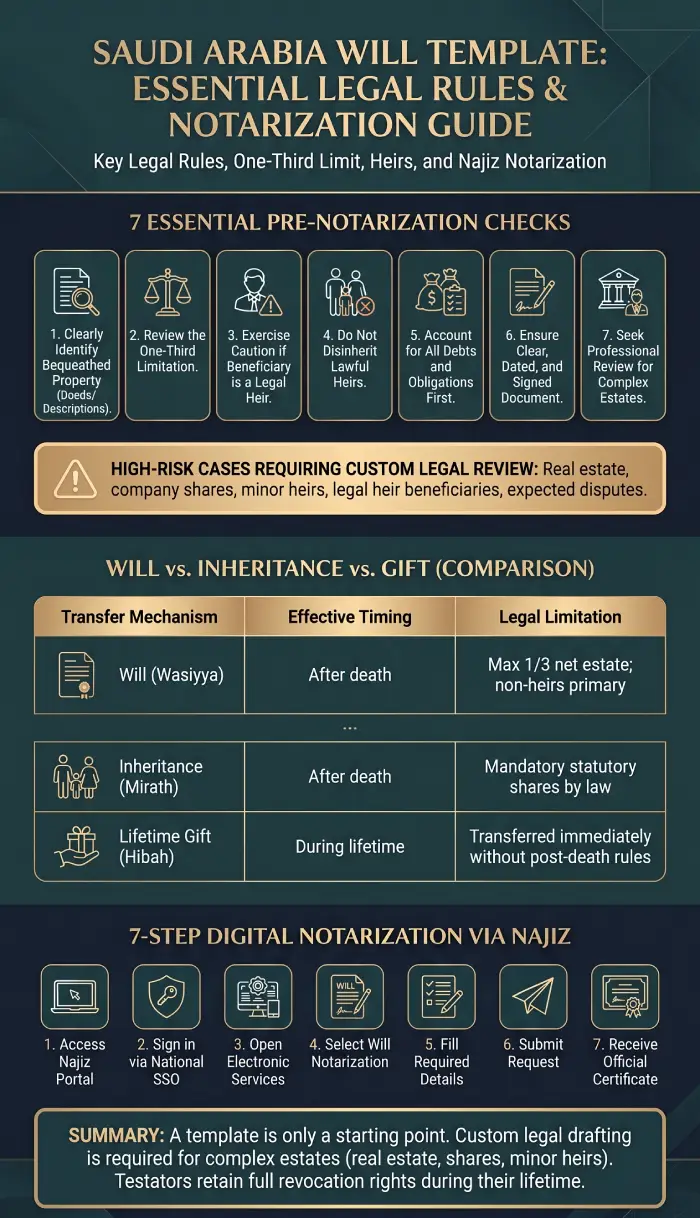
7 Essential Checks Before Notarizing a Will in Saudi Arabia
Before notarizing a Saudi Arabia will template, consider the following seven checks. A will is a personal legal document whose effectiveness depends on the estate, beneficiaries, outstanding obligations, and applicable inheritance rules.
- Clearly identify the bequeathed property. Avoid vague statements such as “I leave my house” if you own more than one property. Specify the title deed number or provide another precise description.
- Review the one-third limitation. If the bequest exceeds one-third of the relevant estate, the excess may require the heirs’ approval under the applicable legal rules.
- Be cautious when naming a legal heir as a beneficiary. Bequests to existing heirs require particular legal consideration and should not rely on generic wording.
- Do not use a will to disinherit a lawful heir. A will is not a mechanism for bypassing Saudi inheritance provisions or eliminating an heir’s lawful entitlement.
- Account for debts and liabilities. Outstanding debts and financial obligations can affect the amount available for executing the bequest.
- Use a clear, dated, and properly executed document. Missing dates, disputed signatures, or ambiguous wording can increase the risk of disagreement.
- Seek additional review for complex estates. Real estate, company shares, and the presence of minor heirs require greater attention because several legal and ownership interests may be involved.
When Is a General Will Template Insufficient?
A standard template may not adequately address your circumstances when the intended beneficiary is an existing heir, the bequest concerns real estate or business interests, or the proposed amount exceeds one-third of the relevant estate.
Similarly, an anticipated family dispute, the presence of minor heirs, or multiple versions of the same will may require a more carefully drafted document.
The key consideration before notarization is whether the assets, beneficiaries, and legal limits are sufficiently clear for the will to be implemented.
What Is a Will Under Saudi Law?
A will, commonly referred to as a Wasiyyah in Islamic law, is a disposition intended to take effect after the testator’s death. It may concern a specified asset, financial benefit, or legal right.
Unlike an immediate transfer of ownership, a will generally determines what is intended to happen after death, subject to Sharia principles and applicable Saudi law.
A will can help clarify financial or charitable intentions, but it cannot simply override inheritance rules or deprive lawful heirs of their entitlements.
People commonly prepare wills to:
- Allocate part of their estate to charitable activities.
- Make a bequest within the one-third limit.
- Record instructions relating to debts and obligations.
- Designate someone to oversee the will’s execution.
- Identify real estate or financial assets covered by a bequest.
- Reduce uncertainty and possible disputes among heirs.
Understanding the differences between a will, a gift, a sale, and an endowment can help determine which legal arrangement is suitable.
| Comparison | Will (Wasiyyah) | Gift (Hibah) | Sale | Endowment (Waqf) |
|---|---|---|---|---|
| When it takes effect | After death | Generally during life | According to the contract | According to its terms |
| Financial consideration | Generally none | None | Payment | Generally none |
| Revocation | Possible during the testator’s lifetime, subject to law | Subject to specific rules | Generally binding | Governed by endowment rules |
| Relationship to inheritance | Connected to the estate | Usually completed during life | Generally outside inheritance once completed | Separate legal nature |
| Importance of documentation | Helps reduce disputes | Important for valuable assets | Depends on the asset and transaction | Particularly important |
Free Saudi Arabia Will Template: Customizable Sample
The following Saudi Arabia will template is intended as a practical starting point. It should be modified to reflect the testator’s circumstances and should not be adopted without further review where the bequest involves an existing heir, real estate, business interests, or substantial financial value.
Sample Last Will and Testament
Copy
In the Name of Allah, the Most Merciful, the Most Compassionate I, the undersigned: Full name: […………….] National ID / Iqama number: […………….] Nationality: […………….] Address: […………….] I declare, while possessing the legal capacity required under Sharia and Saudi law and acting of my own free will, that I make the following bequests: First: I direct that my established debts and liabilities be settled from my estate before the execution of my bequests and the distribution of inheritance. Second: I bequeath […………….], described as […………….], to […………….], within the limits permitted by applicable Saudi laws and Sharia principles. Third: If the bequeathed asset is money, real estate, or a share in another asset, its details are as follows: Title deed / account / asset number: […………….] Location or description: […………….] Percentage or amount: […………….] Fourth: I designate […………….], National ID / Iqama number […………….], to oversee the execution of this will to the extent permitted by law. Fifth: I execute this will on […………….], fully understanding its meaning and legal implications. I retain the right to amend or revoke it during my lifetime in accordance with applicable law. Testator’s signature: […………….] First witness: […………….] Second witness: […………….]
A statement such as “I leave part of my money” may be insufficiently precise. The intended amount, percentage, or asset should be identified as clearly as possible.
Essential Information to Review Before Signing
Before adopting a legal will template, review the following information:
- Full legal name and identification number of the testator.
- Date on which the will is executed.
- Identification details of the beneficiary or receiving organization.
- Description of the asset, property, or right covered by the bequest.
- Amount or percentage of the bequest.
- Known debts and financial obligations.
- Details of the designated executor, where applicable.
- Testator’s signature and witness information when relevant.
A general form may be inappropriate when the intended beneficiary is an existing heir, substantial assets are involved, or the estate includes minor heirs.
If your will concerns inherited property, a potentially disputed estate, or significant financial interests, an inheritance and estate lawyer in Jeddah can review the proposed wording and assess its legal implications before notarization.
Legal Requirements for a Valid Will in Saudi Arabia
The legal requirements governing wills are intended to protect the testator’s intentions while preventing ambiguity and unlawful interference with inheritance rights.
A written document alone does not necessarily establish that every provision is legally effective.
Important considerations include:
- The testator must possess the required legal capacity when making the will.
- The will must reflect a free and voluntary intention.
- The property or right being bequeathed must be identifiable or capable of being determined.
- The beneficiary must be sufficiently identified.
- The provisions must not be intended to unlawfully prejudice the heirs.
- The will must comply with applicable Saudi legislation and Sharia principles.
A will prepared during serious illness or an existing family dispute may be more vulnerable to challenges concerning its validity or the testator’s intentions.
For larger estates or complicated family circumstances, legal review and appropriate documentation are particularly important.
The One-Third Rule for Wills in Saudi Arabia
One of the most important legal considerations when preparing a will is the one-third limit.
The Saudi Personal Status Law establishes rules governing the execution of a bequest within one-third of the estate and the treatment of any amount exceeding that limit.
A bequest exceeding one-third is not automatically effective in full. Its excess portion is subject to the applicable rules concerning approval by the heirs.
For practical estate planning, debts and relevant obligations must be considered before calculating the amount available for a bequest.
Example: Calculating One-Third of an Estate
Assume the net estate, after accounting for debts and applicable obligations, amounts to SAR 900,000.
One-third of this amount is SAR 300,000.
A bequest of SAR 300,000 to an eligible charitable beneficiary would fall within the illustrated one-third threshold, subject to the remaining legal requirements.
However, if the testator bequeaths SAR 500,000, the amount exceeding one-third would be SAR 200,000.
That excess should not be treated as automatically enforceable without reviewing the applicable legal requirements and any necessary approvals.
Can You Leave a Will to One of Your Heirs?
Bequests benefiting existing legal heirs are among the issues most likely to require careful examination after a person’s death.
For example, someone may intend to leave a particular property to a son, daughter, spouse, or another relative. However, the legal effect may depend on whether that person is an heir and whether the bequest complies with the applicable rules.
A general online template cannot resolve these issues by itself.
A will should also not be used to deprive another heir of a lawful inheritance share.
Legal review is particularly important where:
- There are children from different marriages.
- Some heirs are minors or absent.
- The estate includes real estate or business interests.
- Significant debts or unclear liabilities exist.
- One heir is intended to receive a particular asset.
- Previous inheritance disputes have occurred.
Is a Handwritten Will Valid in Saudi Arabia?
A handwritten will may be considered as evidence if its attribution to the testator and the applicable legal requirements can be established.
However, a handwritten or unnotarized will may face greater evidentiary challenges than an officially documented will, particularly when beneficiaries disagree about its authenticity or contents.
The principal concern is not simply that the document is handwritten. Rather, it is whether its date, authorship, contents, and the testator’s intention can be established.
Potential grounds for disagreement include:
- An unclear date of execution.
- Multiple inconsistent versions.
- Disputes over the authenticity of a signature.
- Ambiguous descriptions of bequeathed assets.
- A beneficiary who is already a legal heir.
- Allegations that the testator lacked the required capacity.
Using clear wording, recording the date, and considering official notarization can help reduce avoidable evidentiary problems.
How to Notarize a Will Through Najiz in Saudi Arabia
The Saudi Ministry of Justice provides an online service for notarizing wills through the Najiz platform.
According to the Ministry, the service allows the testator or an authorized representative, as applicable, to request official notarization of a will.
You can review the official Will Notarization service before submitting an application.
Steps to Notarize a Will Through Najiz
The process generally involves:
- Accessing the Najiz electronic services platform.
- Signing in through the National Single Sign-On system.
- Selecting all electronic services.
- Opening the Social Cases category.
- Choosing the Will Notarization service.
- Starting a new application.
- Entering the applicant’s details, the testator’s information, and the relevant bequest information.
- Submitting the application and following its status.
The Ministry’s service page identifies the information required for the application, including details concerning the parties, the will, relevant assets, rights, and obligations.
Before submitting the request, prepare the testator’s identification information, beneficiary details, the proposed will, and an accurate description of the assets.
Where a property is involved, the relevant title deed information may be needed.
Notarization helps establish an official record, but it does not automatically resolve every question concerning the legal effectiveness of the will’s provisions.
Will vs. Gift, Endowment, and Inheritance in Saudi Arabia
Understanding the differences between a will, a gift, an Islamic endowment, and inheritance can help you choose the appropriate legal arrangement.
A person may prepare a will when a lifetime gift or endowment would better serve the intended purpose.
Inheritance is governed by the legally prescribed shares of eligible heirs. These shares are not determined solely by the deceased’s personal preferences.
If you need to identify the heirs and understand the distribution of their entitlements, our guide to calculating inheritance shares in Saudi Arabia explains the relevant considerations.
An Islamic endowment, or Waqf, has a different legal nature. It generally involves preserving an asset and allocating its benefits to specified purposes.
For someone wishing to support a charitable activity over an extended period, an endowment may be worth considering alongside a will, depending on the circumstances.
Can a Will Be Amended or Revoked in Saudi Arabia?
A person’s assets, family circumstances, and financial obligations can change over time. Therefore, an existing will should be reviewed whenever significant changes occur.
The Implementing Regulations of the Saudi Notarization Law address the amendment and revocation of wills, including requests to amend or revoke all or part of a will.
A testator may amend or revoke a will during their lifetime, provided the applicable requirements concerning legal capacity and procedure are satisfied.
An amendment should clearly state whether it replaces an earlier will entirely or changes only specific provisions.
This distinction becomes especially important when several versions of a document exist.
If more than one heir needs to authorize someone to handle estate-related procedures, an appropriately drafted power of attorney for heirs in Saudi Arabia can help establish the representative’s authority and scope of responsibilities.
How Is a Will Executed After Death?
Executing a will generally begins with establishing its existence and contents, identifying the deceased’s estate, and determining the applicable debts and inheritance entitlements.
Estate administration may also require official documents confirming the deceased’s legal heirs.
For information about this procedure, see our guide to obtaining an electronic inheritance certificate through Najiz.
Practical Steps for Executing a Will
The general process involves:
Identifying the deceased’s assets: Prepare an inventory of real estate, funds, business interests, and other property.
Determining debts and liabilities: Establish the outstanding financial obligations that must be addressed.
Confirming the existence of a will: Locate the relevant document and establish which version is applicable.
Reviewing the legal limits: Consider the beneficiary’s status, the amount bequeathed, and the requirements governing execution.
Executing the legally effective bequest: Implement the provisions that can lawfully take effect.
Distributing the remaining estate: Allocate the balance among the lawful heirs according to their entitlements.
Disagreements may arise where the will exceeds the one-third limit, benefits a legal heir, contains unclear descriptions of assets, or exists in conflicting versions.
Other disputes may concern the testator’s legal capacity or the authenticity of the document.
Legal advice may be particularly important where substantial real estate, company interests, minor heirs, or significant debts are involved.
Common Drafting Mistakes That Weaken a Will Template
Using a Saudi Arabia will template can simplify initial preparation, but mistakes may arise when the wording is too general or does not reflect the testator’s actual circumstances.
Some of the most common drafting mistakes include:
Leaving blank fields in the document after it has been signed.
Using descriptions that do not adequately identify the bequeathed property.
Naming beneficiaries without sufficient identifying information.
Including contradictory instructions in different clauses.
Failing to clarify whether a new document replaces or merely amends an earlier will.
Continuing to use an outdated will after significant changes in assets or family circumstances.
A will should form part of a broader approach to organizing the estate, including accurate asset records, outstanding liabilities, and appropriate documentation.
A generic document should not replace a proper assessment of the circumstances in which it will operate.
When Is a Saudi Arabia Will Template Sufficient?
Whether a standard template is suitable depends on the intended beneficiary, the nature of the property, the amount involved, and the likelihood of a dispute.
| Situation | Is a Standard Template Sufficient? | Recommended Approach |
|---|---|---|
| Simple bequest to a non-heir | May be a useful starting point | Customize the document and consider notarization |
| Real estate bequest | Generally insufficient on its own | Identify the title deed and review the provisions |
| Bequest to an existing heir | Requires legal review | Assess the applicable legal rules |
| Minor heirs are involved | Requires additional consideration | Examine the implications for minors |
| Company shares or business interests | Generally insufficient | Review ownership records and obligations |
| Charitable bequest | May be a useful starting point | Verify the beneficiary and wording |
A standard will template may be appropriate as an initial draft where the bequest is straightforward, the beneficiary is not a legal heir, the property is clearly identified, and the amount falls within the applicable limits.
However, estates involving substantial assets, properties, companies, or minor heirs often require a more carefully customized document.
If your primary goal is to organize the estate and determine what happens after a valid bequest is executed, our guide to the inheritance distribution process in Saudi Arabia explains the related considerations.
Is Your Will Legally Ready?
A Saudi Arabia will template is a starting point, not a guarantee of legal validity. BMS Legal Law Firm can review your proposed will, beneficiaries, estate assets and applicable inheritance limits before notarization.
Frequently Asked Questions About Will Templates in Saudi Arabia
1. How do I write a legally valid will in Saudi Arabia?
Identify the beneficiaries, assets, and intended bequests clearly. The will must comply with Saudi legal requirements concerning capacity, beneficiaries, and inheritance limits.
2. Does a will need to be notarized through Najiz?
Notarization through Najiz helps establish the will's authenticity and reduce disputes. However, an unnotarized will may still have legal effect depending on the circumstances and applicable rules.
3. Can a will benefit one of the legal heirs?
A bequest to a legal heir is subject to specific inheritance rules and may require approval from the other heirs. Its validity depends on the circumstances and applicable legal requirements.
4. What percentage of an estate can be left through a will?
Generally, a will may cover up to one-third of the estate, subject to applicable legal rules. Any excess may require approval from the relevant heirs.
A Saudi Arabia will template can help you prepare a clear written record of your intentions, but it cannot replace an understanding of the legal consequences of each provision.
A document that appears straightforward when signed may later become disputed if it involves an existing heir, substantial property, company interests, or an amount exceeding the one-third limit.
Before notarization, review the will as you would any document affecting an estate. Confirm that the intended beneficiaries are clearly identified, the assets are accurately described, and the provisions comply with the applicable rules.
A carefully customized and properly documented will is more likely to reflect the testator’s intentions clearly and reduce avoidable disagreements.
Official Legal Sources: