
The distinction becomes particularly important when employment ends before the agreed expiry date, either party seeks compensation for the remaining contract period, or a disagreement arises over resignation. Understanding the applicable legal grounds is essential before calculating entitlements or taking further action.
When Can a Fixed-Term Employment Contract Be Terminated in Saudi Arabia?
A fixed-term employment contract is an agreement under which an employee and employer establish a specific period for the employment relationship. As a general rule, the contract ends when that period expires, unless it is renewed in accordance with its terms and the applicable law.
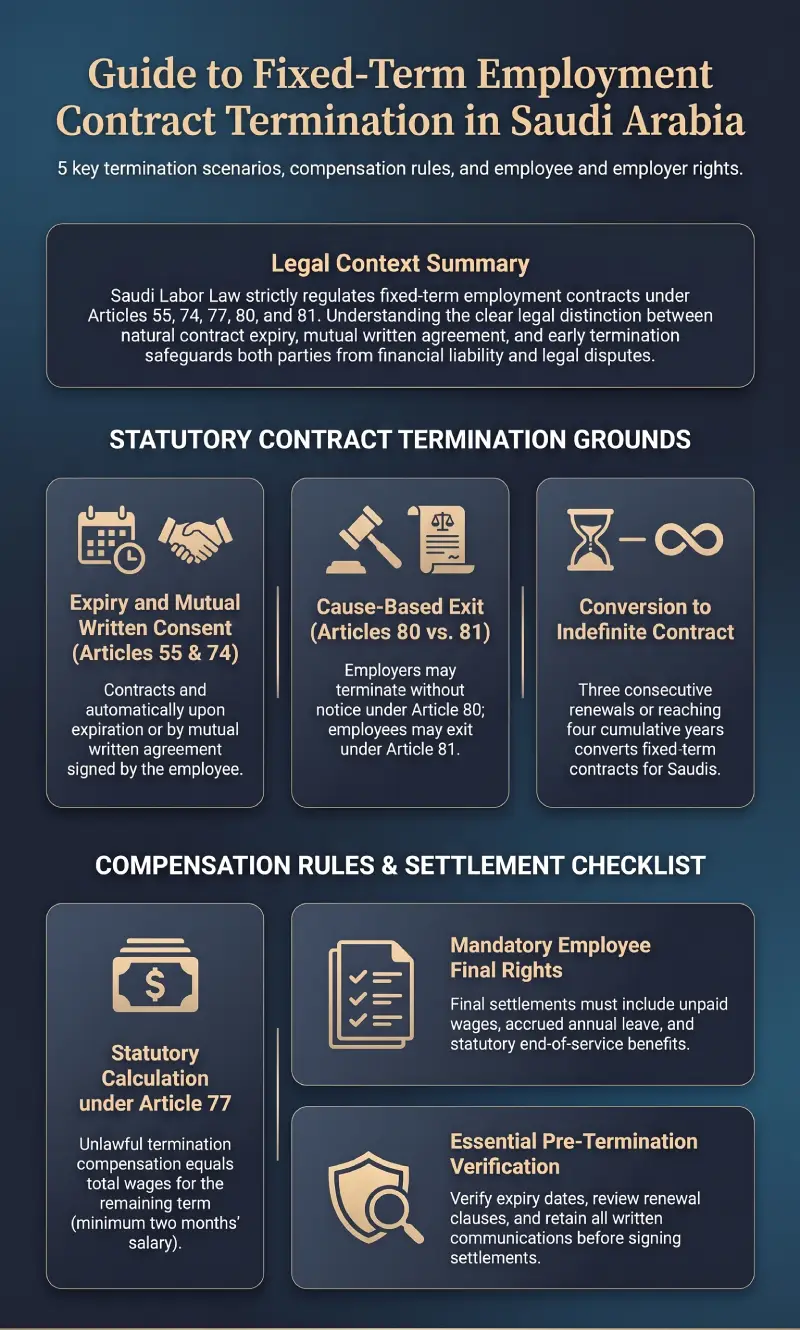
A fixed-term employment contract may end upon expiry, by mutual agreement, through resignation under the applicable statutory procedure, where the employer has lawful grounds for termination, or where the employee is legally entitled to leave without notice. Early termination for an unlawful reason may give rise to compensation under Article 77, depending on the contract terms and the circumstances.
Articles 55, 74, 77, 79 bis, 80 and 81 of the Saudi Labor Law provide the relevant legal framework for these situations.
The following table shows the main termination scenarios and what should be examined in each case.
| How Employment Ends | Legal Basis | What Should Be Verified? |
|---|---|---|
| Expiry of the agreed term | Articles 55 and 74 | Expiry date and renewal provisions |
| Termination by mutual agreement | Article 74 | Agreement between the parties and the employee’s written consent |
| Resignation | Article 79 bis | Resignation request and acceptance date |
| Employer-initiated termination | Article 80 or other applicable provisions | Grounds for termination and statutory conditions |
| Employee leaving without notice | Article 81 | Whether the statutory grounds are established and supported by evidence |
A contract may also be ended before its scheduled expiry without meeting the legal conditions that would justify termination. In that situation, the lawfulness of the decision and its possible financial consequences must be assessed separately.
Expiry and Non-Renewal of a Fixed-Term Employment Contract
A fixed-term employment contract generally ends when its agreed term expires. However, the expiry date stated in the contract may not always determine the final legal position.
If the contract contains a provision for renewal for an equivalent or specified period, that provision must be reviewed. Continued performance by both parties after the original expiry date may also affect the nature of the employment relationship under Article 55, subject to the special rules applicable to non-Saudi employees.
Must an Employee Notify the Employer of Non-Renewal?
The notice periods under Article 75 do not automatically apply to every fixed-term contract, because that article addresses the termination of indefinite-term employment contracts.
Where a fixed-term agreement includes a non-renewal notice clause, the parties should examine the agreed notice period, the required method of communication and the evidence showing when notice was received.
For example, if the contract requires notice 60 days before expiry, the date of delivery and proof of receipt may be important in determining the legal consequences of that provision.
Non-renewal must also be distinguished from early termination. The former concerns an employment relationship reaching its agreed end date, while the latter occurs while the contract remains in force.
The legal consequences of employment contract non-renewal in Saudi Arabia depend on the contract’s renewal provisions, agreed notice requirements and whether the parties continued the employment relationship after expiry.
Fixed-Term Employment Contract Termination by the Employee
An employee may wish to leave before the agreed expiry date because of another employment opportunity or a dispute with the employer. The applicable legal procedure depends on whether the employee is resigning or relying on a statutory ground to leave work.
Resignation Before the Fixed-Term Contract Expires
Article 79 bis of the Saudi Labor Law governs resignation. An employee’s resignation request is deemed accepted if 30 days pass after its submission without a response from the employer.
The employer may defer acceptance for a period not exceeding 60 days where the interests of the business require it, provided the employee receives a written and reasoned explanation before the initial 30-day period expires.
The employee may also withdraw the resignation request within seven days of submission, unless the employer has already accepted it. The employment contract remains in effect during the resignation process, and both parties must continue fulfilling their obligations.
Therefore, resignation before the contractual expiry date should not automatically be classified as unlawful termination. Equally, an employee should not assume that employment ends immediately upon submitting a resignation request.
Financial entitlements arising from resignation remain subject to the Saudi Labor Law, including any separate dispute concerning contractual obligations or compensation.
When May an Employee Leave Without Notice?
Article 81 allows an employee to leave work without notice while retaining statutory rights where one of the specified legal grounds is established.
Examples include the employer’s failure to meet essential contractual or statutory obligations, deception when the employment contract was concluded, assault or degrading treatment, or a serious threat to the employee’s safety that the employer knew about but failed to address.
Simply alleging that one of these circumstances occurred may not be enough. The facts and supporting evidence must be examined, including correspondence, payroll records, complaints and documents relating to the alleged violation.
The legal consequences of employment contract termination by an employee depend on the grounds relied upon. Resignation is governed by Article 79 bis, while Article 81 permits an employee to leave without notice in the circumstances specified by law.
Fixed-Term Employment Contract Termination by the Employer
The legality of an employer’s decision to terminate a fixed-term contract depends on the grounds for termination and whether the required procedures have been followed.
Article 80 identifies circumstances in which an employer may terminate an employment contract without an end-of-service award, notice or compensation, provided the employee has an opportunity to explain their objections to the termination.
Subject to the conditions of each case, these circumstances include using forged documents to obtain employment, certain forms of workplace-related assault, failure to fulfil essential employment obligations, and absence that meets the prescribed periods and warning requirements.
For example, where termination is based on an employee’s absence, establishing non-attendance alone may not be sufficient. The employer must also examine the relevant duration, written warnings and other statutory requirements.
If a fixed-term employment contract is terminated without a lawful reason, the affected party may be entitled to compensation under Article 77, in addition to any other employment entitlements for which the relevant conditions are met.
Employees should retain termination notices, warnings and related correspondence. Employers should likewise document the reasons and procedures supporting their decisions before ending the employment relationship.
Compensation for Fixed-Term Employment Contract Termination
Compensation for fixed-term employment contract termination is an amount that may become payable to the affected party where the contract has been terminated for an unlawful reason, subject to the contractual terms and Article 77 of the Saudi Labor Law.
Such compensation does not arise automatically whenever employment ends before the scheduled expiry date. The first questions are whether the termination was unlawful and whether the contract contains a specific compensation provision.
How Is Compensation for the Remaining Contract Period Calculated?
Where the contract does not specify compensation for unlawful termination, Article 77 provides that compensation for a fixed-term contract is based on the wages for the remaining contractual period, subject to a minimum equivalent to two months’ wages.
Consider an illustrative case in which an employee has a wage of SAR 10,000 per month for compensation purposes, with five months remaining under the contract. Assume the contract is terminated for an unlawful reason and contains no specific compensation clause.
The illustrative calculation would be:
SAR 10,000 × 5 months = SAR 50,000.
If only one month remained, the statutory minimum under Article 77 would need to be considered where the provision applies.
Termination compensation must be distinguished from accrued employment entitlements, such as unpaid wages, payment for unused leave and end-of-service benefits where the relevant eligibility conditions are satisfied.
Each claim must therefore be assessed on its own legal basis rather than assuming that every amount is automatically payable in every termination case.
The amount of compensation for fixed-term contract termination depends on the termination grounds, contractual provisions and applicable wage basis, with particular reference to Article 77 of the Saudi Labor Law.
Where the reason for termination or the compensation amount is disputed, BMS Legal can review the employment contract and supporting documents and explain the available legal options before a claim is submitted or a settlement is signed.
Termination by Mutual Agreement and Its Effect on Employee Rights
The Saudi Labor Law allows an employment relationship to end by agreement between the parties. Under Article 74, mutual termination requires the employee’s written consent.
This differs from unilateral termination because the employee and employer agree on the termination date and the arrangements for settling outstanding employment entitlements.
However, mutual termination does not automatically extinguish wages or rights that have already accrued.
The agreement should therefore specify the amounts due, how they will be paid and whether any disputed claims or compensation amounts are being settled.
Before signing a final settlement or release, the employee should review provisions acknowledging receipt of all entitlements or resolving outstanding claims and ensure that the wording accurately reflects the agreement reached.
How to Terminate a Fixed-Term Employment Contract Through Qiwa
The Saudi Ministry of Human Resources and Social Development provides an electronic service through the Qiwa platform that allows employees to submit employment termination requests when the service conditions are satisfied.
Through the official Employment Contract Termination Service, the employee signs in to Qiwa Individuals, accesses Employment Contracts, selects the relevant contract, chooses the termination option, enters the reason and date, reviews the information and submits the request.
The service requires an active employment contract on the platform and no other termination request for the same contract awaiting approval.
Submitting an electronic termination request does not necessarily resolve every financial or legal issue arising from the employment relationship. The parties may still disagree about whether the termination was lawful, whether compensation is payable or how outstanding entitlements should be calculated.
How Can You Protect Your Rights Before Ending a Fixed-Term Contract?
Before terminating a fixed-term employment contract, it is important to review the facts and documents that may affect the legal outcome.
The following checklist identifies the information that should be examined first.
| Key Question | Document to Review | Why It Matters |
|---|---|---|
| Has the contract actually expired? | Employment contract and renewal addenda | Establishes the correct expiry date |
| Who initiated termination? | Termination notice or resignation request | Identifies the applicable legal procedure |
| What was the reason for termination? | Correspondence and written warnings | Helps assess the lawfulness of the decision |
| Is there a contractual compensation clause? | Compensation provision in the contract | Determines the starting point for the claim |
| Have outstanding entitlements been paid? | Payroll records and final settlement | Helps verify financial entitlements |
Practical example: If an employer informs an employee that their contract is being terminated with four months remaining, the assessment should not begin simply by multiplying the monthly wage by four.
The first steps are to establish the reason for termination, determine whether it was lawful and review any contractual compensation clause. Only then should potential financial entitlements be calculated.
Where the disagreement continues, the parties may pursue the amicable settlement procedure through the Ministry of Human Resources and Social Development and, where applicable, bring the claim before the competent Labor Court in accordance with the prescribed procedures.
When there is a dispute over the legality of termination or the amount of compensation, consulting a labor lawyer in Jeddah at BMS Legal can help employees and employers understand their legal position, review relevant documents and assess the available options, with the scope and cost of the service explained before work begins.
Legal Review & Content Reliability
This article explains fixed-term employment contract
termination in Saudi Arabia, based on the Saudi Labor Law,
including termination conditions, resignation, compensation,
and employment rights.
– Jeddah, Saudi Arabia
55, 74, 77, 79 bis, 80, and 81.
This article is provided for general legal information
and does not replace a review of the employment contract,
relevant facts, and supporting documents before determining
legal rights or taking legal action.
Frequently Asked Questions About Fixed-Term Employment Contract Termination
1. Can an employee resign if the employer does not accept the resignation?
Under Article 79 bis of the Saudi Labor Law, a resignation request is deemed accepted if the employer does not respond within 30 days. The employer may defer acceptance for up to 60 days under specific conditions. Employees should retain proof of submission and any written postponement notice.
2. Is an employee entitled to wages for the remaining contract period?
If a fixed-term contract is terminated without lawful grounds, the affected party may be entitled to compensation under Article 77. Where no contractual compensation is specified, the calculation is based on wages for the remaining term, subject to a statutory minimum of two months' wages.
3. Can a fixed-term employment contract be terminated without prior notice?
Yes, in certain circumstances. Articles 80 and 81 permit termination or leaving employment without notice when their statutory conditions are satisfied. Article 75 notice periods for indefinite-term contracts do not automatically apply to fixed-term contracts. The grounds for termination and contractual provisions must be reviewed.
4. Does mutual termination waive an employee's outstanding entitlements?
No. Mutual termination does not automatically extinguish accrued employment rights. Under Article 74, the employee's consent must be in writing. The agreement should clearly address unpaid wages, unused leave, applicable end-of-service benefits and any disputed payments before a final settlement is signed.
5. What should I do if my employer terminates my fixed-term contract early?
Keep your employment contract, termination notice, correspondence and relevant warnings. Check the remaining contract period, the stated reason for termination and any compensation clause. If the termination is disputed, seek a legal assessment and consider the applicable amicable settlement and labor court procedures.
Fixed-Term Employment Contract Termination: 5 Key Cases Affecting Your Rights highlights the importance of distinguishing between contract expiry, resignation, termination by mutual agreement, an employer’s termination decision and an employee’s statutory right to leave work.
Each situation has different conditions and legal consequences. Having time remaining under an employment contract does not, by itself, establish a right to compensation.
The appropriate starting point is to review the employment contract, the reason for termination and the relevant correspondence, then determine the potential entitlements before signing a final settlement or pursuing an incomplete claim.
If you are facing a dispute over the termination of your contract, or you are an employer seeking to review a termination decision before implementing it, BMS Legal, a law firm in Jeddah, can review the contract and supporting documents and explain the applicable legal options and scope of services.