
Although remarriage may provide grounds for reviewing custody arrangements, it does not necessarily mean that the daughter must leave her mother’s care. The court considers how the new marriage affects the child’s daily care, safety, stability, and overall welfare, as well as whether the mother or father can provide a more suitable environment.
Child Custody After Mother’s Remarriage: The Legal Position
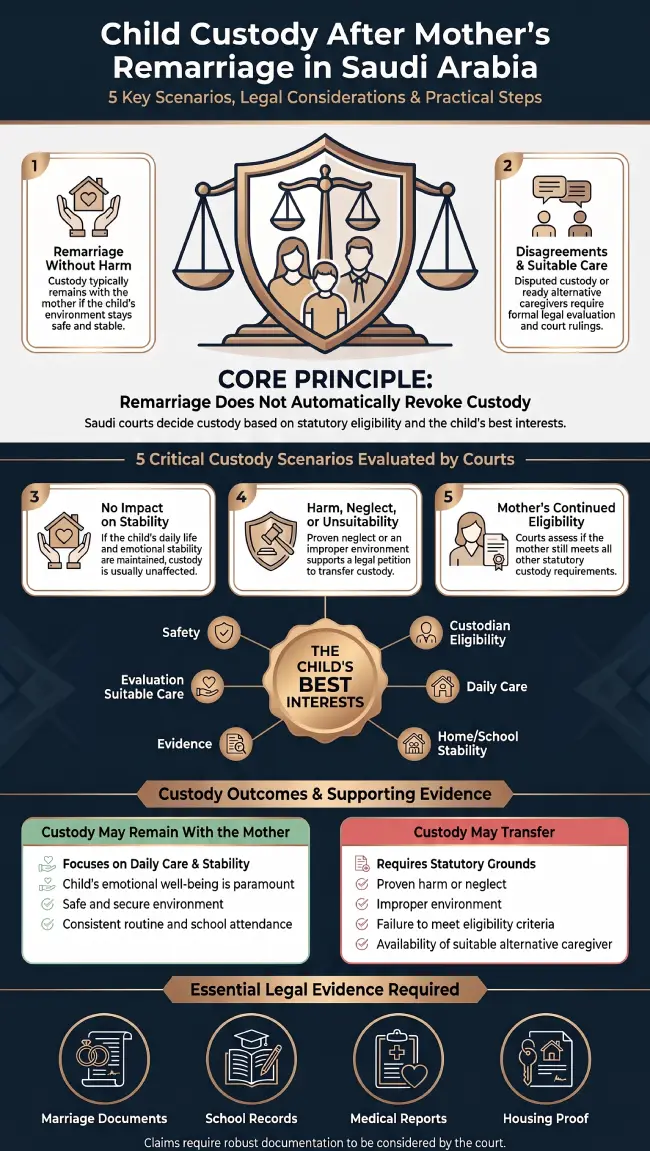
Child custody after mother’s remarriage in Saudi Arabia does not automatically end in every case. If the mother marries a man who is not a mahram to the child, the father or another eligible person may have grounds to request a custody transfer. However, remarriage alone does not determine the outcome in every situation.
The court examines the daughter’s best interests, her safety and stability, and the effect of her mother’s new marriage on her living conditions.
Custody may remain with the mother if this arrangement best serves the daughter. Alternatively, custody may transfer to the father or another eligible custodian if the court determines that a different arrangement would better protect her interests.
The effect of remarriage must also be understood within the broader framework of child custody provisions under Saudi Arabia’s Personal Status Law. The statutory order of eligible custodians and the child’s best interests remain central to any subsequent dispute.
When Does a Mother’s Remarriage Affect Custody of Her Daughter?
A mother’s remarriage can affect custody when it changes the daughter’s care arrangements or raises legitimate concerns about the environment in which she lives.
This principle is reflected in the new child custody rules in Saudi Arabia, which address custody eligibility alongside the child’s best interests and the stability of her daily environment.
Following divorce, the mother’s custody position depends on her ability to provide appropriate care and maintain a stable environment. If she remarries, custody does not necessarily transfer directly to the father. Instead, the court considers the legal effect of the remarriage and the circumstances surrounding the child.
The mother may remain the more suitable custodian. Conversely, the new household may be considered unsuitable if credible evidence establishes harm, neglect, or serious disruption.
| Circumstance | Potential Effect on Custody |
|---|---|
| The mother marries a man who is not a mahram to the daughter | May provide grounds for requesting a custody transfer |
| No harm to the daughter is established | May support continued custody by the mother, subject to legal requirements |
| Neglect or disruption in daily care | May strengthen a custody transfer request |
| The daughter remains settled with her mother | May support maintaining the existing arrangement |
| A dispute arises between the parents | May require legal proceedings or another formal procedure |
5 Important Cases of Child Custody After Mother’s Remarriage in Saudi Arabia
The outcome of a custody dispute depends on the circumstances of each family. It would therefore be inaccurate to claim either that remarriage always terminates a mother’s custody rights or that custody must always remain with her.
The following five situations illustrate how the legal assessment may differ.
1. The Mother Remarries Without Proven Harm to the Daughter
Custody may remain with the mother if the daughter continues to live in a safe and stable environment, and the applicable legal requirements support continued custody.
The absence of demonstrated harm is relevant, although it does not eliminate the need to consider statutory custody conditions.
2. Remarriage Has a Clear Negative Effect on the Daughter
If the new marriage is associated with neglect, inappropriate treatment, or serious disruption to the child’s welfare, these circumstances may strengthen a request to transfer custody.
The alleged harm should be supported by credible evidence.
3. The Daughter Is Academically and Emotionally Stable With Her Mother
Continuity of education, emotional security, and an established daily routine may be significant considerations.
Where a custody transfer would disrupt this stability, the court may consider whether such a change genuinely serves the daughter’s best interests.
4. The Father Is Ready and Able to Provide Suitable Care
Custody may transfer to the father where the statutory requirements are satisfied and his living environment is considered more suitable for the daughter.
His willingness to assume custody is relevant, but the court must also consider his actual ability to provide care.
5. The Parents Disagree About Custody
Where the parents disagree, neither should assume that remarriage gives them the right to change custody arrangements unilaterally.
Resolving the dispute may require a court claim or another legally recognised procedure.
These five scenarios do not guarantee a particular outcome for either parent. They illustrate that the court’s assessment concerns not only the remarriage itself but also its legal implications and practical effect on the daughter’s welfare.
Who Is Considered a Non-Mahram Husband in Custody Cases?
A non-mahram husband, in this context, is a man who does not have a legally recognised relationship with the child that would make him a mahram under the applicable principles of Islamic law.
This distinction becomes important when a mother remarries because her daughter may live in the same household as her new husband.
Simply knowing the family or having a social relationship with the daughter does not necessarily establish mahram status.
The relevant legal and family relationship must be considered, together with the effect of the new living environment on the daughter.
For this reason, it would be incorrect to assume that every remarriage automatically results in custody loss or that any family connection necessarily prevents a custody transfer.
If the daughter remains safe and stable and the mother continues to provide suitable care, these circumstances may support continued custody.
However, if the remarriage is associated with neglect, mistreatment, or significant disruption to housing or education, the new circumstances may justify a custody review.
When Can a Mother Retain Custody of Her Daughter After Remarriage?
In child custody after mother’s remarriage cases, the mother may retain custody where the applicable legal requirements and the daughter’s best interests support continued care by her.
This may occur when the daughter remains settled, no harm from the new household has been established, and the mother continues to fulfil her daily caregiving responsibilities.
The child’s best interests involve several considerations, including emotional security, educational stability, healthcare, appropriate visitation arrangements, and a safe home environment.
The court does not assess remarriage solely as an isolated event. It also considers its practical implications for the daughter’s everyday life.
Circumstances that may support continued custody include:
- Consistent daily care without significant neglect.
- No established abuse or danger in the mother’s household.
- Stability in the daughter’s home and school.
- The daughter’s need for direct maternal care.
- The other proposed custodian’s inability to provide suitable care.
The duration of a mother’s custody rights must also be understood in light of the child’s age, individual circumstances, and the applicable statutory provisions rather than assuming that one fixed period applies to every family.
Likewise, custody arrangements following the mother’s remarriage may differ according to the child’s age and care requirements.
When Can Custody Transfer to the Father or Another Eligible Custodian?
Custody may transfer to the father or another eligible person if the legal requirements for a transfer are satisfied and the change better serves the daughter’s interests.
Relevant circumstances may include established harm, an inability to provide appropriate care, or significant disruption to the daughter’s life following her mother’s remarriage.
However, remarriage alone does not establish that the father is necessarily the more suitable custodian.
The court considers caregiving ability, stability, eligibility, and other relevant circumstances. These considerations are also discussed in the article explaining when a father can obtain child custody in Saudi Arabia.
| Point of Comparison | Formal Custody Transfer Request | Assuming Automatic Custody Loss |
|---|---|---|
| Legal procedure | A court claim or another applicable legal procedure | Unilateral action that may create legal risks |
| Legal basis | Established grounds and the child’s best interests | An assumption that may be insufficient |
| Outcome | An enforceable judgment or decision | May lead to further disputes |
| Evidence | Relevant documents and established facts | Often lacks an organised evidentiary basis |
A grandmother or another eligible relative may also be considered if that arrangement better serves the daughter.
However, custody does not automatically pass to the grandmother simply because the mother remarries. The statutory order of eligible custodians and the child’s best interests remain relevant.
Filing a Custody Termination or Transfer Claim After the Mother’s Remarriage
A custody termination or transfer claim is a legal request seeking to remove custody from the current custodian or transfer it to another eligible person because of remarriage or the failure to satisfy a relevant custody requirement.
Such proceedings require identifiable legal grounds and properly organised supporting evidence.
A claim may be filed when a genuine dispute arises over whether the daughter should continue living with her mother following remarriage.
Depending on the facts, the claimant may request a custody transfer, appropriate visitation arrangements, or a determination that the current household is unsuitable for the daughter.
Where there is no active dispute and the custody arrangement remains stable, the appropriate documentation procedure may differ from contested litigation.
Evidence connecting the remarriage to a significant effect on the daughter may strengthen the claim, particularly where it demonstrates:
- Declining school performance or health concerns.
- Neglect of daily care responsibilities.
- Frequent relocation that undermines stability.
- Unjustified interference with visitation.
- The availability of a more suitable alternative home.
A claim based solely on general allegations or personal disagreements between the parents may be less persuasive.
Before initiating proceedings, the claimant should identify the precise objective: a custody transfer, termination of custody, visitation arrangements, or a negotiated settlement.
Proving Remarriage and Harm in Child Custody Proceedings
Evidence is one of the most important practical elements in custody proceedings.
The court considers relevant documents and other legally admissible evidence rather than relying on assumptions or unsupported allegations.
The mother’s remarriage may be established through official marriage documentation or other evidence accepted by the court.
Where harm is alleged, supporting material may include reports, communications, official records, witness testimony, school documents, or evidence of repeated incidents.
All evidence should be obtained through lawful means without violating privacy or using unauthorised methods.
| Type of Evidence | Relevance to the Dispute |
|---|---|
| Proof of the mother’s marriage | Establishes the remarriage forming part of the claim |
| School records | Helps demonstrate stability or declining performance |
| Medical reports | Documents health concerns and care requirements |
| Housing records | Helps assess the suitability of the living environment |
| Documented communications between the parents | May demonstrate cooperation or obstruction |
| Visitation or maintenance records | Helps clarify related parental obligations |
Where the mother is not a Saudi national, additional legal considerations involving residence or international travel may arise.
However, the fundamental custody assessment remains focused on the relevant statutory requirements and the daughter’s best interests.
Custody Documentation vs. Custody Litigation in Saudi Arabia
Custody documentation and custody litigation are different legal procedures.
Custody documentation generally concerns the formal recording of an existing arrangement where the applicable requirements are satisfied and there is no relevant dispute.
Custody litigation, by contrast, is used when the parties disagree about custody, a transfer is requested, or a custodian’s eligibility is challenged.
Where the existing arrangement is agreed and no active dispute exists, documentation may be the appropriate route.
However, where the father objects, custody termination is requested, or the custodian’s eligibility is contested, judicial proceedings may be necessary.
The procedure must be selected according to the actual circumstances of the case, rather than the name of the available service alone.
For uncontested cases, the more relevant question may concern how to obtain a child custody document through Najiz in Saudi Arabia rather than immediately filing a contested custody claim.
| Point of Comparison | Custody Documentation | Custody Litigation |
|---|---|---|
| Situation | No apparent custody dispute | Existing disagreement or transfer request |
| Purpose | Formally document an existing custody arrangement | Resolve a custody dispute |
| Procedure | Documentation process | Judicial proceedings |
| Required documents | Basic supporting documentation | Evidence, case documents, and legal submissions |
| Result | Custody document | Court judgment or judicial decision |
Common Mistakes in Child Custody After Mother’s Remarriage Cases
Many custody disputes become more difficult because of premature decisions rather than an inherently weak legal position.
Parents should therefore approach custody disagreements carefully, document relevant facts, and avoid unilateral actions that could adversely affect the daughter.
Common mistakes include:
- Assuming that custody automatically ends once the mother remarries.
- Filing a claim without evidence supporting the legal grounds or the child’s best interests.
- Taking the daughter without an appropriate court decision or clear lawful arrangement.
- Preventing visitation because of a custody disagreement.
- Ignoring the daughter’s age, educational stability, and emotional needs.
- Relying on general accusations instead of specific facts that can be established through evidence.
Interference with visitation following the mother’s remarriage may also lead to separate legal proceedings concerning the enforcement of visitation orders in Saudi Arabia.
Visitation rights should therefore be distinguished from the underlying custody dispute.
If you are involved in a custody dispute following the mother’s remarriage, the family law team at BMS Legal Law Firm can review the circumstances and relevant documents confidentially.
The purpose of this review is to clarify whether documentation, litigation, or settlement may be the most appropriate course of action, without promising a predetermined outcome.
CONFIDENTIAL CASE REVIEW
Family Law | Saudi Arabia
Can a Mother’s Remarriage Affect Her Daughter’s Custody?
A mother’s remarriage does not automatically determine custody.
The child’s best interests, applicable legal requirements, and
supporting evidence must be assessed before choosing the
appropriate legal action.
What Do We Review First?
The impact of remarriage on the child’s living environment
Evidence of care, stability, or potential harm
Whether litigation or custody documentation is appropriate
The next legal step without weakening your case
BMS Legal Law Firm
Saudi Licensed Law Firm | Commercial Registration No. 7053637679
Your case summary is handled confidentially.
Please do not include sensitive personal details
in your initial message.
Request a Confidential Review via WhatsApp
Every custody case is assessed individually. No particular legal outcome is guaranteed.
Frequently Asked Questions About Child Custody After Mother’s Remarriage
1. Does a mother lose custody after remarriage in Saudi Arabia?
Not automatically. Saudi law considers custody eligibility and the child's best interests. Remarriage may affect custody, but the outcome depends on the circumstances.
2. Can a father get custody if the mother remarries?
Yes, the father may request custody if legal grounds exist. The court considers his eligibility, the child's welfare, and the evidence presented.
3. Can a mother keep custody after marrying a non-mahram?
Yes, in certain circumstances. The court may allow continued custody when the applicable legal requirements and the child's best interests support it.
4. What evidence is needed to transfer custody after remarriage?
Relevant evidence may include marriage records, school reports, medical documents, and proof of neglect or harm, depending on the grounds for the claim.
Child custody after mother’s remarriage in Saudi Arabia is not determined solely by the fact that the mother has entered a new marriage.
The five key scenarios discussed in this article demonstrate the importance of the applicable legal requirements and the daughter’s best interests.
Custody may remain with the mother where her continued care is legally appropriate and provides a suitable environment. Alternatively, custody may transfer to the father or another eligible person where the legal grounds for a different arrangement are established.
Neither parent should act solely on family pressure or assumptions about custody rights.
A more effective starting point is to identify the relevant facts, organise the available evidence, and understand the distinction between custody documentation and litigation.
Where the circumstances are complicated or the evidence is disputed, consulting a child custody lawyer in Jeddah can help clarify the available legal options and determine the most appropriate course of action before filing a claim.
Official Legal References: