
Selling a mortgaged property in Saudi Arabia is possible under certain legal conditions, whether the property is a house financed by a bank, a mortgaged plot of land, or another property subject to a registered security interest. However, the legal ability to sell does not necessarily mean that ownership can be transferred immediately. The property’s registration status, the mortgagee’s rights, the financing agreement, and the outstanding debt must all be examined.
Can I sell my house in Saudi Arabia while it is still mortgaged to a bank? The answer depends on the property’s registration status and the restrictions affecting it. Article 11 of the Saudi Registered Real Estate Mortgage Law distinguishes between property registered under the Law of Real Estate Registration and property that has not been registered under that system.
The same distinction matters when selling mortgaged land or buying property with an outstanding mortgage. Agreeing on a price or paying a deposit does not resolve the lender’s rights or guarantee that the transaction can be completed.
This guide explains seven essential checks before selling a mortgaged property, the procedures involved, when lender consent or mortgage release may be necessary, and how buyers and sellers can protect their contractual rights.
Planning to Buy or Sell a Mortgaged Property?
Before signing an agreement or paying a deposit,
the BMS Legal team can help you review the mortgage
status, sale terms, and outstanding debt, identify
potential legal risks, and assess the appropriate
steps for completing the property transaction.
Important:
Any initial assessment depends on the available
documents and the circumstances of the transaction.
No particular legal outcome is guaranteed.
Or continue reading this article to learn more.
Can You Sell a Mortgaged Property in Saudi Arabia? A Quick Answer
Yes, a mortgaged house or plot of land may be sold before the financing has been fully repaid, provided the proposed transaction complies with the applicable legal requirements.
Article 11 of the Registered Real Estate Mortgage Law establishes an important distinction:
- Property registered under the Law of Real Estate Registration may be disposed of, subject to the applicable rights and registration requirements.
- Where the property has not been registered under that system, the mortgagor may not dispose of the mortgaged property unless otherwise agreed and that agreement is documented in the title deed and relevant record.
The distinction concerns the legal right to dispose of the property. Completing the official transfer of ownership is a separate matter and may require further documentation, lender consent, or other measures depending on the applicable registration process.
| Property situation | Sale position | Main consideration |
|---|---|---|
| Registered under the real estate title registration system and subject to a mortgage | Disposal may be legally permitted | Review registered rights and title-transfer requirements |
| Not registered under that system, with no documented agreement permitting disposal | Disposal is not permitted in that situation | Obtain and document the required agreement before proceeding |
| Property with outstanding bank financing | Depends on the mortgage and property status | Confirm the debt and settlement arrangement |
| Property subject to enforcement proceedings | Different legal procedure may apply | Review enforcement restrictions and any judicial sale process |
Before committing to a transaction: Obtain an up-to-date statement of the outstanding debt, verify the ownership records, and establish how the mortgage will be dealt with at or before completion.
Licensed Lawyer in the Kingdom of Saudi Arabia
BMS Legal for Law and Legal Consulting
473356
Jeddah, Saudi Arabia
Legal Review Scope:
Property disposal restrictions, mortgagee rights,
outstanding debt, title transfer, mortgage release,
contractual obligations, and earnest money under
applicable Saudi laws.
Key Legal References:
Registered Real Estate Mortgage Law and
Saudi Civil Transactions Law.
Last Legal Review:
[ENTER ACTUAL REVIEW DATE]
article’s general legal content. It does not
constitute legal advice for an individual transaction
or guarantee a particular legal outcome.
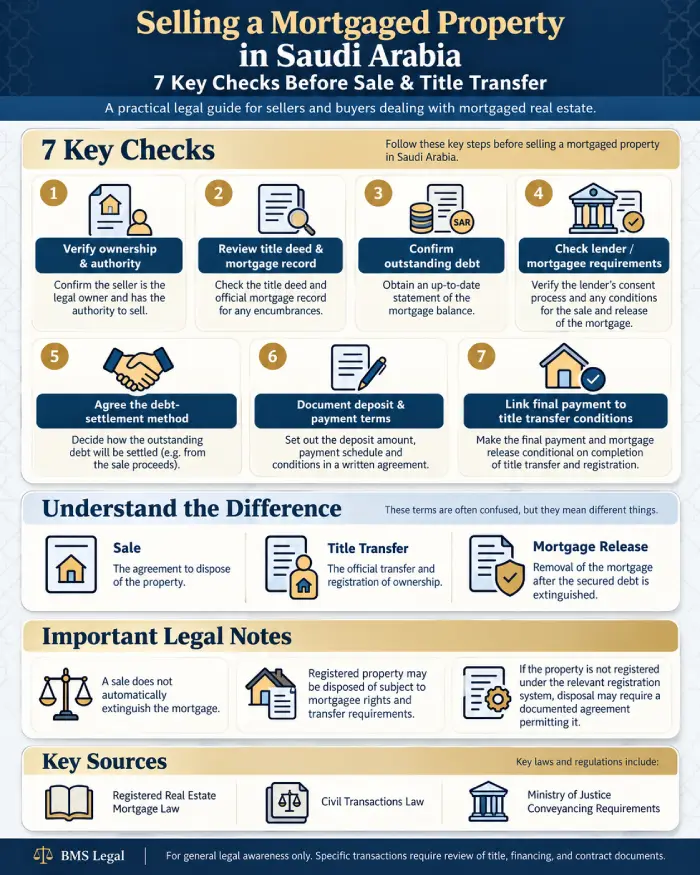
7 Essential Checks Before Paying a Deposit on Mortgaged Property
Selling a mortgaged property should begin with a documented review, not merely a verbal agreement between the seller and buyer.
The following seven checks help identify risks that may otherwise delay ownership transfer or create disputes over payments.
1. Verify Ownership and the Seller’s Authority
Confirm that the seller is the legal owner or holds valid authority to dispose of the property.
If the transaction is conducted through a representative, examine the power of attorney and confirm that it covers the intended sale and any relevant registration procedures.
An inaccurate ownership record or insufficient authority can create a dispute even where the parties agree on the purchase price.
2. Examine the Title Deed and Mortgage Registration
Review the electronic title deed or title registration record to identify existing mortgages, restrictions, and third-party rights.
Determine whether the property has been registered under the Law of Real Estate Registration. This affects the rules governing disposal under Article 11 of the Registered Real Estate Mortgage Law.
An old copy of the title deed should not be treated as conclusive evidence of the property’s current legal status.
3. Confirm the Outstanding Mortgage Debt
Request a recent debt statement from the lender or financing institution.
The amount payable may differ from the original loan balance because of repayments, overdue instalments, or contractual early-settlement terms.
The parties should establish the amount that must be paid, the date on which it is calculated, and whether additional amounts could arise before completion.
4. Identify the Mortgagee’s Approval Requirements
Lender consent must be considered in light of the property’s registration status and the applicable conveyancing requirements.
Although Article 11 does not impose an identical restriction on all mortgaged properties, the Saudi Ministry of Justice lists mortgagee consent among the requirements for conveyancing mortgaged property through its relevant procedures.
The parties should therefore verify which approvals, documented agreements, or additional steps apply to their particular transaction.
5. Agree on How the Debt Will Be Settled
The sale agreement should explain whether:
- The seller will repay the debt before completion.
- An agreed part of the purchase price will be used to settle the mortgage.
- Another legally permissible arrangement will be made to address the outstanding obligation.
The agreement should also specify what happens if the debt balance changes or the proposed settlement arrangement is not accepted.
6. Document the Deposit and Its Treatment
Before paying earnest money or another advance payment, the parties should state its legal character and the circumstances in which it may be retained or returned.
The agreement should address delays, refusal of a required approval, failure to satisfy a condition, and any inability to complete the transfer of ownership.
The term used for a payment matters less than its legally effective terms and the circumstances in which it is made.
7. Link the Remaining Payments to Completion Requirements
Avoid paying the entire purchase price without a clear and documented mechanism for completing the transfer.
The parties should identify when the remaining price becomes due and whether payment is conditional upon settlement of the mortgage, registration of the transfer, or another agreed milestone.
These seven checks do not eliminate every legal risk. They help the parties identify essential conditions before assuming financial obligations.
Is It Legal to Sell a Mortgaged House or Plot of Land?
The legal position depends on the registration status of the property and the rights attached to it.
Under Article 11 of the Registered Real Estate Mortgage Law, the mortgagor may dispose of property registered under the Law of Real Estate Registration. By contrast, disposal of mortgaged property outside that registration system is restricted unless the parties have agreed otherwise and the agreement has been documented as required.
What about selling mortgaged land? A mortgaged plot is subject to the applicable rules governing the disposal of mortgaged real estate. Whether the mortgage is held by a commercial bank or another financing entity, the seller should verify the registration status, restrictions, and requirements for completing the transaction.
An important distinction remains: the sale of mortgaged property does not automatically extinguish the mortgage or the secured debt.
Even where a sale is legally permissible, the buyer and seller must determine how the mortgagee’s existing rights will be respected.
For related rules concerning the creation and documentation of mortgages, see our guide to Mortgage Conditions in Saudi Arabia. That guide addresses mortgage establishment and requirements, rather than the sale transaction itself.
How to Sell a Mortgaged Property: 8 Practical Steps
Selling a mortgaged property requires checking its registration status, outstanding debt, and applicable transfer requirements before signing the sale agreement.
- Verify the seller’s ownership: Examine the title deed or registration record and confirm the authority of the person conducting the sale.
- Check the mortgage and registration status: Identify the mortgagee, the nature of the registered security, and the applicable registration framework.
- Obtain an updated debt statement: Confirm the financing balance and examine any early repayment conditions.
- Determine legal and contractual requirements: Review the mortgage and financing agreements to establish which consents, documented arrangements, or other procedures are necessary.
- Agree on the debt-settlement method: Decide whether repayment will take place before completion, from the sale proceeds, or through another permitted arrangement.
- Draft a clear sale agreement: Define the purchase price, mortgage status, payments, deposit, completion date, and consequences of delay or non-performance.
- Satisfy the applicable mortgage-related requirements: Obtain required approvals, settle and release the mortgage where necessary, or implement an arrangement that lawfully preserves the mortgagee’s rights.
- Complete title transfer and documentation: Follow the relevant conveyancing or registration procedure and confirm the property’s registered status after completion.
Important: The eight stages describe a practical transaction workflow. They do not mean that mortgage release is legally required before every disposal of mortgaged property.
Transactions involving the transfer of a mortgage or changes to the financing arrangement may require a different procedure. For that issue, see Real Estate Mortgage Transfer Conditions.
Costs and Financial Responsibilities in a Mortgaged Property Sale
Unclear responsibility for the outstanding loan, deposit, and completion expenses is a common source of disagreement.
Some transactions use a portion of the sale proceeds to settle the debt. In others, the seller undertakes to discharge the mortgage before completing the transfer.
The parties should document their financial responsibilities rather than rely on assumptions.
| Financial item | Who may bear it? | What should be documented? |
|---|---|---|
| Outstanding mortgage debt | Seller or from the agreed sale proceeds | Current balance and settlement method |
| Deposit or earnest money | Usually initially paid by the buyer | Its legal character and repayment conditions |
| Mortgage release expenses | According to the agreement and applicable rules | Required action, responsibility, and timing |
| Title-transfer expenses | According to the agreement and applicable rules | Completion procedure and payment responsibility |
| Changes in the debt balance | As determined by the agreement | Treatment of additional amounts |
| Legal review | Party requesting the service, unless otherwise agreed | Scope of work and documents reviewed |
Real Estate Transaction Tax and any applicable exemptions or transaction-specific requirements should also be considered when estimating the overall cost.
The parties should confirm the relevant tax position before completion rather than relying on a general assumption about the amount payable.
Property Conveyancing and Mortgage Release: What Is the Difference?
Property conveyancing and mortgage release are legally distinct concepts.
A property sale establishes contractual rights and obligations between the parties.
Conveyancing or title transfer concerns the formal transfer and registration of ownership through the applicable procedure.
Mortgage release concerns the termination of the mortgage as security for the underlying obligation and the necessary update of the relevant property record.
These events may be connected, but they are not automatically identical or required to occur in one fixed sequence in every transaction.
When Must the Mortgage Be Released Before Completion?
Mortgage release may be necessary to complete the transaction in the manner agreed by the parties, particularly where the buyer requires title free from the existing mortgage or the financing arrangement requires repayment and removal of the security.
Where the law and applicable procedures permit ownership transfer while the mortgage remains in place, the transfer itself does not extinguish the mortgagee’s rights.
The Ministry of Justice also identifies mortgagee consent as a requirement for its procedures involving the conveyancing of mortgaged property. Accordingly, the specific administrative process must be checked before a completion date is agreed.
The relevant question is not simply whether a mortgaged property can be sold. It is which legal and registration steps are necessary to complete this particular sale.
What Happens After the Mortgage Debt Is Fully Repaid?
Article 37 of the Registered Real Estate Mortgage Law provides that the mortgage is released upon the extinguishment of the entire debt secured by it.
However, the parties should still verify that the relevant release and registration records have been updated.
If the bank or other mortgagee delays the necessary release procedures after repayment, retain the settlement evidence, written release requests, and communications with the financing entity.
These documents may be relevant when assessing the appropriate contractual or legal remedy.
Buying a Mortgaged Property: What Should the Buyer Check?
Buying a mortgaged property may be possible, but the buyer should examine obligations that could affect the transfer of ownership or the property after purchase.
Three issues require particular attention.
First: Whether the mortgage will remain registered. A buyer may acquire ownership subject to an existing registered mortgage in circumstances permitted by law. Completion of a sale should not be assumed to remove the mortgage automatically.
Second: The outstanding debt and purchase price. The agreement should establish how much is owed, who is responsible for settling it, and how any difference between the debt and the purchase price will be handled.
Third: Advance payments and completion risk. The agreement should address when payments become due and what happens if a required approval, settlement, or title-transfer procedure cannot be completed.
Under Article 27 of the Registered Real Estate Mortgage Law, a person who acquires ownership or another mortgageable real right after the mortgage is created may be regarded as a holder of the mortgaged property without being personally liable for the secured debt merely by acquiring that right.
This distinction is important. Acquiring a mortgaged property is not automatically the same as assuming the borrower’s personal debt. The property may nevertheless remain subject to the mortgagee’s security rights.
A buyer should not assume that payment of a deposit or execution of a sale agreement guarantees that title can be transferred without restrictions.
What Should a Mortgaged Property Sale Agreement Include?
A mortgaged property sale agreement must allocate responsibilities relating to the existing mortgage. Listing the property description and purchase price alone is insufficient.
A carefully drafted agreement should address:
- Mortgage status: Identify the mortgagee, the registered security, and whether the intended transfer is to be completed with or without the mortgage.
- Responsibility for repayment: State who will settle the outstanding debt and whether any part of the purchase price will be allocated for that purpose.
- Conditions of completion: Identify the required approvals or procedures, the responsible party, and the agreed deadline.
- Deposit and instalments: Define the nature of each payment, its due date, and the consequences of delay or failure to complete.
- Breach and remedies: Address notice, performance, termination, repayment, and compensation in accordance with applicable law.
How Does Saudi Law Treat Earnest Money?
Article 44 of the Saudi Civil Transactions Law governs earnest money (arbun) paid when a contract is concluded.
As a general rule, such payment indicates that the payer alone has the right to withdraw from the contract and, if the payer withdraws, cannot recover the earnest money, unless the parties agree otherwise.
The provision also addresses the withdrawal period and circumstances in which the payer’s conduct may amount to withdrawal.
Therefore, it is unsafe to assume that a buyer is automatically entitled to recover every deposit if a mortgage-related transaction fails.
The agreement should clearly distinguish an earnest-money arrangement from a part payment of the price and explain the consequences if lender consent is refused, mortgage release is delayed, or ownership transfer cannot be completed.
For broader contract-drafting guidance, refer to our Real Estate Sale Agreement Template in Saudi Arabia.
Documents to Prepare Before Seeking Legal Advice
A preliminary legal assessment is easier when the relevant ownership, mortgage, and payment records are available.
Prepare the documents you have, including:
- A copy of the title deed or title registration details.
- The signed sale agreement or draft contract.
- A recent outstanding debt statement.
- Any approval, refusal, or correspondence from the mortgagee.
- Receipts for earnest money or other advance payments.
- Communications between the seller, buyer, and intermediary.
- Financing documents relating to the bank or relevant fund.
- Previous sale offers, advertisements, or relevant agreements.
Not every document must be available before an initial consultation. The ownership record, mortgage details, and main contractual issue are usually an appropriate starting point.
The purpose of the review is to identify whether the situation calls for a contractual amendment, mortgage settlement, release procedure, negotiation, or a legal claim.
Common Disputes When Selling Mortgaged Property
Disputes arising from selling a mortgaged property often involve unclear contractual obligations, outstanding financing, or delays in title transfer.
Common examples include:
- The seller fails to complete an agreed mortgage release.
- The lender refuses a required approval.
- The buyer pays earnest money but the transaction cannot be completed.
- The outstanding mortgage debt is higher than the amount disclosed.
- Funds intended for loan repayment are not used as agreed.
- One party requests termination of the sale agreement.
- The buyer or seller claims compensation for an alleged contractual breach.
Where a dispute arises, the appropriate remedy depends on the agreement, the evidence, the nature of the breach, and whether completion remains legally possible.
The first step should be to collect the contract, payment records, lender correspondence, and the documents showing why completion was delayed or prevented.
These materials can help determine whether negotiation, performance, repayment, termination, or another legal remedy is appropriate.
Buying Mortgaged Property at a Public Auction
Purchasing mortgaged property at a public auction differs from a voluntary transaction between a private seller and buyer.
An auction may arise from debt default, enforcement proceedings, or another formal process. The applicable sale and registration rules must be examined separately.
Before participating, check the supervising authority, property description, existing rights, payment terms, and registration arrangements.
Particular attention should be paid to the legal effect of the auction on existing mortgages and the timing of title transfer.
Under the Registered Real Estate Mortgage Law, forced-sale procedures and the distribution of proceeds are subject to specific provisions. Article 39 addresses the extinguishment of a registered mortgage following a legally conducted forced sale and the required handling of the sale proceeds.
A buyer should not assume that an ordinary private sale agreement and a judicial auction have identical legal consequences.
Special Situations Involving Mortgaged Real Estate
Some transactions require a more specific review because of the type of financing or the status of the property.
A house mortgaged to a commercial bank: Begin by checking the debt statement, mortgage registration, financing terms, and requirements for the proposed transfer.
Property with outstanding real estate financing: A remaining loan balance does not automatically prohibit every transaction. The sale must nevertheless satisfy the applicable disposal restrictions and completion requirements.
Property financed through a government-linked housing programme: Review the programme conditions and the financing entity’s contractual requirements before assuming that a conventional bank-financed sale procedure applies.
A mortgage that has not been fully repaid: A clear purchase agreement is important but does not, by itself, override statutory restrictions or the mortgagee’s rights.
Transfer of financing or continuation of the mortgage: Distinguish the transfer of property ownership subject to a mortgage from transferring personal responsibility for the debt. A private agreement between buyer and seller does not automatically bind the lender to a debt transfer.
For transactions focused on restructuring the mortgage arrangement rather than selling the property, our separate guide to Real Estate Mortgage Transfer Conditions provides additional context.
When Should You Consult a Real Estate Lawyer?
Legal review is particularly useful before signing a contract for selling a mortgaged property, paying a substantial deposit, or committing to a transaction involving an unresolved debt.
It may also be necessary where the lender delays mortgage release, the ownership records contain unexpected restrictions, or the parties disagree over the terms of completion.
BMS Legal for Law and Legal Consulting assists clients with the examination of property documents, contractual obligations, mortgage-related disputes, and the identification of suitable legal procedures.
A useful initial assessment begins with the title deed, financing documents, current debt position, and the outcome the client wishes to achieve.
Contact BMS Legal to Review Your Property Transaction
Frequently Asked Questions About Selling a Mortgaged Property
Can I Sell Mortgaged Land in Saudi Arabia?
A mortgaged plot of land may be sold where the applicable law permits the transaction. Article 11 of the Registered Real Estate Mortgage Law distinguishes between property registered under the Law of Real Estate Registration and property outside that system. The mortgagee's rights and relevant title-transfer requirements must still be respected.
Does the Buyer Automatically Take Over the Mortgage Debt?
No. Acquiring ownership of a mortgaged property does not, by itself, make the buyer personally liable for the secured debt. However, the property may remain subject to the mortgage. Any arrangement involving personal debt transfer must be assessed separately.
Can the Outstanding Loan Be Paid From the Sale Proceeds?
The parties may agree on a settlement arrangement using part of the purchase price, subject to the applicable legal requirements and the financing entity's acceptance where needed. The agreement should specify the debt amount, payment method, timing, and conditions for completing ownership transfer.
Will I Get My Deposit Back if the Bank Refuses the Transaction?
Not necessarily. The answer depends on the legal character of the payment, the contract, the reason the transaction failed, and the applicable provisions of Saudi law. Article 44 of the Civil Transactions Law is particularly relevant where the payment constitutes earnest money.
What Can I Do if the Seller Fails to Release the Mortgage?
Review the agreed obligations and completion deadline, then preserve the contract, payment records, and lender correspondence. Depending on the circumstances, the appropriate response may involve a request for performance, negotiation, termination, repayment, or a claim for compensation.
Conclusion
Selling a mortgaged property in Saudi Arabia requires distinguishing between the right to sell, the transfer of ownership, and the release or continuation of the mortgage.
Before paying earnest money or signing a binding agreement, the parties should verify the registration status, mortgagee’s rights, outstanding debt, settlement method, and completion requirements.
Mortgage release is not an absolute condition for every disposal of mortgaged property. However, each transaction must comply with the applicable legal restrictions, registration procedures, and rights of the parties.
If a sale involves disputed approvals, unclear financing terms, delayed title transfer, or a contractual disagreement, reviewing the documents before escalation can help identify the most appropriate legal course.
Official Legal Sources
- Saudi Registered Real Estate Mortgage Law — particularly Articles 11, 27, 37, and 39.
- Saudi Civil Transactions Law — particularly Article 44 on earnest money.
- Ministry of Justice — Real Estate Ownership Registration Requirements — including requirements relating to mortgaged property conveyancing.
- Real Estate General Authority — Law of Real Estate Registration — provisions governing title registration and subsequent property transactions.
- Real Estate General Authority — Real Estate Registry — official information on property registration and related services.
Legal information notice: This article provides general information about Saudi law. It does not replace a review of the property documents, financing arrangements, contractual terms, or circumstances of a particular transaction.