
The waqf nazir rules in Saudi Arabia decide who manages an endowment, how that person’s capacity is proved, and where the limits of their authority and legal responsibility lie. A nazir (waqf supervisor or trustee) does far more than handle day-to-day administration: the role covers protecting the endowed asset, carrying out the founder’s conditions, distributing the revenue, and documenting income and expenses.
The topic becomes urgent when a new nazir must be appointed, when the current nazir dies, or when heirs and beneficiaries fall into dispute. It also matters when a nazir refuses to distribute revenue, departs from the founder’s conditions, or deals with the endowed asset without a proper route.
A nazir’s work in Saudi Arabia touches several bodies and procedures, including the Ministry of Justice, the Najiz portal and the General Authority for Awqaf. Before looking at supervision in detail, it helps to read our guide to waqf law in Saudi Arabia for the general foundations, then move on to appointment, removal and accountability.
This guide explains the conditions for a waqf nazir, who appoints one and how, the nazir’s powers, fee and duties, and the routes for challenging a nazir. It also explains when escalation is appropriate and when reviewing the waqf deed and documents is enough.
Facing a dispute over a waqf nazir or the founder’s condition?
A lawyer can review the waqf deed and your documents, and help identify the right route before you file a report or a claim.
Enquiries are handled confidentially · No specific court outcome can be guaranteed
Waqf Nazir Rules in Brief: What Matters First
The rules for a waqf nazir start with the waqf deed itself. The deed names the nazir, sets the limits of the nazir’s authority, and fixes how revenue is spent and what the beneficiaries are entitled to. A nazir does not run the waqf as private property. The nazir protects the asset, carries out the founder’s conditions, and documents income and expenses.
When a condition is unclear, the nazir has died, the nazir refuses to distribute revenue, or a significant violation appears, the file moves from ordinary administration to a formal route. That route may involve proving the trusteeship, changing the nazir, filing a report, or bringing a claim for accountability or removal. The right first step is therefore not escalation but a careful review of the deed and the documents.
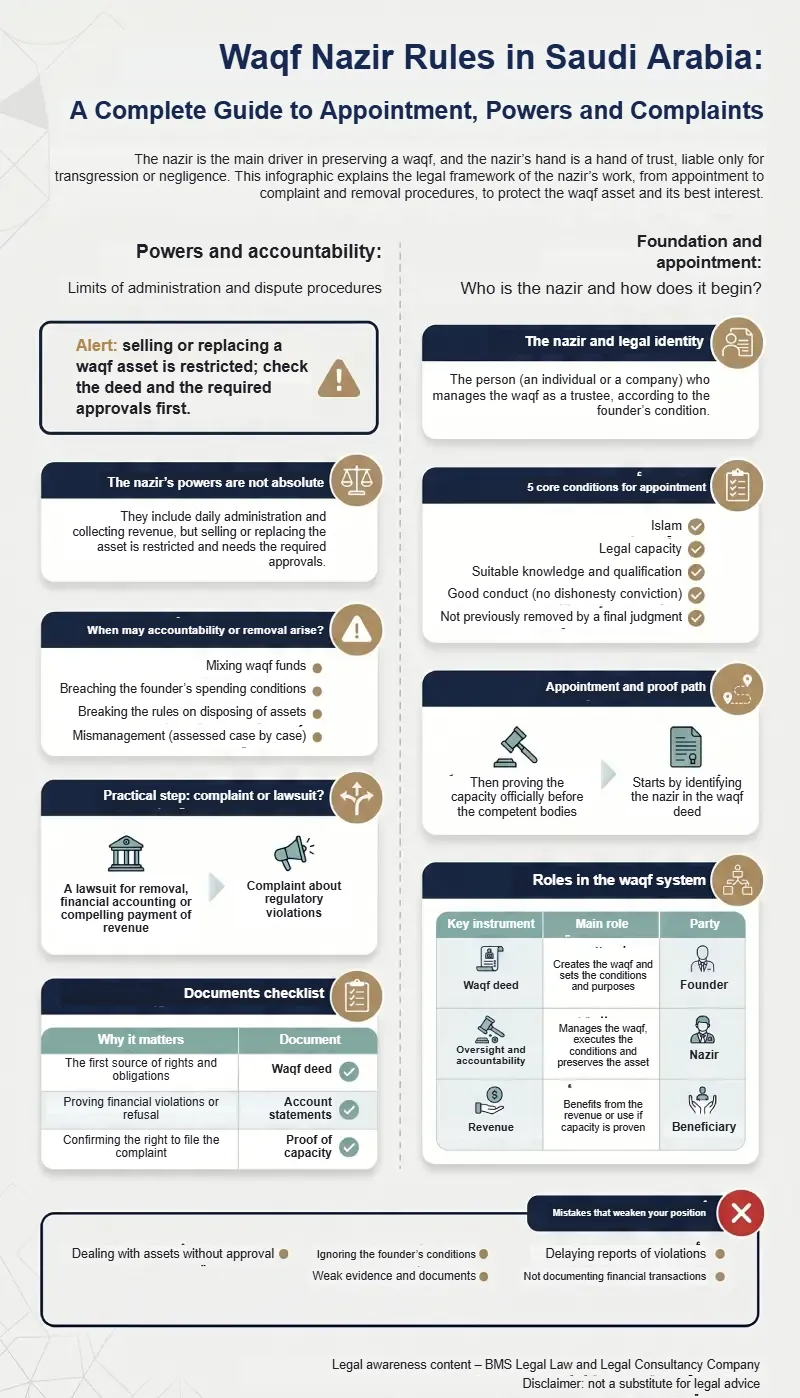
7 Practical Issues in Appointment, Removal and Complaints
Before going into detail, the table below sets out the seven core issues in the rules for a waqf nazir, from definition and conditions to removal and complaints.
| Issue | Practical meaning | Why it matters |
|---|---|---|
| 1. Who the nazir is | The person or entity that manages the waqf under the deed | Fixes capacity and responsibility |
| 2. Conditions | Legal capacity, competence, integrity and understanding of the founder’s condition | Accepting an appointment or challenging it |
| 3. Appointment | Following the waqf deed or the competent route | Dealing with a vacancy or a dispute |
| 4. Proving trusteeship | Showing the nazir’s capacity to authorities and banks | Dealing with Najiz or banks |
| 5. Powers | Administration, spending, representation and protecting the asset | Setting the limits of action |
| 6. Removal | Ending the nazir’s role after a significant violation | Protecting the waqf and its beneficiaries |
| 7. Complaint or report | A supervisory or administrative route against a violation | Addressing a breach of the condition or the regulation |
This guide is prepared with reference to official Saudi sources on waqf, taking into account the regulation governing trusteeship work and the services of Najiz and the General Authority for Awqaf.
If you have a dispute about appointing a waqf nazir, proving trusteeship or understanding the founder’s condition, start by reviewing the documents. You can then request a legal consultation to identify the right route before filing a report or a claim.
How to Read a Waqf File: A Three-Step Method
Step 1: Read the founder’s condition. Is the text clear on the nazir, the beneficiaries, the revenue and how the trusteeship passes on?
Step 2: Identify the type of request. Is it proof of trusteeship, a revenue claim, accountability, removal, or a report to the competent body?
Step 3: Choose the lowest-risk route. Not every dispute needs a lawsuit. Sometimes the right start is a request for clarification or an organised set of documents.
Practical note: the strength of a waqf file does not depend on how much is said. It depends on a clear deed, proven capacity, and documented evidence of the violation or refusal.
Who Is a Waqf Nazir, and What Are the Limits of the Role?
A waqf nazir is the person or entity that manages the waqf, protects its assets and spends its proceeds according to the waqf deed. The nazir acts within the limits of the founder’s condition and the relevant regulations, not according to personal preference or sole discretion.
A nazir may be an individual, or a legal entity specialised in managing endowments where the founder’s condition and the formal procedure allow it. A nazir’s responsibility varies with the nature of the waqf, so it is useful to understand the types of waqf in Saudi Arabia to read powers and duties accurately.
A nazir does not own the waqf and cannot deal with it as an owner deals with private property. The job is to carry out the founder’s purpose, protect the asset, collect the revenue, spend it on the stated beneficiaries, and follow contracts and records.
To avoid confusing the roles, the table below compares the founder, the nazir and the beneficiary.
| Point of comparison | Founder (waqif) | Waqf nazir | Beneficiary |
|---|---|---|---|
| Role | Creates the waqf and sets its condition | Manages the waqf and carries out the condition | Benefits from the revenue or usufruct |
| Authority | Sets the spending purposes and, usually, the nazir | Administration, representation and spending | Claims entitlement once its conditions are met |
| Key document | The waqf deed | A deed or proof of trusteeship | Whatever proves capacity or entitlement |
| Typical dispute | Validity or interpretation of the condition | Administration, spending or violation | Amount or delay of revenue |
Three rights must be kept apart: the founder’s right to set the condition, the nazir’s right to administer, and the beneficiary’s right to benefit. Many waqf disputes begin when one party treats its role as wider than the deed supports.
Conditions for Serving as a Waqf Nazir
The conditions for a waqf nazir do not stop at the name written in the deed. They concern the person’s ability to manage the waqf and protect its assets. They matter more when the waqf is real estate, a family waqf, a waqf with recurring income, or one with several beneficiaries.
The regulation organising trusteeship work sets the formal conditions: Islam, legal capacity, suitable knowledge and qualification, good conduct, no conviction for a dishonesty offence, and no previous removal by a final judgment. A company acting as nazir must be licensed by the General Authority for Awqaf, and the founder’s own conditions come first where they exist.
The conditions for appointing a waqf nazir usually include:
- Legal capacity and the ability to carry out trusteeship work.
- Practical competence in managing the endowed money or property.
- Integrity and sound handling of money and revenue.
- Understanding the founder’s condition and not departing from it by individual decision.
- Ability to keep records, contracts and documents.
- Avoiding conflicts of interest when contracting or spending.
- Experience that suits the nature and size of the waqf.
The conditions vary with the endowed asset. A small waqf differs from a large real estate waqf, a commercial waqf, or one with several contracts and investments. Where the waqf involves property, leasing or exchange, it can help to review the legal and property effects with a real estate lawyer in Jeddah before taking any significant step.
Who Appoints the Waqf Nazir?
As a rule, the founder names the nazir in the waqf deed, unless there is a vacancy or a dispute. Where the text is missing or cannot be applied, the matter goes to the competent route depending on the deed and the facts.
The founder may appoint the nazir in the deed and set the nazir’s powers and how the trusteeship passes afterwards. A founder may keep the trusteeship first, then name a particular person, then the most suitable of the descendants or a specified body.
Where the text is clear, the parties’ task is to apply what the deed says. Where it is unclear or contradictory, interpretation or proof before the competent body may be needed.
Appointment by the founder does not place the nazir beyond accountability. The appointment gives the nazir the capacity to administer, but it does not prevent holding the nazir to account for breaching the founder’s condition or harming the waqf.
If the deed does not name a nazir, the right route has to be identified. That may require proving the applicant’s capacity, showing the interest of the waqf, and supplying supporting documents.
An oral agreement between heirs or beneficiaries is not enough where formal dealings are involved. Official bodies, banks and opposing parties generally need a document that proves the nazir’s capacity and powers.
When a nazir dies or resigns, the waqf does not lapse and its spending purposes do not stop. The deed should be checked to find the next nazir or the appointment mechanism. Where the waqf overlaps with heirs or several beneficiaries, a consultation with an inheritance and estates lawyer in Jeddah can help settle capacity and documents before escalation.
A founder may name more than one nazir, or a board of trustees. That helps in larger endowments, but it invites disputes if the deed does not explain how decisions, voting and signatures work. In a dispute, the right response is not unilateral action but a review of the deed and records, and a decision on the best route.
Proving Trusteeship and Changing the Nazir After a Vacancy or Dispute
Appointing a waqf nazir starts with the waqf deed, then examines the reason for the request, then chooses the proper procedure. The need may be to document a waqf, prove a nazir, change a nazir, or bring a claim over a dispute.
Appointment means deciding who takes the trusteeship when no nazir is in place or the post is vacant. Proving capacity means showing that a particular person is the nazir under the deed or the competent route.
A nazir may be named in the deed but still need to prove that capacity to an official body or a bank. A previous nazir may have died, in which case the situation calls for appointing or proving a replacement.
Proving a nazir through Najiz is generally tied to the appropriate judicial route when capacity must be proved or a dispute resolved. Documenting the waqf itself is a different service, aimed at issuing an official waqf deed.
Documenting a waqf must therefore not be confused with proving who manages it. Mixing the two can delay the request or lead to documents that do not address the real problem.
Where the deed alone cannot persuade an official body or settle a dispute among beneficiaries, capacity becomes something to prove, not assume. This is where a claim to appoint a nazir for a waqf becomes the way to decide who holds the right to manage and represent, before turning to revenue, accounts or a change of nazir.
The documents differ by type of waqf and reason for the request. The table below shows those most commonly needed in files on proving or changing a nazir, noting that the competent body may ask for more.
| Situation | Core documents | Supporting documents |
|---|---|---|
| Appointing a nazir | Waqf deed, the nazir’s details, the reason for the request | Proof of the vacancy or the parties’ consent |
| Proving trusteeship | Waqf deed, the nazir’s details, proof of capacity | Correspondence or decisions linked to the trusteeship |
| Changing the nazir | The deed, the reason for the change, the replacement’s details | Death, resignation, incapacity or a proven violation |
| Holding the nazir to account | Account statements, contracts, revenue records | Correspondence, receipts, signs of shortfall or defect |
| Removing the nazir | Text of the condition, the reason, evidence of violation | Evidence of harm, reports, financial records |
| Claiming waqf revenue | Proof of capacity, the spending text, the claim period | Statements, messages, proof of refusal |
Organising the documents before any step saves time and keeps a report separate from a claim. It also helps decide whether the case needs proof of capacity, a financial claim, or removal.
Limits of Administration and Dealing With the Waqf Asset
A nazir’s powers allow administration of the waqf, but not unrestricted dealing with the asset or the revenue. Every power must stay within the deed, the regulations and the interest of the waqf.
A nazir’s powers usually include:
- Representing the waqf before the competent bodies, within the limits of the nazir’s capacity.
- Managing the endowed asset and protecting it from disruption or encroachment.
- Following up leasing, maintenance and collection contracts.
- Spending revenue according to the stated purposes and shares.
- Keeping the financial and administrative records of the waqf.
- Taking the steps needed to protect the interest of the waqf.
- Seeking permission or the competent route for acts of major effect.
A nazir may deal with government bodies, follow contracts, claim rights and defend the waqf’s interests. That representation does not extend to acting outside the deed or taking decisions that touch the asset without the correct route.
A nazir may lease waqf property where this is ordinary administration and serves the waqf. The contract should be clear, documented and free of conflicts of interest.
Selling or exchanging the waqf asset is not ordinary day-to-day administration. It should be handled with care and tied to the interest of the waqf, the regulatory controls and the competent route. It is not enough for the nazir to think a sale is better; the deed, the condition of the asset, the proposed replacement and the financial effect must all be examined.
A Nazir’s Duties Toward the Asset and the Beneficiaries
A waqf nazir’s duties start with carrying out the founder’s condition and extend to protecting funds, organising records and avoiding conflicts of interest. These duties are the basis for holding a nazir to account for default or violation.
The main duties can be summarised as:
- Carrying out the founder’s condition as stated in the deed.
- Protecting the waqf asset and preventing its disruption or harm.
- Keeping waqf funds separate from personal funds.
- Documenting income, expenses and contracts.
- Spending revenue on the stated purposes.
- Avoiding conflicts of interest in contracts and decisions.
- Disclosing information and providing documents when needed.
- Acting for the interest of the waqf and its beneficiaries without unjustified preference.
Carrying out the founder’s condition is the nazir’s first duty. It means keeping to the spending purposes, shares and restrictions set by the founder in the deed, unless a regulated route exists to deal with ambiguity or impossibility.
A nazir may not change the spending purpose simply because another seems better. If the condition is clear, the starting point is to follow it. If it is ambiguous, the answer is to ask for interpretation or take a suitable procedure.
Where the facts mix revenue, heirs and real estate assets, an initial review of the file with a waqf lawyer may be sensible before choosing the procedure.
A Waqf Nazir’s Fee and Remuneration
A nazir’s fee is the payment due for managing the waqf, where the deed provides for it or the competent body sets it. No single percentage suits every waqf without regard to its nature and the amount of work involved.
A nazir may take a fee where the waqf deed provides for it or it is fixed through the competent route. Trusteeship can demand ongoing time, effort and financial and administrative follow-up.
But a fee does not mean the nazir owns the revenue or can spend it freely. The fee should be defined or capable of assessment, and kept separate from expenses and beneficiaries’ entitlements.
There is no uniform nazir percentage for all cases. A founder may set a specific percentage, a fixed sum, or say nothing about a fee.
Where the deed gives a clear percentage, that applies unless there is a significant legal reason not to. Where the deed is silent, the nazir may ask for a fee assessed by reference to the nature of the tasks and the effort involved.
Be careful about copying general percentages found online. Every waqf has its own deed, spending purposes and scale of administration, and what suits a small waqf may not suit a large or investment waqf.
If the deed sets no fee, the first step is to look at the actual work. Does the nazir manage one property, several assets, or a waqf with contracts, claims and periodic accounting?
The parties can then agree, or go to the competent body if they disagree. Any assessment should be reasonable, should not harm the beneficiaries, and should not exceed the interest of the waqf.
Breaching the Founder’s Condition: Forms and Consequences
Breaching the founder’s condition means a nazir acting contrary to what the founder set in the deed. It may concern the spending purposes, the revenue, the management of the asset, or the choice of beneficiaries.
This is among the most sensitive issues in the rules for a waqf nazir. The condition defines the purpose of the waqf, and breaching it may defeat the very aim for which the waqf was created.
A breach may appear where a nazir spends revenue on people who are not beneficiaries, prefers a beneficiary without a basis, or changes the spending purpose. It may also be a refusal to pay even though the conditions of entitlement are met.
Common practical examples include:
- Paying revenue to people not named as beneficiaries in the deed.
- Delaying distribution of revenue without a clear reason or document.
- Changing a charitable spending purpose without a regulated route.
- Mixing waqf funds with the nazir’s personal accounts.
- Contracting with related parties without sufficient disclosure.
- Dealing with the waqf asset without meeting the required controls.
- Refusing to produce records or documents when asked.
These examples do not mean every case is treated the same way. Some violations can be corrected, while others call for a report, a removal claim or an accountability claim.
Where the breach involves a family waqf or a dispute among beneficiaries, the file may need a legal reading that combines the deed with the beneficiaries’ capacity. Here it is important to engage a personal status lawyer in Jeddah who handles waqf matters.
Accountability and Removal: When Are They Sought?
Removing a waqf nazir is a protective step for the waqf where a significant violation is proved or an important condition of the trusteeship is lost. Removal should not be sought before the violation is identified, evidence is collected and its effect on the waqf and the beneficiaries is understood.
The main grounds that can lead to removal or accountability include:
- A significant breach of the founder’s condition.
- Refusal to distribute revenue without justification.
- Mixing waqf funds with personal funds.
- Dealing with the waqf asset without the proper route.
- Mismanagement that harms the asset or the revenue.
- Hiding records or blocking review.
- A significant, undisclosed conflict of interest.
- Loss of the ability to manage the waqf properly.
Removal means ending the nazir’s capacity, or asking that the nazir be kept away from managing the waqf. Accountability means reviewing the nazir’s financial and administrative acts and establishing whether they caused harm or shortfall.
Accountability can be sought without removal where the aim is to see the accounts or correct a financial act. Removal and accountability may be sought together where the violation is serious or the harm continues.
A claim to remove a waqf nazir does not begin by drafting the request. It begins by reading the waqf deed, which shows who the nazir is, what the powers and duties are, and how the post passes on.
A claim to remove a nazir does not begin with a feeling that revenue is short. It begins with questions that can be proved: what came into the waqf, what was spent, on whom, and on what document? At that point accountability becomes a tool for exposing the administration through figures, not a place to trade accusations.
Where the dispute reaches removal or accountability, a review by a waqf lawyer helps define the requests and the evidence before the claim is filed. See also how to contact BMS Legal to start a review.
Report or Claim? Choosing the Right Route
A complaint or report against a nazir suits cases where a violation needs examination or correction by the competent body. A report does not always replace a claim where the aim is removal, accountability or a financial order.
A report is suitable where there is a regulatory or administrative violation tied to trusteeship work, such as a breach of the founder’s condition, a breach of the trusteeship regulation, or refusal to disclose.
It may also suit cases where basic information about the waqf cannot be obtained, or where acts raise a suspicion of harm to the asset or revenue.
A claim for accountability or removal is more suitable where the aim is a judgment or decision affecting the nazir’s capacity or the beneficiaries’ rights, for example removal, accountability, a revenue claim or proof of trusteeship.
Heirs and Beneficiaries: Limits of Objection
The relationship between a nazir and the heirs and beneficiaries rests on the deed, capacity and interest. Not every heir may object merely because of kinship, and a nazir may not ignore beneficiaries whose rights are proved.
Disputes arise most often in family waqfs, because the beneficiaries may come from the same family. Waqf issues may also overlap with estates, ownership and revenue, which calls for tighter control over requests and documents.
A person with capacity and interest may object where there is a recognised reason, such as a breach of the founder’s condition or refusal to distribute revenue. Objection cannot rest on personal dissatisfaction alone.
If an heir is a beneficiary of the waqf, the heir may claim the entitlement under the deed. If not, the heir may need to prove capacity or interest before making an effective request.
A dispute among nazirs can paralyse daily decisions, especially where the deed sets no voting or signing mechanism. A dispute between a nazir and beneficiaries needs precision: is the problem the interpretation of a condition, a delay in payment, an allegation of mismanagement, or a request for documents?
Distributing Waqf Revenue and the Nazir’s Limits
Distributing waqf revenue is one of the most practical sources of dispute between a nazir and beneficiaries. Revenue is the fruit of the waqf, and delay or shortfall without explanation opens the door to objection and accountability.
The deed shapes how distribution works, because it may set purposes, shares and dates. A nazir’s act cannot be judged without reading the deed first.
Revenue should be distributed as the founder’s condition provides, after the expenses needed to preserve the waqf. Maintenance or administration costs may come first where they are necessary to keep the asset going.
If the deed sets a date or a share, it should be followed. If it is silent on detail, the nazir’s conduct should be reasonable and documented, without harming beneficiaries or delaying the spending purpose.
If a nazir refuses to distribute revenue, the first step is to review the deed. There may be a legitimate reason for the delay, such as necessary maintenance or a dispute over entitlement.
Next, ask the nazir for a written explanation of the revenue, the expenses and the reasons for delay. If there is no response, a report or a claim can be considered according to the facts.
A beneficiary claiming waqf revenue must prove capacity first. Being a relative of the founder is not enough; the person must show that they fall within the spending purpose set in the deed.
Leasing waqf property and investing its revenue are forms of administration that can serve the waqf. They must follow the deed, be at a fair price, use clear contracts and avoid conflicts of interest.
Common Mistakes That Weaken a Waqf Dispute
Many mistakes occur in nazir disputes because of haste or reliance on a general understanding of waqf. They grow more likely when the dispute is within a family or tied to income-producing property.
The most common mistakes that weaken a legal position are:
- Filing a claim or report without reading the waqf deed.
- Relying on a personal quarrel instead of a proved violation.
- Asking for removal without a clear reason.
- Neglecting account statements, contracts and correspondence.
- Confusing proof of a nazir with a change of nazir.
- Claiming revenue without proving capacity or entitlement.
- Ignoring the founder’s condition when reading the nazir’s powers.
When Is Legal Review Necessary?
You need legal advice when the question is more than a definition or a simple procedure and involves a dispute over capacity, revenue or removal. The need is clearest with an old deed, an unclear condition or several beneficiaries.
Legal review is also needed where the founder’s condition is breached, a nazir refuses to distribute revenue, or there is a suspicion that funds have been mixed. It matters more where the waqf is real estate or of significant value.
At BMS Legal, a waqf file usually begins with reading the deed and then choosing the route. That may be a report to the authority, a statement of claim, a revenue claim or a claim for accountability.
Before getting in touch, prepare the waqf deed, whatever proves your capacity or entitlement, revenue statements if any, and your correspondence with the nazir, then send the details through our contact page.
Trust and Legal Basis
Legal basis
This guide is based on the General Authority for Awqaf trusteeship regulation and services listed below, together with Najiz and Ministry of Justice services, and is written for general legal awareness rather than as advice on a specific case.
Published by: BMS Legal Law and Legal Consultancy Company.
Address: Jeddah, Al-Mishrifah District, Palestine Street, Al-Safeer Tower
Frequently Asked Questions About Waqf Nazir Rules in Saudi Arabia
Who is a waqf nazir in Saudi Arabia?
A waqf nazir is the person or entity that manages the waqf, protects its assets and spends its revenue according to the waqf deed, the founder's condition and the relevant regulations.
What are the conditions for a waqf nazir?
They include legal capacity, the ability to manage, integrity, sound handling of money, and an understanding of the founder's condition and the nature of the waqf.
Who appoints the waqf nazir, and how is one appointed?
As a rule, the founder appoints the nazir in the waqf deed. Where the text is absent, or after a death, resignation or dispute, the matter goes to the competent route according to the facts. Capacity before an official body may need to be proved, which is a different step from documenting the waqf itself.
What are a waqf nazir's powers and duties?
A nazir may manage the waqf, represent it, collect and spend revenue, follow contracts and protect the asset. A nazir must carry out the founder's condition, keep records, separate waqf funds from personal funds, and avoid conflicts of interest.
Is a waqf nazir entitled to a fee, and what is the nazir's percentage?
A nazir is entitled to a fee if the deed provides for one or the competent body fixes it. There is no uniform percentage for all waqfs: what counts is the founder's condition, or an assessment by the competent body where there is no text.
When can a waqf nazir be removed, and is that different from accountability?
A nazir can be removed where a significant violation is proved, such as breaching the founder's condition, mixing funds, harming the waqf or refusing to distribute revenue without reason. Removal ends the nazir's capacity, while accountability reviews the nazir's financial and administrative acts and may follow or accompany it.
Conclusion
The waqf nazir rules in Saudi Arabia rest on one clear principle: a nazir manages the waqf for the benefit of the waqf, not for personal advantage. Every significant act must stay within the waqf deed and the relevant regulations.
Dealing properly with a waqf dispute therefore starts with two questions: what does the waqf deed say, and which documents prove the violation or the capacity? Once those are answered, the choice of route becomes clearer and carries less risk.
Need help with a waqf nazir dispute? Send us the deed and your documents for an initial review of the route that fits your case.
Need help with a waqf nazir dispute?
Speak with a BMS Legal lawyer in Jeddah for an initial review of the waqf deed, your documents and the route that protects your rights.
Enquiries are handled confidentially · No specific court outcome can be guaranteed
Official Legal and Government Sources
- Regulation Organising Trusteeship Work, General Authority for Awqaf (Arabic-language official document).
- Schedule of Violations and Penalties under the Trusteeship Regulation (Arabic-language official document).
- General Authority for Awqaf: report a nazir service (Arabic-language official service page).
Disclaimer: This article is for general legal awareness and is not advice on an individual case, and reading it does not create a lawyer–client relationship. The legal assessment varies with the facts, the documents and the rules that apply to each case.