A reduce alimony in Saudi Arabia claim is a court request to modify an existing maintenance order because the paying party’s circumstances have materially changed. It is not the same as simply paying less or stopping payment, and the order stays enforceable until a court changes it.
In Saudi law, the term usually translated as alimony is nafaqah, meaning maintenance. It can cover a wife’s maintenance during marriage or the waiting period, and a child’s maintenance after separation. The Personal Status Law links the amount to the needs of the person receiving maintenance and the financial capacity of the person paying it, which is why a lasting change in either can justify a review.
This guide explains when a court may consider reducing maintenance, the documents commonly needed, how a request is filed through Najiz, and why requests are rejected. For background on how maintenance is set in the first place, see our guide to maintenance after divorce in Saudi Arabia.
Need Help Asking the Court to Reduce Maintenance?
If your income has fallen or your circumstances have changed since a maintenance judgment was issued, we can review the judgment and your supporting documents and explain the options available to you.
Enquiries are handled confidentially · No specific court outcome can be guaranteed
What Is a Reduce Alimony Lawsuit in Saudi Arabia?
A reduction lawsuit asks the court that issued, or has jurisdiction over, an existing maintenance judgment to modify the amount because circumstances have changed since the judgment. It assumes that a judgment already exists. It is a request to revise that judgment, not a way to cancel it or to avoid enforcement.
Until the court issues a new decision, the original amount continues to apply. Paying less on your own initiative can create arrears, which the other party may pursue through enforcement. See our guide to what happens when maintenance is not paid for how such claims are handled.
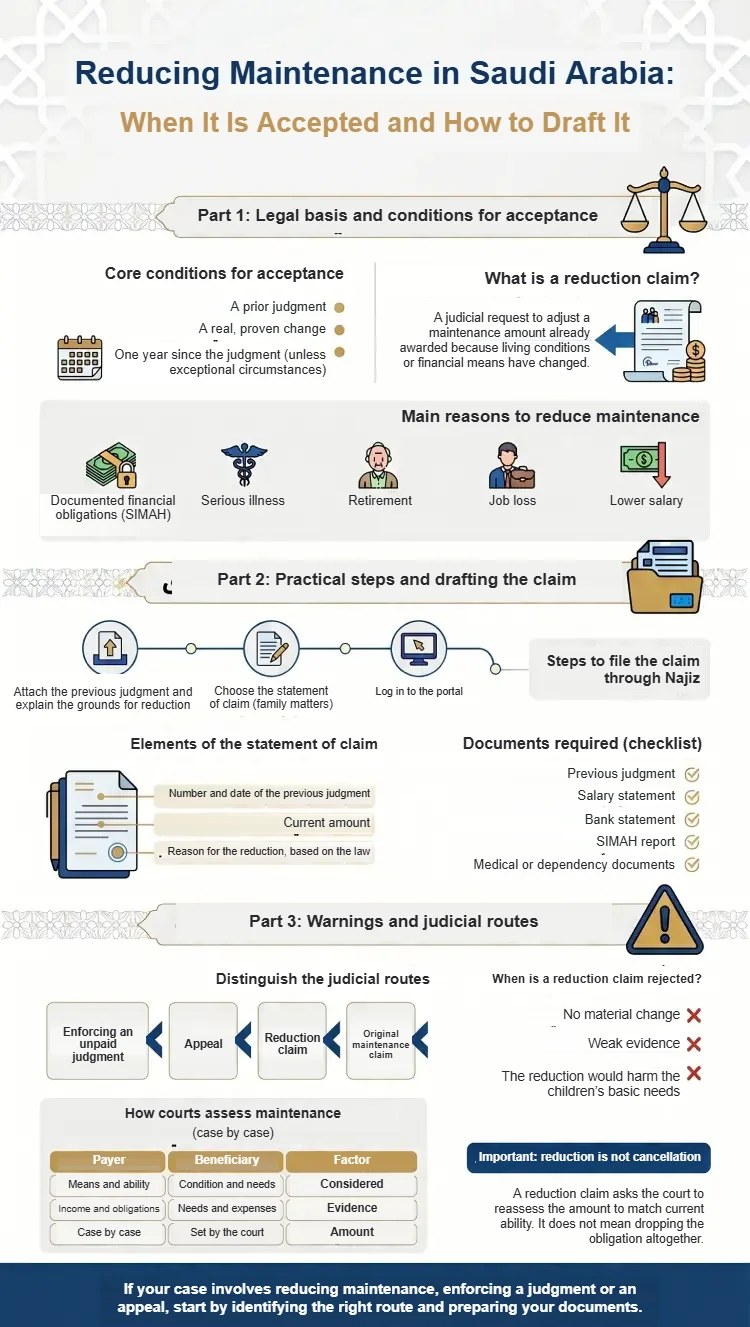
When Can a Court Reduce Maintenance?
Courts look at whether the situation that supported the original amount has actually changed, and whether the change is lasting and documented. The points below are the conditions most commonly examined.
- An existing judgment. There must be a maintenance judgment whose amount you are asking the court to modify.
- A change after the judgment. The change must have occurred after the judgment was issued, not before it or during the original proceedings.
- Official proof. The change should be supported by official records rather than statements alone, such as an employer certificate or a retirement record.
- The time limit, or an exceptional circumstance. A modification request is generally not accepted within one year of the judgment unless the court finds an exceptional circumstance (see below).
- The recipient’s basic needs. A reduction should not leave the person receiving maintenance, particularly a child, without what they basically need.
- The type of maintenance. The request should identify whether it concerns a wife’s maintenance, a child’s maintenance, or another category.
- A clear request. The statement of claim should specify the amount sought and tie each reason to a supporting document.
What Counts as a Material Change in Circumstances?
Not every difficulty qualifies. A court is more likely to take seriously a change that is significant, lasting, and verifiable. Examples that are commonly raised include:
- Loss of employment or termination of a contract.
- Retirement with a reduced income.
- A significant reduction in salary supported by an employer certificate.
- A medical condition that affects the ability to work or creates documented medical expenses.
A temporary setback, a voluntary resignation, or a lifestyle choice may be viewed differently. The other party will often argue that the payer’s capacity has not really changed, so the strength of the documents matters as much as the change itself.
The One-Year Rule and Exceptional Circumstances
Under the Personal Status Law, a maintenance amount may be increased or decreased when circumstances change. As generally applied, a request to modify the amount is not ordinarily heard until a year has passed since the judgment, unless the court accepts that exceptional circumstances justify an earlier review. Whether circumstances are exceptional is a matter for the judge, so an early request should explain clearly and with evidence why it cannot wait.
If the judgment is very recent and you disagree with the amount itself rather than with a later change, the better route may be an appeal. Our guide to appealing a child support judgment explains how that works.
Documents Usually Needed to Support the Request
The documents below are those commonly relied on. The court may ask for others depending on the case.
| Document | What It Helps Show |
|---|---|
| The previous maintenance judgment | The amount and date of the order you want modified |
| Salary certificate | Your current income compared with the position when the judgment was issued |
| Bank statements | Your actual financial position and capacity to pay |
| Retirement or job-loss document | A change that occurred after the judgment |
| Medical report | The effect of a health condition on income or expenses |
| Documents about the recipient’s needs | That a proposed reduction is balanced against the recipient’s interest |
Present the documents so that each factual claim in your statement is linked to a specific attachment. Contradictory documents, such as a salary certificate that does not match bank deposits, can damage the whole request.
How to File a Reduction Request Through Najiz
Claims are filed electronically through the Ministry of Justice’s Najiz platform. In general, the process looks like this:
- Sign in to Najiz through the national single sign-on.
- Choose the service for filing a statement of claim and select the relevant court and case type.
- State the date and amount of the existing judgment and describe the change in circumstances that has occurred since.
- Specify the amount you ask the court to set and attach the supporting documents.
- Follow the hearing schedule and respond to the court’s requests for further evidence.
Menu names and steps on Najiz can change, so check the current service description on the platform. Our guide to filing a maintenance claim covers the procedure from the other side of the dispute.
What the Other Party May Argue
The person receiving maintenance, or the parent acting for a child, may respond that the need continues and that the payer remains financially capable. They may point to assets, other income, or spending that does not match the claimed hardship. Anticipating these arguments and documenting the true position, including any benefits or other income, is usually more persuasive than leaving gaps for the other side to fill.
Common Reasons a Reduction Request Is Rejected
- No material change since the judgment was issued.
- Weak or unofficial proof of the change.
- Filing within one year of the judgment without an exceptional circumstance.
- Documents that contradict one another.
- A proposed reduction that would harm the child’s basic needs.
- A request that does not state the type of maintenance or the amount sought.
Does the Maintenance Fund Reduce a Judgment?
No. The Maintenance Fund exists to help secure payment of maintenance that a court has already ordered, so that a beneficiary is not left without support when the payer does not pay. It does not reduce or modify judgments. A request to reduce the amount must still be brought before the court. For the current amounts, see how much child maintenance is after divorce and how much wife maintenance is per month.
When Should You Consult a Lawyer?
Professional advice is especially useful if the judgment is already being enforced, if arrears have built up, if your income comes from several sources, if the judgment is recent and an appeal may be the better route, or if the dispute also involves custody, visitation or divorce. A lawyer can assess whether the facts support a reduction, prepare the statement of claim, and organise the evidence. You can read about our alimony lawyer in Jeddah and personal status lawyer in Jeddah services, or contact us to discuss your documents.
Trust and Legal Basis
Legal basis
This guide relies on the Saudi Personal Status Law, as it relates to maintenance and the modification of maintenance judgments, and on the official guidance published for filing claims through Najiz. How these rules apply depends on the terms of the judgment and the facts of each case. See the Personal Status Law (Bureau of Experts at the Council of Ministers) and the Najiz e-services guidance.
Published by: BMS Legal Law and Legal Consultancy Company.
Address: Jeddah, Al-Mishrifah District, Palestine Street, Al-Safeer Tower
Frequently Asked Questions About Reducing Alimony in Saudi Arabia
Can I stop paying alimony if my income has dropped?
No. A maintenance judgment remains enforceable until a court modifies it. If your income has fallen, the appropriate step is to ask the court for a review and keep paying what you can in the meantime. Stopping payment without a court order can lead to arrears and enforcement.
How long must I wait before asking to reduce maintenance?
As generally applied under the Personal Status Law, a request to modify maintenance is not ordinarily heard within one year of the judgment, unless the court finds exceptional circumstances. Whether a particular case qualifies is for the judge to decide.
What evidence is needed to reduce alimony?
Courts generally expect official evidence of the change, such as the previous judgment, a salary certificate, bank statements, a retirement or job-loss record, or a medical report. Each fact in the claim should be tied to a specific document.
Does retirement or losing my job automatically reduce maintenance?
No. Retirement or job loss may be a material change, but the court will still weigh your actual capacity against the recipient's needs. The existing amount stays in force until the court decides otherwise.
Can the Maintenance Fund reduce my payments?
No. The Maintenance Fund helps secure payment of maintenance already ordered. It does not change the amount of a judgment, and a reduction must be requested from the court.
Should I appeal instead of filing a reduction claim?
If the judgment is recent and your objection concerns the amount set rather than a later change, an appeal within the applicable time limit may fit better. If circumstances have changed since a final judgment, a reduction request is the usual route. A lawyer can help you choose.
Conclusion
A reduce alimony in Saudi Arabia request depends on showing a real, lasting and documented change since the maintenance judgment, while keeping the recipient’s basic needs in view. Paying less without a court order does not change the judgment and can create arrears.
Clear official documents, a precise statement of claim and attention to the one-year rule give the request its best chance of being considered on its merits.
Has your income changed since a maintenance judgment was issued?
You may share the judgment and your supporting documents so that we can review whether a reduction request appears supportable and explain the next steps.
Official Legal and Government Sources
- Personal Status Law (Bureau of Experts at the Council of Ministers)
- Najiz e-services: filing a statement of claim (Ministry of Justice)
Request a Review of Your Maintenance Judgment
You may send us the maintenance judgment, proof of income and any documents showing a change in your circumstances. We will explain whether a reduction request appears supportable and which steps may follow.
Enquiries are handled confidentially · No specific court outcome can be guaranteed
Disclaimer: This article is for general legal awareness and is not advice on an individual case, and reading it does not create a lawyer–client relationship. The legal assessment varies with the facts, the documents and the rules that apply to each case.