Proving non-ownership of property in Saudi Arabia becomes necessary when an official or private body asks for something showing that a person has no property registered in their name. The request may relate to housing support, social security, correcting property data, or answering a claim that treats you as an owner.
Stating verbally that you own no property is rarely enough, because the requesting body needs a document it can review. The right approach therefore begins with an official inquiry about properties or deeds, then saving the result and preparing the declaration or supporting document that fits the reason for the request.
The strength of the proof depends on the case. If no property appears under your name, the inquiry result may be enough for some requests. If a property is registered in your name by mistake, the matter needs a closer look before any general declaration is submitted.
Property in your name by mistake, or a support refusal?
A real estate lawyer can review your inquiry result, deed data and the body’s letter, and help identify the right route.
Enquiries are handled confidentially · No specific court outcome can be guaranteed
Quick Answer: Preparing Your Non-Ownership File
If you are asked to prove that you own no property, start by identifying the reason for the request: housing support, a data correction, a financing body, or a dispute. Then run an official inquiry, save the result with a clear date, and prepare the declaration or supporting document that suits the case.
If your question is “how do I prove that I do not own property?”, the answer does not begin with a ready-made form alone. It begins by matching the inquiry result to the reason for the request. Proving that you do not own a rented property is different from a property that appears under your name by mistake, and both differ from a court claim to prove non-ownership.
Which Situation Is Yours, and Which Document Fits?
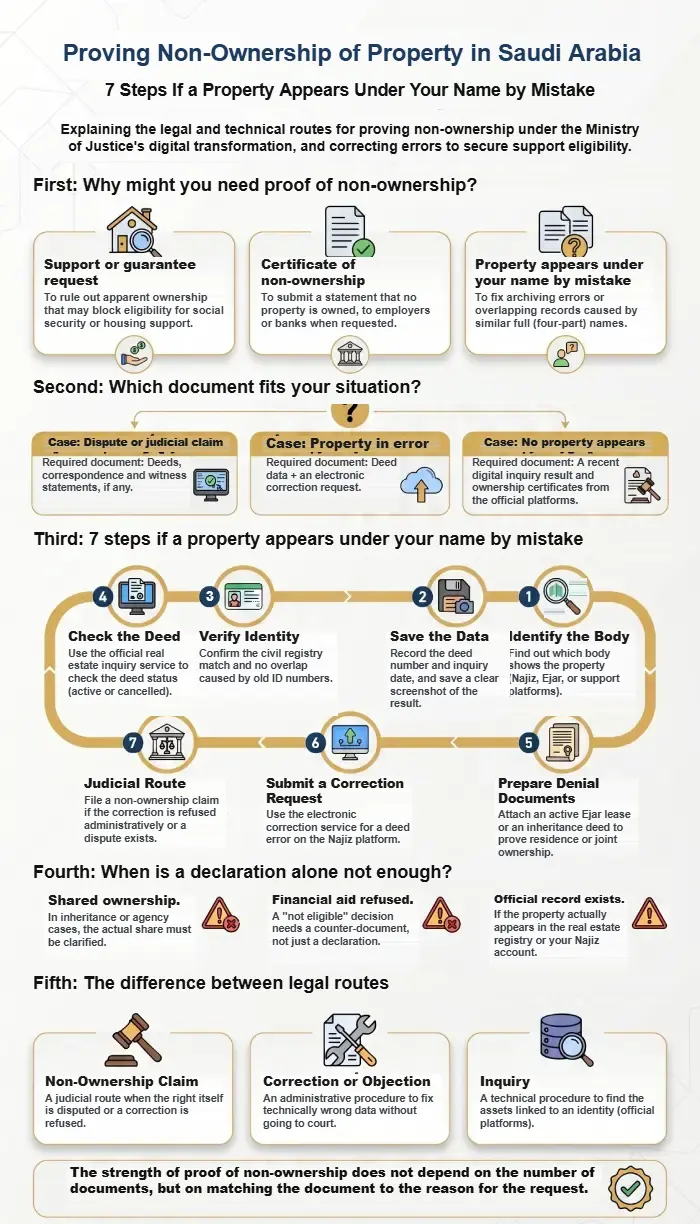
Before preparing any document, decide why you need to prove non-ownership. The right document is not set by the name of the request alone but by the case itself: does no property appear under your name? Did one appear by mistake? Was a support request refused? Or has the matter become a dispute or a claim? The table shows the closest route for each situation.
| Situation | Closest document | When is legal review needed? |
|---|---|---|
| No property appears under your name | A recent inquiry result | Usually not, unless the body rejects it |
| A body asks for a non-ownership certificate | Inquiry result, plus a declaration if needed | When the document name requested differs |
| A property appears under your name by mistake | Property data plus a correction request | Yes, before submitting a declaration |
| Support refused because of a property | The reason for refusal plus the inquiry result | Usually yes |
| A dispute or a claim | Deeds, correspondence and requests | Yes, because the route may become judicial |
Do not let the declaration come before checking the property data
The strength of a document varies with the reason for the request. If no property appears under your name, the inquiry result may be enough. If a deed, a document or a refusal of support relates to ownership data, the better course is to examine the source of that data before submitting any general declaration.
- Start with the reason for the request, not the form name: a support request, a non-ownership certificate, a deed correction or rebutting a claim each needs a different document.
- Save the inquiry result clearly: the date of the inquiry, the deed or document number and the property data shown help decide whether a declaration is enough or a correction or objection is needed.
- Avoid a general declaration where the data conflict: if a property appears under your name by mistake, a declaration alone does not cure the source of the error. Decide first whether you need a data correction, an objection, or a claim to prove non-ownership.
A practical rule: the strength of the file does not come from the number of documents but from how well each document matches the reason for the request.
When Is Proof of Non-Ownership Requested?
Proof of non-ownership is not usually requested out of general curiosity, but when ownership has a practical effect. Identify the reason for the request first, because a document for social security or housing support may differ from one needed in a property dispute.
Support requests and official bodies
This arises when a body asks you to prove that you own no property or home in your name. The request may relate to social security, housing support, a financing body, or an administrative file that needs recent proof.
Practical cases include:
- An official body asks you to prove that you own no property or home.
- You need a non-ownership certificate or an alternative document the body will accept.
- You need to show that your status in the property is tenant, not owner.
- You need to explain why support was refused because of unclear ownership data.
Errors in data or deeds
This arises when a property appears under your name although you do not own it, or when an old deed or ownership document does not match the facts. A general declaration is not enough here, because the problem lies in the source of the data itself.
The most important cases are:
- A property appears on an official platform or body without your knowledge.
- A deed or document needs correction.
- A claim is directed at you as the owner.
- An inherited or jointly owned share needs clarifying before a declaration is submitted.
How Do You Inquire About Property Registered Under Your Name?
An inquiry about property in your name starts from the official services available for properties and deeds. Najiz presents an inquiry service for a property ownership document, and describes it as showing the details of the document, the owner and the property once the required document data is entered. Najiz’s property services also include services tied to deeds and properties.
Where you need to examine deed data before presenting the inquiry result to the requesting body, an inquiry about a property deed becomes an important step. Our guide to a Saudi property deed inquiry explains how to check deed data.
Steps to inquire and save the result
Arrange the inquiry clearly so the result is usable when needed. Do not rely on an unclear screenshot or an old result, especially if the request relates to support or an objection.
- Sign in through National Single Sign-On or the official channel available.
- Inquire about the deeds or ownership documents linked to your name or data.
- Save the inquiry result, whether or not any property appears.
- Check the name, ID number, document number, property location and type of ownership.
- Keep a copy of the body’s letter or the refusal message if there is an official request.
What if the result is unexpected?
If no property appears under your name, the result may support a non-ownership certificate request or the declaration the body requires. If a property you do not know appears, move to examining the document before submitting any general declaration.
In that case, save the property data shown, then verify its source. The cause may be a similar name, an agency relationship, an inheritance, or an error in the deed or the register.
Is There a Property Non-Ownership Certificate?
People often search for the phrase “property non-ownership certificate”, but the name that is accepted may differ between bodies. Some ask for a “certificate”, some accept an inquiry result, and some ask for a written declaration with supporting documents.
The certificate may be only the name the requesting body uses, while the inquiry result is the practical document available in many cases. Read the body’s request carefully to see whether it wants a statement, an inquiry result, or a declaration attached to documents.
| What the body asks for | Likely practical document | When it is not enough |
|---|---|---|
| A certificate of no ownership | A recent inquiry result | If a property appears under your name |
| A statement of no property | Inquiry result plus a declaration | If the data conflict |
| Proof of owning no housing | Inquiry plus a housing document | If a share or joint ownership exists |
| Denial of ownership of a specific property | Property documents plus an objection | If there is a dispute or a deed |
The Real Estate Registry presents services such as verifying property ownership documents, real estate registry data, correction requests and filing a grievance. These services help where property data needs review or correction.
Documents That Prove You Do Not Own Property
The documents are not many, but they must be organised and match the reason for the request. A missing document may lead to refusal, and a general document may not address the reason for refusal or the dispute.
In simple requests the aim is usually to show that no property appears under your name, or to provide a document the requesting body accepts. A short, clear file is usually enough.
Prepare the following:
- The national ID, checking that the name and ID number match.
- The result of the inquiry about properties or deeds.
- The letter from the requesting body, or the refusal message.
- A declaration of owning no property, where needed.
- A lease contract if you need to show your status as a tenant.
Documents for errors or disputes
If a property appears under your name or a conflicting deed exists, a declaration alone is not the priority. The deed or document data, the refusal message and the reasons the property appeared become more important than a general form.
You may need:
- The deed or ownership document data.
- The inquiry result in which the property appeared.
- A power of attorney, if the appearance relates to an agency.
- An heirs’ deed or a document on joint ownership.
- Correspondence from the body or the reason support was refused.
- Any earlier correction request or objection.
The strength of the file does not lie in the number of documents but in their link to the reason for the request. For support, the refusal letter becomes important. For a property that appears under your name, the deed or document data matter more than a general declaration.
Trust and Legal Basis
Legal basis
This guide is based on the Najiz property inquiry service, the Real Estate Registry services and the Ministry of Justice deed update service listed below, and is written for general legal awareness rather than as advice on a specific case.
Published by: BMS Legal Law and Legal Consultancy Company.
Address: Jeddah, Al-Mishrifah District, Palestine Street, Al-Safeer Tower
Short Template for a Declaration of Owning No Property
A declaration may be used when a body asks for a written statement, or when no specific document exists under the name “non-ownership certificate”. It does not always replace the inquiry result, and it is unsuitable where official data show a property under your name.
A suitable short wording:
I, ……, holder of ID number ……, declare that, according to the attached inquiry result, no property registered in my name appears as of the date of this declaration. It has been prepared to be submitted to ……, and I bear responsibility for the accuracy of the data provided according to the documents available to me.
When is a declaration not enough?
A declaration may suit some administrative requests but is not always enough. If official data show a property under your name, the declaration alone does not explain why the property appears.
Do not rely on a declaration alone in these cases:
- A property appears in your name on an official platform or body.
- The request relates to refusal of support or an entitlement.
- A deed or document needs correction.
- You hold an inherited share or joint ownership.
- You act as an agent in a property transaction and are not the owner.
- A claim is directed at you as owner.
The wording of the declaration must be tied to the documents, not a general phrase for every case. If the declaration conflicts with the official data, understand the reason for the conflict before submitting any new document.
What If a Property Appears Under Your Name by Mistake?
A property appearing under your name when you do not own it needs a different order from the case where no property appears at all. The phrase “the property is not mine” is not enough here, because the body needs to know why the data appeared: an error in the deed, the register, the ID number, an agency relationship or an inheritance.
The Ministry of Justice presents a service to submit a request to update or amend a property deed. Its steps include choosing the type of request, entering the data, attaching documents and submitting the request. Administrative correction may therefore be suitable where the error is clear and supported by documents.
Where the error relates to a deed, a claim or a refusal of support, you can consult a real estate lawyer in Jeddah before sending the request. The wrong route may prolong handling, especially if the matter needs an objection rather than a declaration.
7 Steps If a Property Appears Under Your Name
If a property appears under your name and you do not own it, the right approach does not begin with a general declaration. It begins with ordered steps that show the source of the error and identify the right document. These steps help you decide whether administrative correction is enough or you need an objection or a claim to prove non-ownership.
- Identify the body in which the property appeared, such as Najiz, the Real Estate Registry or a support body.
- Save the property data shown, such as the deed or document number and the inquiry date.
- Check whether the data really concern you, or arise from a similar name or an ID error.
- Inquire about the deed or ownership document through the available official channel.
- Prepare the documents that negate your capacity as owner, such as a lease, a power of attorney or inheritance documents.
- Submit a correction request or objection if the error can be dealt with administratively.
- Move to the judicial route if correction is refused or the harm continues.
When Does It Become a Claim to Prove Non-Ownership?
A claim to prove non-ownership appears when the inquiry result or a correction request is not enough. The need may arise from a dispute, a deed that appears under your name, a financial claim, or refusal to correct data despite supporting documents.
The matter usually needs a judicial route in these cases:
- Another party insists that you are an owner or hold a capacity in the property.
- A deed or document produces an effect on you that you do not accept.
- An administrative correction is refused despite clear documents.
- You are deprived of support or a benefit because of incorrect ownership data.
- A claim is directed at you as the owner of the property.
If the dispute is not limited to denying ownership and involves a party seeking to establish their right in the property, the procedures for proving property ownership differ in documents, requests and the way the argument is built.
Administrative correction or a claim?
Administrative correction suits a clear error in data or a deed where it can be handled with documents. A claim appears when there is a dispute, a material refusal to correct, or a legal effect that an administrative request cannot resolve.
At this stage the question is no longer just how to prove that you own no property. You need to define the judicial request precisely: denying ownership, proving lack of capacity, or correcting the effect of property data. The Saudi Law of Evidence and its procedural guides deal with evidence topics such as admission, writing, digital evidence, testimony, presumptions and expertise, so documents should be arranged according to the facts, not a general title.
Common Mistakes That Weaken a Non-Ownership File
Many requests are weakened by how the file is prepared, not by the weakness of the right itself. Watch for these practical mistakes before filing the request or submitting the declaration.
- Relying on a general declaration although a property appears in official data.
- Submitting an old or unclear inquiry result.
- Confusing a lease with ownership.
- Ignoring inheritance or joint ownership.
- Using a single template for social support, housing support and a court dispute.
- Repeating a correction request without addressing the reason for refusal.
A practical rule: if the official data show no property, the file is usually simple. If a property appears, the matter needs examination before you choose between a declaration, a correction or a claim.
When Is Legal Review Needed?
Not every case needs legal review, especially if the inquiry result is clear and there is no refusal or dispute. Review becomes important where a property appears under your name by mistake, support is refused over ownership data, a document needs correction, or a claim is directed at you as owner.
Review helps in these cases:
- A property appears under your name on a platform or body although you do not own it.
- A support or entitlement request was refused over incorrect ownership data.
- A deed or property document needs correction or objection.
- You need a declaration that does not conflict with official data.
- A claim or lawsuit is directed at you as an owner.
- The case is complicated by inheritance, agency or joint ownership.
Where a conflicting deed, a refusal of support and a claim as owner come together, it is essential to obtain advice from a law firm in Jeddah with real estate litigation experience. It helps decide whether the closest route is administrative correction, an objection, or a claim to prove non-ownership. Where inheritance is involved, our guide to inheritance and estates in Saudi Arabia explains how heirs’ rights are organised.
Frequently Asked Questions About Proving Non-Ownership of Property
How do I prove that I do not own property in Saudi Arabia?
Start with an inquiry about properties or deeds, then save the result and attach it to the body's letter or the declaration it requires.
Is there an official property non-ownership certificate?
The accepted name may differ by body; some accept an inquiry result, a statement or a declaration backed by documents.
Does having no deed in my hand prove that I own no property?
Not always, because what counts is the registered data and electronic documents, not only the paper in your hand.
Is a declaration of owning no property enough?
It may be enough for some requests, but not if official data show a property under your name.
What should I do if a property appears under my name by mistake?
Save the property data, examine the deed or document, then choose between a correction, an objection or a claim.
Does a lease mean the property is mine?
No. A lease shows your capacity as a tenant and does not transfer ownership of the property to you.
Conclusion
Proving non-ownership of property in Saudi Arabia begins with the reason for the request, not the form name. If you were asked to prove that you own no property, or a property appeared under your name by mistake, start with an official inquiry and save the result with a clear date, then match it against the letter of the requesting body or the reason for refusal.
If the inquiry shows no property, the file is usually simple. If a property appears, do not rush to a general declaration. Examine the source of the data first, then choose between correction, objection or a claim to prove non-ownership.
For an initial review, send the inquiry result, the body’s letter or the property data that appeared under your name through WhatsApp, so the case can be examined and directed to the right step without promising a result in advance.
Need help proving non-ownership of property? Send us your inquiry result or the body’s letter for an initial review of the route that fits your case.
Need help proving non-ownership of property?
Speak with a BMS Legal lawyer in Jeddah for an initial review of your documents and the route that protects your rights.
Enquiries are handled confidentially · No specific court outcome can be guaranteed
Official Legal and Government Sources
- Najiz: inquiry about a property ownership document (Arabic-language official service page).
- Saudi Real Estate Registry (Arabic-language official website).
- Ministry of Justice: request to update or amend a title deed (Arabic-language official service page).
Disclaimer: This article is for general legal awareness and is not advice on an individual case, and reading it does not create a lawyer–client relationship. The legal assessment varies with the facts, the documents and the rules that apply to each case.