
How to register property in Saudi Arabia does not start with filling in an electronic form alone, but with identifying the right procedure. The case may be a first in-kind registration, a transfer of ownership, a data correction, or an objection to an existing entry.
If the property lies within a declared real estate zone, the route is usually tied to the Real Estate Registry platform. That includes entering the owner’s and property’s data, checking the geospatial location, and attaching supporting documents where needed.
Registering a property does not always mean transferring its ownership, because the conveyance or transfer of ownership is usually a separate procedure. Understanding the meaning of real estate conveyance and its steps therefore helps in choosing the right route before starting the request.
Property registration refused, or unsure which route to take?
A real estate lawyer can review your deed and documents, and help identify the right route before you resubmit.
Enquiries are handled confidentially · No specific court outcome can be guaranteed
Before You Submit: A Quick Summary of How to Register Property
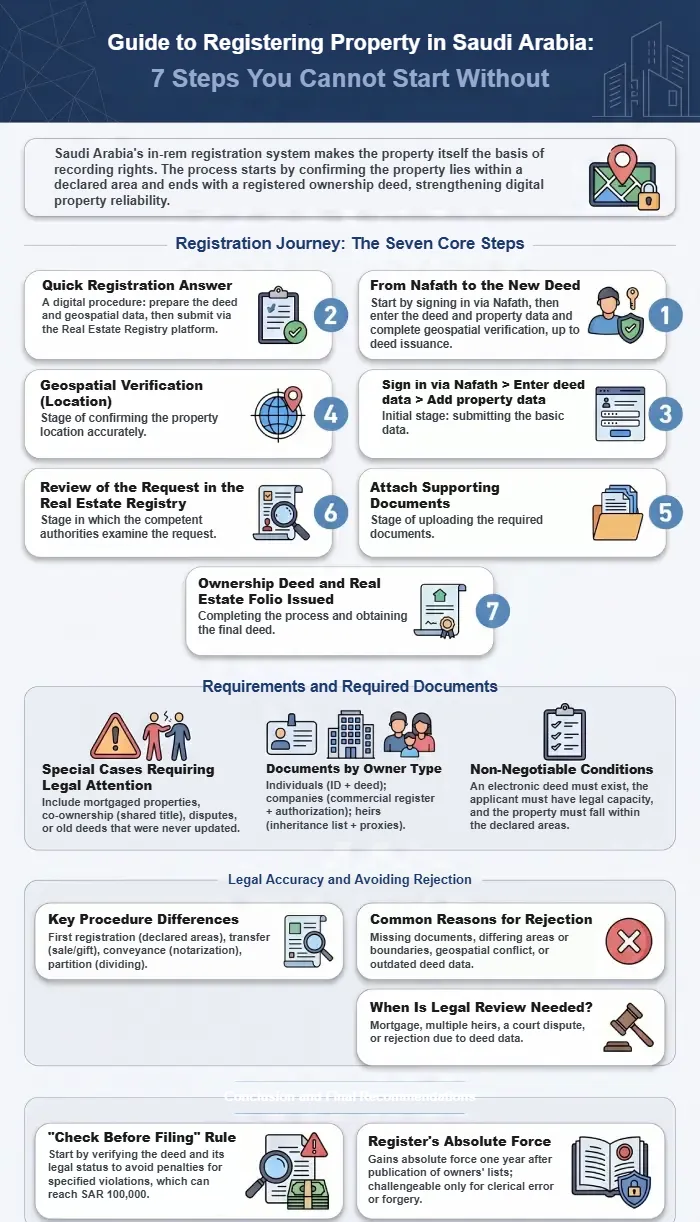
Registering a property starts with confirming the deed and the capacity, then entering the Real Estate Registry platform, entering the property data, checking the geospatial information, and attaching the required documents. The request is then reviewed until the ownership registration deed and the real estate register extract are issued once the requirements are met.
Before submitting the request, prepare the following:
- An electronic title deed, or an old deed that needs updating before registration.
- The data of the owner, the agent, or the legal representative of the property.
- The deed number, the boundaries of the property, its location and its basic data.
- Heirs’, mortgage or partnership documents where they exist.
- Documents supporting a data correction or proof of ownership of a property.
If your goal is to sell the property, the closer route is usually a transfer of ownership, not the first in-kind registration. Knowing the conditions for selling property in Saudi Arabia helps you tell the sale requirements apart from the registration requirements.
What Does Registering Property in Saudi Arabia Mean?
Registering a property means entering the property’s data, ownership and rights in the real estate register, so that its description, its location and the restrictions tied to it appear. Some researchers use the phrase “real estate registration law” to refer to the In-Kind Real Estate Registration Law and the regulations that organise it.
In-kind registration is a system that makes the property itself the basis of the entry, not only the owner’s name. This helps register real estate ownership more clearly and link the property to its geospatial data and the rights attached to it.
The important difference is that the first in-kind registration opens the property’s basic entry, while a transfer of ownership usually concerns the property passing from one owner to another. So not every real estate request should be treated as a conveyance or a sale.
When Do You Need to Register a Property?
You need to register a property when it lies within a declared real estate zone, or when the aim is to document ownership in the real estate register. The need may also arise when registering a new property, registering an unregistered property, or registering land in Saudi Arabia for the first time.
The case varies with the type of property and the documents. The request may be to register land in your name, to register an apartment in the real estate register, or to register a villa in the real estate register. It becomes more delicate if the property is inherited, mortgaged, or jointly owned by more than one owner.
The main cases to check before the request:
- A complete electronic deed, but the property data need matching.
- An old deed that requires updating a title deed before registration.
- Heirs or partners whose capacity and shares must be confirmed.
- A mortgage or restriction that may appear in the real estate register extract.
- A dispute or objection that may affect acceptance of the request.
- A power of attorney that needs clear authority to submit and follow up.
7 Steps to Register Property in the Real Estate Registry
The steps start from the official platform, then pass through review of the property data and the validity of the documents. It is not advisable to submit the request before verifying the deed and the capacity, because missing data may lead to delay or refusal.
| Step | What you do | Why it matters |
|---|---|---|
| 1 | Sign in through National Single Sign-On | To verify the identity of the applicant |
| 2 | Enter the deed data | To link the request to the ownership document |
| 3 | Add the property data | To fix the location, description and area |
| 4 | Geospatial verification | To reduce errors in boundaries and overlaps |
| 5 | Attach the documents | To support the mortgage, heirs or power of attorney |
| 6 | Review the request | To address notes before approval |
| 7 | Issuance of the documents | To obtain the ownership registration deed and the real estate register extract |
These steps do not by themselves resolve disputes over ownership or capacity. If an objection or a difference between the deed and reality appears, you may need legal review before completing the request.
Conditions for Registering Property in Saudi Arabia
The conditions for registering a property do not depend only on having a deed; they include legal capacity, the accuracy of the data, and the property’s status. You should therefore confirm the requirements before submitting the request, especially if the property is old, jointly owned or tied to a mortgage.
The main practical conditions:
- An electronic deed, or dealing with the old deed before the request.
- The applicant is an owner, an agent or a legal representative.
- A valid power of attorney when applying on behalf of another.
- Clear data on the property, its location and its boundaries.
- No material conflict between the deed and reality.
- Attaching proof of the mortgage, heirs or partnership where needed.
- The property lies within a declared real estate zone, except for routes designated outside it.
If you want to register an old title deed, begin by examining the deed. Updating a title deed or amending the data of a title deed may be a step before registration, especially if the data is incomplete. Our guide to a Saudi property deed inquiry explains how to check the deed’s data.
Documents Required to Register Property
The documents required to register a property differ with the applicant’s capacity and the property’s status. No single list suits every case, because registering a property without a deed differs from registering an inherited, mortgaged or jointly owned one.
| Case | Expected documents |
|---|---|
| An individual owner | ID, electronic deed, contact details |
| A company or establishment | Commercial register, deed, authorisation or power of attorney |
| An agent | A valid power of attorney with authority to register and follow up |
| Heirs | Heirs’ deed, the real estate deed, heirs’ powers of attorney |
| A mortgaged property | The mortgage document or what proves the restriction attached to the property |
| A jointly owned property | Details of the partners, shares and supporting documents |
Before filing the request, it is best to run an inquiry about the property registration or verify the deed where an appropriate service exists. This helps catch errors before submission, especially in the area, the deed number or the owner’s data.
The Ownership Registration Deed and the Real Estate Register Extract
The ownership registration deed is the document that proves ownership data once registration is complete. The real estate register extract is a record that shows the property’s data and the rights, restrictions or later dispositions attached to it.
| Element | Ownership registration deed | Real estate register extract |
|---|---|---|
| Function | Proves ownership and property data | Shows rights, restrictions and changes |
| Use | Verify the capacity of the owner | Know the property’s status and history |
| Importance | Proves the ownership data | Shows a mortgage, restrictions or amendments |
When there is a dispute, looking at the owner’s name alone is not enough. The deed, the register extract and the restrictions must be examined, because proving ownership of a property may be affected by a mortgage, a partnership, an objection or an existing claim.
Fees and Time for Registering Property
Fees for registering a property differ from the tax connected with transferring ownership. On a sale or conveyance, the real estate transaction tax should therefore be checked as a financial route separate from in-kind registration.
Several factors affect the time to register a property:
- Completeness of the deed and the owner’s data.
- Clarity of the property’s location and boundaries.
- No mortgage, dispute or objection.
- No difference between the deed and reality.
- How quickly the required documents are attached.
- The nature of the service requested: first registration, correction, grievance or transfer of ownership.
If the request is delayed, first examine the reason for the note. It may be technical, such as a difference in area, regulatory, such as a shortfall in capacity, or legal, such as a dispute over ownership.
Trust and Legal Basis
Legal basis
This guide is based on the Real Estate General Authority service page and the In-Kind Real Estate Registration Law listed below, and is written for general legal awareness rather than as advice on a specific case.
Published by: BMS Legal Law and Legal Consultancy Company.
Address: Jeddah, Al-Mishrifah District, Palestine Street, Al-Safeer Tower
Registration in Special Cases
Not every registration request follows the same course. Some cases need a closer review of capacity, documents and restrictions before submitting. This shows when ownership overlaps with heirs, a mortgage, a partnership, or a dispute over the root of the right.
- Inheritance: the review starts from the title deed and the heirs’ deed, then the heirs’ data and the powers of attorney they issued.
- Several heirs: the shares, the capacity of the applicant and the state of any partition must be fixed so that the request is not held up for lack of capacity.
- Joint ownership: the partners’ names, ownership percentages and supporting documents become a basic step before submitting.
- A mortgage on the property: it does not always lead to refusal, but it may appear as a restriction in the real estate register extract.
- An existing dispute: the claim or objection must be examined, with its effect on the entry and later dispositions.
- Applying on behalf of another: this needs a valid power of attorney with clear authority to submit and follow up before the competent body.
- Old deeds: they may require updating or an advance check before moving to the registration request.
- Unregistered properties: their route depends on location, deed type and ownership status, and whether they lie inside or outside a declared zone.
A mortgage on the property does not always prevent registration, but it may appear as an influential restriction in the real estate register extract. When thinking of selling or transferring ownership, knowing the procedures for selling a mortgaged property matters for the approvals and documents required. See our guide to selling a mortgaged property.
In these cases the risk lies not only in filling in the request, but in submitting it before capacity is complete or the restrictions are clear. Reviewing the deed and documents before registration reduces the chance of refusal or delay.
Why a Registration Request May Be Refused or Delayed
A registration request may be refused or delayed if the data or documents are insufficient. It may also stall where the deed and reality conflict, or where it is submitted by someone without legal capacity.
The most common reasons:
- Missing required documents.
- An error in the deed data.
- A difference in the property’s area or boundaries.
- A mortgage or restriction that needs proof.
- A dispute over ownership or capacity.
- Applying through an unclear power of attorney.
- Not updating the deed data before registration.
- Geospatial information that does not match reality.
When a refusal or a note appears, do not begin with a new request straight away. Read the reason for refusal, gather the documents, then decide whether you need a data correction, a grievance, or just completed data.
Check before resubmitting a registration request
Before resubmitting, review the reason for the note carefully. The hold-up may be a missing document, a difference in the deed data, a mortgage, or an unclear capacity of the applicant.
- First check, the deed data: the deed number, the area, the boundaries and the state of the update before submitting again.
- Second check, the applicant’s capacity: is the request made by the owner, an agent, an heir, a partner or a legal representative?
- Third check, the influential restrictions: a mortgage, a dispute, a partnership or any restriction that may affect acceptance of the registration.
It is not advisable to submit a new request before understanding the reason for refusal or delay. Sometimes a data correction is needed, sometimes completed documents, and sometimes a formal grievance. If your registration request was refused, the BMS Legal team can review the reason and identify the closest route; send the deed, the reason for the note and any document on the mortgage, heirs or dispute.
Objecting to a Registration and Correcting Property Data
An objection to a property registration arises when the owner or an interested party considers the property’s data incorrect. A correction of property data is suitable where there is an error in the name, the number, the area, the boundaries or the description of the property.
Before objecting or correcting, prepare:
- The ownership deed or ownership registration deed.
- What proves the error or conflict.
- Survey or boundary documents, if any.
- Heirs’ data or powers of attorney where needed.
- Any earlier correspondence or refusal decisions.
If the objection is tied to an ownership dispute, the route is not always only administrative. The matter may need a legal assessment that identifies the effect of the dispute on the entry and on later dispositions.
Registration vs Transfer of Ownership vs Conveyance
Confusing registration with conveyance weakens the legal decision, because each route has a different aim. Registering a property focuses on documenting the property’s data and ownership, while transfer of ownership relates to the property passing from one owner to another.
| Procedure | When it is used | Example |
|---|---|---|
| First in-kind registration | When registering the property for the first time | A property inside a declared zone |
| Transfer of ownership | On a sale or gift | Ownership passing to a buyer |
| Real estate conveyance | When completing a disposition that transfers ownership | A sale that meets its conditions |
| Correction | Where there is an error in the data | A difference in name or area |
| Verification | When examining the deed or ownership | Verifying a title deed |
If your goal is to sell the property, search for transfer of ownership or conveyance. If your goal is to enter the property into the real estate register, the subject is closer to first in-kind registration.
When Do You Need a Real Estate Lawyer to Register Property?
You need a real estate lawyer when the problem is not merely technical but tied to ownership, capacity, a mortgage or a dispute. In those cases, submitting the request without examining the documents may lead to refusal, objection or a long delay.
The need for legal review grows when:
- There are heirs, minors or absent persons.
- A partner refuses registration or disposition.
- There is a mortgage, restriction or usufruct right.
- The registration request was refused for no clear reason.
- The deed data differ from reality.
- There is a claim or an objection to ownership.
- A grievance or a data correction is needed.
When the problem relates to heirs, a mortgage or a dispute over capacity, a real estate lawyer in Jeddah can help examine the deed and documents and identify the closest legal route. For wider disputes, see our guide to real estate lawsuits in Saudi Arabia.
Frequently Asked Questions About Registering Property in Saudi Arabia
How do I register property in Saudi Arabia?
Start by entering the Real Estate Registry platform, enter the property data, verify the geospatial information, attach the required documents, and follow the request until the documents are issued.
What is the difference between property registration and conveyance?
Registration documents the property's ownership data in the register, while conveyance usually relates to transferring ownership from one party to another.
What is the first in-kind registration of a property?
It is registering a property in the real estate register for the first time, according to the procedures of the In-Kind Real Estate Registration Law and its executive regulation.
What are the conditions for registering property in Saudi Arabia?
The main conditions are a sound deed, the applicant's legal capacity, and the property lying within a declared zone where applicable.
Can a property be registered with an old deed?
An old deed may need updating before registration, especially if its data are not electronic or not complete.
What should I do if a registration request is refused?
Review the reason for refusal, then decide whether to correct the data, complete the documents, or file a formal grievance.
Conclusion
How to register property in Saudi Arabia: 7 steps is not just a heading but a practical summary for every owner who wants to reduce hold-ups before submitting the request. Successful registration starts from examining the deed, understanding the property’s status, preparing the documents, and knowing the effect of heirs, a mortgage or a dispute on the route.
Before submitting, make sure the capacity is clear, the data match, and the documents are complete. If a note, a refusal or a conflict in the property’s data appears, a legal review of the case helps you choose the right way: a data correction, a grievance, or completing documents before resubmitting.
For an initial review, contact a law firm in Jeddah and send the deed and the reason for the note, so the file can be examined and directed to the right step, without promising any result in advance.
Was your registration request refused? Send us the deed and the reason for the note for an initial review of the route that fits your case.
Was your registration request refused?
Speak with a BMS Legal lawyer in Jeddah for an initial review of your deed and the reason for the note.
Enquiries are handled confidentially · No specific court outcome can be guaranteed
Official Legal and Government Sources
- Real Estate General Authority: first in-kind registration service (Arabic-language official service page).
- Bureau of Experts: In-Kind Real Estate Registration Law (Arabic-language official law page).
Disclaimer: This article is for general legal awareness and is not advice on an individual case, and reading it does not create a lawyer–client relationship. The legal assessment varies with the facts, the documents and the rules that apply to each case.