The conditions for non-Saudis owning property in Saudi Arabia start before the contract is signed or a deposit is paid, not after the price is agreed. A non-Saudi buyer needs to check the buyer’s status, the location of the property, the type of right sought, the soundness of the title deed, and whether transfer or registration is realistically possible.
It is not enough that the price and location suit you, because the problem often shows up only when ownership is to be transferred. Treat the purchase as a legal path that starts with checking, then the contract, then transfer and registration.
Is the property ready for a non-Saudi buyer?
Check the deed, the location, the buyer’s status and the deposit clause. A BMS Legal lawyer in Jeddah can give your documents an initial review.
Enquiries are handled confidentially · No specific court outcome can be guaranteed
Summary: What to Confirm Before Any Financial Commitment
Before buying property in a non-Saudi’s name, confirm that the property can be owned and registered, and that the buyer’s status and documents fit the legal controls. Also check the deed, the location, the type of right sought and what happens to the deposit if transfer fails.
The key point is not the seller’s agreement to sell but whether the deal can really be carried out. If the property is mortgaged, lies in a zone with special controls, or the buyer’s status is unclear, transfer may stop even though a preliminary contract exists.
The checks only make sense once the general framework is understood, so it helps to read the overview of the sale agreement terms alongside the controls that apply to non-Saudi buyers, and to confirm the current rules with the General Authority for Real Estate (REGA), since the regulation and zones were updated recently.
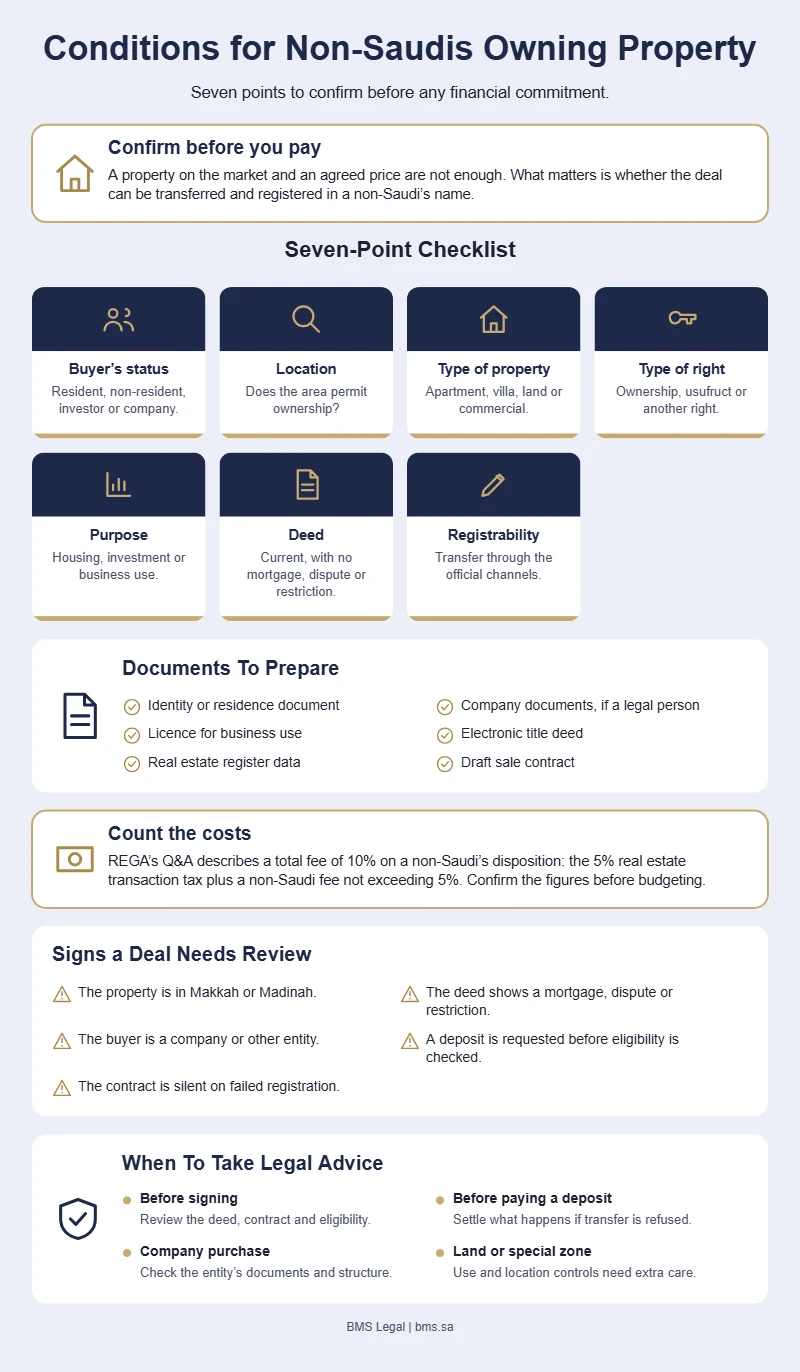
Conditions for Non-Saudis Owning Property in Saudi Arabia: A Seven-Point Checklist
It is not enough that a property is on the market or that the parties agree a price. What matters in practice is whether the deal can be transferred and registered, and whether the documents fit the legal controls.
The seven points are:
- The buyer’s status: a resident, a non-resident, an investor, a company or another legal entity with clear documents.
- The property’s location: whether it sits in an area that permits ownership or needs extra verification before transfer.
- The type of property: an apartment, villa, land, commercial property or premises tied to an activity.
- The type of right: full ownership, usufruct or another in rem right.
- The purpose of the purchase: housing, investment, company premises or commercial use.
- The soundness of the deed: current and free of mortgages, disputes and restrictions that matter.
- Registrability: whether transfer or registration in a non-Saudi’s name can be completed through the official channels.
These points do not mean a deal will be accepted or refused in advance, but they show whether the case needs further review before a financial commitment is made.
A Quick Pre-Deposit Table
Before moving from enquiry to payment, bring the legal and financial elements together in one place. The table helps to organise the first check and to see which points need deeper review before a binding contract.
| Item to check | What to confirm |
|---|---|
| The buyer’s status | Residence, identity, licence or the entity’s documents |
| The property | Type, location, use and boundaries |
| The deed | Ownership, restrictions, mortgage, disputes and up-to-date data |
| The contract | Deposit clause, transfer period and how to withdraw |
| Costs | Tax, transfer costs and any agreed charges |
| Registration | Whether ownership can be transferred or the right registered in a non-Saudi’s name |
If any of these cannot be verified, it is better to delay the deposit until the deal’s viability is clear.
Documents a Non-Saudi Buyer Should Prepare
Documents vary with the buyer’s status and the type of property, but some are basic and should be prepared and reviewed before signing. Having them does not by itself make ownership acceptable, but it helps to assess the deal early.
The main documents to review are:
- The identity or residence document of the person seeking ownership, or the relevant official data.
- Company or entity documents if the buyer is a legal person.
- The licence or registration linked to the activity if the purchase is for business use.
- The electronic title deed or current ownership data.
- Real estate register data, to check restrictions or mortgages.
- The draft sale contract, before signing or paying a deposit.
- Finance or mortgage documents if the property is linked to a financier.
- Anything that shows the purpose of the purchase, such as housing or business premises, where needed.
If a document is unclear, delay the deposit until the review is complete. A defect in the deed or the buyer’s status may not show during negotiation, but it will show at transfer.
What to Check in the Deed Before Buying
The deed is the starting point for any non-Saudi purchase, because it shows the owner, the description of the property, its boundaries and the restrictions on it. Do not rely on an unclear copy of the deed or on a broker’s promise. The check should also confirm that the registered owner is the person signing the sale contract, and that the data on the property and the restrictions match reality before the transaction is completed.
Before signing, check that:
- The deed is current and matches the actual property data.
- The property is free of mortgage, attachment, dispute, waqf or any restriction that blocks transfer.
- The owner’s details match the person signing the sale contract.
- The area and boundaries match reality and the approved plans.
- You know whether the property is an independent unit or part of shared ownership.
- There are no obligations or violations that could affect the transfer of ownership.
If the property is mortgaged or financed, decide how the mortgage will be released, or obtain the mortgagee’s approval, before transfer. A mortgage does not always mean the sale will fail, but it can change the way payment is made and obligations are documented. The rules on selling a mortgaged property explain the usual routes.
Contract Terms to Settle Before Paying a Deposit
The deposit is one of the most disputed points in property deals, especially where the buyer is not a Saudi. Do not pay anything before a contract exists that addresses the possibility that registration or transfer cannot be completed.
Before the deposit, the contract should include:
- The buyer’s status, stated precisely.
- A link between the final commitment and the possibility of transfer or registration.
- What happens to the deposit if ownership cannot be transferred for legal reasons.
- A duty on the seller to provide an up-to-date deed free of blocking restrictions.
- Who bears the taxes, fees and transfer costs.
- A clear period for completing transfer.
- The effect of a mortgage, dispute or restriction that appears after signing.
- A clear way of ending the contract if the deal cannot proceed.
A model such as a real estate transfer agreement template in Saudi Arabia shows how undertakings may be organised, but it has to be adapted to a non-Saudi buyer and to the specific property.
A good contract does not stop at the price and the payment date. It addresses foreseeable risks, because the deal depends on the buyer’s status, the location of the property and whether registration can be completed.
Before you pay a deposit
Confirm the buyer’s status, the deed, the location and what happens to the deposit if transfer fails. A signed preliminary contract does not replace registration.
Enquiries are handled confidentially · No specific court outcome can be guaranteed
Can a Resident Buy Property in Saudi Arabia?
A resident may be able to buy a property if the legal controls are met and the property can be registered in the resident’s name. But the seller’s consent is not enough, because transfer is the real test of whether the deal is sound.
Before buying a home or an apartment, a resident should check:
- The resident’s status and whether the controls apply.
- The property’s location and any special restriction on it.
- The type of property: residential, commercial or land.
- That the deed is free of mortgage, dispute or restriction.
- That the property can be transferred or registered in a non-Saudi’s name.
- That the contract deals clearly with failure to register.
Buying land needs more care than buying a ready apartment, because use, location and zone can affect whether ownership is accepted. A deposit should therefore not be paid before the deed, the location and the type of right have been checked.
When Does a Deal Stop or Need a Further Review?
A deal can look sound on price and location but stop at transfer because of a defect in the deed, the status or the documents. Certain signs call for legal review before signing.
A deal needs extra review if:
- The property is in Makkah, Madinah or a zone with special controls.
- The buyer is a company or a foreign investor.
- There is a mortgage, attachment, dispute or restriction on the deed.
- The deed data differs from reality.
- A large deposit is demanded before the check is complete.
- The buyer’s status or the purpose of ownership is unclear.
- It is unclear who pays the fees and taxes.
- The seller insists on a quick signature with no time to check.
- A broker makes promises without clear documents.
In these cases the question is not only whether purchase is permitted, but whether it can be carried out and the right registered without a later dispute.
Fees and Costs to Calculate Before Buying
Count the costs before signing, because the sale price is not always the final cost. Real estate transaction tax may be due on the deal, plus transfer or documentation costs, and sometimes other charges linked to the property. REGA’s published Q&A describes a total fee of 10% on a non-Saudi’s real estate disposition, made up of the 5% real estate transaction tax and an additional non-Saudi fee not exceeding 5%, with the percentages set by the implementing regulation. Confirm the current figures with REGA and the Zakat, Tax and Customs Authority before budgeting.
Before signing, count:
- Real estate transaction tax due on the deal.
- Any additional fee that applies to a non-Saudi acquisition.
- Transfer or documentation fees, where they apply.
- The cost of checking the deed, the contract and the documents.
- Mortgage or finance obligations if the property is financed.
- Any amounts owed on the property or operating obligations.
- Legal advice or review fees where needed.
The contract should say who bears each cost, when it is paid and what a failure to pay does to the transfer. General wording leads to disputes at performance.
Common Mistakes Before a Non-Saudi Buys Property
Mistakes recur when a buyer treats the deal as an ordinary sale even though a non-Saudi party adds a legal check. They often appear only at transfer or when the deposit is claimed back.
Avoid these mistakes:
- Paying a deposit before checking eligibility and registrability.
- Relying on a broker’s word without reviewing the deed and restrictions.
- Signing a contract that does not say what happens to the deposit if transfer fails.
- Overlooking mortgages, disputes or registered restrictions.
- Buying in a company’s name without checking its licence and purpose.
- Not fixing who pays fees, taxes and costs.
- Confusing ownership with usufruct or use.
- Treating a property in a special zone as an ordinary property.
- Signing a power of attorney or contract without checking the representative’s authority.
Avoiding these mistakes does not guarantee that a deal will be accepted, but it lowers the risk and bases the decision on clear documents.
When Do You Need a Lawyer Before Buying?
You need a lawyer if the deal is real and not just a general enquiry. The need grows when large sums are involved, or where there is a mortgage, a registered restriction, a foreign company, or a property in a zone with special controls.
A legal review does not guarantee that an application will be accepted or how a deal will end. Its purpose is to check the deed, the buyer’s status, the contract terms, the fate of the deposit and the options before commitment. Where the buyer’s status overlaps with deed restrictions or the property’s location, a review by a real estate lawyer in Jeddah helps to organise the checks before final commitment.
Trust and Legal Basis
Trust and Legal Basis
Legal basis
This guide is based on the official REGA Q&A on the updated Law of Real Estate Ownership by Non-Saudis and the ZATCA real estate transaction tax regulation listed below, and is written for general legal awareness rather than as advice on a specific case. Rules, zones and fees are updated by regulation, so confirm the current position with REGA before acting.
Published by: BMS Legal Law and Legal Consultancy Company.
Address: Jeddah, Al-Mishrifah District, Palestine Street, Al-Safeer Tower
Frequently Asked Questions About the Conditions for Non-Saudi Ownership
What are the main conditions for a non-Saudi to own property?
They start with checking the buyer's status, the location, the type of right sought, the purpose of the purchase and the soundness of the deed, then confirming that transfer and registration are possible.
What documents does a non-Saudi buyer need?
Typically identity or residence data, entity documents where relevant, the title deed, real estate register data and the draft sale contract. The exact list depends on the case.
Should the deed be checked before paying a deposit?
Yes. The deed can reveal a mortgage, restriction or dispute that blocks transfer or delays registration.
Can a resident buy property in Saudi Arabia?
A resident may be able to buy if the legal controls are met and the property can be registered in the resident's name. This must be checked before signing.
What should a purchase contract include?
It should say what happens to the deposit, the period for transfer, who pays fees and taxes, the effect of restrictions and how to withdraw if registration is refused.
Does owning property give a non-Saudi residency?
Not by itself. Ownership does not automatically grant residency or nationality; each has its own legal conditions.
Conclusion
The conditions for non-Saudis owning property in Saudi Arabia are a practical way to avoid a deal that looks sound during negotiation and then stalls at transfer. The value of the check is seen before signing, not after a dispute over the deposit or the fees.
Start with the buyer’s status, then review the deed, the location and the contract, and only then decide whether to move to payment and transfer or to restructure the deal. That way the purchase rests on clear documents, not on verbal promises or incomplete assumptions.
Before paying a deposit, you can contact our legal team and send the deed and the draft contract so the points to check before signing can be identified.
To have your deed and draft contract reviewed before you pay a deposit, contact BMS Legal in Jeddah for a preliminary review.
Mortgage, a company buyer or a special zone?
Send us the deed and the draft contract and a BMS Legal lawyer in Jeddah will tell you what to check before any deposit or binding signature.
Enquiries are handled confidentially · No specific court outcome can be guaranteed
Official Legal and Government Sources
- General Authority for Real Estate: Q&A about the updated Law of Real Estate Ownership by Non-Saudis (English-language official document)
- Zakat, Tax and Customs Authority: real estate transaction tax regulation (Arabic-language official website)
Disclaimer: This article is for general legal awareness and is not advice on an individual case, and reading it does not create a lawyer–client relationship. The legal assessment varies with the facts, the documents and the rules that apply to each case.