The non-Saudi property ownership law in Saudi Arabia lets individuals and entities from outside the Kingdom own real estate under defined controls. It is not an open permission in every case. The answer depends on who the buyer is, what type of property it is, where it is, and what the purchase is for: housing, investment, premium residency or a foreign company.
The most useful question is not only whether a foreigner may buy property in Saudi Arabia. It is whether this specific property can be registered in the buyer’s name without delay or dispute. That means checking the title deed, the buyer’s status, the location, the type of right sought, and whether transfer and registration are possible, all before any commitment.
An early check matters because a missed point can turn into a dispute over the deposit, the price or the performance of the contract. This guide explains the legal framework in practical terms, with the cases, controls and risks to consider before buying.
Is the property ready to be owned by a non-Saudi?
Check the deed, the location, the buyer’s status and the deposit clause. A BMS Legal lawyer in Jeddah can give your documents an initial review.
Enquiries are handled confidentially · No specific court outcome can be guaranteed
Non-Saudi Ownership Law: What to Confirm First
The law allows a non-Saudi to own real estate, or to acquire certain in rem rights over it, inside Saudi Arabia under defined controls. It is not a permission that applies everywhere or to everyone. Before signing, check the buyer’s status, the type of property, its location, the soundness of the title deed and whether statutory registration is possible. Take particular care if the property is in Makkah or Madinah, if a foreign company is buying, or if the purchase is linked to premium residency.
The law is reported to have been issued by Royal Decree No. M/14 dated 19/01/1447 AH, replacing the earlier law on ownership and investment by non-Saudis, and to have entered into force in 2026, with an executive regulation and geographic zones approved afterwards. The regulatory detail has moved quickly, so confirm the current text, the zone maps and any fees on the website of the General Authority for Real Estate (REGA) before relying on this guide.
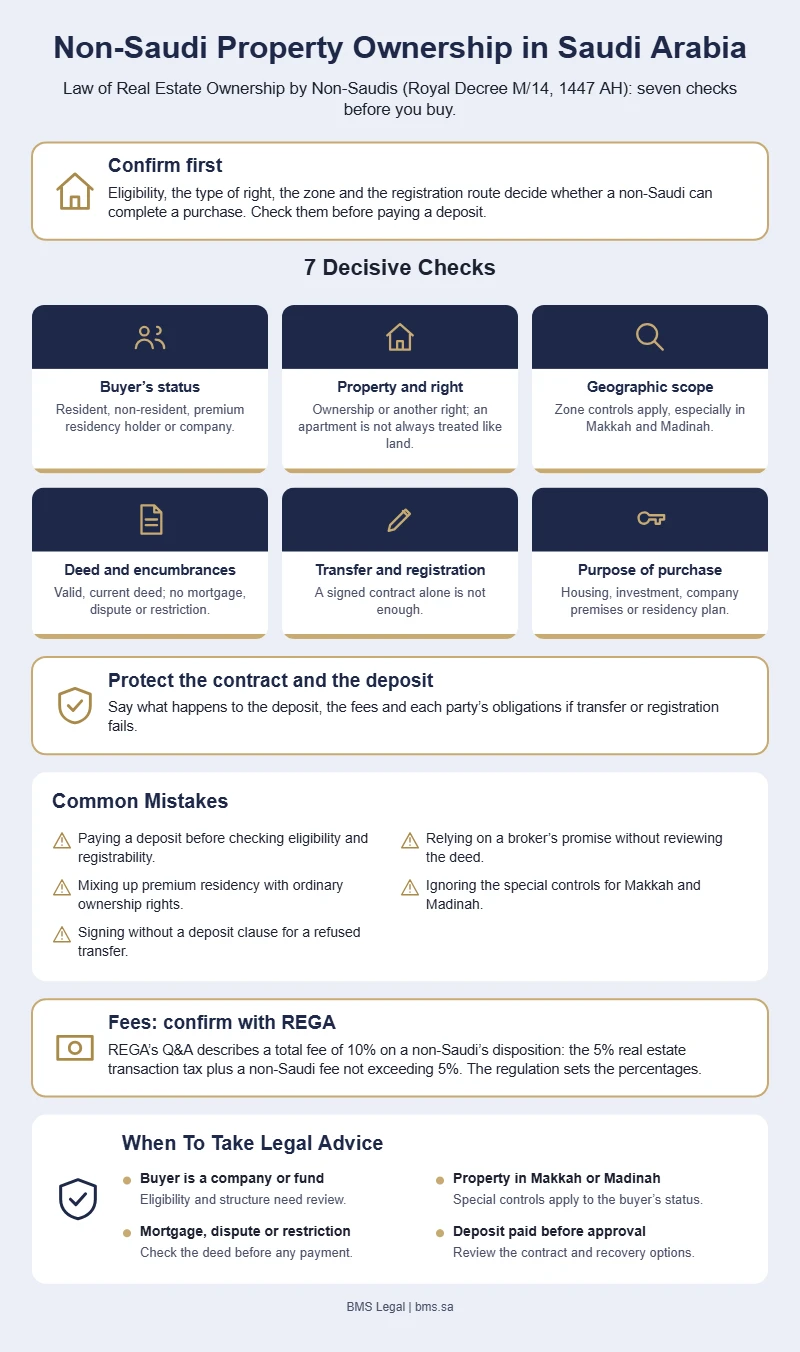
Seven Decisive Checks Before Buying in a Non-Saudi’s Name
It is not enough that a property is on the market or that the parties agree a price. These practical checks decide whether a deal can be transferred and registered, or needs legal treatment before the deposit is paid.
- The buyer’s identity and legal status. The analysis differs for a resident, a non-resident, a premium residency holder, a foreign company or a business entity operating in the Kingdom.
- The nature of the property and the right sought. An apartment or villa is not always treated like land, a commercial property or an investment asset.
- The geographic scope. Location is central, especially in Makkah or Madinah, or inside a zone with special ownership controls.
- The deed and any encumbrances. Confirm that the deed is valid and current, and that the property is not mortgaged, disputed or restricted in a way that blocks transfer.
- Whether transfer and registration are possible. A signed contract is not enough, because the legal effect depends on completing transfer and registration under the approved procedures.
- The real purpose of the purchase. The position changes if the purchase is for private housing, investment, a company’s premises or a residency-linked plan.
- Protection of the contract and the deposit. The contract should address the risk that transfer or registration fails, and say clearly what happens to the deposit, the fees and the parties’ obligations.
These checks do not mean a deal will be accepted or refused in advance, but they give the buyer a clear picture before committing. If one of them reveals a problem, it is better to deal with it before signing than to argue after the deposit has been paid.
What Is the Non-Saudi Property Ownership Law in Saudi Arabia?
It is the framework that governs a non-Saudi’s right to own real estate, or to acquire certain in rem rights over it, inside the Kingdom. In rem rights are rights tied directly to the property, such as ownership, usufruct or other rights the law identifies.
The framework is not limited to individuals. It also reaches non-Saudi entities, companies and other bodies that may want property for housing, investment or operations. The cases cannot all be treated alike: a resident’s position differs from a company’s, and a property in Makkah or Madinah differs from one in another city.
The practical aim is to regulate ownership, reduce uncertainty and tie transactions to clear controls. Rather than relying on verbal promises or loose opinions, the buyer must check the case against specific points: who is buying, what the property is, where it is and why the purchase is being made.
The earlier regime was known as the law of real estate ownership and investment by non-Saudis. The updated law is drafted more broadly, so the text, the executive regulation and the related decisions must be read together before any case is treated as accepted.
| Point of comparison | Earlier regime | Updated law |
|---|---|---|
| Scope | Closer to licensing and exceptions | A broader framework with controls and geographic zones |
| Who is covered | Greater focus on residents and investment | Individuals and non-Saudi bodies, according to the controls |
| Practical application | Several separate requirements | Tied to the executive regulation and official zones |
| Legal check | Licence and procedure | Status, property, location and registration |
Can a Resident Own Property in Saudi Arabia?
A resident may be able to own property in Saudi Arabia under the legal controls, but that does not mean every resident can buy any property. The answer is affected by the location of the property, its type, the purpose of the purchase and whether it can be registered in the resident’s name.
Many people ask whether a resident can buy a house in Saudi Arabia. The short answer is that it may be possible, but only after the case is checked, not just by signing a contract or paying a deposit. A resident’s purchase is usually linked to housing or personal settlement rather than speculation or unregulated purchases of several assets.
For an apartment, check the unit details and the shared parts. For a villa, check the land, the building, the boundaries and the restrictions attached to them. Land needs more care, because it may carry rules on use, building and zone, and the result can differ depending on whether it is for housing, investment or a commercial activity.
A resident should therefore not sign a final contract before confirming that the property can be owned. A large deposit should not be paid without a clear clause setting out what happens to the money if transfer or registration fails for legal reasons.
Foreigners Buying Property in Saudi Arabia: Before You Sign
A foreign buyer needs a legal check before signing, not after a problem appears. A property may suit the buyer on price and location but still fail on the deed, on restrictions, or on whether it can be registered.
The deed is the starting point of any transaction, because it shows the owner, the boundaries and the restrictions on dealing. Make sure it is current, that the details match the real property, and that there is no mortgage, attachment or dispute that would block transfer or delay registration.
The location also matters. A property may sit inside a zone with special controls, in a city treated differently, or in an area that needs extra verification before ownership is accepted.
The sale contract is as important as the deed. Understanding the conditions for selling a property in Saudi Arabia helps set the obligations and the points to check before signing or paying a deposit. A model such as a real estate sale agreement template in Saudi Arabia can help structure the terms, but it must be adapted to a non-Saudi buyer.
Before the deposit is paid, the contract should deal with:
- What happens to the deposit if transfer or registration fails.
- The seller’s duty to update the deed or release a mortgage.
- The period for completing the transfer of ownership.
- Who bears the fees and costs.
- The effect of a restriction or dispute that appears after signing.
- How to withdraw from the contract without a long dispute.
Check before you pay a deposit
Confirm who the buyer is, where the property is, and whether the deed is clean and registration is possible. Tie the deposit to transfer so the money is protected if registration is refused.
Enquiries are handled confidentially · No specific court outcome can be guaranteed
Registering Property in a Non-Saudi’s Name and Transferring Ownership
Signing a sale contract is not enough for a non-Saudi’s ownership to be complete. Understanding the steps to transfer a property in Saudi Arabia helps when moving from the preliminary agreement to the formal transfer of ownership. A real estate transfer agreement template in Saudi Arabia shows how the parties’ undertakings may be organised, but it does not replace the official procedure.
This point matters because disputes often arise when a buyer assumes that the preliminary contract is the same as registration. The contract creates obligations between the parties, but it does not replace the official route for transferring the right.
The practical path starts with checking that the case can be owned before any final financial commitment. That covers the buyer’s status, the property’s compliance with the controls, the documents needed, and a contract that ties the final obligations to the possibility of transfer and registration.
Transfer may be held up for a reason connected with the buyer, such as not meeting the controls, or for a reason connected with the property, such as a mortgage, a restriction or a problem with the deed. The contract should therefore not be general or silent on these possibilities.
Registration in the real estate register gives a transaction stronger standing against others. It matters particularly for non-Saudis, because the purchase is not just a private sale between two parties but a dealing subject to controls linked to the buyer, the property and the location. Check the register’s details before buying, not after signing.
Foreign Ownership in Makkah and Madinah
Ownership by foreigners in Makkah and Madinah is among the most sensitive questions, because these two cities are not always treated like other places, given their religious and regulatory character. The special controls do not necessarily bar every case, but they prevent the deal being handled as an ordinary sale.
As our Arabic guide explains, ownership or other in rem rights in Makkah and Madinah is limited to a Muslim non-Saudi natural person, within the provisions and controls of the law. REGA’s published Q&A also refers to Saudi companies with non-Saudi shareholders in this context. Because the detail is technical, check it against the current text and the geographic zones before any step.
When considering property in either city, start with the buyer’s status. Is the buyer an individual or a company, and does the status the law permits apply? Then check the property itself, its boundaries, its deed and whether it can be registered.
It is not enough that the property is on offer or that the seller agrees. A commercial agreement between the parties does not replace the legal controls specific to these cities, and it does not by itself remove the risk that the transfer cannot be completed. Any contract for property in Makkah or Madinah should say clearly what happens if registration is refused.
Foreign Companies Owning Property in Saudi Arabia
A foreign company’s ownership differs from an individual’s, because a company does not usually buy for personal housing. The purchase may be linked to headquarters, a business activity, warehouses or an operational need inside the Kingdom.
For that reason the rules for a resident individual cannot simply be applied to a foreign company. Check the company’s constitutional documents, its licence, its activity, the real need for the property and the location sought, as well as the authority of the person who signs the purchase contract.
The question is not only whether the company is non-Saudi. It is also whether its ownership relates to a lawful activity and whether its legal status allows it.
| Item | Non-Saudi individual | Non-Saudi company |
|---|---|---|
| Usual purpose | Housing or settlement | Business premises, operations or investment |
| Documents | ID or residence, deed, sale contract | Registration, licence, constitutional documents, deed |
| Main risks | Eligibility to own and the location | Activity, licence and scope of ownership |
| Legal check | The person and the property | The entity, its activity and the property |
If the purchase is in a company’s name, review the constitutional documents, the commercial registration, the licences and any power of attorney used for signing. The purchase contract should also fit the company’s purpose, because buying property unrelated to its activity may raise regulatory questions at registration or review.
Property Ownership and Premium Residency
Many people link owning property in Saudi Arabia with premium residency. Property ownership as a real estate question should be kept separate from residency as an independent legal question, with its own conditions and controls.
It is not correct to say that buying any property automatically grants residency. Nor is it correct to say that every premium residency holder may buy without controls. Each case needs both regimes to be read together, followed by a check of the property for location, deed and registrability.
Buying property may be one element in certain residency routes, but it does not replace the conditions of the residency itself. The buyer should therefore decide the real aim: housing, investment, or supporting a residency file under a separate regime.
Before buying for residency purposes, check two separate things. First, can the property be owned in a non-Saudi’s name? Second, does the purchase meet the conditions of a specific residency programme, if there is one? Mixing the two questions can lead to an unsuitable financial decision.
Fees and Violations
The fees on non-Saudi ownership depend on the type of dealing and the right concerned, and should be distinguished from real estate transaction tax and any other costs that may apply when the deal is executed.
It is more accurate for the buyer to confirm the fees at the time of the transaction, because the implementing details can be affected by the regulation and related decisions. Our Arabic guide states that the law provides for a fee on the value of a non-Saudi’s dealing in in rem rights over real estate, not exceeding 5% of that value. That does not cancel any other fees or taxes the law provides for, so a total should not be stated with certainty without checking. REGA’s published Q&A describes a total fee of 10% on a non-Saudi’s real estate disposition, made up of the 5% real estate transaction tax and an additional non-Saudi fee not exceeding 5%, with the percentages set by the implementing regulation, so confirm the current position with REGA.
The sale contract should state the financial elements clearly: statutory fees, transfer costs, taxes where they apply, and the effect of a party’s delay in paying. This reduces disputes where the buyer is not a Saudi.
As for violations, they may include giving incorrect information, concealing the real purpose of the ownership, using a sham contract, or evading the legal controls. Penalties may include a fine or, in some cases, the sale of the property right.
Examples of risky information include:
- Giving an incorrect buyer status.
- Hiding a partner or the real financier.
- Concealing the real purpose of the ownership.
- Using a sham contract or a nominee buyer.
- Concealing a restriction or dispute that affects the property.
The safe route is to give information that matches reality and review documents before submitting them, and to record every important agreement in writing, especially in high-value or complex deals.
When Do You Need a Lawyer Before a Non-Saudi Buys Property?
You need a lawyer when the risks are higher than in an ordinary purchase. That is the case when the property has restrictions, the location is sensitive, a foreign company is buying, or the amount is large.
Legal advice does not guarantee that an application will be accepted or that a deal will succeed. Its role is to review the options, explain the risks and organise the documents before commitment. The higher the value of the property, the more important it is to review the contract and the deed before paying, since a small mistake in a deposit clause or payment mechanism can cause a large loss if a legal obstacle appears after signing.
The need grows for property in Makkah or Madinah, where the contract should include a clause that deals with the possibility that registration cannot be completed. Companies and investors also need a different review from individuals: licences, corporate purposes, signing authority and whether the activity needs the property.
If the deal is real and not just an enquiry, advice from a real estate lawyer in Jeddah can help review the deed, the buyer’s status, the location and the contract terms before the final commitment.
Common Mistakes Before a Non-Saudi Buys Property
Certain mistakes repeat in non-Saudi property deals. They often do not show up during negotiation, but when transfer is attempted, the deposit must be recovered, or the right is registered in the buyer’s name.
The most frequent mistakes are:
- Paying a deposit before checking the buyer’s eligibility and the property’s registrability.
- Relying on a broker’s promise without reviewing the deed, location and restrictions.
- Mixing up premium residency with ordinary ownership rights.
- Ignoring the special controls for Makkah and Madinah.
- Signing a contract that does not say what happens to the deposit if transfer is refused.
- Entering inaccurate information in an application or deal documents.
- Failing to say who pays fees and statutory costs.
- Overlooking mortgages or restrictions that may block transfer.
- Signing a power of attorney or contract without checking the representative’s authority.
- Treating the deal as an ordinary sale without checking the buyer’s status.
One influential mistake is to treat a mortgage as a minor administrative detail, when it can change the way payment, transfer and documentation work. Understanding the rules on selling a mortgaged property is advisable before paying a deposit or signing a contract that does not deal clearly with release of the mortgage.
A good contract does not stop at the price and the date. It should address the possibility that transfer fails, particularly where the buyer is not a Saudi, and set out a way of leaving the contract without a long dispute.
Trust and Legal Basis
Trust and Legal Basis
Legal basis
This guide is based on the official REGA Q&A on the updated Law of Real Estate Ownership by Non-Saudis and the legal text listed below, and is written for general legal awareness rather than as advice on a specific case. The rules, zones and fees are updated by regulation, so confirm the current position with REGA before acting.
Published by: BMS Legal Law and Legal Consultancy Company.
Address: Jeddah, Al-Mishrifah District, Palestine Street, Al-Safeer Tower
Frequently Asked Questions About the Non-Saudi Property Ownership Law
Can a foreigner own property in Saudi Arabia?
Yes, a non-Saudi may own property under legal controls. The ruling differs according to the buyer's status, the location and the type of property.
What are the conditions for a non-Saudi to own property?
They start with the buyer's status, the type of property, its location, the soundness of the deed and whether transfer and registration are possible.
Is ownership in Makkah and Madinah different?
Yes. These two cities have special controls and are not treated like other cities, so the buyer's status and the legal text must be checked before any commitment.
Does buying property give residency?
No. Buying property does not grant residency automatically. Property ownership and residency are separate matters, each with its own conditions.
Can a foreign company buy property in Saudi Arabia?
It may, if the ownership relates to a lawful need and its status allows it, after reviewing its licence, its authority to sign and the purpose of the purchase.
What fees apply to non-Saudi ownership?
The law provides for a fee on a non-Saudi's dealing in in rem rights over real estate, capped according to our Arabic guide at 5% of the value, without prejudice to other fees or taxes. Confirm the current rates and any exemptions with REGA.
Conclusion
The non-Saudi property ownership law is best treated as a practical way of checking a deal before a contract is signed or a deposit is paid. The result depends not only on the wishes of buyer and seller but on the buyer’s status, the type and location of the property, the purpose of the purchase and whether transfer and registration are possible.
A resident, a foreign company and a premium residency holder are analysed differently, and property in Makkah or Madinah needs closer checking. Where the property is mortgaged, disputed or of high value, the contract should deal with the risk of delayed transfer before any financial commitment is made.
The safest order is to check the deed, confirm the location, review the buyer’s status, fix the deposit clause, and confirm that registration is possible. That way the decision rests on legal clarity rather than verbal promises or assumptions.
Before paying a deposit or signing a binding contract, you can contact us and send the property details for review, to see whether the deed, the contract or the buyer’s status needs checking first.
To have your property documents and contract reviewed before you commit, contact BMS Legal in Jeddah for a preliminary review.
Buying in Makkah, Madinah or through a company?
Send us the property details and a BMS Legal lawyer in Jeddah will tell you what to check before any deposit or binding contract.
Enquiries are handled confidentially · No specific court outcome can be guaranteed
Official Legal and Government Sources
- General Authority for Real Estate: Q&A about the updated Law of Real Estate Ownership by Non-Saudis (English-language official document)
- Bureau of Experts: law text cited by our Arabic guide (Arabic-language official website)
Disclaimer: This article is for general legal awareness and is not advice on an individual case, and reading it does not create a lawyer–client relationship. The legal assessment varies with the facts, the documents and the rules that apply to each case.