
Understanding the penalty for hashish use in Saudi Arabia begins with identifying the legal classification of the conduct and the circumstances surrounding it. The presence of hashish in a case does not, by itself, determine the applicable sentence.
The Law of Combating Narcotic Drugs and Psychotropic Substances establishes a principal penalty where the purpose of the conduct is personal use or consumption. It also provides separate legal pathways relating to first-time use, treatment, mitigation, and other circumstances affecting the case.
Two cases may involve the same substance but lead to different outcomes because of the defendant’s age, previous record, surrounding facts, or eligibility for treatment. A first offense does not automatically remove criminal liability, while requesting treatment after proceedings begin does not necessarily produce the same effect as a qualifying voluntary treatment request.
When a case is already pending, the first step is to identify its current stage. The matter may still be under investigation, may have been referred to the criminal court, or may already have resulted in a judgment. Knowing the procedural stage helps identify the relevant rule and the next issue requiring legal review.
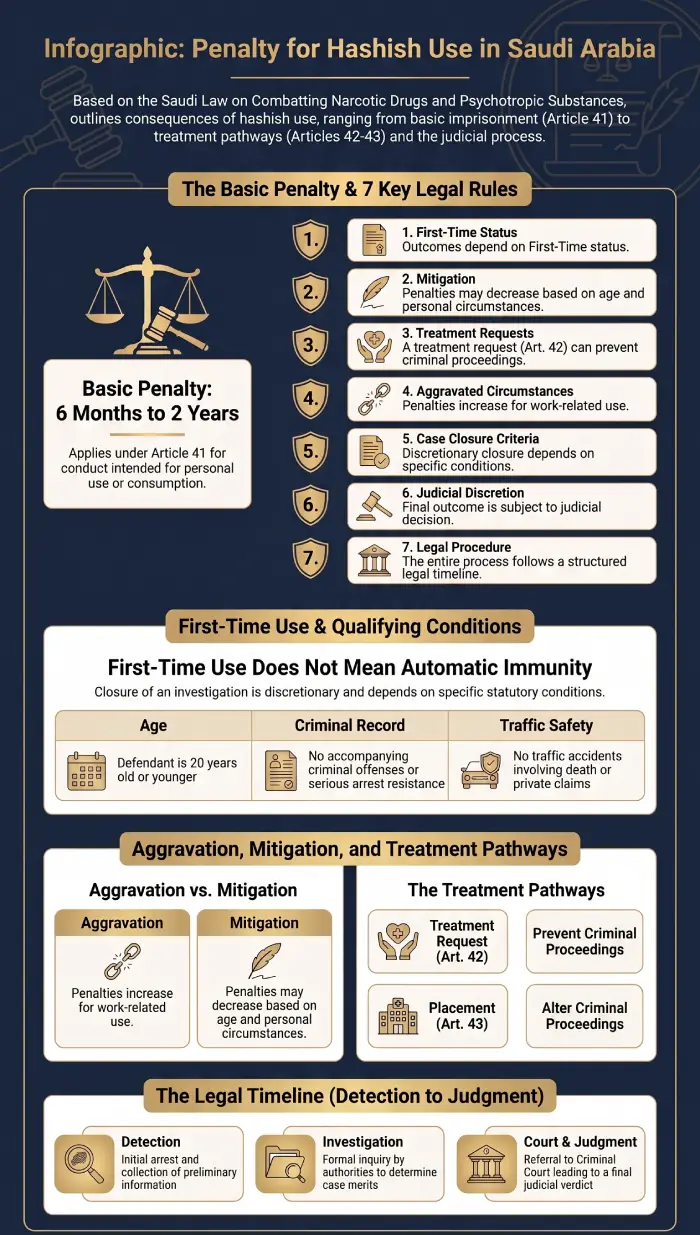
Penalty for Hashish Use: 7 Rules That May Shape the Case
Where Article 41 applies and the conduct is proven to have been intended for consumption or personal use, the imprisonment range is between six months and two years. However, the sentence for hashish use does not depend on that range alone.
Saudi law also regulates first-time cases, aggravated circumstances, mitigation, voluntary treatment, medical placement, and the general judicial process.
| Rule | Summary |
|---|---|
| Basic penalty | Imprisonment from 6 months to 2 years where Article 41 applies |
| First-time use | The investigation may be closed if the conditions under Article 42 are satisfied |
| Aggravation | Applies in the two employment-related circumstances identified in Article 41 |
| Mitigation | The court may impose a sentence below the minimum for legally recognised reasons |
| Treatment request | May prevent criminal proceedings when the Article 42 requirements are fulfilled |
| Treatment placement | A person suffering from addiction may be admitted to a treatment facility under Article 43 |
| Judicial process | The case proceeds through procedural stages that may end with a court judgment |
These rules provide the general framework for the penalty for hashish use, but they do not determine the outcome of an individual case without reviewing its facts. Where there is detention, a summons, or an approaching hearing, identifying the current stage of the file becomes the first practical priority.
If there is an active investigation, detention order, or upcoming court hearing, an initial confidential assessment may begin with a drug crimes lawyer in Jeddah by explaining the stage of the case, the main facts, and the nearest procedural deadline.
What Is the Penalty for Hashish Use in Saudi Arabia?
The penalty for hashish use in Saudi Arabia is imprisonment for a period of no less than six months and no more than two years where Article 41 applies. This rule covers conduct intended for consumption or personal use outside legally permitted circumstances.
There is therefore no single prison term automatically imposed in every case. The stated range answers common searches such as: What is the penalty for hashish use? How long may a person be imprisoned for using hashish? What is the sentence for personal cannabis use in Saudi Arabia?
The final judgment may still be affected by the legal classification established in the case and the possible application of aggravation, mitigation, treatment, or closure of the investigation. The outcome cannot be determined solely from the name of the substance or from a brief description of the incident.
The criminal court considers the established facts, evidence, legal classification, and circumstances before imposing a sentence within the limits permitted by law. This is why the penalty for hashish use differs from penalties arising from possession, promotion, or trafficking, where the purpose of the conduct may lead to a different offense and legal provision.
Where the defendant is not a Saudi national, additional consequences may arise from the judgment. The separate guide on the penalty for hashish use by foreigners in Saudi Arabia explains the rules concerning punishment and deportation in those cases.
Penalty for First-Time Hashish Use in Saudi Arabia
A first-time hashish use offense does not automatically exempt the defendant from punishment. Article 41 remains the principal rule where personal use or consumption is established.
Article 42, however, provides a separate possibility under which the investigation into first-time use may be closed when all statutory conditions are satisfied. This does not create a separate reduced sentence for every first-time defendant.
For this route to apply, the defendant must not be older than twenty. The incident must not be connected with another criminal offense requiring judicial consideration. It must also not be associated with a traffic accident resulting in death or private claims.
The defendant must not have displayed serious resistance during arrest that caused harm to the arresting authority or another person. The absence of a previous record alone is therefore insufficient.
Closing the investigation remains discretionary where the required conditions are met. It is not an automatic entitlement arising simply because the incident occurred for the first time.
Questions concerning the sentence for a first drug offense in Saudi Arabia may also involve the final outcome of the case and its subsequent legal effects. Those issues are not determined merely by describing the incident as a first episode of hashish use.
When May the Penalty Be Increased or Reduced?
Article 41 identifies two circumstances in which the penalty for a hashish user may be aggravated. The first applies where the person is responsible for combating narcotic drugs, monitoring their possession or circulation, or has an occupational connection with narcotic drugs or psychotropic substances.
The second applies where the person consumes or uses the substance, or remains under its influence, while performing work duties. Not every profession or employment status automatically results in an aggravated penalty.
The specific employment relationship and circumstances described in the legal provision must be examined. It would therefore be inaccurate to assume that every employee or every person working in a sensitive sector is subject to the same aggravated treatment.
Article 60, in contrast, allows the court to impose a sentence below the statutory minimum for legally recognised reasons. Relevant considerations may include the defendant’s personal circumstances, age, background, conduct, and the circumstances in which the offense occurred.
Those considerations may support a conclusion that the person is unlikely to commit another violation. Their existence does not, however, guarantee mitigation, because the decision remains subject to the court’s assessment of the case.
Reducing the prison term must also be distinguished from suspending the execution of a discretionary prison sentence. Suspension is governed by separate provisions and conditions under the Saudi Criminal Procedure Law.
Can a Treatment Request Prevent Criminal Proceedings?
Saudi law gives a qualifying treatment request a different legal effect from a request made only after criminal proceedings have already begun. Criminal proceedings for use, consumption, or addiction may not be initiated where the request is submitted through the legally recognised route and the statutory conditions are fulfilled.
The request may be made by the person concerned or by one of the persons identified under the applicable provision. If narcotic drugs or psychotropic substances are in the person’s possession, the legal route may depend on surrendering them or identifying their location.
A distinction must therefore be made between two separate mechanisms:
- Not initiating criminal proceedings because of a qualifying treatment request.
- Closing an investigation into first-time use where the specific first-offense conditions are satisfied.
The first mechanism is connected with voluntary treatment and its requirements. The second depends on the defendant’s age, the surrounding circumstances, and the separate conditions established for first-time use.
The law may also permit a person suffering from addiction to be admitted to a designated treatment facility instead of receiving punishment for use. This treatment pathway applies where the relevant requirements are satisfied.
A person legally classified as suffering from addiction may therefore follow a different treatment route from someone whose case involves a single proven incident of use.
What Happens After a Hashish Use Case Is Detected?
A hashish use case generally begins with arrest-related procedures and the collection of preliminary information. It then proceeds to investigation, where the facts, evidence, and possible legal classification are examined.
Where sufficient grounds exist to bring criminal proceedings, the matter is referred to the competent criminal court for determination based on the evidence submitted. Arrest or detention does not, by itself, amount to a conviction.
The length of detention also does not determine the eventual judgment. The applicable time limits and procedural controls are addressed separately in the guide on the duration of a criminal investigation by the Public Prosecution in Saudi Arabia.
After a judgment is issued, the next step depends on the type and procedural status of that judgment and whether it may be challenged under the applicable rules. Drafting grounds of appeal requires reviewing the actual judgment, case documents, and facts.
Generic templates taken from unrelated cases are not sufficient for assessing the appropriate response. Where the case is active, the relevant starting information includes:
- The current stage of the case.
- A concise summary of what occurred.
- The nearest investigation, hearing, or procedural date.
- Any document specifically requested for review.
This information helps identify the immediate priorities before further legal steps are taken.
Frequently Asked Questions About the Penalty for Hashish Use in Saudi Arabia
1. What is the penalty for hashish use in Saudi Arabia?
Usually 6 months to 2 years’ imprisonment where Article 41 applies.
2. What is the penalty for first-time hashish use?
A first offense may qualify for investigation closure under Article 42 conditions.
3. Can a first-time user avoid imprisonment?
Possibly, if a specific statutory alternative applies.
4. Can the penalty be reduced?
Yes. The court may reduce it where legal grounds for mitigation exist.
5. When is the penalty aggravated?
In specific employment-related circumstances defined by Article 41.
6. Can requesting treatment prevent prosecution?
Yes, if the requirements under Article 42 are satisfied.
7. Can treatment replace punishment?
In qualifying addiction cases, treatment placement may apply under Article 43.
8. Does every hashish use case receive the same sentence?
No. The outcome depends on the facts and applicable legal provisions.
From imprisonment to treatment, the title “Penalty for Hashish Use in Saudi Arabia: 7 Key Rules” reflects the principal legal routes that may affect a case. Article 41 establishes the basic imprisonment range, while other provisions address first-time use, aggravation, mitigation, treatment requests, placement in a treatment facility, and the judicial process.
The likely outcome cannot be determined from the phrase “hashish use” alone or from another case that appears similar. A proper assessment begins with the legal classification of the conduct, the procedural stage, and the circumstances relevant to the individual file.
BMS Legal, as a law firm in Jeddah, provides confidential initial assessments for active cases under its clarity-before-action approach. The first review may begin by identifying the stage of the case, summarising the incident, and specifying the nearest procedural deadline.
Official Sources: