
The Penalty for Cannabis Use by Foreigners in Saudi Arabia is not limited to the prison term imposed by the court following a conviction. Because the convicted person is not a Saudi national, the judgment also carries an additional consequence: deportation from the Kingdom after the sentence has been served.
A first offense does not automatically close the case or prevent deportation. However, the defendant’s age, criminal record, personal circumstances, and the statutory conditions governing treatment or closure of the investigation may affect the assessment of the sentence and the course of the case.
The legal outcome of cannabis use by a foreign national depends on the established conduct, the defendant’s age and prior record, and whether the requirements for treatment or closing the investigation are satisfied.
It is also necessary to distinguish cannabis use from possession for personal use, distribution, trafficking, and other drug offenses. Each legal classification depends on different conduct and intent, so the rules applicable to one offense should not automatically be applied to another.
Penalty for Cannabis Use by Foreigners in 7 Key Facts
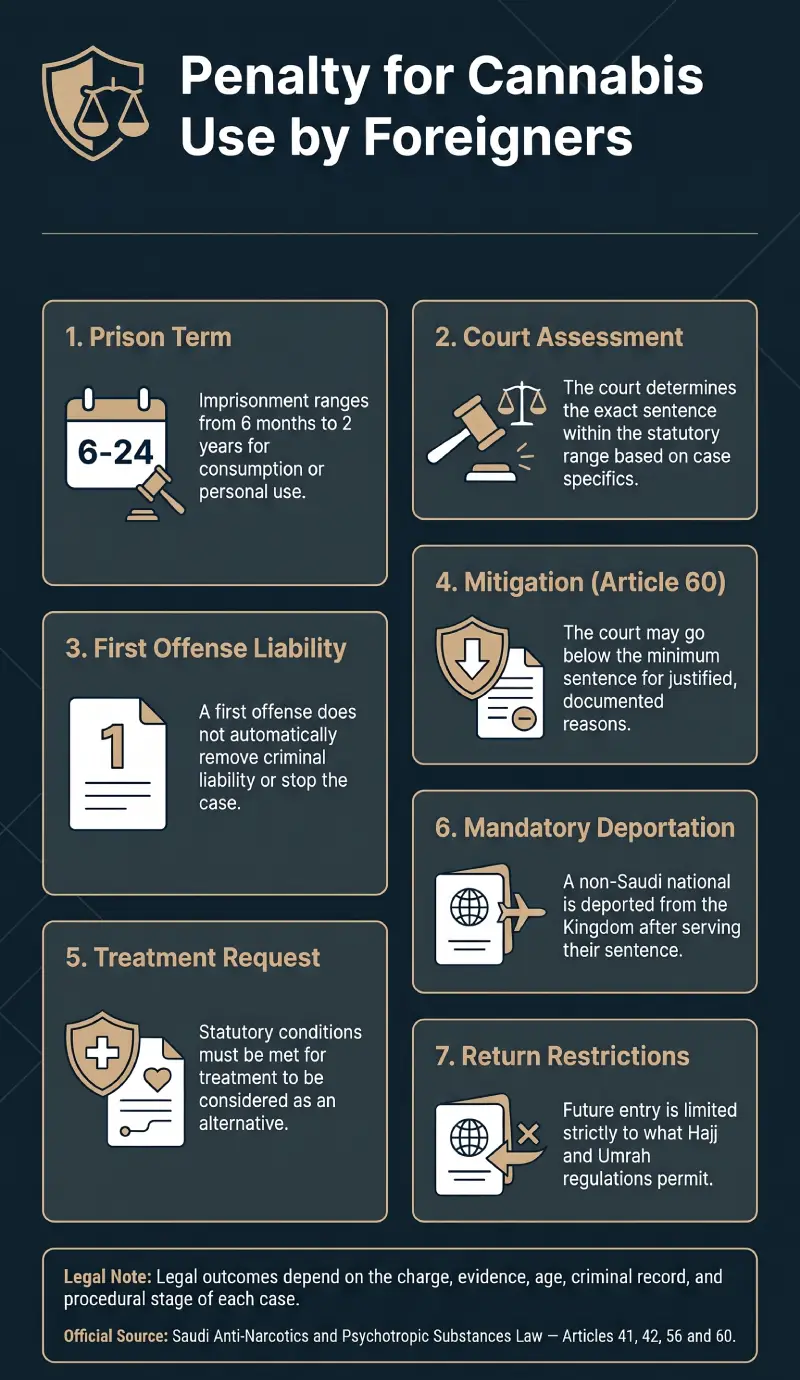
The Penalty for Cannabis Use by Foreigners can be understood through seven key legal facts that distinguish personal use from other narcotics offenses.
When the acts specified by law are committed for personal consumption or use, the original penalty is imprisonment for a period ranging from six months to two years. The court selects the appropriate term within this range after reviewing the circumstances of the case and the defendant. There is no fixed sentence applied to every case.
A first offense does not remove criminal liability, although a clean record may be presented with the defendant’s age, background, and personal circumstances when requesting mitigation.
The court may also impose a sentence below the statutory minimum where justified reasons exist under Article 60.
A voluntary treatment request is legally different from closing the investigation in a first-use case. Each route is subject to separate conditions.
For a non-Saudi national, deportation generally takes place after completion of the sentence. The fact that the case is a first offense does not, by itself, cancel this consequence.
| Key fact | Concise answer |
|---|---|
| 1. Prison term | From six months to two years |
| 2. Sentence assessment | The court selects the term within the statutory range |
| 3. First offense | It does not automatically remove criminal liability |
| 4. Mitigation | The court may go below the minimum for justified reasons |
| 5. Treatment request | It is subject to conditions different from closing an investigation |
| 6. Deportation | It follows completion of the imposed sentence |
| 7. Return to Saudi Arabia | Limited to what Hajj and Umrah regulations permit |
What Is the Original Penalty for Cannabis Use by a Foreigner?
The prison sentence prescribed for personal cannabis use applies to both Saudi and non-Saudi defendants when the conduct is legally established. A foreign national is additionally affected by the deportation provision.
Article 41 provides for imprisonment for no less than six months and no more than two years where the specified acts are committed for personal consumption or use.
The same prison term is not imposed in every case. The court considers the circumstances of the incident, the defendant’s age and prior record, and any personal factors that may justify mitigation.
Penalties applicable to distribution or trafficking should not be used when explaining the Penalty for Cannabis Use by Foreigners, because each offense depends on different conduct, evidence, and criminal intent.
Article 41 does not prescribe a separate fine as part of the original punishment for this classification. A fine should therefore not be presented as an automatic additional penalty unless the case includes another offense carrying its own punishment.
Different categories of drug offenses should not be combined in a single legal answer. The sentence imposed on a foreign resident depends on the charge established in the case and the statutory provision applied by the court.
When Is the Penalty for Cannabis Use Aggravated?
The law provides for aggravation in two specific situations connected to the defendant’s work. The penalty is not aggravated merely because the arrest occurred in a public place or because the person has a previous conviction.
The first situation applies where the defendant is responsible for combating narcotic substances, supervising them, or performing work connected with their possession or circulation.
The second applies where the person consumes the narcotic substance, or is under its influence, while performing their work.
Resistance during arrest or the commission of another act may create a separate criminal classification requiring independent assessment. It should not automatically be added to the aggravating circumstances specified under Article 41.
This distinction helps explain the penalty applicable to a foreign resident without adding circumstances not included in the statutory provision.
Neither the location of the arrest nor the general nature of the defendant’s employment is sufficient unless the legally defined condition is established by the evidence presented in the case.
How Does a First Cannabis Offense Affect a Foreign Resident?
A first cannabis offense does not necessarily end with a written undertaking, nor does it automatically exempt the foreign national from imprisonment or deportation.
The absence of previous convictions may be presented alongside the defendant’s age, personal history, and individual circumstances when requesting a reduced sentence.
Under Article 60, the court may impose a sentence below the statutory minimum where justified reasons exist. The court must explain the reasons supporting that decision.
Mitigation is therefore not a guaranteed right for every defendant with no previous convictions.
The outcome of a first cannabis-use case may differ according to the defendant’s age, the circumstances of the incident, and their criminal record.
A distinction must also be maintained between mitigating the sentence after conviction and preventing criminal proceedings or closing the investigation.
Mitigation is not an acquittal and does not, by itself, remove the deportation consequence applicable to a non-Saudi national.
Age and a clean criminal record may affect the treatment of a first drug offense in Saudi Arabia, provided that the statutory conditions connected with the first incident are satisfied. This does not mean that deportation is cancelled after completion of the sentence.
When Are Criminal Proceedings Not Initiated or the Investigation Closed?
Criminal proceedings for consumption, personal use, or addiction may not be initiated where the person voluntarily requests treatment, either personally or through one of the individuals identified by law, and all statutory requirements are satisfied.
These requirements include surrendering any narcotic substance in the person’s possession, where applicable, or disclosing its location.
Merely expressing a desire to receive treatment does not automatically cancel an existing criminal case. Article 42 requires compliance with the prescribed method and conditions.
The treatment route must also be distinguished from closing an investigation in a first-use case.
The stages of a drug case in Saudi Arabia begin with evidence gathering and investigation. Depending on the outcome, the case may proceed to trial, appeal, and enforcement of the judgment.
The investigation may be closed in a first-use incident when specific conditions are satisfied. These include that the defendant must not be over twenty years old and that the incident must not involve circumstances preventing closure.
Describing a matter as the defendant’s first cannabis case is therefore not enough to predict that the investigation will be closed. The defendant’s age, record, the circumstances of the incident, and any accompanying factors must be examined.
Closing the investigation is also discretionary when its conditions are complete. It is not an automatic result for every defendant with no previous convictions.
The outcome of a first offense remains connected to the details of the case rather than the phrase “first offense” alone.
Is a Foreigner Deported After a Cannabis-Use Conviction?
Yes. The law provides for the deportation of a non-Saudi national after completing the sentence imposed for an offense governed by the Anti-Narcotics and Psychotropic Substances Law.
Deportation follows execution of the sentence. It does not occur merely because the person has been arrested or placed under investigation, since an accusation is not equivalent to a conviction.
Reducing the prison term or imposing a sentence below the statutory minimum does not automatically remove deportation.
Deportation is based on a separate statutory provision applying specifically to non-Saudi nationals.
Article 56 does not establish a general exception solely because the matter is the defendant’s first offense.
The question of whether a first cannabis case results in deportation therefore depends on whether the offense is ultimately established through a conviction, not merely on the number of prior offenses.
A clean criminal record may affect the prison term, but it does not create an independent exemption from deportation.
Can a Deported Foreigner Return to Saudi Arabia?
A non-Saudi national deported following a drug-related judgment is generally not permitted to return to Saudi Arabia, except to the extent allowed under the regulations governing Hajj and Umrah.
This limited permission does not provide a right to return for employment or to resume a previous residence permit.
It is also not possible to confirm through a general answer that deportation can be prevented or cancelled.
The legal position depends on the original conviction, the stage reached by the judgment, and any statutory grounds available before the judgment becomes final.
Long-term residence, employment, or the presence of family members in Saudi Arabia does not create a general statutory exception.
Claims that deportation can certainly be cancelled or suspended should therefore be treated cautiously until the judgment and case documents have been reviewed.
The legal assessment begins with the charge, evidence, and judgment itself rather than a separate request disconnected from the underlying conviction.
What Factors Can Affect the Foreigner’s Sentence?
The court does not determine the sentence based solely on the name of the substance or the defendant’s nationality. It first considers the conduct established in the criminal proceedings.
The court may then examine the defendant’s age, prior convictions, personal history, and circumstances that could qualify as justified reasons for mitigation.
Compliance with the conditions governing treatment requests or closing an investigation may also affect the route taken before a judgment is issued.
A first offense alone is not sufficient to determine the outcome.
A defendant over twenty years old does not fall within the same age condition governing closure of the investigation, although a clean record may still be presented as part of a mitigation request.
Personal consumption must remain distinct from possession for personal use or distribution.
Where a narcotic substance is physically found with the defendant, or evidence suggests that it was transferred to another person, the case may require an assessment extending beyond personal consumption alone.
Where cannabis is found in the possession of a foreign national for personal use, the penalty for drug possession for personal use in Saudi Arabia depends on proof of possession and the intended purpose, rather than consumption alone.
What Should a Foreigner Do After Arrest or Sentencing?
The appropriate step depends on the stage reached by the case.
Criminal investigation procedures in Saudi Arabia begin with collecting evidence and taking statements. The investigation may result in closing the file or referring the case to court, depending on the evidence.
During the investigation, the defendant should understand the legal classification of the charge and request an interpreter if they do not understand Arabic.
They should also avoid signing a statement that does not accurately reflect what they said.
Once the case is referred to court, the defendant should retain the statement of claim, hearing dates, and all documents received.
After a judgment is issued, a copy should be obtained and the date of formal receipt recorded. Delay in reviewing the judgment may affect the procedural options still available.
Sensitive information and complete case files should not be sent through an unverified channel during the first contact.
It is generally sufficient to identify the stage of the case, the next hearing date, and the date the judgment was received. Additional documents can then be provided through the channel specified for legal review.
Essential Documents for Legal Review:
- The statement of claim or charge sheet, where available.
- A copy of the judgment, if issued.
- The hearing date or date the judgment was received.
- The laboratory report or documents delivered to the defendant.
- A copy of the residence permit and passport where immigration status must be confirmed.
The Role of a Drug Lawyer in a Foreigner’s Cannabis Case
The lawyer’s role begins with identifying the procedural stage, the exact charge, and the statutory provision applied to the case.
The initial review should determine whether the matter concerns personal consumption alone or includes another legal classification requiring separate treatment.
The lawyer also examines the defendant’s age, criminal record, and personal circumstances, together with the possible application of Article 60 or the requirements governing treatment and closure of the investigation.
Where a judgment has already been issued, its operative terms, reasoning, and date of receipt must be reviewed before explaining its potential effect on deportation and the next procedural step.
A drug lawyer in Jeddah can help the foreign resident and their family organise the relevant documents and understand the appropriate legal step before submitting an application or response.
BMS Legal follows a clarity-first approach by defining the scope of the legal service, the required documents, and the applicable fees after an initial review of the matter, without promising a particular result.
Frequently Asked Questions About the Penalty for Cannabis Use by Foreigners
What is the penalty for cannabis use by a foreigner?
Imprisonment ranges from six months to two years, followed by deportation after the sentence.
Is a foreigner deported after conviction?
Yes. Deportation generally follows completion of the imposed sentence.
Does a first offense prevent deportation?
No. A clean record may support mitigation but does not cancel deportation.
Can the sentence be reduced below six months?
Yes, where the court finds justified reasons under Article 60.
Is there an automatic fine for cannabis use?
No. Article 41 does not prescribe a separate fine for personal use.
Can requesting treatment prevent prosecution?
It may, but only when all statutory treatment conditions are satisfied.
Can a first-use investigation be closed?
It may be closed when the statutory age and case conditions are met.
Can a deported person return to Saudi Arabia?
Generally no, except as permitted under Hajj and Umrah regulations.
7 Facts About the Penalty for Cannabis Use by Foreigners extends beyond the custodial sentence imposed by the court.
The original prison term ranges from six months to two years. Where justified reasons exist, the court may impose a sentence below the statutory minimum, although mitigation is not guaranteed in every case.
A first offense does not remove criminal liability. A treatment request and closure of an investigation are also separate legal routes with different requirements.
For foreign residents, deportation remains the most significant additional consequence because it takes effect after completion of the sentence and is not automatically removed by a clean criminal record.
The correct legal assessment begins by identifying the charge, the defendant’s age and prior record, the evidence, and the procedural stage reached by the case.
Where a judgment has been issued, the date of formal receipt should be recorded and the judgment reviewed promptly to determine the procedural options that remain available.
A law firm in Jeddah reviews the stage of the case, the established charge, and the principal documents before defining the scope of representation and the next legal step, without making advance promises concerning the outcome.
Official Source