
Understanding the types of real estate development in Saudi Arabia becomes particularly important when raw land is converted into a residential project, a commercial center is developed, or a landowner enters into a development partnership. These decisions are also closely connected with the broader types of real estate investment in Saudi Arabia.
Choosing a development model is not merely a planning or construction decision. It is also a legal decision that determines obligations, risks, responsibilities, and the documentation required before a project begins.
A landowner, investor, or buyer may need to examine the title deed, licensing status, permitted land use, and the contractual relationship with the developer or contractor before making a financial commitment.
This guide explains real estate development in Saudi Arabia from a practical legal perspective. It focuses on the differences between development models and the situations in which reviewing a project with a real estate lawyer in Jeddah may become important before signing a contract or making a payment.
What Are the Types of Real Estate Development in Saudi Arabia?
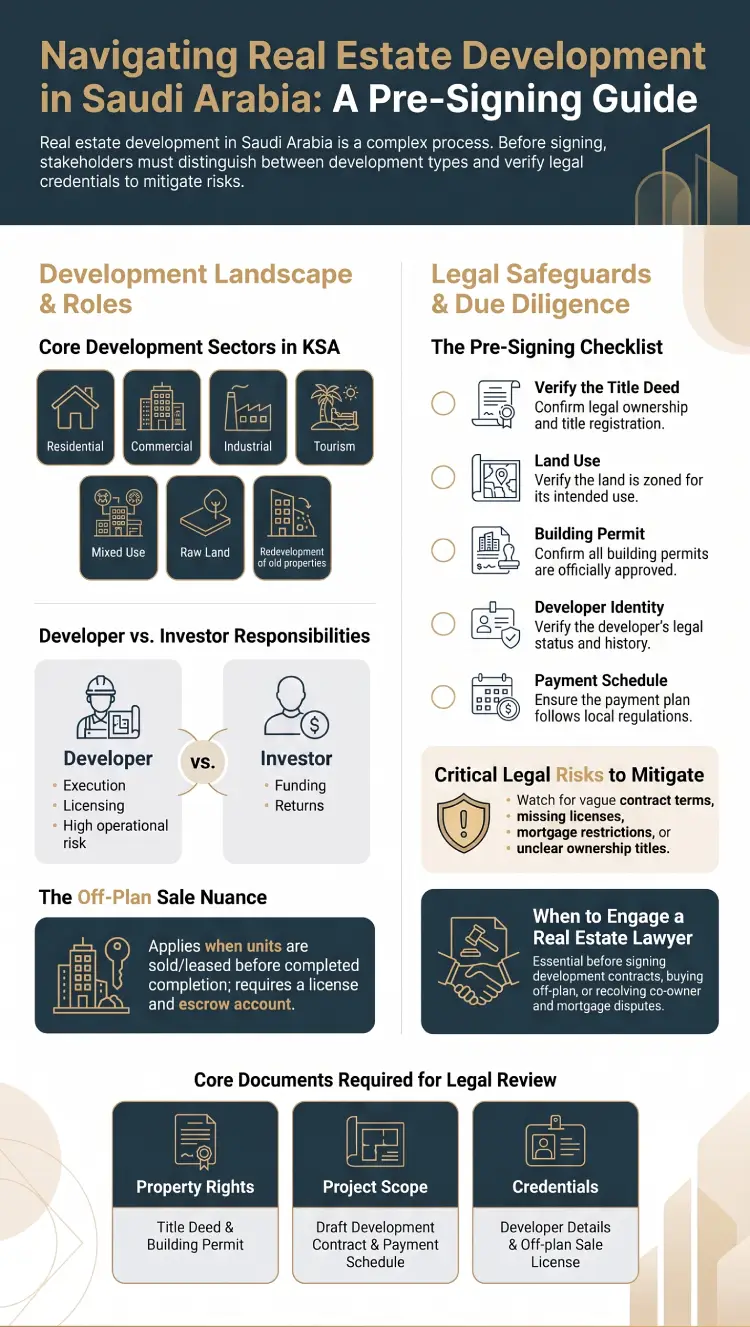
The main types of real estate development in Saudi Arabia include residential, commercial, industrial, tourism, mixed-use, raw land development, and redevelopment of existing properties.
Each model differs according to the nature of the land, the intended use of the project, whether the asset will be sold, leased, or operated, and the regulatory obligations attached to the project.
| Development Type | Common Examples | Key Legal Risk | What to Check |
|---|---|---|---|
| Residential | Apartments, villas, compounds | Delays, subdivision, warranties | Title deed, permits, specifications |
| Commercial | Offices, shops, malls | Land use and leasing | Permitted use and operating agreements |
| Industrial | Warehouses, logistics facilities | Safety and licensing | Permits and technical requirements |
| Tourism | Hotels and resorts | Operation and management | Contracts and licenses |
| Mixed-use | Residential and commercial | Shared facilities | Subdivision and service charges |
| Raw land | Plots and infrastructure | Restrictions and planning | Title deed and permitted use |
| Redevelopment | Older properties | Disputes and additional costs | Ownership and demolition requirements |
Before choosing a development model or signing with a developer, the project documents should be reviewed to identify the main legal risks relating to the title deed, licensing, and contract structure.
Knowing the type of project provides only a starting point. A development may appear to be purely residential but still require unit subdivision arrangements or off-plan licensing where units are marketed or sold before construction is completed.
What Is Real Estate Development?
Real estate development is the process of transforming land or an existing property into an asset with greater economic or functional value that can be sold, leased, or operated.
The project may begin with undeveloped land requiring infrastructure, an older building requiring rehabilitation, or a prepared site intended for residential or commercial construction.
Development is not limited to construction. It may include planning, financing, contracting, licensing, marketing, and risk management.
As the number of parties increases, the need for a clear agreement becomes more important. The contract should identify each party’s responsibilities, warranties, deadlines, and dispute-resolution mechanisms.
What Is the Difference Between a Developer, Contractor, and Investor?
A real estate developer usually leads the project and coordinates the land, financing, design, construction, and marketing process.
A contractor, by contrast, performs construction work according to the agreed contract and drawings. The contractor is not necessarily responsible for project licensing or selling completed units.
An investor provides capital or participates financially in the project. The investor’s rights may arise through a development partnership, investment agreement, or financing arrangement.
These roles should not be treated as interchangeable because each party may carry different responsibilities if the project is delayed, defective, or otherwise fails to meet contractual obligations.
Residential Real Estate Development
Residential development is one of the types of real estate development in Saudi Arabia most directly connected with individual buyers and landowners.
It includes apartments, villas, residential compounds, townhouse projects, and serviced residential plots. The objective is generally to create housing units for sale, leasing, or, in some cases, sale before completion.
The legal structure depends on how the project will ultimately operate. Units may be sold individually, leased, or retained and managed as one development.
Opportunities and Risks in Residential Development
Legal review becomes particularly important where a landowner contributes the land to a developer in exchange for a percentage of the completed project rather than selling the property for cash.
In such arrangements, the agreement should define each party’s share, completion milestones, performance guarantees, and what happens if costs increase or delivery is delayed.
Common risks include:
- Differences between agreed and delivered specifications.
- Delayed completion.
- Insufficient contractual guarantees.
- Difficulties with subdivision of units.
- Issues involving off-plan sales.
The title deed, building permit, approved plans, sales terms, and any off-plan obligations should therefore be checked before the parties commit to the project.
Commercial and Industrial Real Estate Development
Commercial real estate development includes offices, retail units, showrooms, shopping centers, and administrative buildings.
Unlike residential development, its commercial viability often depends heavily on the location’s ability to attract businesses, maintain occupancy, and support long-term operations.
A site may be suitable for commercial development when it is located on an active commercial corridor, within a service district, or near the intended customer base.
Land area alone is not enough. Access, parking, competition, and the profile of potential tenants can all affect the project.
Industrial and logistics development includes warehouses, storage facilities, industrial sites, and distribution centers.
This category requires particular attention to permitted land use, technical requirements, licensing, and safety because a regulatory problem can prevent the property from operating even after construction is completed.
When Is Commercial or Industrial Development Suitable?
From a legal perspective, the parties should examine permitted land use, future lease arrangements, facility management, maintenance obligations, and operating responsibilities.
Weak contractual provisions in these areas can transform an income-producing asset into an ongoing dispute between owners, tenants, operators, or service providers.
Industrial development contracts should also address:
- Material cost fluctuations.
- Supply deadlines.
- Contractor responsibility.
- Defect warranties.
- Whether the intended activity is permitted on the land.
These matters should be established before substantial payments are made or long-term contractual commitments are signed.
Tourism, Mixed-Use, and Multi-Use Development
Tourism development may include hotels, serviced apartments, resorts, and recreational facilities that depend heavily on ongoing management and operation.
The physical building is only one component of the project. Revenue may also depend on management quality, marketing, operating agreements, and regulatory compliance.
Mixed-use real estate development combines two or more uses within the same project, such as residential, commercial, office, or hospitality components.
This model is often used on strategically located sites where a combination of uses can increase land value and diversify project income.
Management Risks in Mixed-Use Developments
The main advantage of mixed-use development is the ability to generate income from different activities rather than relying on a single use.
A project might, for example, contain apartments, shops, and offices.
This can increase the economic potential of the site, but only where the project’s management structure and contracts are carefully organized.
The project should clearly regulate:
- Shared facilities.
- Parking.
- Service charges.
- Maintenance.
- Rights of owners and tenants.
- Management responsibilities.
- Unit subdivision arrangements.
Poorly drafted governance and management provisions can result in recurring disputes once the project becomes operational.
Raw Land Development and Redevelopment of Existing Properties
Raw land development involves preparing undeveloped land so it can be built on, sold, or operated commercially.
The process may involve planning review, infrastructure, land-use analysis, and determining an appropriate exit strategy for the owner or investor.
Redevelopment, by contrast, concerns an existing property that may require demolition, refurbishment, expansion, or a change in use.
Redevelopment can be commercially attractive in established locations, but it may require a deeper legal and technical review than purchasing vacant land.
Key Risks Before Developing Land or an Older Property
Raw land development should begin by verifying:
- The title deed.
- Land area.
- Registered restrictions.
- Permitted land use.
- Planning status.
A development agreement should not be signed before determining whether the property can legally support the proposed model or whether additional approvals are required.
Additional issues may arise where the property involves:
- Heirs or multiple co-owners.
- A mortgage.
- An existing dispute.
- Differences between the registered and actual area.
- Demolition or clearance costs.
Ownership and restrictions should therefore be established before entering into an agreement with a developer or contractor.
When Do Off-Plan Sales and Wafi Apply?
Off-plan rules become relevant when units are sold or leased before the development is completed, subject to the applicable Saudi regulatory requirements.
In these situations, marketing plans or construction drawings alone are not sufficient. Buyers and investors should verify the project’s licensing status, developer information, and applicable escrow arrangements.
Wafi is not relevant to every real estate project.
Its relevance generally arises where units are sold or leased off-plan before completion. This must be distinguished from a development where units are marketed only after construction has been completed.
Where a project involves off-plan sales, the licensing information, developer details, and escrow account should be checked before any payment is made.
What Should Be Checked Before Signing?
A buyer should generally verify the project’s license, developer status, unit details, completion schedule, and payment structure.
A landowner should also determine whether the proposed development model creates additional obligations before units can be sold or handed over.
The agreement should clearly regulate:
- Payment schedules.
- Delays.
- Warranties.
- Technical specifications.
- Changes in the scope of work.
- Consequences of default.
A strong development agreement does more than describe the project. It should explain what happens when the project is delayed, specifications change, or one party fails to perform its obligations.
How Do You Choose the Right Type of Real Estate Development?
Choosing the right development model should begin with the land itself rather than with a desire to pursue the highest potential return.
Location, permitted use, market demand, financing, implementation period, and the developer’s capabilities all influence whether residential, commercial, industrial, or mixed-use development is suitable.
The following factors should be considered before selecting a project model:
- Location and suitability for residential, commercial, or operating use.
- Approved land use and whether a change may be required.
- Demand in the area.
- Target buyers or tenants.
- Developer’s financial and technical capacity.
- Expected implementation period.
- Delay risks.
- Need for external financing.
- Possible off-plan sales.
- Contractual guarantees.
- Dispute-resolution mechanism.
A licensed real estate lawyer in Jeddah may be relevant before signing a development agreement, introducing a new partner, paying a deposit, or purchasing an off-plan unit.
Risks of Real Estate Development Before Signing the Contract
Real estate development risks do not begin only during construction. Many originate at the point when the parties sign a contract that does not clearly allocate responsibilities.
The parties may assume that a short-form agreement or verbal understanding is sufficient, only to discover significant issues when financing, delays, licensing, or sales begin.
Development risks can generally be divided into three areas:
- Ownership and title deed risks.
- Licensing and land-use risks.
- Development and partnership contract risks.
Each requires separate review before a financial or legal commitment is made.
Ownership uncertainty is one of the most important risks. For this reason, verifying property ownership documents and title information is a basic step before entering into a development or partnership agreement.
Title Deed, Licensing, and Partnership Contract Risks
Problems may arise from unclear ownership, co-owners, mortgages, restrictions, or existing disputes affecting the property.
Issues can also appear where the registered area differs from the actual site or where title deed information has not been updated.
A property can be correctly owned but still be unsuitable for the proposed project because of its permitted land use.
For example, a commercial development may be proposed for residential land, or a mixed-use development may require approvals that have not yet been obtained.
A development agreement should also do more than state the percentage allocated to the owner and developer.
It should identify responsibility for:
- Licensing.
- Financing.
- Construction.
- Marketing.
- Delays.
- Guarantees.
- Project management.
The legal assessment will ultimately depend on the documents of the particular project. A general description of the development is not enough to determine whether the obligations are properly structured.
Documents Required for Legal Review
Before reviewing a development agreement or off-plan project, it is useful to prepare the principal documents related to the property and proposed transaction.
Having the documentation available helps identify risks more quickly and reduces the likelihood of forming a legal assessment from incomplete information.
The most useful documents generally include:
- Property title deed or ownership information.
- Building permit or available licensing information.
- Draft development or partnership agreement.
- Developer, contractor, or investor details.
- Project plan or project description.
- Payment schedule or partnership percentages.
- Off-plan sales materials, where applicable.
- Previous correspondence between the parties.
Among the most important initial checks are verification of the property title deed, ownership information, building permit, and draft development or partnership agreement.
Frequently Asked Questions About Types of Real Estate Development in Saudi Arabia
What are the main types of real estate development in Saudi Arabia?
They include residential, commercial, industrial, tourism, mixed-use, raw land development, and redevelopment of old properties.
What is residential real estate development?
It involves developing housing projects such as villas, apartments, compounds, townhouses, or residential plots.
What is commercial real estate development?
It includes offices, shops, showrooms, administrative buildings, and commercial centers designed for business use.
What is mixed-use real estate development?
It is a project that combines more than one use, such as residential, commercial, office, or hospitality spaces.
When does off-plan sale apply to real estate development?
It applies when units are sold or leased before project completion, requiring review of licensing and project documents.
What should be checked before signing a development contract?
The title deed, land use, license, developer identity, contract terms, guarantees, payment schedule, and delivery timeline.
What are the main legal risks in real estate development?
Common risks include unclear ownership, missing licenses, mortgage restrictions, vague contracts, delays, and specification changes.
When do you need a real estate lawyer before development?
Before signing a development contract, adding a partner, buying off-plan, or when the property has heirs, disputes, or liens.
The 7 types of real estate development in Saudi Arabia should not be treated as a simple list of project categories. They form part of a decision-making framework that should be considered before land, contracts, or an initial payment creates obligations that may be difficult to reverse.
A project may appear to be a straightforward residential development, an attractive commercial opportunity, or a high-value mixed-use scheme. The more important questions, however, are whether the title deed is clear, the proposed use is properly licensed, and the contract adequately addresses delays, specification changes, and execution risks.
The types of real estate development in Saudi Arabia differ in their physical form, but the more significant differences often involve risk allocation, guarantees, sales structures, and the responsibilities of the parties.
The earlier these issues are reviewed, the easier it becomes to structure the project on a clearer legal basis.
Where a landowner is considering a developer’s proposal, BMS Legal, as a law firm in Jeddah, can review the title deed, licensing position, and development agreement before signing and identify provisions that may require amendment or additional documentation.
Official References: