
The drug possession penalty in Saudi Arabia depends on the purpose of possession, the circumstances of the incident, and the evidence connecting the accused to the seized substance. Finding a controlled substance does not, by itself, determine the applicable penalty because the legal classification of the conduct must be established first.
Possession may be linked to personal use, or it may fall outside both personal use and trafficking. The legal position changes significantly when the evidence supports an intent to sell or promote drugs.
The place where the substance was found also matters, along with the accused’s knowledge of it, connection to it, and the legality of arrest, search, seizure, handling, and laboratory analysis.
For this reason, assessing a drug possession case in Saudi Arabia begins with two questions: what connects the accused to the substance, and what purpose does the evidence support?
Drug Possession Penalty in Saudi Arabia: What Determines the Sentence?
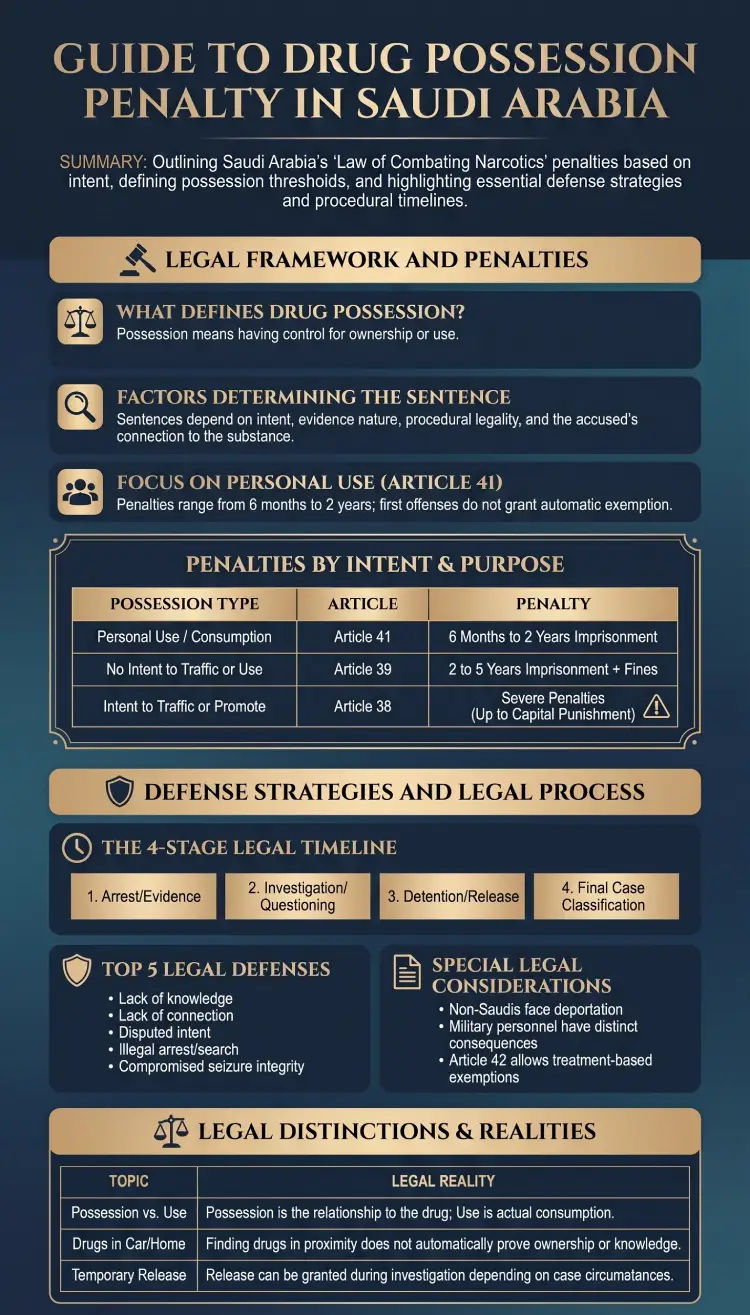
There is no single sentence that applies to every drug possession case in Saudi Arabia. The applicable provision depends primarily on why the substance was possessed and how the conduct is legally classified.
Where the conduct is committed for personal use or consumption, Article 41 provides for imprisonment ranging from six months to two years.
Article 39 addresses possession, control, transportation, or delivery where the conduct is not committed for trafficking, promotion, personal use, or consumption. It provides for imprisonment from two to five years together with the other penalties stated in that provision.
Where the evidence establishes an intent to traffic or promote drugs, Article 38 applies and exposes the accused to a significantly more serious sentencing range.
Accordingly, the question “How long is the sentence for drug possession in Saudi Arabia?” cannot be answered properly without first identifying the purpose, evidence, and legal classification of the conduct.
A small quantity does not automatically result in a lighter sentence. Quantity is considered alongside the surrounding circumstances and is not, by itself, a fixed dividing line between personal use and trafficking.
| Nature of the Conduct | Provision | Basic Sentencing Position |
|---|---|---|
| Possession for personal use or consumption | Article 41 | Imprisonment from 6 months to 2 years |
| Possession outside trafficking, promotion, or personal use | Article 39 | Imprisonment from 2 to 5 years, with other penalties stated by law |
| Possession with intent to traffic or promote | Article 38 | More severe penalties, with imprisonment potentially reaching 15 years |
If you have an active case or an upcoming investigation, reviewing the file with a drug lawyer in Jeddah should begin with the current stage of the case, where the substance was seized, and the next expected procedure before identifying the documents that may affect the case.
What Does Drug Possession Mean Under Saudi Law?
Under the Saudi Anti-Narcotics and Psychotropic Substances Law, possession concerns having control over a controlled substance for ownership or exclusive use.
This becomes particularly important when drugs are found inside a vehicle, home, bag, room, or another location accessible to several people.
The fact that a substance was physically close to a person does not automatically resolve criminal responsibility. Similarly, simply denying ownership does not necessarily establish that the accused had no connection to the drugs.
The evidence must be assessed to determine the accused’s relationship with the seized substance, degree of control, knowledge of its presence, and the intent associated with that control.
The distinction between possession and other forms of control should also not be reduced to the idea that one is permanent while another is temporary. Both concepts must be understood within the statutory wording and the particular circumstances of the case.
This is why searches such as drug possession without knowledge or drug possession without intent ultimately concern proof of connection, knowledge, and criminal intent rather than the label “possession” alone.
Penalty for Drug Possession for Personal Use in Saudi Arabia
Possession for personal use or consumption falls within Article 41 when its legal requirements are satisfied. The applicable imprisonment range is between six months and two years.
This form of possession is distinct from conduct falling under Article 39 and from possession where an intent to traffic or promote drugs is established.
A first-time drug possession offense for personal use does not automatically result in exemption merely because the accused has no previous convictions. Personal circumstances, criminal history, and the facts of the case may nevertheless be relevant where the law allows them to be considered.
Article 60 permits the court, where the statutory requirements and sufficient reasons exist, to sentence below the prescribed minimum for certain offenses, including those governed by Article 41.
Article 42 also contains provisions relating to treatment requests and situations in which proceedings for drug use, consumption, or addiction may not be initiated if its conditions are satisfied. It further addresses the possibility of closing an investigation in certain first-use cases subject to specific requirements.
A first drug offense should therefore not be presented as a guarantee of dismissal, exemption, or sentence reduction. The outcome depends on whether the conditions of the relevant provision apply to the individual case.
What Is the Difference Between Possession, Drug Use, and Trafficking?
Drug possession concerns the person’s relationship with the controlled substance, while drug use concerns the actual consumption of that substance. Both may exist in the same case, but proof of one does not automatically establish the other.
Trafficking or promotion concerns the purpose behind dealing with the substance. This is why possession for personal use must be distinguished from possession with intent to traffic or promote.
Intent is assessed from the evidence as a whole rather than from the quantity of drugs alone.
Depending on the case, relevant evidence may include the way the substance was stored, communications, statements, digital data, delivery arrangements, or other conduct connected to the drugs. Any individual indicator must still be assessed within the overall factual context.
Accordingly, when does drug possession become trafficking? The answer depends on evidence establishing the purpose of possession rather than on a universal quantity threshold applicable to every case.
What If the Drugs Did Not Belong to the Accused?
When drugs are found in a vehicle, home, or shared location, simply saying that they belong to someone else does not end the legal analysis. Equally, criminal responsibility should not be assumed solely because the substance was found in that location.
In a situation such as “drugs were found in my car without my knowledge,” relevant questions include where the substance was located, who used the vehicle, how it was discovered, whether it was visible or concealed, and what statements or other evidence relate to it.
The same approach applies to a shared home, room, bag, or other space accessible to several people.
Where another person claims ownership of the substance, that statement must be assessed with the rest of the evidence. Neither another person’s admission nor the accused’s denial resolves criminal liability automatically.
A defense based on lack of knowledge becomes more significant when supported by verifiable facts. The central issue remains whether the evidence establishes a connection between the accused and the substance, knowledge of its presence, and the relevant intent.
What Are the 5 Key Defenses in a Drug Possession Case?
Potential defenses in a Saudi drug possession case depend on the facts, evidence, and procedures involved. No standard defense guarantees acquittal or a reduced sentence.
Five areas commonly require careful examination:
- Lack of knowledge: where the surrounding facts support the position that the accused did not know the substance was present or did not know its nature.
- Lack of connection to the seized drugs: where the available evidence does not sufficiently link the controlled substance to the accused or establish actual control.
- Absence or different form of intent: where the evidence does not establish that possession occurred for the purpose alleged by the prosecution.
- Legality of arrest and search: including whether the relevant procedures, legal grounds, and limits were properly observed.
- Integrity of seizure and laboratory analysis: including whether the seized substance can be reliably connected to the sample examined and how it was handled.
A challenge to the arrest or search does not automatically succeed in every case. Its significance depends on the procedure involved, any violation established, and its effect on the relevant evidence.
Likewise, insufficient evidence may become decisive where there is a genuine gap in proving the accused’s connection to the substance, knowledge, or intent.
The appropriate defense should therefore be based on the actual case file. The arrest record, location of the drugs, search procedure, statements, and laboratory report may materially change how the case is assessed.
What Happens After an Arrest for Drug Possession?
A drug possession case will generally move from arrest and evidence gathering to investigation and questioning, followed by a decision concerning detention or release and the subsequent handling of the case.
There is no fixed investigation period applicable to every drug possession case. Under the Saudi Law of Criminal Procedure, the initial detention period ends after five days unless it is extended through the legally prescribed process.
Further extensions may be permitted within the statutory framework. The existence of a maximum detention period does not mean that every accused person will remain detained for that entire period.
Likewise, statutory detention limits should not be treated as a fixed duration for the Public Prosecution investigation. The time required depends on the evidence, nature of the allegations, investigative measures, and procedural needs of the case.
Temporary release may also be ordered where continued detention is no longer justified, release would not prejudice the investigation, and there is no material concern that the accused will abscond or disappear, subject to compliance with appearance requirements.
For that reason, the common question “Is bail available in Saudi drug cases?” is better understood as a question about temporary release and its legal conditions, because the decision depends on the circumstances of the investigation and the case.
Does the Position Change for a First Offense, Residents, or Military Personnel?
There is no separate sentence that applies solely because a drug possession case is a first offense. The analysis begins with the provision governing the conduct, followed by consideration of criminal history, personal circumstances, and any other factors the law permits the court to consider.
For a non-Saudi national, Article 56 provides for deportation from Saudi Arabia after completion of the sentence in accordance with its provisions.
The same article provides for travel restrictions on Saudi nationals convicted of the offenses covered by the provision after completing imprisonment. The restriction is for a period equivalent to the prison sentence and may not be shorter than two years.
For military personnel, military status alone does not automatically create one uniform sentence or result in automatic dismissal from service.
Article 41 provides for enhanced treatment in specified occupational circumstances, including persons responsible for combating narcotics or supervising their possession or circulation, as well as certain cases involving drug use or impairment while performing official duties.
The legal position of military personnel may therefore require consideration of both the Anti-Narcotics and Psychotropic Substances Law and the employment or service rules governing the individual’s position.
Frequently Asked Questions About Drug Possession Penalties in Saudi Arabia
What is the drug possession penalty in Saudi Arabia?
The sentence depends on the purpose of possession. Article 41 provides six months to two years for personal use or consumption where its conditions apply.
How long is the prison sentence for drug possession?
There is no single sentencing range for all forms of possession. The applicable range depends on the legal classification of the conduct.
What is the penalty for possession for personal use?
Article 41 provides for imprisonment from six months to two years when its statutory requirements are satisfied.
What is the penalty for a first drug possession offense?
There is no separate first-offense sentence. The applicable law and individual circumstances determine the legal position.
Does possessing a small quantity mean a lighter sentence?
Not necessarily. Quantity is assessed alongside intent, evidence, and the circumstances of the case.
What is the difference between possession and drug use?
Possession concerns the person’s relationship with the substance, while use concerns actual consumption.
What is the difference between possession and trafficking?
Trafficking concerns the purpose of dealing with the substance and is subject to a different and more serious sentencing framework.
Does finding drugs in a car prove possession?
Not by itself. The accused’s connection to the substance, knowledge of it, control, and other evidence must be assessed.
What if the drugs belonged to someone else?
The evidence relating to each person must be examined. A denial or another person’s admission does not resolve liability by itself.
What are the main defenses in a drug possession case?
Potential issues may include lack of knowledge, lack of connection, intent, insufficient evidence, procedural irregularities, or issues involving the seized substance.
Drug Possession Penalty in Saudi Arabia 2026: 5 Key Defenses can take on very different significance depending on whether the case involves lack of knowledge, a weak connection to the seized substance, disputed intent, the legality of arrest and search, or the integrity of seizure and analysis. None of these issues can be assessed properly by looking only at the quantity, type of substance, or wording of the accusation.
Possession for personal use is treated differently from other forms of possession, and both are distinct from possession connected to trafficking or promotion. A proper assessment starts with where the substance was found, how the accused was connected to it, whether knowledge can be established, what intent the evidence supports, and whether the case procedures were properly followed.
If a case, summons, or investigation is already pending, contact with a law firm in Jeddah can begin with the current stage, the next deadline or hearing, and the key facts. The relevant documents and next legal step can then be identified without assuming any particular outcome.
Legal Sources: