
Real estate lawsuits in Saudi Arabia often begin with a dispute over ownership, possession, sale, delivery, eviction, or the right to use a property. Identifying the exact nature of the dispute should come before filing, because the claim itself affects jurisdiction, evidence, supporting documents, and the remedy requested from the court.
You may already have a title deed or contract, yet still need to identify the precise right being disputed. A property ownership claim is different from a claim to recover possession, just as eviction differs from rescinding a real estate sale agreement or claiming compensation for the use of property.
Before filing, you should therefore determine what right you are asserting, who the opposing party is, and what outcome you want the court to order. This distinction helps avoid confusion between real estate disputes that may appear similar at the outset but follow different legal paths.
Real Estate Lawsuits in Saudi Arabia: Which Path Fits Your Dispute?
Real estate lawsuits in Saudi Arabia are judicial claims involving property, ownership, possession, use, or obligations arising from a property transaction. The dispute may concern a title deed, sale agreement, delivery, eviction, unlawful interference, or compensation.
Before asking how to file a real estate lawsuit, first determine whether the dispute concerns ownership itself or protection of possession. You should then identify the document supporting your position and whether your requested remedy is delivery, eviction, rescission, compensation, or recognition of a specific right.
| Nature of the dispute | Legal path to consider |
|---|---|
| Dispute over ownership | Ownership claim or appropriate registration process |
| Loss of possession | Claim to recover possession |
| Interference with existing possession | Claim to prevent interference with possession |
| Failure to deliver property | Delivery claim or contractual claim |
| Breach of a sale agreement | Rescission claim, depending on the circumstances |
| Use of property without due payment | Fair rental value or compensation claim |
This initial classification helps identify the likely direction of the case, but it does not replace reviewing the contract, title documents, facts, and previous procedures.
The legal path may also change when the property forms part of an estate, falls within the Real Estate Registry system, involves an administrative authority, or is subject to special jurisdiction.
What Are Real Estate Lawsuits in Saudi Arabia?
Real estate lawsuits are judicial proceedings through which a party seeks recognition, protection, or enforcement of a right relating to property. They include disputes concerning ownership, possession, sale, eviction, delivery, use, real rights, and compensation associated with property.
There is no single litigation procedure that applies to every property dispute because the source of the right and the remedy sought differ between cases. A dispute may concern a real right, such as ownership or usufruct, while another may arise from a sale agreement or an obligation to deliver property.
Likewise, there is no standalone law called the “Real Estate Litigation Law” that contains every rule governing property disputes in Saudi Arabia.
Instead, real estate litigation may involve several legal frameworks, including the Law of Civil Procedure, the Civil Transactions Law, the Law of Evidence, and the Real Estate Registration Law.
When Does a Property Dispute Become a Court Case?
A property dispute becomes a lawsuit when a contested right requires a court judgment to establish, protect, or enforce it. This may arise from refusal to deliver property, interference with possession, disagreement over ownership, or breach of a real estate sale agreement.
Not every property problem requires immediate litigation. Some issues may first require registration, documentation, or correction through the relevant authority rather than a judicial claim.
The first step is therefore to determine whether the problem is procedural and can be addressed without litigation, or whether the parties are genuinely disputing a right that requires a court decision.
This distinction becomes particularly important where the relationship relies on incomplete agreements, scattered correspondence, or documents that do not clearly define each party’s obligations. Clear documentation does not eliminate every dispute, but it makes the claim and supporting evidence easier to identify.
What Are the Main Types of Real Estate Lawsuits in Saudi Arabia?
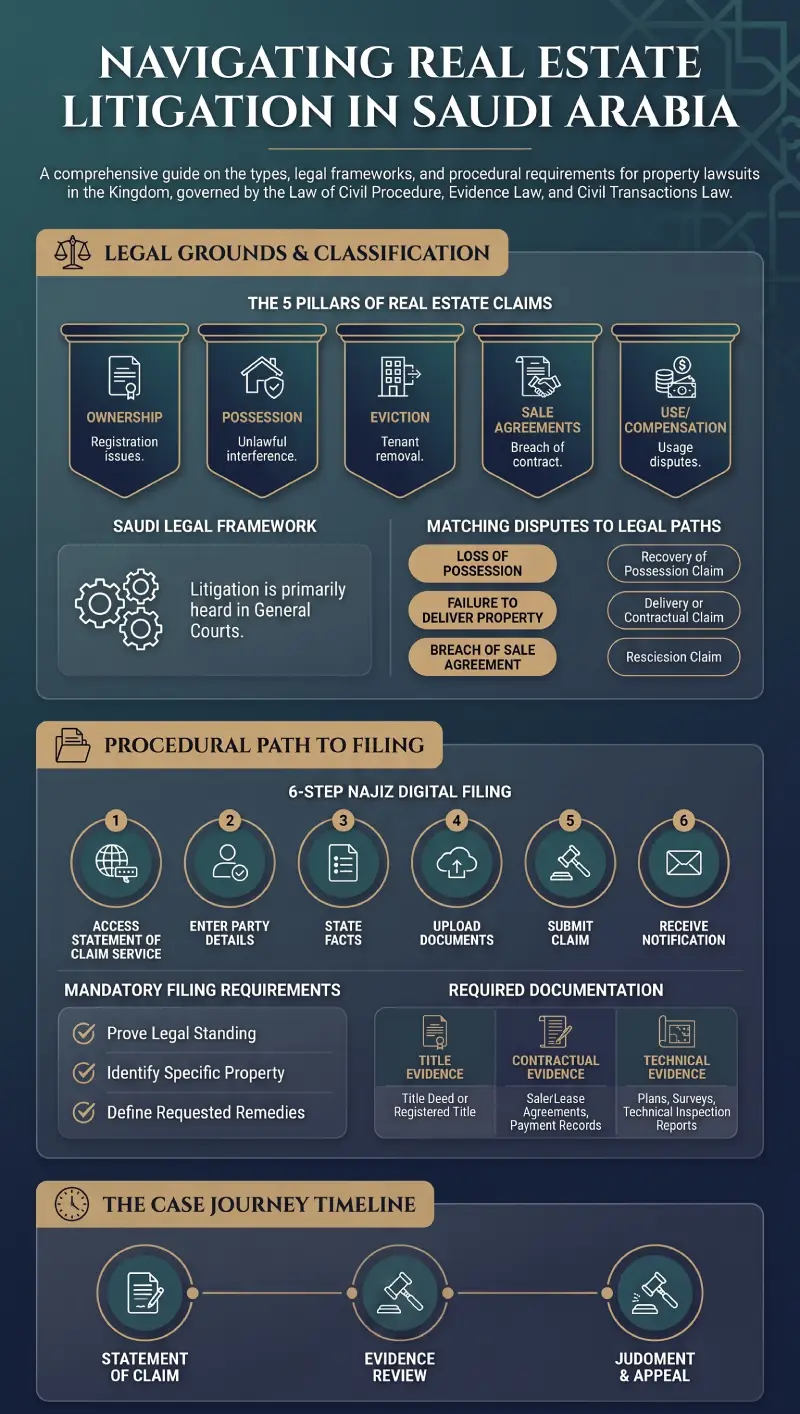
The most common real estate lawsuits in Saudi Arabia can be grouped into five broad categories. These categories are intended to help identify the nature of a dispute; they are not an exhaustive statutory classification of all property claims.
1. Ownership, Title Deed, and Registration Disputes
These disputes concern ownership itself or rights registered against the property. They may include a property ownership claim, conflicting claims to ownership, disagreements over title information, boundaries, documents, or entries in the Real Estate Registry.
A dispute over ownership should be distinguished from a procedural issue concerning registration or correction. Proving real estate ownership in Saudi Arabia becomes particularly relevant where ownership itself is contested and the available evidence must be examined.
Similarly, a request to invalidate or cancel a title deed cannot be treated as a standard remedy applicable to every case. The reason for the challenge, registration status, underlying rights, and competent authority must first be identified.
For properties subject to the Real Estate Registration Law, registry information, first registration, and subsequent registered transactions can be central to establishing the legal position.
Disputes concerning correction of registry information should also be distinguished from challenges involving first registration or rights that have acquired legal conclusiveness under the applicable rules.
2. Possession and Property Encroachment Claims
Possessory claims protect actual possession according to their applicable conditions without automatically determining who ultimately owns the property.
For that reason, a property ownership claim should be distinguished from a claim to recover possession or a claim to prevent interference with possession.
A recovery-of-possession claim may arise where a party loses control of property and seeks to restore that possession. A prevention-of-interference claim addresses conduct that disrupts existing possession without necessarily removing the possessor from the property altogether.
Encroachment may involve boundaries, use, construction, or possession. Where conduct interferes with ownership rights, a property encroachment complaint may need to be considered according to the facts and available documentation.
The appropriate legal path depends on the right affected and the nature of the alleged encroachment.
3. Eviction and Property Delivery Claims
An eviction claim may arise when a person entitled to the property seeks to end another party’s occupation based on a legally relevant ground.
The requirements for a real estate eviction lawsuit depend on the relationship between the parties, the contract, the basis for occupation, and the obligations governing continued use of the property.
A property delivery claim, by contrast, seeks to require the responsible party to place the property at the disposal of the person entitled to receive it.
Such a claim may arise after a sale or after the expiry of a contractual obligation. The delivery date, agreed conditions, and steps preceding the claim may therefore become important.
The labels “eviction” and “delivery” should not be used interchangeably merely because another person occupies or refuses to hand over the property. The basis of that person’s occupation and the right being enforced determine the appropriate claim.
4. Real Estate Sale Agreement Disputes
A dispute over a real estate sale agreement may concern payment, delivery, contractual obligations, performance, or the consequences of a breach.
A claim to rescind a real estate sale agreement may arise where a statutory or contractual basis supports terminating the agreement and addressing its legal consequences.
These claims should be distinguished from disputes over ownership itself because the central issue may be the contractual obligation rather than the title deed.
The starting point is usually the agreement, its annexes, payment records, correspondence, delivery records, and any other documentation showing the obligations of each party.
Not every breach automatically results in rescission. The nature of the breach, the terms of the agreement, the requested remedy, and the surrounding facts determine the appropriate legal path.
In some cases, enforcement, delivery, or compensation may be more relevant than terminating the agreement.
5. Use, Fair Rental Value, and Compensation Claims
These claims concern the benefit derived from property, the value of its use, or loss caused by another party’s use or interference.
They may include claims for fair rental value, compensation for use of property, or damages associated with the property or its occupants.
Fair rental value is not a fixed amount that automatically applies to every property. Its assessment depends on the property, the relevant period, the circumstances, and the basis of the claim.
A claim for compensation for use should also be distinguished from a property damage claim, because damages require identifying the legal basis, the harmful event, and the elements supporting the compensation sought.
Other real estate disputes may involve usufruct, easements, mortgages, co-ownership, and division. Jurisdiction may change where the dispute falls within a special category.
For example, division of an estate containing real property may fall within the jurisdiction of the Personal Status Court depending on the circumstances, parties, and nature of the estate dispute.
What Is the Legal Basis for Real Estate Lawsuits in Saudi Arabia?
Real estate lawsuits in Saudi Arabia may involve several laws, depending on the right asserted and the remedy requested. A property claim involving ownership, contract, possession, or registration therefore cannot always be analysed under one legal framework alone.
The Law of Civil Procedure governs matters such as court jurisdiction, filing procedures, judicial proceedings, and available methods of challenging judgments. It also places a broad category of property disputes within the jurisdiction of the General Courts, unless another rule establishes special jurisdiction.
The Civil Transactions Law governs contracts, obligations, sales, real rights, usufruct, damage, and compensation. These issues frequently arise in real estate disputes involving contractual performance or property rights.
The Law of Evidence regulates the methods used to prove claims, including written evidence, testimony, digital evidence, and expert evidence.
Transactions exceeding SAR 100,000, or whose value is not specified, generally require written proof, subject to the applicable statutory exceptions. This does not mean that witness testimony is prohibited in every high-value real estate dispute.
The Real Estate Registration Law governs first registration, Real Estate Registry records, subsequent registered transactions, objections, and corrections in areas where the system applies.
First registration acquires conclusive effect within the period specified in the decision declaring the relevant real estate area, provided that this period does not exceed one year from publication.
Real Estate Lawsuits in Saudi Arabia
has been reviewed from a legal and editorial perspective, including the main types of disputes,
legal basis, court jurisdiction, filing requirements, and litigation procedures,
while taking into account the distinction between ownership, possession,
eviction, contracts, use, and compensation claims.
BMS Legal | Attorneys & Legal Consultants
Legal and editorial review based on the article topic and related regulations
July 2026
The information provided is for general legal awareness only and does not replace
a review of the specific facts, documents, and legal position of each real estate dispute.
Which Court Has Jurisdiction Over Real Estate Lawsuits?
The competent court for real estate lawsuits in Saudi Arabia depends on the nature of the dispute and the remedy sought, rather than merely the fact that property is involved.
General Courts have jurisdiction over a broad range of disputes involving property ownership, related rights, benefits, eviction, and possession, unless a specific legal rule assigns jurisdiction elsewhere.
You should also distinguish between subject-matter jurisdiction and territorial jurisdiction. The first determines the type of court that may hear the dispute, while the second determines the appropriate court location under the applicable procedural rules.
It is therefore not enough to conclude that a dispute is “real estate related.” The type of claim, location, parties, and any special jurisdictional rules must also be considered.
The presence of a government authority does not automatically make every property dispute an administrative case.
Administrative Courts may have jurisdiction where the dispute concerns an administrative decision, administrative action, administrative contract, or another matter falling within their statutory jurisdiction.
Some disputes involving property may also fall within another specialist jurisdiction. For example, division of an estate may involve the Personal Status Court where the legal nature of the dispute places it within inheritance or personal status jurisdiction.
Claims involving real rights over property located outside Saudi Arabia are also governed by specific rules on international jurisdiction and should not be treated in the same way as property located within the Kingdom.
What Are the Requirements for Filing a Real Estate Lawsuit?
The requirements for filing a real estate lawsuit begin with having a legitimate interest, the proper legal standing in relation to the right claimed, and an identifiable opposing party.
The claim must also contain a clear remedy, organised facts, and documentation explaining the relationship between the parties and the property in dispute.
Possession is not a universal requirement for every real estate claim. Its importance depends on the nature of the right being protected.
Possession is central to recovery and interference claims, while ownership lawsuits examine the underlying right and the independent evidence supporting it.
The property should also be identified sufficiently to distinguish it from other properties using available official details concerning ownership, location, area, and registration.
The remedy sought must correspond with the facts. Delivery differs from eviction, while rescission differs from proving ownership or claiming compensation.
Depending on the dispute, relevant documents may include:
- Title deed or registered property title and Real Estate Registry information.
- Sale or lease agreement and related annexes.
- Payment records, transfers, and correspondence between the parties.
- Plans, surveys, delivery records, and inspection reports.
- Technical reports relating to defects, boundaries, or measurements.
- Power of attorney or other evidence of legal standing where the claim is filed on another person’s behalf.
There is no single real estate statement of claim template suitable for every type of property dispute.
An ownership claim requires different allegations and remedies from an eviction claim, sale agreement rescission, recovery of possession, or fair rental value claim.
How to File a Real Estate Lawsuit Through Najiz
A real estate lawsuit may be filed electronically through the Statement of Claim service on the Najiz platform after preparing the parties’ details, facts, requested remedies, and supporting documents.
Before starting the electronic filing process, however, you should first identify the nature of the dispute and the remedy sought. Filing a real estate lawsuit through Najiz involves more than completing an online form.
The main steps include:
- Access the Statement of Claim service through Najiz.
- Enter the applicant, claimant, and defendant information.
- Provide the facts of the case and clearly state the requested remedies.
- Enter the relevant property information required for the claim.
- Upload contracts, title documents, and supporting evidence.
- Submit the application and retain the reference number for tracking.
After submission, the application goes through a review stage and may require additional information or documents before the case is registered and referred onward.
For that reason, the statement of claim should be reviewed before submission to ensure that the requested remedy is supported by the pleaded facts and documents.
Before filing through Najiz, start with the most important question: What exactly do you want the court to order?
That answer helps determine the claim, the supporting evidence, and the next procedural step.
What Are the Stages of a Real Estate Case?
A real estate case generally progresses from filing and review to registration, examination of the dispute, evidence, judgment, and any available challenge to that judgment.
The details vary according to the type of dispute, number of parties, available documentation, and whether expert evidence, inspection, or additional records are required.
After registration, the court considers the parties’ facts, remedies, and evidence. Title documents, agreements, correspondence, and digital evidence may provide sufficient information in some cases.
Other disputes, particularly those involving boundaries, measurements, or technical defects, may require expert evidence.
There is no single fixed duration for real estate litigation in Saudi Arabia.
The timeframe may be affected by:
- completeness of the documents;
- complexity of the evidence;
- expert involvement;
- number of parties;
- complexity of the remedies requested; and
- whether the judgment is challenged.
For that reason, a case should not be assessed solely by an expected timeframe. The clarity of the right, remedy, and evidence at the filing stage is equally important.
Organising the case file may reduce avoidable deficiencies, but it does not allow a guaranteed date for judgment.
How Do You Appeal and Enforce a Real Estate Judgment?
An appeal against a real estate judgment depends on the type of judgment, the available avenue of challenge, and the applicable statutory deadline.
A real estate appeal brief should address the reasons for the judgment and the specific grounds being challenged rather than simply repeating the original facts of the dispute.
Saudi Ministry of Justice procedures include a stage for challenging eligible first-instance judgments, after which the next procedural step depends on the particular judgment and available remedy.
It should therefore not be assumed that every judgment is subject to the same procedure or deadline.
Enforcement begins once the real estate judgment qualifies as an enforceable instrument under the applicable rules.
The judgment may require:
- eviction from the property;
- delivery of the property;
- payment of money; or
- performance of another obligation ordered by the court.
Enforcement is distinct from the stage in which the underlying dispute is proved.
The operative part of the judgment should therefore be reviewed carefully to identify exactly what the court ordered before an enforcement application is submitted.
When Should You Consult a Real Estate Lawyer?
Legal review becomes particularly important where the correct type of claim, jurisdiction, or requested remedy is uncertain.
A Real Estate Lawyer in Jeddah may also be relevant where title documents conflict, several parties are involved, registration issues arise, or technical evidence must be assessed before proceedings begin.
Legal review may be particularly useful where the case involves:
- disputed ownership or property boundaries;
- recovery of possession or interference with possession;
- ongoing encroachment requiring the correct legal route;
- delivery or eviction disputes;
- rescission of a real estate sale agreement;
- title deed or Real Estate Registry disputes;
- fair rental value or compensation claims; or
- appealing a judgment or moving to enforcement.
The starting point should not be whether you are guaranteed to win or lose. It should be identifying the right, remedy, documents, and procedures already taken.
BMS Legal reviews the file to clarify the available legal options, next step, and scope of service without promising a predetermined outcome.
Frequently Asked Questions About Real Estate Lawsuits
What are real estate lawsuits in Saudi Arabia?
They are judicial claims involving property ownership, possession, use, contracts, rights, or obligations connected with real estate.
What are the main types of real estate lawsuits?
They include ownership and registration, possession and encroachment, eviction and delivery, sale agreement disputes, and use or compensation claims.
How do I know which real estate lawsuit applies to my case?
Identify the disputed right, the remedy you want from the court, the property documents, and any procedures already taken.
Which court handles real estate disputes in Saudi Arabia?
General Courts hear a broad range of property disputes, but jurisdiction may change where special rules apply to the dispute or parties.
How do I file a real estate lawsuit through Najiz?
Use the Statement of Claim service to enter the parties, facts, requested remedies, property information, and supporting documents before submitting the application.
What documents are required for a real estate lawsuit?
Depending on the dispute, they may include title documents, contracts, payment records, correspondence, plans, technical reports, and proof of legal standing.
What is the difference between an ownership claim and a possession claim?
An ownership claim determines the underlying right to the property, while a possession claim protects possession without itself deciding ownership.
When can an eviction lawsuit be filed?
An eviction claim may be considered where there is a valid basis to end occupation, depending on the contract, relationship, and circumstances.
Someone is encroaching on my property. What should I do?
Start by identifying the nature of the encroachment and the documents supporting your right, then determine the appropriate authority and legal procedure.
How long does a real estate lawsuit take in Saudi Arabia?
There is no fixed timeframe. Duration depends on the dispute, evidence, expert involvement, parties, procedures, and any challenge to the judgment.
If the path from the first dispute to the appropriate court procedure is reduced to its essentials, Real Estate Lawsuits in Saudi Arabia: 5 Types & Filing provides a practical way to identify where your dispute belongs before taking formal action.
The first step is to determine whether the dispute concerns ownership, possession, eviction and delivery, a sale agreement, or use and compensation. Only then should you move to jurisdiction, supporting documents, evidence, and the remedy requested from the court.
The legal route may change where a property forms part of an estate, falls within the Real Estate Registration system, involves an administrative relationship, or is subject to another specialist jurisdiction.
The clearer the connection between your right, facts, evidence, and requested remedy, the easier it becomes to identify the appropriate real estate litigation procedure.
Where the dispute requires a broader review of both the legal file and procedural path, a Law Firm in Jeddah can begin by identifying the right involved, reviewing the key documents, and examining the steps already taken before determining the next course of action.
Official Sources: