
Real estate investment in Saudi Arabia does not start with finding a suitable price only. It starts with understanding the property as a complete legal and financial asset. A property may look attractive from the outside, but it still requires a review of the title deed, ownership, mortgage status, tax position, contract terms, and previous obligations.
Legal due diligence becomes more important when the property is intended for leasing, partnership, off-plan sale, or non-Saudi ownership. The key question is not only: is real estate investment profitable in Saudi Arabia? The more important question is whether the property can be owned, transferred, registered, and invested in without material restrictions.
BMS Legal approaches real estate investment from the principle of clarity before action. The objective is not to block the transaction, but to identify legal risks before paying a deposit or signing a binding agreement.
Saudi Real Estate Investment Guide
Real estate investment in Saudi Arabia is based on selecting an asset with potential return, while conducting a legal review before any financial commitment. This includes checking the title deed, seller capacity, restrictions, tax, and contract before paying the deposit.
This quick answer gives the investor a basic rule. A return is not reliable if the property is disputed, mortgaged, linked to an unclear contract, or not transferable within the expected timeline.
Before buying, review these key points:
- The title deed matches the property details and is up to date.
- The seller’s capacity is clear: owner, agent, heir, or company representative.
- There are no undisclosed mortgages, attachments, or existing lease obligations.
- Real Estate Transaction Tax is addressed in the contract.
- The deposit position is clear if the transfer fails or a legal obstacle appears.
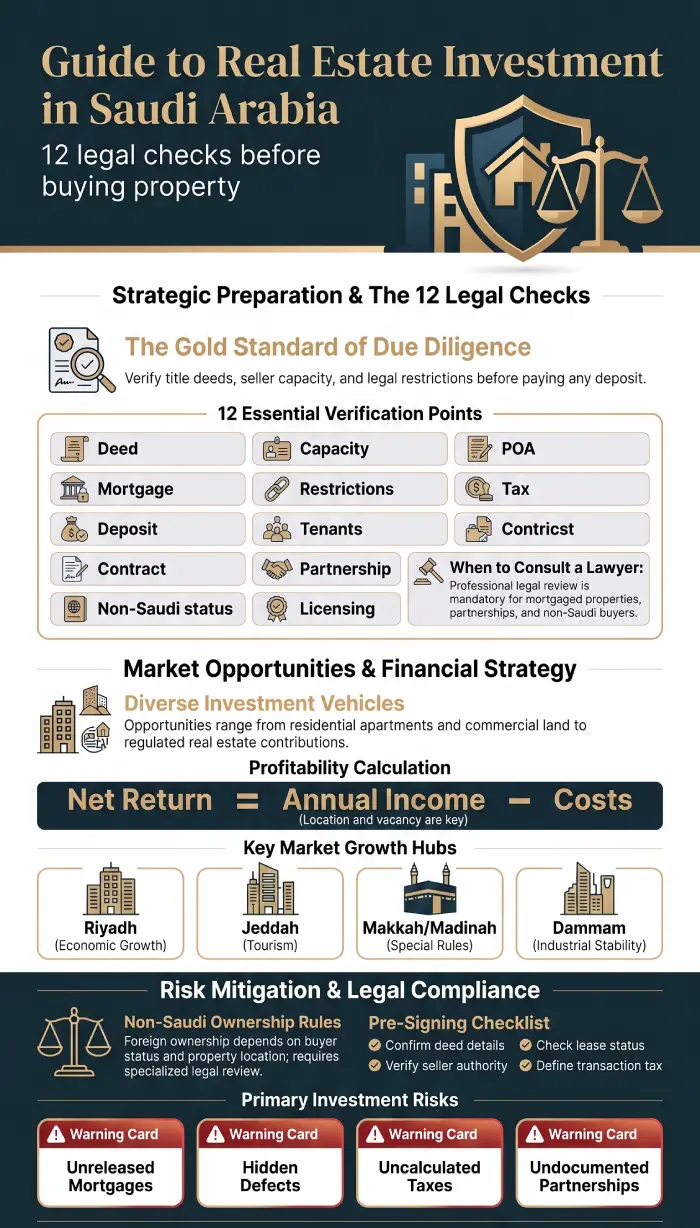
12 Checks Before Real Estate Investment in Saudi Arabia
Do not base the purchase decision on price or promised return only. These checks help you view the transaction from both a legal and practical perspective before committing.
| Check | Why it matters before buying |
|---|---|
| Title deed | Confirms ownership and the ability to transfer and dispose of the property. |
| Seller capacity | Prevents buying from someone who lacks authority to sell. |
| Power of attorney | Shows the agent’s authority to sell and receive payment. |
| Mortgage | Clarifies whether ownership transfer requires mortgage release or lender approval. |
| Restrictions | Reveals attachments or limitations that may delay transfer. |
| Tax | Prevents disputes over Real Estate Transaction Tax. |
| Deposit | Defines what happens to the paid amount if the deal fails or review results change. |
| Tenants | Affects return, handover, and practical control of the property. |
| Contract | Protects obligations and defines transfer, guarantees, and liabilities. |
| Partnership | Regulates shares, management, profits, and exit. |
| Non-Saudi ownership | Requires review of geographic scope and buyer status. |
| Licensing | Important for off-plan sale and regulated real estate projects. |
These checks do not mean every transaction is risky. They prevent treating the property as a financial asset separate from its legal documents. The higher the property value or the more complex the parties, the more important early legal review becomes.
The practical review often starts by checking the title deed to confirm its details and ownership status before paying the deposit.
What Is Real Estate Investment in Saudi Arabia?
Real estate investment is the purchase, development, or leasing of property to generate recurring income or capital growth. It differs from buying a home for personal use because the decision is not based on comfort only, but on return, risk, and transferability.
In property investment in Saudi Arabia, the investor treats the property as an asset that can be managed, sold, or leased. For that reason, legal documents become part of the property’s value, not a formality to be checked at the end of the transaction.
The difference between buying property for residence and buying property for investment appears in the evaluation method. A resident focuses on location, services, and comfort, while an investor adds expected return, leasing potential, liquidity, and legal obligations.
Price alone is not enough. A cheaper property may be linked to a mortgage, dispute, or obligations that reduce its real value. Real estate investment in Saudi Arabia therefore becomes a legal decision when it involves a title deed, contract, financing, partnership, or a non-Saudi ownership right.
Types of Real Estate Investment in Saudi Arabia
Real estate investment methods in Saudi Arabia vary according to capital, investor objectives, investment period, and acceptable risk level. There is no single model that fits every case, because the best real estate investment in Saudi Arabia depends on the city, property type, and ability to manage the asset.
| Investment type | Practical objective | Main advantage | Key review point |
|---|---|---|---|
| Residential apartments | Recurring rental income | Ongoing demand and relatively simple management | Lease agreement, unit condition, services |
| Land | Long-term capital growth | Flexibility for development and resale | Title deed, zoning, fees, master plan |
| Commercial property | Potentially higher return | Longer leases and higher rental value | Licences, activity, tenant |
| Monthly income properties | Regular cash flow | Suitable for income-focused investors | Vacancy, management, maintenance |
| Real estate partnership | Access to larger projects | Distribution of capital and risk | Shares, management, exit mechanism |
| Real estate contributions | Regulated collective investment | Indirect entry into a project | Licensing, disclosure, liquidation mechanism |
Apartment investment may suit many beginners because demand is easier to understand and prices are easier to compare. Still, the unit condition, lease contract, service charges, and owner obligations must be reviewed.
Land investment requires patience and a broader study of planning, zoning, and development timelines. The gain may be capital-based, but it is affected by liquidity, fees, and changes in demand.
Commercial property may suit companies and experienced investors, but it requires a more precise contract. Business activity, licensing, lease duration, and maintenance obligations directly affect investment value.
Best Areas for Real Estate Investment in Saudi Arabia
Location is one of the most important factors in real estate investment in Saudi Arabia, but it is not enough without legal review. A good city does not fix an unclear title deed, weak contract, or undisclosed obligations.
Real estate investment in Riyadh is linked to administrative and economic growth and increasing residential and commercial demand. However, it still requires careful comparison between districts, purchase prices, and actual demand.
Real estate investment in Jeddah benefits from varied residential, commercial, and tourism-related demand, especially near services and active routes. Still, the property status, zoning, and documents must be checked before paying any amount.
Makkah and Madinah have a special nature due to religious and seasonal demand and restrictions linked to some ownership structures. Investment there should be handled with precise legal review, especially if a non-Saudi party is involved.
In Dammam and Khobar, real estate investment is linked to industrial and commercial activity and a relatively stable rental market. Location, services, and occupancy period remain essential before buying.
Is Real Estate Investment in Saudi Arabia Profitable?
Real estate investment in Saudi Arabia may be profitable if it is based on realistic financial and legal review. Profitability does not mean guaranteed return, and a decision should not be based on marketing promises or general percentages without calculation.
Real estate return in Saudi Arabia is affected by several factors, including purchase price, location, rental demand, construction quality, vacancy period, tax, maintenance, and management costs. The investor should distinguish expected return from actual return.
Expected return is the figure before deducting costs. Actual return is the result after deducting expenses. These expenses may include Real Estate Transaction Tax, maintenance, management, vacancy periods, and any property-related obligations.
A simplified return calculation may look like this:
| Item | How to assess it |
|---|---|
| Annual income | Total expected rent during one year |
| Expenses | Maintenance, management, vacancy, fees, obligations |
| Net income | Annual income after deducting expenses |
| Return percentage | Net income divided by purchase cost |
A monthly-income property may be suitable if demand is stable, the contract is clear, and costs are predictable. If the return appears unusually high without explanation, the reason should be examined before commitment.
Real Estate Investment Rules in Saudi Arabia Before Buying
Real estate investment rules in Saudi Arabia begin with reviewing documents before any money transfer. The main practical rule is not to pay a deposit before knowing the title deed, seller capacity, restrictions, and property-related obligations.
Reviewing the title deed means checking ownership details, property type, location, area, and conformity with the actual property. The title deed is the basis for transferring ownership, and any ambiguity may delay registration or cause a later dispute.
Verifying ownership is just as important as reviewing the title deed. The seller may be the direct owner, an agent, an heir, or a company representative. Each capacity has different requirements that must be reviewed before signing.
Mortgages and restrictions must also be checked. Buying a mortgaged property requires a clear arrangement for mortgage release and ownership transfer. The contract should not leave this issue to broad wording such as “transfer will take place later.”
Existing lease agreements should also be reviewed, especially when the property is leased at the time of sale. The buyer needs to know the lease term, rent amount, obligations, and documentation status on official platforms.
Before signing the contract, review the following:
- Title deed and property data.
- Seller capacity and authority.
- Mortgage, attachments, and restrictions.
- Existing lease agreements.
- Utility bills and obligations.
- Real Estate Transaction Tax.
- Transfer date and deposit conditions.
A real estate lawyer in Jeddah can help review the documents and identify risks before commitment, especially where there is a mortgage, partnership, or existing tenants.
Real Estate Investment for Foreigners and Residents in Saudi Arabia
Real estate investment for foreigners in Saudi Arabia is subject to special rules and should not be treated in the same way as property ownership by Saudi nationals. Buying property in Saudi Arabia for non-Saudis requires checking the type of right, geographic scope, and buyer status.
The non-Saudi property ownership framework regulates ownership according to specific rules and geographic zones. The result may differ depending on whether the buyer is a resident, non-resident, foreign company, or Premium Residency holder.
A non-Saudi investor should understand the rules of foreign ownership of real estate before entering into any financial commitment related to buying.
The question should not be reduced to: can a foreigner buy property in Saudi Arabia? The answer depends on the applicable system, regulations, property location, and buyer’s legal status.
Real Estate Transaction Tax and Purchase Costs
Real Estate Transaction Tax is one of the main costs that must be calculated before buying property. Its importance appears during ownership transfer or when documenting contracts linked to transfer of ownership.
A verbal agreement on who bears the tax is not enough, because disputes often appear at the transfer stage. The sale contract should state who bears the tax, how it will be paid, and the effect of delay.
Purchase costs may also include review, valuation, management, maintenance, and previous obligations if any. These costs may affect the real estate investment return more than the investor expects.
In well-drafted sale contracts, tax is not left as a marginal clause at the end of the document. It is addressed as one of the main financial obligations so the transaction is clear before the deposit is paid.
Before transfer, Real Estate Transaction Tax in Saudi Arabia should be defined in the contract to avoid disputes when the sale is completed.
Property Purchase Contract for Investment in Saudi Arabia
A property purchase contract for investment in Saudi Arabia is the document that defines the rights and obligations of the seller and buyer before transfer. The more precise the contract, the lower the risk of dispute if a mortgage, defect, delay, or document inconsistency appears.
The contract should clearly state the property and title deed details, price, and payment method. It should also define the deposit, transfer date, and whether the deposit is refundable or forfeited if the deal fails.
The contract should include seller declarations regarding ownership and the absence of undisclosed restrictions. If the property is leased, mortgaged, or disputed, this should be clearly stated before sale.
Important clauses also include jurisdiction and dispute resolution mechanisms. In some commercial transactions or real estate partnerships, it may be appropriate to include mediation or arbitration, depending on the nature of the relationship.
Before signing, the requirements for selling property in Saudi Arabia should be reviewed so that the title deed, price, deposit, and transfer date are clear.
Real Estate Investment Risks in Saudi Arabia
Real estate investment risks in Saudi Arabia are not limited to price drops or weak rental demand. Some risks are legal and contractual and may appear after paying the deposit or after ownership transfer.
One of the main risks is real estate fraud, especially where incomplete documents are presented or the buyer is pressured to pay quickly. No amount should be transferred before checking the title deed, seller capacity, and property-related restrictions.
Other risks include buying at an unrealistic price or ignoring a material construction defect. A problem may also arise when buying a mortgaged property without a clear arrangement for releasing the mortgage before transfer.
Additional risks appear in undocumented partnerships, unclear lease agreements, and ignoring Real Estate Transaction Tax. The decision should therefore be based on verifiable documents, not promises or rushed offers.
If the property is off-plan, the off-plan sale or lease licence should be checked. Projects under construction require a different review from completed or already leased properties.
Where there is a mortgage, the transaction should be treated as the sale of a mortgaged property that needs a clear arrangement for mortgage release and ownership transfer.
Real Estate Investment Partnership Agreement
A real estate investment partnership agreement is necessary when more than one party participates in buying, developing, or managing one property. Verbal agreement or personal trust is not enough, because disputes often appear when returns are distributed or a sale decision is required.
The agreement should define partner shares, capital contributions, property management, and profit distribution. It should also clarify who bears losses or unexpected expenses when income decreases.
The partnership also needs a clear exit mechanism because an investor may want to sell their share before the project ends. Without a written mechanism, the share may become an illiquid asset that is difficult to dispose of.
Disputes Related to Real Estate Investment
Real estate disputes often start with unclear contract terms, delayed transfer, or a disagreement over the deposit. A small dispute may later become a claim for contract termination or compensation.
A dispute over delayed transfer occurs when one party fails to complete ownership transfer within the agreed time. The contract should therefore link the transfer date to clear conditions, such as tax payment, mortgage release, and document readiness.
Deposit disputes require precise wording because the parties may disagree about withdrawal or failed due diligence. The contract should state whether the deposit is refundable when a legal obstacle appears in the title deed or ownership.
Disputes may also arise between partners over management, return distribution, or sale decisions. They may also arise because of a property defect or a previous obligation that the seller did not disclose.
When ownership transfer is delayed, understanding the property transfer steps becomes important to identify what may block the transfer or require corrective action.
When Do You Need a Lawyer for Real Estate Investment?
You need a lawyer for real estate investment before paying the deposit if the transaction is large or the documents are unclear. Early review helps identify risks before withdrawal becomes costly or difficult.
You also need a lawyer before signing the sale contract, especially if there are mortgages, tenants, or partners. These elements do not always prevent the transaction, but they require written handling in the contract.
When buying a mortgaged property, the mortgage release, debt settlement, and ownership transfer process must be defined. Any ambiguity may leave the buyer between the bank and the seller without sufficient protection.
Legal review becomes more important when real estate investment involves non-Saudis or a real estate partnership. These cases are linked to additional rules and may not be suitable for general contract templates.
If you have a title deed, contract, purchase offer, or property details under negotiation, you may contact the legal team for an initial review before paying the deposit.
Frequently Asked Questions About Real Estate Investment in Saudi Arabia
What is real estate investment in Saudi Arabia?
It is buying, developing, or leasing property to generate income or increase asset value, with legal and financial review before commitment.
Is real estate investment in Saudi Arabia profitable?
It may be profitable if the price, location, documents, and net return are properly reviewed after costs and tax.
How do I start real estate investment in Saudi Arabia?
Start by defining your objective, then review the title deed, ownership, mortgage, tax, and contract before paying the deposit or signing.
What is the most important thing to check before buying an investment property?
The title deed, seller capacity, mortgage, restrictions, and contract should be checked before transferring any amount.
What are the best types of real estate investment in Saudi Arabia?
There is no single best type. Apartments suit recurring income, land suits long-term growth, and commercial property requires more experience.
Is an apartment better than land for investment?
An apartment may generate income faster, while land depends more on future value growth. The choice depends on the investor’s objective.
How do I calculate real estate investment return?
Calculate annual income, deduct maintenance, management, vacancy, and tax, then compare net return with the purchase cost.
What are the main risks of real estate investment in Saudi Arabia?
Key risks include weak title documents, mortgage issues, unclear contracts, property defects, undocumented partnership, and undisclosed obligations.
What are the conditions for buying property for investment in Saudi Arabia?
The practical conditions include reviewing the title deed, verifying ownership, checking seller capacity, mortgage, tax, and deposit terms.
Can a foreigner buy property in Saudi Arabia?
Non-Saudi property ownership is regulated by specific rules and zones. The answer depends on buyer status and property location.
Real Estate Investment in Saudi Arabia: 12 Checks Before Buying summarizes the difference between someone who buys property because the price looks attractive and someone who enters the transaction knowing where risk may appear.
A property does not reveal everything through its façade, location, or expected return. What determines the strength of the investment is often what is not immediately visible: a clear title deed, a seller with legal capacity, a contract that does not leave the deposit unresolved, a mortgage with a clear release path, and tax calculated before transfer.
Each check works as a filter for the transaction. If the property passes these filters, the decision becomes more stable. If it fails at one of them, legal review may prevent a dispute or obligation that was not visible during negotiation.
Do not make your first step in real estate investment a money transfer or contract signature. Make it a structured review of what you will own, who you are dealing with, and what may delay transfer, weaken return, or open the door to dispute.
Before a promising property becomes a commitment that is difficult to reverse, let the review start with a legal team that understands the local market; Jeddah law firm that reads the title deed, contract, and mortgage before reading the expected return.
Official Sources: