
A property encroachment complaint becomes relevant when a physical act affects the boundaries, possession, or lawful use of real property. Encroachment may involve an adjoining building, a fence extending beyond its boundary, unlawful occupation, a blocked entrance, or unauthorized use of part of the land.
Not every disagreement between neighbors proves that an encroachment has occurred. The issue may result from a surveying error, inconsistent coordinates, or an overlap between two title deeds. The first step is therefore to review the title deed, identify the disputed area, document the property’s condition, and select the claim and remedies supported by the available evidence.
You should also determine whether the matter falls within real estate disputes in Saudi Arabia concerning ownership, possession, or property boundaries before selecting the appropriate court request.
Property Encroachment Complaint: What Should You Do First?
Document the act as soon as you discover it. Gather the electronic title deed, photographs of the site, the approved plan, and any available land survey or engineering report. When construction is continuing, consider whether the current condition should be formally recorded or whether an application to stop new works may be appropriate before the site changes.
Next, identify the true nature of the dispute. Do you remain in possession while another person interferes with your use of the property? Have you lost possession altogether? Is another party physically controlling the land?
Depending on the facts, the matter may involve preventing interference with possession, recovering possession, removing unlawful possession, or addressing a structure that crosses the property boundary. The correct route depends on the title documents, the existing possession, the nature of the act, and the remedies being requested.
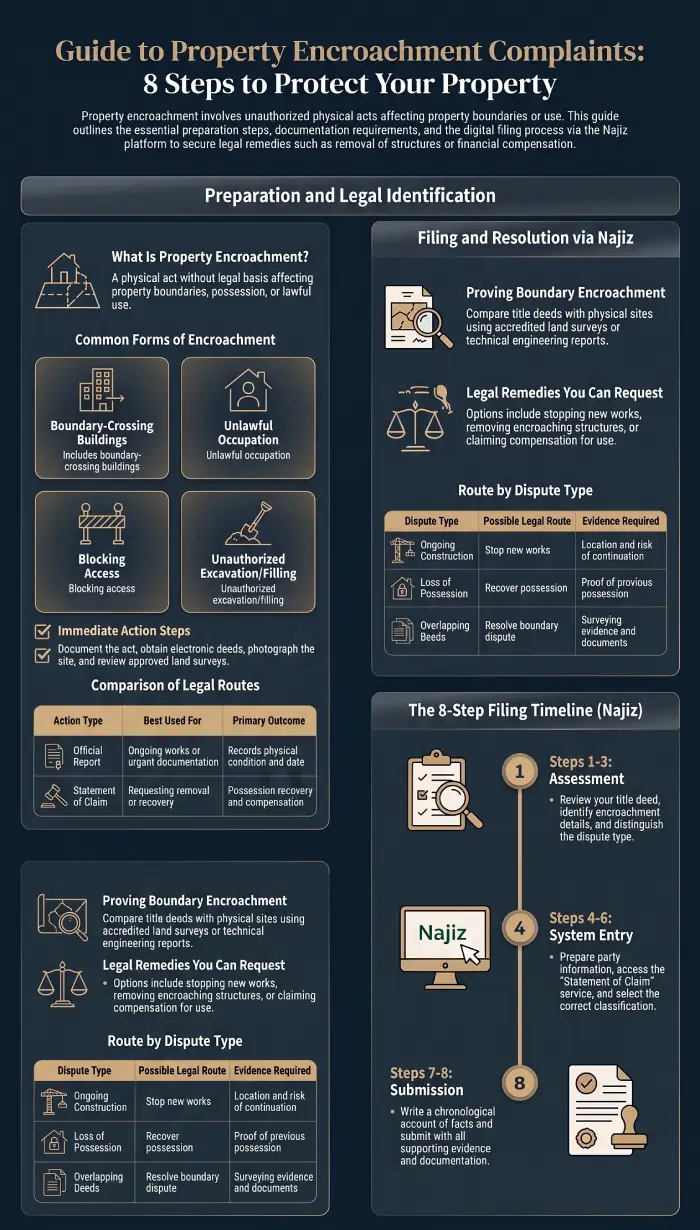
What Is Encroachment on Real Property?
Property encroachment is a physical act carried out without a valid legal basis that interferes with an owner’s or lawful possessor’s control, possession, or use of real property. There is no single procedure that applies to every case because the legal classification changes according to the act and the right requiring protection.
Common Forms of Encroachment on Another Person’s Property
Common examples include occupying another person’s land, constructing a building or fence on it, excavating or filling part of the site, and blocking private entrances or access routes. Encroachment may affect the whole property or only a defined portion.
Unauthorized occupation may also continue after the expiry of a lease, license, or previous permission to use the property. In that situation, the earlier legal relationship must be reviewed before treating the matter as a straightforward encroachment claim.
A distinction must also be made between clear physical encroachment and a surveying dispute. Encroachment is more apparent when a person uses land without showing a valid right. A surveying dispute, however, may concern boundaries, coordinates, measurements, or the application of an approved plan.
When both parties hold title deeds, the possibility of overlapping deeds or an incorrect boundary application should be examined before requesting removal of the alleged encroachment.
When Should You File a Land Encroachment Complaint?
Action should be considered when the physical act is specific, identifiable, and capable of proof, particularly when it is continuing or changing the site. Early documentation can help establish when the act began and the area it affected, but it does not replace proof of ownership, possession, or the relevant boundary.
Where an occupant remains after the expiry of a lease or another legal basis for occupation, the more suitable route may be a property eviction claim, depending on the earlier relationship and available documents.
Circumstances requiring prompt review may include:
- Construction, excavation, or fencing within the property boundary.
- Placing materials or equipment that prevents use of the land.
- A neighboring wall or building crossing a technically established boundary.
- Preventing the owner or lawful possessor from entering the property.
- Continued occupation after the legal basis for occupation has ended.
- Removing boundary markers or materially altering the land.
Should You File a Report or a Statement of Claim?
The phrase “land encroachment complaint” is commonly used as a general description, but it does not identify one specific authority or procedure. An official report may be useful when ongoing works, property damage, or an urgent need to document the situation exists. However, it is not a fixed requirement for every private property dispute.
A statement of claim is used when the claimant seeks a judicial order, such as removing unlawful possession, preventing interference, recovering possession, or removing unauthorized structures. Saudi procedural law also regulates urgent applications relating to inspection for the preservation of evidence, interference with possession, recovery of possession, and the stopping of new works.
| Dispute situation | Possible route | What should be established |
|---|---|---|
| Ongoing construction | Stopping new works or recording the current condition | Location of the works and the risk of continuation |
| Interference with possession | Action to prevent interference | Existing possession and the interfering act |
| Loss of possession | Action to recover possession | Earlier possession and how it was lost |
| Control without a valid right | Action to remove unlawful possession | The relevant right and the other party’s control |
| Encroaching wall or building | Removal of encroachment or boundary resolution | Location and size of the encroachment |
| Overlapping title deeds | Resolution of ownership or boundary dispute | Title documents and surveying evidence |
What Documents Are Required for a Property Encroachment Complaint?
A well-prepared file combines evidence of the legal right, evidence of the property boundary, proof of the physical act, and evidence of loss when compensation is requested. The required attachments vary, so every document listed below will not necessarily be required in every case.
| Document | Purpose |
|---|---|
| Electronic title deed | Establishing the claimant’s standing and the property details |
| Sale, inheritance, or partition documents | Showing how ownership transferred and the claimant’s legal capacity |
| Land survey and approved plan | Identifying the boundaries and disputed area |
| Photographs and video recordings | Recording the building, fence, occupation, or other physical act |
| Engineering report | Describing the works, structural effects, or damage |
| Inspection report, if available | Establishing the property’s condition on a specific date |
| Defendant’s available details | Identifying and serving the opposing party |
| Correspondence and notices | Showing an objection, notice, acknowledgment, or refusal |
| Damage records | Supporting compensation or a claim for the value of use |
Photographs should show how the alleged encroachment relates to identifiable features of the property. A picture of a wall or building without demonstrating its location in relation to the legal boundary may have limited value.
When the dispute concerns boundaries, the technical comparison between the title deed and the physical site is generally more important than a large number of photographs unsupported by clear measurements.
If the underlying right or the claimant’s standing is disputed, the available methods of proving property ownership in Saudi Arabia should be reviewed before relying on the title deed alone.
This guide has been reviewed to explain common forms of property encroachment, the difference between physical encroachment and boundary disputes, the documents used to establish property limits, and the legal routes that may apply under relevant Saudi laws.
BMS Legal for Law Practice and Legal Consultations
Legal and editorial review based on the article topic and relevant Saudi property regulations
7053637679
August 2026
This content is provided for general legal information and does not replace a review of the title deed, land survey, possession status, and facts of the alleged encroachment. The appropriate claim and requested remedies depend on the property, available evidence, and circumstances of each case.
How Do You Prove Encroachment Beyond a Property Boundary?
Proof begins by reviewing the property’s area, sides, measurements, and recorded boundaries. These details should then be compared with the approved plan, land survey, and available coordinates.
A technical report may identify the location and size of the disputed portion. However, it remains one part of the evidence assessed alongside the title documents, photographs, possession history, and other relevant records.
If works are continuing, document them from a lawful position without entering another person’s property or damaging their belongings. An inspection application to preserve evidence may be useful when the site is likely to change or the effect of the works may disappear before the main dispute is considered.
A difference between a physical measurement and a title deed does not automatically establish intentional encroachment. The difference may result from an old surveying issue, an incorrect application of the plan, or overlapping title deeds.
A complaint against a neighbor for land encroachment should therefore be distinguished from a deed-overlap or boundary claim before the requested remedies are drafted.
8 Steps to File a Property Encroachment Claim Through Najiz
The Najiz Statement of Claim service allows the applicant to enter the claim classification, party details, facts, requests, and supporting documents before submitting the application electronically. The available classification and its requirements should be checked at the time of filing because service options may be updated.
- Review the title deed and the claimant’s legal standing.
- Identify the location of the encroachment and when it was discovered.
- Distinguish between an ownership, possession, or boundary dispute.
- Prepare the claimant’s and defendant’s available details.
- Access the Statement of Claim service through Najiz.
- Select the classification matching the facts and review its requirements.
- Present the facts chronologically and state the requested remedies clearly.
- Attach the evidence, submit the application, and monitor notifications.
Do not use a generic land encroachment complaint template without adapting it to the facts. A claim to remove unlawful possession differs from an action to prevent interference with possession.
Likewise, the supporting documents for removing a structure that crosses a boundary may differ from those needed in a dispute arising from overlapping title deeds.
What Can You Request in a Property Encroachment Claim?
The appropriate remedies depend on the right being protected, the condition of possession, whether the works are continuing, and the damage that can be proved. Requests may include stopping new works, preserving evidence, preventing interference, recovering possession, or removing unlawful control over the property.
A claimant may also request removal of an encroaching wall or structure, restoration of the property, compensation, or payment for the period of unauthorized use. Removal is not an automatic outcome in every case because the Saudi Civil Transactions Law distinguishes between different circumstances involving construction on another person’s land, including cases involving good faith.
A compensation claim requires evidence of the damage, its value, and its connection to the alleged act. A claim for the fair rental value or value of use also requires evidence of the occupation period and the value of the benefit received.
Where encroachment has caused physical damage or deprived the owner of using the property, a property damage compensation claim explains the evidence needed to establish loss and its connection to the disputed conduct.
Mistakes That Can Weaken a Property Encroachment Claim
A claim may be delayed when the boundary, disputed area, or requested remedies are unclear. Problems also arise when the submitted evidence does not identify the relevant part of the property or explain how the alleged act affected its use.
Avoid the following mistakes:
- Relying on the title deed without comparing its boundaries with the site.
- Selecting a claim that does not match the existing possession.
- Submitting photographs that do not identify the location of the encroachment.
- Confusing removal of encroachment with an overlapping-title dispute.
- Removing a wall or structure personally before documenting its condition.
- Requesting compensation without evidence of the damage.
- Ignoring the standing of heirs or co-owners of undivided property.
- Relying on an outdated claim classification within Najiz.
The Lawyer’s Role in Reviewing an Encroachment File
The lawyer begins by reviewing ownership, legal standing, boundaries, and the available technical documents. The lawyer then determines whether the matter is primarily an ownership, possession, or boundary dispute.
The review also covers the statement of claim, chronology of events, requested remedies, photographs, surveys, and engineering reports. This helps identify missing evidence before proceedings begin.
Where the title deed, boundaries, or technical report require legal review, a real estate lawyer in Jeddah can assess the nature of the dispute and the most appropriate requests before the claim is submitted.
Frequently Asked Questions About Property Encroachment Complaints
Where Do I File a Land Encroachment Complaint in Saudi Arabia?
The appropriate route depends on the facts. You may need to submit a statement of claim through Najiz or obtain urgent official documentation when physical works are still continuing.
Is a Title Deed Enough to Prove Encroachment?
A title deed establishes the right and records the property details. However, it may not identify the physical location of an encroachment without a land survey or technical assessment.
Is a Land Survey Required?
A survey is not a fixed requirement in every dispute. It becomes particularly important when the disagreement concerns a boundary or the size of the disputed area.
How Can I Prove That My Neighbor’s Fence Is Inside My Land?
The title deed, approved plan, land survey, and actual position of the fence should be compared. Clear photographs or a technical report may help identify the extent of the encroachment.
What Is the Difference Between Removing Unlawful Possession and Removing Encroachment?
Removing unlawful possession seeks to end another party’s control over the property. Removing encroachment focuses on a building, wall, fence, or other structure extending beyond the lawful boundary.
Can I Ask the Court to Stop Construction?
An application to stop new works may be considered when construction is continuing and the requirements for urgency are met. Such an application does not by itself decide the underlying ownership right.
Can the Owner Remove the Encroachment Personally?
Self-removal is generally not advisable before documentation and legal review. It may destroy important evidence, damage another person’s property, or create an additional dispute.
Can I Claim Compensation or Fair Rental Value?
Compensation or the value of unauthorized use may be claimed where there is a valid legal basis and evidence of the damage, use period, and financial value.
What Should I Do If Two Title Deeds Overlap?
Begin by reviewing both title deeds and obtaining an appropriate land survey. The matter may be a boundary or title dispute rather than intentional physical encroachment.
Is the Claim Different When the Property Belongs to Heirs?
The inheritance documents, the claimant’s standing, the scope of the requested relief, and the interests of the remaining heirs must be reviewed before filing.
Property Encroachment Complaint: 8 Steps Before Filing describes a practical process that begins with boundaries and evidence, not merely an allegation against a neighboring owner. Identify the act, document the location, review the title deed and land survey, and select the claim and remedies that match the actual dispute.
The matter may concern interference with possession, unlawful occupation, a building beyond the boundary, or overlapping title deeds. Early review can preserve evidence, identify missing documents, and prevent the use of a procedure that does not serve the intended legal objective.
At a law firm in Jeddah, the review should begin with the title deed, site photographs, and any available land survey. The legal team can then explain the possible route without suggesting that a particular outcome is guaranteed.
Official References: