
A Property Damage Claim in Saudi Arabia may arise when damage can be linked to a neighboring property, its use, or work carried out on it. Common examples include water leaks, cracks following excavation, or structural defects that affect a neighboring house or residential unit. Before claiming compensation, you need to identify the source of the damage, determine who may be legally connected to it, and establish how the incident caused the resulting loss.
The appropriate claim depends on the facts and the remedy sought. You may need to stop an ongoing source of damage, repair physical loss, claim monetary compensation, or preserve the condition of the property before important evidence changes. Ownership of the neighboring property does not automatically make its owner liable, and photographs alone may not establish causation where the dispute requires technical or engineering evidence.
Property Damage Claim in Saudi Arabia: 7 Checks Before Filing
Start by identifying the damage itself, then establish its likely source and the connection between that source and the result. You should then identify the potentially responsible party, preserve the available evidence, determine the remedy you are seeking, and choose the appropriate judicial procedure.
| Check | What You Need to Establish |
|---|---|
| 1. Damage | The type of damage and its effect on the property |
| 2. Source | Where and how the damage originated |
| 3. Causation | The connection between the source and the loss |
| 4. Responsible party | The person linked to the act or legal custody |
| 5. Evidence | Photographs, reports, records, and documents |
| 6. Remedy | Removal of damage, compensation, or restoration |
| 7. Procedure | Statement of claim and competent court |
Where repairs may remove important signs of the damage, consider documenting the condition before making changes that could make the cause harder to establish. A compensation claim based on a harmful act requires a sufficient connection between the wrongful conduct, the damage, and the claimed loss. Neighbor-related nuisance, however, is assessed under rules that also consider the nature of the property, local custom, and what can ordinarily be tolerated between neighboring properties.
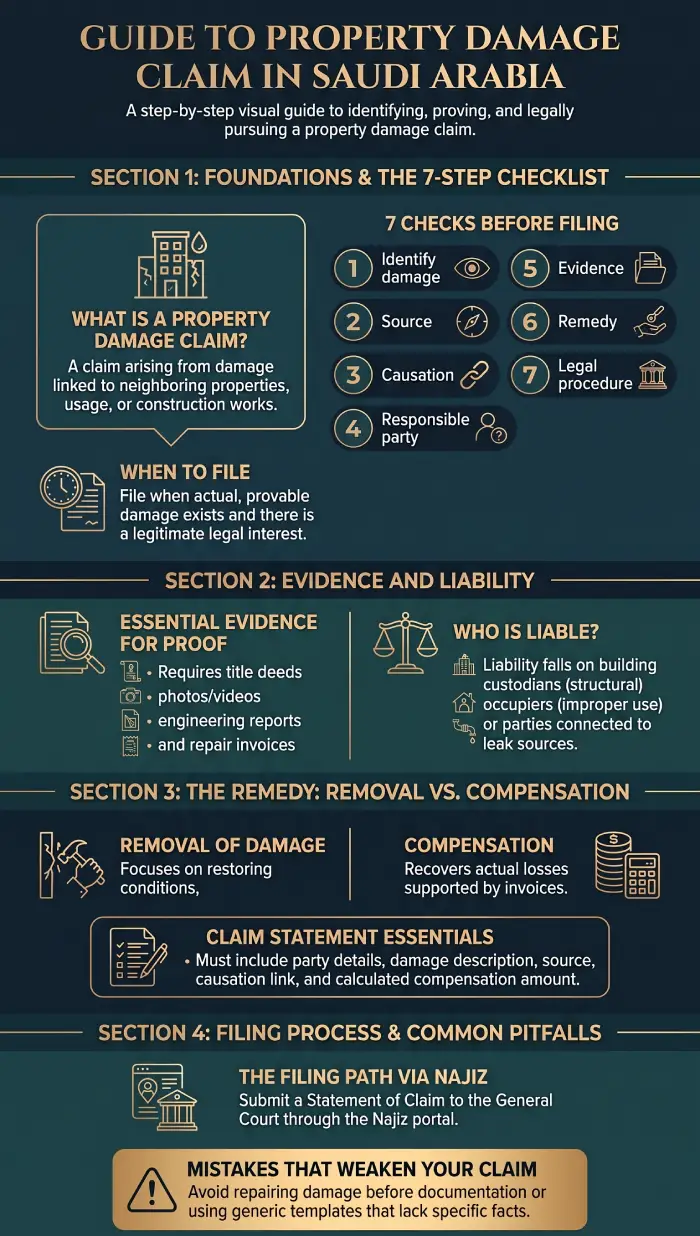
When Can You File a Property Damage Claim?
A property damage lawsuit may be appropriate where you have a legitimate interest and an identifiable incident that justifies removing the harmful condition or seeking compensation. The damage may originate from the property itself, its use, excavation or construction work, or a person exercising control over the source of the damage.
Such claims fall within the broader field of real estate disputes in Saudi Arabia, where the correct legal route depends on the nature of the right, the facts, and the remedy being requested.
For neighbor-related nuisance, the Saudi Civil Transactions Law distinguishes between ordinary effects that generally arise from neighboring properties and harm that exceeds the customary level. Factors may include local custom, the location and nature of the properties, and their intended use. A permit for construction or other work does not, by itself, prevent a neighbor from seeking removal of nuisance that exceeds the legally tolerated level.
Where the claim is based on a harmful act, the source of the damage, the resulting loss, and the person responsible must be examined. Liability may involve more than one party where several persons contributed to the damage. The injured party’s own conduct may also affect compensation where it contributed to causing or increasing the loss.
How Is Property Damage Proved and Who May Be Liable?
Proving property damage requires more than showing that physical loss exists. You also need evidence addressing its source and the connection between the alleged cause and the damage. Photographs and videos may establish visible cracks, moisture, or deterioration, but they may not identify the technical cause where that point is disputed.
What Evidence Can Support the Claim?
Relevant evidence may include the title deed or another document establishing your legal interest, photographs, videos, correspondence, invoices, repair estimates, official records, and engineering or technical reports. An engineering report may be particularly useful where the dispute involves water leakage, cracks, excavation work, or a structural defect requiring specialist assessment.
Where your standing or relationship with the affected property is disputed, evidence used for property ownership verification may also become relevant alongside the documents proving the damage itself.
A party may also seek judicial inspection or preservation of the existing condition where there is a risk that important features of the damage will disappear before the dispute is resolved. Expert evidence can assist the court with technical issues, but an expert report does not itself determine legal liability.
Who Is Responsible for Property Damage?
Responsibility depends on the source of the damage, who exercised actual control, and the conduct that produced the loss. In construction-related cases, the legal custodian of a building may need to be examined. Damage arising from the use of a unit may instead relate to the tenant, occupier, or person who caused it. A contractor may also become relevant where the damage can be connected to the execution of construction works.
| Source of Damage | Potentially Responsible Party | Key Issue to Prove |
|---|---|---|
| Collapse or structural defect | Building custodian | Cause, custody, and maintenance |
| Improper use of a unit | Occupier or person responsible | Conduct and connection to damage |
| Excavation or construction | One or several parties | Execution and causation |
| Water leakage | Party connected to the source | Leak source and maintenance responsibility |
Where several parties are involved, or the damage arises from technical works or contracting activity, reviewing the facts with a Real Estate Lawyer in Jeddah can help identify the potentially responsible party and the evidence needed before directing the claim.
Removing the Damage or Claiming Compensation?
The appropriate remedy depends on whether the harmful condition is continuing and what loss has already occurred. Where the source remains active, stopping or removing the cause may be the immediate priority. Where the event has ended but left measurable damage, compensation for property damage may become the main remedy.
Compensation is intended to address legally recoverable loss. Depending on the circumstances, it may include actual financial loss and lost gain where the applicable requirements are satisfied. The remedy may also involve restoring the previous position or requiring a specific action connected to removing the effects of the harmful conduct.
The amount of a property damage compensation claim should not be arbitrary. Where the claim includes repairing cracks or water-related damage, the amount should be supported by invoices, quotations, or an appropriate technical assessment. A figure stated without explaining how it was calculated does not clearly establish the extent of the financial loss or its connection to the incident.
What Should a Property Damage Compensation Pleading Include?
People frequently search for a property damage compensation pleading or a sample property damage claim. In Saudi court procedure, the action is commenced through a statement of claim, while the term “compensation pleading” is often used more broadly to describe the written presentation of facts, legal basis, evidence, and requested relief.
Key Elements of a Compensation Claim
A well-prepared statement of claim should organize the parties, facts, supporting basis, and remedies clearly. Relevant elements may include:
- The claimant’s details, legal capacity, and relationship to the affected property.
- Available details of the defendant.
- The court before which the claim is filed.
- A description of the property and the location of the damage.
- When the damage appeared and how it developed.
- The alleged source of the damage and surrounding events.
- The connection between the defendant’s conduct and the resulting loss.
- The type of damage and financial loss suffered.
- Supporting documents and evidence.
- The remedies requested, including removal of damage or compensation.
- The compensation amount and how it was calculated, where a monetary award is sought.
The requested remedies should correspond with the facts of the dispute. Simply stating that a property was damaged and requesting a monetary amount does not explain the source of the damage, the defendant’s alleged responsibility, or the basis on which compensation has been calculated.
Which Court Has Jurisdiction and How Do You File Through Najiz?
As a general rule, the General Courts have jurisdiction over disputes concerning real property, including claims arising from damage caused by the property itself or by those using it, unless another legal provision assigns jurisdiction elsewhere. The nature of the underlying relationship should therefore be reviewed before filing, especially where the dispute is connected to a commercial agreement, construction contract, or another relationship that may affect jurisdiction.
A Property Damage Claim in Saudi Arabia can generally be initiated electronically through the Statement of Claim service on Najiz. After signing in through the National Single Sign-On service, go to Electronic Services, select the Judiciary services, open the Statement of Claim service, and submit a new application. You will then enter the claimant and defendant details, provide the claim information and remedies requested, attach the supporting documents, and submit the application for review.
Do not rely on a classification used in another case or an older guide. The appropriate Najiz classification should match the facts, remedies, and options available on the platform at the time of filing. Missing information may need to be completed before the application is accepted and referred to the competent judicial circuit.
A compensation action arising from a harmful act is generally subject to the statutory non-hearing period applicable under Saudi law: three years from the date the injured party becomes aware of both the damage and the person responsible, with an overall limit of ten years from the occurrence of the damage, subject to applicable statutory rules and exceptions.
Mistakes That Can Weaken a Property Damage Claim
Repairing all traces of the damage before documenting them can create evidentiary problems, especially where the cause itself is disputed. Once cracks, moisture, or signs of leakage have been removed, it may become harder to establish the property’s condition when the damage occurred.
Another mistake is assuming that the property owner must be liable simply because they own the neighboring property. Responsibility depends on the source of the damage, the relevant conduct, and control over the property or activity involved. A claim may also be weakened by requesting compensation without explaining how the amount was calculated or by relying solely on photographs where technical evidence is needed to establish causation.
A generic property damage claim template should also be adapted to the actual facts. Start with the source of the damage, then identify the potentially responsible party, collect the evidence, and define the remedy being sought. Where technical evidence is necessary, the report should address the cause and extent of the damage and its connection to the disputed works, rather than dealing only with repair costs.
Frequently Asked Questions About Property Damage Claims
Which court hears a property damage claim?
The General Court ordinarily hears claims concerning damage arising from real property or its users, unless another jurisdiction applies to the particular dispute.
What should I include in a property damage compensation pleading?
Include the parties, facts, source of damage, evidence, loss, remedies requested, and the amount and basis of compensation where money is claimed.
Is an engineering report required to file the claim?
Not in every case. It may be important where the source of the damage or causation depends on technical or engineering analysis.
Who is responsible for water leakage between apartments?
Responsibility depends on the source of the leak, its cause, and the person responsible for the relevant act, maintenance obligation, or source.
Are photographs enough to prove property damage?
They may establish visible damage, but may not prove its technical source or causation where those issues are disputed.
Can I seek both removal of the damage and compensation?
Potentially, depending on the facts and legal basis. Each remedy must be supported by the circumstances and evidence relevant to it.
Does a building permit prevent a claim for removal of damage?
A permit does not by itself prevent a claim seeking removal of neighbor-related nuisance that exceeds the legally tolerated level.
How is compensation for property damage calculated?
It depends on the legally recoverable loss and supporting evidence, including invoices, repair estimates, and appropriate technical assessments.
Property Damage Claim in Saudi Arabia: 7 Key Checks Before Filing starts with practical questions rather than an assumed compensation figure. Identify the damage and its source, establish causation, determine who may be responsible, preserve the evidence, define the remedy, and then select the appropriate judicial route.
A property damage compensation pleading should connect the facts, supporting basis, evidence, and remedies clearly. Water leakage, structural cracks, and excavation damage may require technical documentation before repairs alter the condition of the property or remove important evidence.
Where a broader review of the documents and litigation route is required, a Law Firm in Jeddah can begin by examining the source of the damage, the available evidence, the potentially responsible party, and the appropriate next step before the statement of claim is filed.
Request an initial confidential assessment of the property damage and determine the appropriate next step before filing the statement of claim.
Legal Sources: