
Criminal defences in Saudi Arabia are not merely a denial of the accusation. They are legal tools used to examine the procedure, the evidence, and the elements of the alleged offence. A properly raised defence may affect the exclusion of evidence, weaken the accusation, change the legal characterization of the facts, or support a request for acquittal when the record and documents justify that outcome.
Under Saudi law, criminal defences are not built on general statements. They require a careful reading of arrest reports, investigation records, and available evidence. For that reason, the strength of a defence differs according to the type of offence and the stage of the case.
Before the Case Speaks: Where Does the Defence Stand?
In brief, criminal defences are legal arguments through which the accused or their lawyer challenges the validity of procedures, the strength of evidence, or the existence of the offence’s legal elements. A defence may be procedural, such as challenging arrest or search, substantive, such as denying criminal intent, or evidence-based, such as questioning witness contradictions or weak evidence.
No single defence works in every criminal case. Each case has its own facts, records, procedural stage, and evidentiary structure. Before preparing any response, it is important to know whether the matter is still under investigation, before the criminal court, or already subject to a judgment that may require an objection.
In an active criminal case, the correct approach does not begin by choosing a defence immediately. It begins with reviewing the records and evidence through a law firm in Jeddah to understand the current stage and determine the next suitable step.
What Are Criminal Defences?
Criminal defences are legal or factual objections submitted by the accused or their representative to respond to the accusation. They are not limited to denying the incident. They may include examining the legality of arrest and search, challenging a confession, assessing testimony, and reviewing the legal elements of the offence.
The difference between general defence and a specific legal defence matters in criminal cases. A general defence may explain the facts or deny the allegation, while a legal defence targets a specific procedure, piece of evidence, or element that may affect the outcome.
For a defence to be serious, it should be clear, relevant, and capable of affecting the direction of the case. A general argument that is not connected to the evidence may not change the course of the proceedings unless it addresses a material point.
Types of Criminal Defences
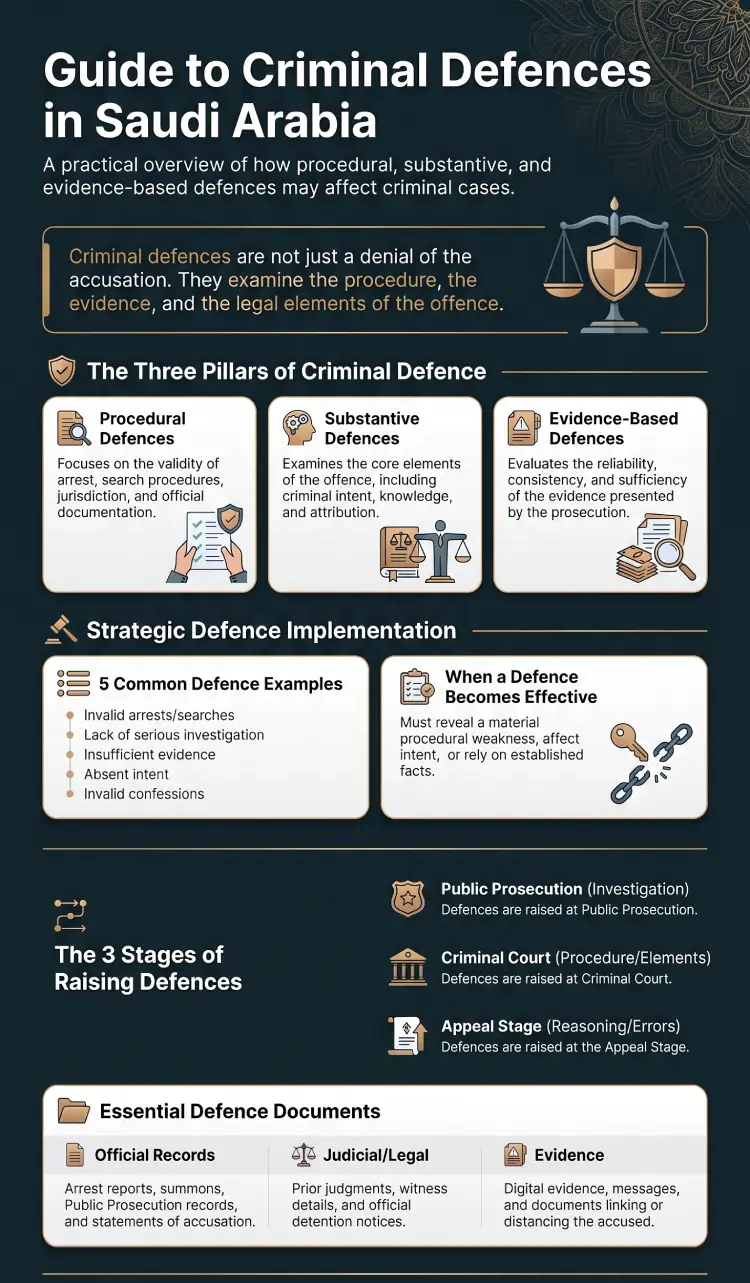
Criminal defences are commonly divided into procedural defences, substantive defences, and evidence-based defences. This classification helps organize the defence memorandum and identify the issues that should be examined first.
| Type of Defence | What It Targets | Practical Example |
|---|---|---|
| Procedural defences | The validity of the procedure before the accusation itself | Invalid arrest or search |
| Substantive defences | The elements of the offence and attribution of the act | Absence of criminal intent |
| Evidence-based defences | The strength and reliability of evidence | Contradictory witness statements |
Procedural defences challenge the validity of measures such as arrest, search, jurisdiction, and arrest reports. Substantive defences address the core accusation, such as the absence of the physical or mental element of the offence, or the lack of proper attribution to the accused.
Evidence-based defences address matters such as weak technical evidence, contradictory witness statements, or the absence of material evidence. These defences do not merely deny the incident; they examine whether the evidence can support a stable judicial conviction.
7 Examples of Effective Criminal Defences
The strength of a defence is not measured by its name alone. It depends on how closely it relates to the procedure, the evidence, or the elements of the offence. A single defence may be highly effective in one file, yet irrelevant in another if the records and facts do not support it.
Common examples of criminal defences include:
- Invalid arrest when the defect relates to the legality of the procedure or the evidence resulting from it.
- Invalid search when there is an issue with the basis, scope, or method of the search.
- Invalid arrest or investigation report when there is a material defect or apparent contradiction in the facts.
- Lack of seriousness in investigations when they are general or unrelated to specific facts concerning the accused.
- Insufficient evidence when the documents or indicators do not support a stable conviction.
- Absence of criminal intent when the required knowledge or intention is missing.
- Invalid confession when there is a dispute over free will, pressure, coercion, or consistency with other evidence.
Key Procedural Defences in Saudi Criminal Cases
Procedural defences examine whether the case reached the investigation authority or court through a valid legal path. They may be relevant when the defect concerns a material procedure that produced evidence or affected the right of defence.
One of the main examples is the defence of invalid arrest or search. This defence is raised when there is a question about the legal basis of the procedure or its limits. It does not automatically cancel the entire case, but it may affect how the resulting evidence is evaluated.
A defence may also challenge an arrest report or investigation record when the report contains a material omission or an apparent contradiction. The defence of lack of seriousness in investigations may arise when the investigation is general, vague, or fails to show a clear link between the accused and the alleged offence.
If your file includes arrest, search, or digital evidence, reviewing the sequence of procedures becomes essential. In cases involving messages or devices, reviewing digital evidence differs from reviewing traditional evidence, especially in cybercrime cases.
Key Substantive Defences in Criminal Cases
Substantive defences target the accusation itself, not merely the procedure that preceded investigation or trial. They are therefore connected to the legal elements of the offence, attribution of the act, and the existence of intent or knowledge.
Insufficient evidence is one of the most common criminal defences in Saudi Arabia. An accusation alone is not enough to establish guilt. The evidence must be coherent and capable of supporting the conclusion sought by the prosecution or private claimant.
The defence of absence of criminal intent under Saudi law arises when the offence requires a specific intention or knowledge, while the facts show otherwise. The defence of absence of the physical element focuses on the act itself, whether it occurred, and whether it can be attributed to the accused.
The defence of lack of attribution may be the most direct defence in cases involving multiple individuals or weak linkage. It becomes particularly relevant when the evidence does not clearly identify the offender or show the accused’s connection to the incident.
Defences Related to Confession, Testimony, and Evidence
Confessions, testimony, and technical evidence require careful review because they may influence the court’s conviction. The mere presence of evidence in the file is not enough. Its source, content, and consistency with other evidence must be examined.
The defence of invalid confession may be raised when there are indicators that the confession was not made freely. A defence based on coercion requires connecting the allegation to the circumstances of the investigation, visible indications, or other arguable evidence.
Contradictory witness statements are not always decisive. Their real effect appears when the contradiction concerns a material fact in the accusation, especially when assessing witness testimony in criminal evidence and its sufficiency as proof.
The issue sometimes described as “judgment based on suspicion” in criminal cases should be handled carefully. The point is the effect of doubt on the strength of evidence, not a general rule that suspicion alone is sufficient for conviction.
When Does a Defence Become Effective?
A defence becomes effective when it addresses a point capable of changing the evaluation of the file. It should not be a side comment. Its strength is measured by its impact on the procedure, evidence, elements of the offence, or reasoning of the judgment.
Signs that a defence may deserve serious examination include:
- It relates to a material procedure, such as arrest, search, or interrogation.
- It reveals weakness in the evidence or a material contradiction in statements.
- It affects an element of the offence, such as intent or attribution.
- It relies on a document, report, or established fact.
- It is presented clearly and ends with a specific request.
Accepting a defence does not always mean immediate acquittal. It may lead to excluding evidence, reassessing the evidence, changing the legal characterization, preserving the case at the investigation stage, or acquittal if the defence affects the core accusation.
Criminal Defences Before the Public Prosecution
Submitting defences before the Public Prosecution differs from presenting them before the court. The investigation stage aims to examine the facts and collect evidence. Defences at this stage usually focus on denying connection, requesting further investigation, or identifying evidentiary gaps.
A defence may include requesting witness hearing, submitting a document, discussing contradictions in the complaint, or explaining a point that affects the accusation. These points should be raised clearly without expanding into facts that do not serve the file.
A request to preserve or close a criminal case may be appropriate when there are material reasons, such as insufficient evidence or weak attribution to the accused. Submitting such a request does not mean that the case will automatically be preserved, since the decision depends on the prosecution’s assessment of the investigation file.
Understanding the Public Prosecution investigation period in Saudi Arabia may also help clarify the expected timeline before referral or preservation.
Criminal Defences Before the Criminal Court
Before the criminal court, defences should be arranged in a way that clearly shows the disputed issues. The presentation usually begins with procedural defences, then discussion of evidence, then defences relating to the legal elements of the offence, followed by final requests.
A defence memorandum in a criminal case should not be a collection of general phrases. It is better to include a summary of the facts, the accusation, procedural and substantive defences, discussion of evidence, and specific requests.
Not every defence leads to acquittal. The effect may be limited to weakening evidence, opening further discussion, or changing the legal characterization of the act. A defence becomes decisive when it affects a main piece of evidence or an essential element of the offence.
Criminal Appeal Defences
Appeal defences usually address the judgment, its reasoning, and the application of law. Therefore, the judgment should be read carefully before preparing an objection, rather than simply repeating the earlier defence memorandum.
Important appeal defences may include insufficient reasoning, failure to address a material defence, or failure to discuss significant evidence. The objection should explain the effect of the error on the judgment, not merely mention it as a general complaint.
No single objection form works for every criminal judgment. In one case, the objection may focus on weak evidence. In another, it may focus on insufficient reasoning or incorrect application of law.
When Do You Need a Criminal Cases Lawyer?
The need for legal file review increases when the case is at the stage of detention, investigation, trial, or appeal.
The lawyer’s role is not to promise a result. It is to review the file, identify strengths and weaknesses, and select the appropriate defences for each stage. If you need to review an active file in Jeddah, a criminal cases lawyer in Jeddah can assess the available documents and procedures.
To prepare for a more accurate initial review, collect any available arrest report, summons notice, investigation record, judgment, messages, images, or documents related to the incident.
Documents That Help Assess Criminal Defences
Assessing criminal defences in Saudi Arabia requires reviewing the main documents because the proper defence changes from one file to another. A single document may reveal a procedural defect, an evidentiary contradiction, or a point that helps deny connection.
Useful documents for an initial review include:
- Arrest report or complaint.
- Summons or detention notice.
- Public Prosecution investigation record.
- Statement of claim or accusation.
- Judgment, if already issued.
- Messages, images, or digital evidence.
- Witness names or anything proving inconsistent statements.
- Any document showing the accused’s location or connection to the incident.
When attendance before the investigation authority or court is part of the file’s progress, understanding attendance bail in criminal cases may help clarify the effect of guarantees and attendance on the continuation of procedures.
FAQ About Criminal Defences in Saudi Arabia
What are criminal defences in Saudi Arabia?
Criminal defences are legal or factual arguments used by the accused or their lawyer to challenge the procedure, evidence, or legal elements of the alleged offence.
What are the main types of criminal defences?
The main types are procedural defences, substantive defences, and evidence-based defences. Each type targets a different part of the criminal case.
What is a procedural defence in a criminal case?
A procedural defence challenges the validity of legal procedures, such as arrest, search, jurisdiction, or official records.
What is a substantive defence?
A substantive defence addresses the accusation itself, including the elements of the offence, criminal intent, attribution, and the accused’s connection to the incident.
What are evidence-based defences?
Evidence-based defences challenge the reliability, consistency, or sufficiency of evidence, including testimony, confessions, technical evidence, and contradictions in the file.
Can criminal defences lead to acquittal?
They may lead to acquittal if they affect the core accusation, but not every defence results in acquittal. Some defences may only weaken evidence, exclude a document, or change the legal characterization.
When can invalid arrest or search affect the case?
Invalid arrest or search may affect the case when the defect concerns a material procedure or the evidence resulting from that procedure.
Can a confession be challenged in Saudi criminal cases?
Yes. A confession may be challenged if there are indications that it was not made freely, or if there are concerns about pressure, coercion, or inconsistency with other evidence.
When are contradictory witness statements important?
Contradictory witness statements become important when the contradiction concerns a material fact that affects the accusation or the sufficiency of the evidence.
How are criminal defences raised before the Public Prosecution?
They may be raised by denying connection to the incident, submitting documents, requesting witness hearing, or pointing out evidentiary gaps during the investigation stage.
Criminal defences in Saudi Arabia: 3 types and their impact is not a saved list of arguments. It is a way to read the file before responding. The strongest defence is the one that touches a real defect in the procedure, evidence, intent, or attribution.
A serious review begins with the records, evidence, and current stage, then arranges the defences according to their impact. A defence may be suitable before the Public Prosecution, before the court, or within an objection memorandum, depending on the case path.
If you need to understand the next step, you may contact BMS Legal via WhatsApp to share a summary of the case and the available documents.
Official Sources: