
A Drug Case Appeal Petition in Saudi Arabia begins with reviewing the judgment and its reasoning, rather than copying a general template or objecting only to the outcome. A criminal judgment identifies the facts the court considered established, the evidence it relied upon, the legal classification applied, and the resulting sentence. Each ground of appeal should therefore relate to a specific part of the judgment, an important procedure, or evidence that may have affected the outcome.
If a judgment has been issued in a drug possession, drug use, or promotion case, begin by obtaining a copy of the judgment and identifying when the appeal period starts. Then review the operative part of the judgment, its reasoning, seizure and investigation records, and any relevant reports before drafting the appeal.
This review helps determine whether the appeal concerns the sufficiency of evidence, the lawfulness of a material procedure, inadequate judicial reasoning, or the legal classification applied to the facts.
Filing an appeal against a drug judgment does not mean the decision will automatically change. The Court of Appeal reviews the judgment, the stated grounds of appeal, and the material submitted in support of those grounds before deciding the case under the applicable Saudi procedural rules.
Drug Case Appeal Petition: What You Need to Know First
A drug case appeal petition is a written memorandum identifying the judgment being challenged, the grounds that the appellant asks the court to review, and the relief requested on the basis of those grounds.
The petition is more effective when it deals directly with the judgment. It becomes weaker when it merely asks for acquittal or a reduced sentence without explaining the disputed error, evidence, procedure, or legal classification.
The period for appealing or requesting review of a criminal judgment is thirty days. It is therefore important to determine when that period begins and avoid leaving the review of the judgment until the final days.
The appeal memorandum should also identify the judgment, its number and date, the grounds relied upon, the appellant’s requests, and the required procedural information.
If you are searching for a drug judgment appeal template or a sample drug case appeal memorandum, use it only to understand the structure of the document. Do not copy grounds from another case. A ground that may be relevant to a drug use judgment may have little relevance to a possession-with-intent-to-promote case, and the reverse is equally true.
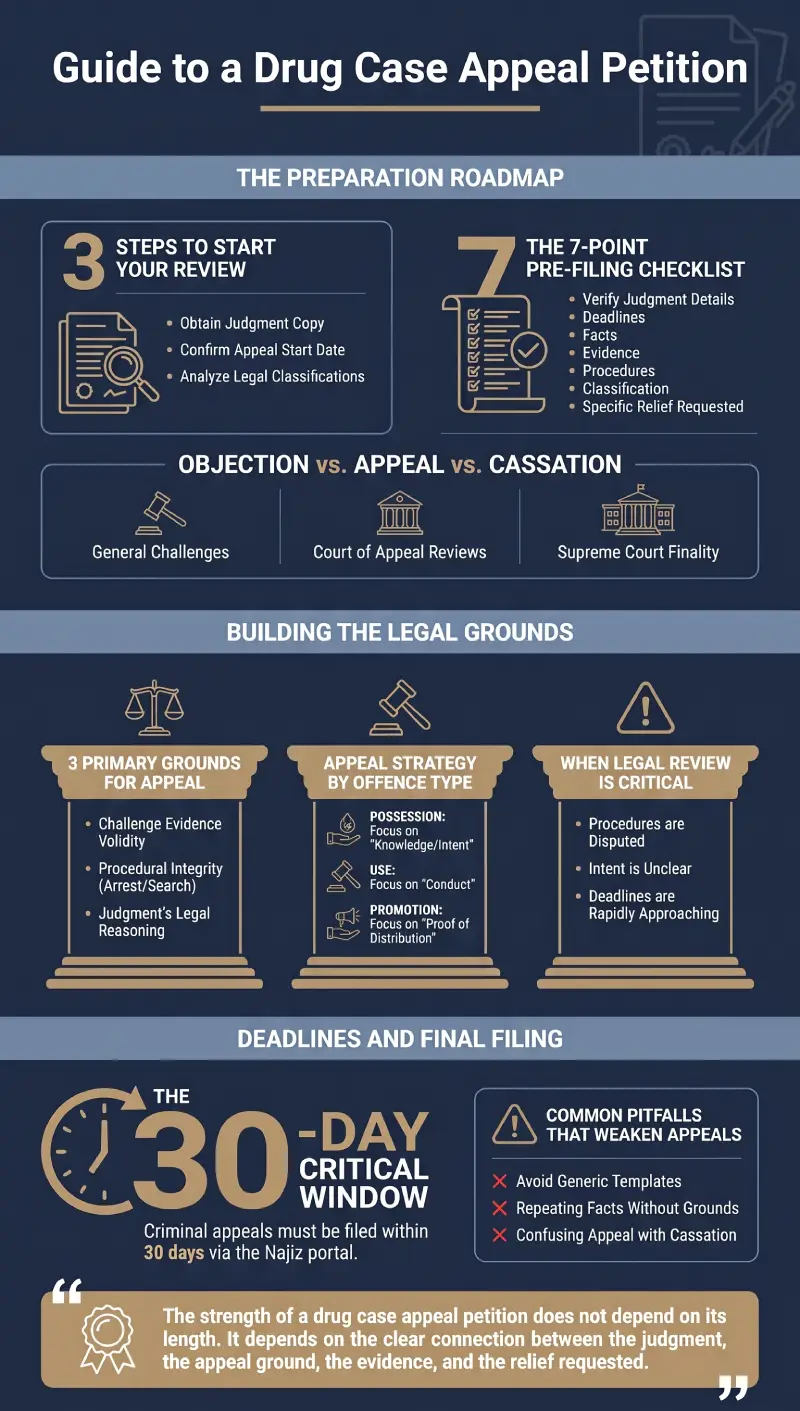
What Is the Difference Between an Objection, Appeal, and Cassation?
An objection is the broader concept of challenging a judgment through a procedure recognised by law. An appeal or judicial review concerns the examination of a first-instance judgment before the Court of Appeal.
Cassation is a separate form of challenge concerning judgments issued or upheld by the Court of Appeal and is submitted to the Supreme Court on the grounds prescribed by law.
This distinction is important when preparing a drug case appeal. Grounds used before the Court of Appeal are not drafted in exactly the same way as grounds supporting an application for cassation.
The procedural stage should therefore be identified before choosing the wording, legal arguments, or requested relief. The phrase “grounds for cassation of a drug judgment” should not be treated as an automatic synonym for grounds of appeal.
| Route | Main Function |
|---|---|
| Objection | Seeking review of a judgment through the appropriate legal route |
| Appeal or review | Review of a first-instance judgment by the Court of Appeal |
| Cassation | Review before the Supreme Court of a judgment issued or upheld on appeal, subject to its legal requirements |
How Do You Draft an Appeal Against a Drug Judgment?
Drafting begins with reading the case file before writing the memorandum, then arranging the grounds according to their legal significance and potential effect.
Where an argument concerns a procedural or substantive defence, understanding the different types of criminal defences helps distinguish the nature of the argument before connecting it to the judgment and case documents.
Before filing an appeal against a drug judgment, review seven essential points:
- The judgment number, date, and court that issued it.
- The start and expiry of the appeal period.
- The facts the court treated as established.
- The evidence relied upon by the court.
- Material arrest, search, seizure, or investigation procedures.
- The legal classification of the conduct and the sentence linked to it.
- The relief that can be connected directly to the stated grounds of appeal.
These seven points provide the practical foundation for a Drug Case Appeal Petition in Saudi Arabia. They also prevent a standard appeal template from becoming a lengthy document that fails to address the actual judgment.
Each ground should identify the relevant evidence, procedure, or part of the reasoning that the appellant asks the Court of Appeal to review.
Key Grounds for Appealing a Drug Judgment
Grounds for appealing a drug judgment vary according to the facts, evidence, and procedures in the individual case. Some grounds may concern whether the offence itself was sufficiently established or whether the evidence supports the conviction.
Where the appeal goes to the basis of criminal liability, reviewing the reasons for acquittal in drug cases can help explain the types of evidential and legal issues that may affect whether the offence has been established.
- Sufficiency of evidence: Review the evidence relied upon by the court and whether it supports both the facts and the legal classification stated in the judgment. Relevant material may include seizure records, statements made by the accused, statements of arresting officers or witnesses, technical reports, and evidence linking the accused to the seized substance. Simply stating that the evidence is insufficient is not enough without identifying the disputed evidence and explaining the issue.
- Arrest, search, and seizure: The lawfulness of arrest or search procedures may become a ground of appeal where the case documents support the existence of a material procedural issue. The petition should identify the disputed procedure, why it is challenged, and its relationship to the evidence. A procedural issue should not be presented as automatically cancelling the entire case.
- Judicial reasoning and legal classification: An appeal may question inadequate reasoning where the judgment fails to address an important issue affecting the case. The appellant may also challenge legal classification where the proven facts do not, in the appellant’s position, support the classification adopted by the court.
| Matter Under Review | Main Question |
|---|---|
| Evidence | Does it establish the conduct and classification reached by the court? |
| Procedures | Is there a material procedural issue requiring review? |
| Reasoning | Did the judgment address the important issues in the case? |
| Classification | Do the established facts support the legal classification? |
| Sentence | Is it connected to the classification and legal provision applied? |
How Does an Appeal Differ Between Possession, Drug Use, and Promotion?
The focus of an appeal depends on the offence for which the defendant was convicted and the evidence used to establish that classification.
Understanding the elements of drug offences under Saudi law is therefore useful when examining whether the facts established in the judgment sufficiently support possession, personal use, or promotion under the classification applied by the court.
In an appeal against a drug possession judgment, the review may consider the defendant’s connection to the seized substance, knowledge of its presence, the place where it was found, and the intent inferred by the court.
Where possession is alleged to have been for promotion or distribution, the evidence supporting that purpose becomes particularly important when preparing an appeal against possession with intent to promote.
A drug use appeal focuses on the underlying conduct, the evidence associated with use, the relevant intent, and any specific legal provisions that may apply to the circumstances.
The fact that the matter is a first offence does not automatically mean the result will change. The applicable legal conditions and the circumstances established in the case should be examined before any particular relief is requested.
In an appeal against a drug promotion judgment, the evidence supporting the alleged act of promotion and the relevant intent should be reviewed collectively.
The absence of one particular indicator, such as a specific tool or amount of money, should not be treated by itself as automatically changing the legal classification.
Drug Appeal Deadline and Filing Through Najiz
The period for filing an appeal or requesting review of a criminal judgment is 30 days. If that period expires without the required objection being filed, the right to use that route may lapse in accordance with the applicable procedural rules.
You should therefore confirm the start of the appeal period from the case record, the judgment copy, and the procedures relating to its receipt rather than relying on an approximate calculation.
Najiz provides an electronic service for objecting to first-instance judgments before the Court of Appeal. When submitting the request, follow the information and requirements displayed by the platform at the time of filing.
Do not rely on outdated instructions concerning character limits, upload formats, or other technical details because electronic service requirements may change.
After the appeal petition is submitted, the Court of Appeal reviews the case file, the stated grounds, and the supporting material submitted in connection with those grounds.
The court may decide to consider the appeal through a hearing where appropriate. It may uphold the judgment, overturn it in whole or in part, or decide the portion that has been overturned in accordance with its procedural powers.
Mistakes That Can Weaken a Drug Case Appeal
An appeal becomes weaker when it turns into an emotional request or a lengthy repetition of the facts without identifying the disputed point in the judgment.
Likewise, copying a ready-made drug appeal petition or a general appeal template may introduce arguments that have no connection to the case while overlooking the issues the Court of Appeal actually needs to review.
Common mistakes include delaying preparation until the appeal period is nearly over, repeating the factual narrative, presenting numerous weak grounds, using hostile language toward the court, and confusing appeal with cassation.
A request to reduce or overturn a drug judgment should also not be separated from its legal and factual basis. The relief requested should follow from the grounds explained in the petition.
Before filing, make sure each ground answers three questions: What part of the judgment is challenged? Why does it require review? What relief is requested in relation to that ground?
When Should a Drug Appeal Be Reviewed by a Lawyer?
A legal review becomes particularly important where the judgment relies on several pieces of evidence, where arrest or search procedures are disputed, where the case concerns promotion and intent, or where the appeal deadline is approaching.
Review may also be useful where it is difficult to distinguish between a genuine legal ground of appeal and simple disagreement with the outcome.
The practical starting point is the judgment copy, the date it was received, the reasons for conviction, and the documents that may affect the appeal.
When contacting BMS Legal for Law and Legal Consulting, prepare the judgment, case number, date of receipt, a brief description of the charge, and any report or document directly related to the proposed grounds.
If judgment has already been issued and the appeal period has started, a specialist review may be needed before filing. A Drug Lawyer in Jeddah can review the relevant documents and explain the procedural route according to the stage of the case without promising a specific outcome.
Frequently Asked Questions About a Drug Case Appeal Petition
1) What are the Real Estate Bank requirements in Saudi Arabia?
They include housing support eligibility, accurate applicant information, financing approval, a satisfactory credit record, and acceptance of the property.
2) Is the Real Estate Bank the same as the Real Estate Development Fund?
Not necessarily. The Real Estate Development Fund provides housing support, while the bank or finance company assesses the financing application and issues the financing approval.
3) Are Real Estate Bank requirements the same as Sakani requirements?
No. Sakani requirements relate mainly to housing support eligibility, while the financing provider assesses repayment capacity and financing eligibility.
4) Does being eligible on Sakani mean the bank will approve the financing?
No. Sakani eligibility confirms eligibility for housing support only. It does not require a bank or finance company to approve the financing application.
5) Why might an applicant be ineligible for Sakani?
Possible reasons include outdated information, previous use of housing support, ownership of a suitable home, or failure to meet an applicable eligibility requirement.
6) Does having a personal loan prevent me from obtaining a mortgage?
Not necessarily. However, existing personal loans may reduce your financing capacity if your financial obligations are already high.
7) Can a SIMAH credit record affect mortgage approval?
Yes. Payment defaults, overdue obligations, or irregular credit history may affect the financing provider’s decision.
8) Should I pay a deposit after my Sakani status shows “Eligible”?
It is generally safer not to pay a substantial deposit until the financing approval and the conditions for refunding the deposit are clear.
9) Should I file a complaint against the bank or the Real Estate Development Fund?
If the issue concerns housing support eligibility, the appropriate route generally involves Sakani or the Real Estate Development Fund.
10) When should I consult a lawyer about Real Estate Bank requirements?
Legal review may be useful when the reason for rejection is unclear, there is a dispute involving the property deed, an objection must be submitted, or the final financing agreement differs from the original offer.
A Drug Case Appeal Petition in Saudi Arabia: 7 Filing Points begins with reviewing the judgment details, the statutory deadline, the established facts, evidence, procedures, legal classification, and the relief requested.
Organising these elements helps produce an appeal focused on specific parts of the judgment rather than a general objection to the final outcome.
The strength of a Drug Case Appeal Petition in Saudi Arabia does not depend on its length or the number of legal expressions used. What matters is the connection between the judgment, the stated ground, the relevant evidence, and the relief requested.
The review should therefore begin with the judgment and the date it was received, followed by the evidence, procedures, and legal classification applied by the court before the final grounds are drafted.
In possession, drug use, and promotion cases, appeal grounds differ according to the facts, evidence, and legal classification of each case. Early review of the judgment and supporting documents can therefore help identify the appropriate appeal route before the statutory period expires.
The practical process begins with the judgment copy, its date of receipt, the reasons for conviction, and the relevant documents. Where an organised review of the judgment and appeal route is required, a Jeddah law firm with a criminal law team can assess the procedural stage and the nature of the proposed appeal before the next legal step is taken.
Official Sources: