
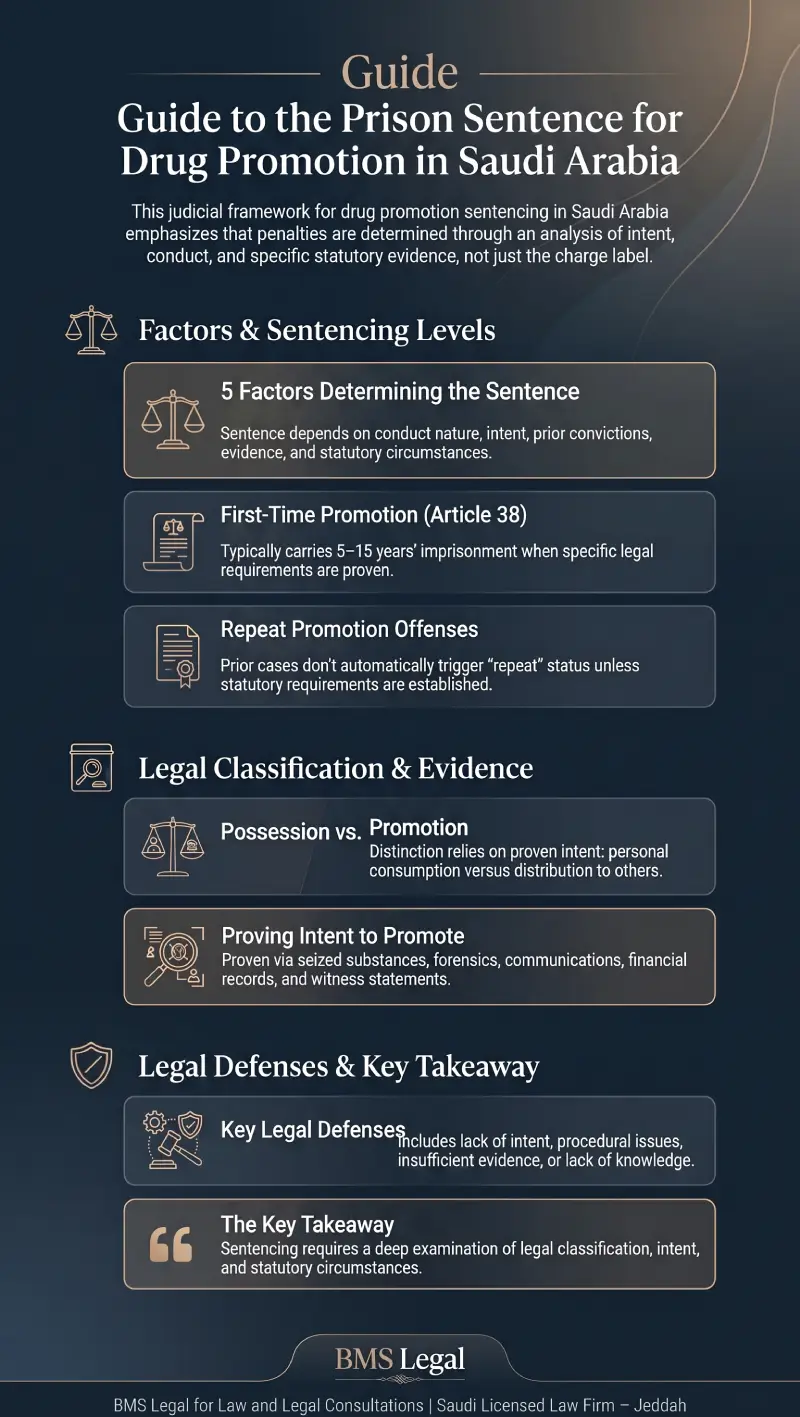
The prison sentence for drug promotion in Saudi Arabia depends on the legal classification of the conduct, the accused person’s intent, prior convictions, evidence, and applicable statutory circumstances. A case cannot therefore be treated as drug promotion merely because narcotics were seized, since Saudi law distinguishes personal use, possession with intent to promote, and repeat promotion offenses.
If you want to know how many years a person may receive for promoting narcotics, start with the applicable statutory provision, the proven facts, the evidence, and any previous judgment. This guide explains the penalty, legal classification, proof of intent, available defenses, mitigation, and challenges to a judgment.
Drug Promotion Sentence: 5 Factors That Affect the Penalty
Article 38 of the Saudi Law of Combating Narcotics and Psychotropic Substances provides for imprisonment ranging from five to fifteen years for conduct falling within its scope when committed with the intent to traffic in or promote narcotics, together with the other penalties prescribed by law. Article 37, however, regulates more serious cases, including a second promotion offense when its statutory conditions are satisfied.
Accordingly, the answer to how long the prison sentence for drug promotion in Saudi Arabia is depends mainly on five factors: the conduct involved, intent to promote, any previous judgment, the evidence, and aggravating or mitigating circumstances. These factors explain why the punishment may differ between cases that initially appear similar.
- Nature of the conduct: possession, sale, transport, delivery, receipt, or mediation.
- Intent to promote: does the evidence establish an intention to circulate or provide the substance to others?
- Prior convictions: what was the previous conviction, and how does it affect the new case?
- Evidence: what connects the accused to the conduct and the alleged intent to promote?
- Statutory circumstances: does an aggravating circumstance apply, or is there a legal basis for mitigation?
If the case is at the investigation or trial stage, a drug lawyer in Jeddah can review the legal classification, evidence, and prior convictions, then explain the appropriate legal step before any action is taken.
Penalty for a First Drug Promotion Offense
A first-time drug promotion sentence may fall within Article 38 when the intent to traffic in or promote narcotics is established. The provision covers several forms of conduct, including possession, sale, purchase, transport, delivery, receipt, and mediation, whether the promotion was carried out for payment or without payment.
The prison sentence for first-time drug promotion is therefore not determined merely by finding narcotics in a person’s possession. The underlying act, intent, and connection between the accused and the conduct must also be established. Where Article 38 applies, imprisonment ranges from five to fifteen years, but having no previous convictions does not automatically guarantee the minimum sentence.
For that reason, the punishment for drug promotion in Saudi Arabia varies according to the facts, evidence, and circumstances established in each case.
Describing a case as a first offense is also not enough to determine the legal outcome. The significance of a first drug offense in Saudi Arabia depends on the nature of the earlier offense and the legal classification adopted in the judgment.
When Does a Second Drug Promotion Offense Carry a Harsher Penalty?
A second promotion offense may fall within Article 37 when the statutory requirements are met, including the existence of a previous final conviction establishing promotion on the first occasion. The provision prescribes ta’zir capital punishment for the cases it identifies, while allowing the court, for reasons it states in the judgment, to impose a lesser penalty within the limits permitted by law.
Accordingly, not every previous drug conviction automatically triggers the rules governing a second promotion offense. The previous judgment, the offense for which the person was convicted, and the conditions of Article 37 must be examined before determining the penalty for repeat drug promotion.
When Does Drug Possession Become Drug Promotion?
Possession with intent to promote means that control over a narcotic substance is accompanied by an intention to circulate, provide, or distribute it to others. Possession for personal use, by contrast, is associated with an intention to consume the substance personally.
The distinction does not depend solely on the quantity seized. It is determined from the overall facts and evidence showing the purpose for which the substance was possessed.
If intent to promote is not established, the case may remain within a possession-based classification. In that situation, the penalty for possession of drugs for personal use in Saudi Arabia depends on the proven intent, circumstances, and evidence in the case.
The manner in which the substance was stored, communications, financial dealings, statements, and other circumstances may form part of the evidentiary picture. Article 38 also covers mediation, transport, delivery, and receipt where intent to promote is established. The correct legal classification should therefore be determined before assessing the penalty for possession with intent to promote.
| Legal classification | Intent to be established | Key distinction |
|---|---|---|
| Possession for personal use | Personal consumption | Circumstances and evidence indicating personal use |
| Possession without proven promotion | Determined from the facts | Possession alone does not establish promotion |
| Possession with intent to promote | Distribution or circulation to others | Conduct, circumstances, and evidence establishing intent |
| Repeat drug promotion | New promotion offense plus qualifying prior conviction | Nature of the previous judgment and Article 37 requirements |
How Is Intent to Promote Drugs Proven?
Proving drug promotion requires connecting the physical conduct with criminal intent and attributing both to the accused person. The assessment may begin with the nature of the seized substance and the forensic report, followed by arrest, search, and seizure records, statements, witness testimony, messages, calls, or financial transactions where relevant.
The existence of seized narcotics alone does not establish promotion. The elements of drug offenses under Saudi law must be established and connected to the alleged conduct, intent, and attribution of the offense to the accused.
No single circumstance necessarily has the same evidentiary value in every case. Quantity, money, communications, or other indicators must be considered together with the remaining evidence. The absence of sufficient proof of intent to promote can therefore become significant where possession is established but the evidence does not adequately show an intention to distribute the substance to others.
The legal assessment consequently extends beyond the mere existence of narcotics to the accused person’s knowledge, control over the substance, purpose of possession, and alleged role in the transaction.
Defenses in Drug Promotion Cases and Grounds for Acquittal
Defenses in drug promotion cases depend on the specific allegations and evidence in the file. There is no fixed list of arguments that guarantees a particular outcome. A defense may concern the absence of intent to promote, failure to establish that the seized substances belonged to or were controlled by the accused, lack of knowledge of the substance, or insufficient evidence to classify possession as promotion.
Where intent to promote is not established, or where a material issue affects the evidence or procedure, these matters may fall within the broader grounds for acquittal in drug cases depending on the circumstances of the individual case.
The review may also extend to the legality of arrest, search, seizure, preservation of evidence, and the resulting evidence. The significance of any procedural defect should be assessed in relation to its effect on the case rather than assuming that it automatically invalidates the judgment.
Contradictions between official records, witness statements, or digital evidence may also be relevant when they materially affect attribution of the conduct or proof of intent. Ultimately, grounds for acquittal in drug promotion cases depend on the actual weakness identified in the prosecution case, and no particular result can be guaranteed in advance.
If you have an arrest report, statement of claim, prosecution document, or judgment, the initial legal review should identify the central issue: intent to promote, attribution of the seized substances, legality of the procedure, or application of the relevant statutory provision. BMS Legal can review the available documents and explain the available legal options and next steps clearly and confidentially.
Mitigation and Challenging a Drug Promotion Judgment
Mitigation of a drug promotion sentence in Saudi Arabia is different from denying the charge or seeking a different legal classification. Mitigation assumes that the offense has been established and then considers the circumstances that the law allows the court to take into account when determining the sentence.
Article 60 regulates circumstances in which the court may impose a sentence below the prescribed minimum for legally recognized reasons related to the convicted person, personal circumstances, and circumstances surrounding the offense. The absence of previous convictions therefore does not, by itself, guarantee a reduced sentence.
Once a judgment has been issued, its reasoning, treatment of the evidence, and legal classification become central when preparing an appeal in a drug case within the applicable statutory period.
Where the dispute concerns intent to promote, the evidence and legal classification should be examined first. Saudi criminal procedure permits challenges to judgments in accordance with the applicable deadlines and procedures. Grounds may concern legal classification, reasoning, assessment of evidence, or a material procedural issue.
An appeal should address the reasons given in the judgment directly rather than merely repeating the factual narrative of the case.
Frequently Asked Questions About Drug Promotion Sentences
How long is the prison sentence for drug promotion in Saudi Arabia?
Article 38 provides for imprisonment from five to fifteen years when its conditions apply, while more serious cases are subject to different provisions and requirements.
How many years can a first-time drug promoter receive?
When drug promotion is established, the basic sentencing range under Article 38 applies, subject to the facts, evidence, and circumstances of the case.
What is the punishment for drug promotion in Saudi Arabia?
The penalty depends on the legal classification, intent, prior convictions, evidence, and statutory circumstances relevant to each case.
What is the sentence for a first-time drug promoter?
Article 38 applies where the elements of drug promotion are established and no more severe statutory provision governs the case.
Does every prior drug conviction increase the drug promotion sentence?
No. The type of prior offense, the judgment issued, and whether the statutory requirements for aggravation apply must first be determined.
What is the sentence for a second drug promotion offense?
Article 37 governs a second drug promotion offense when its statutory requirements are met, including the qualifying prior conviction.
Does a second drug promotion offense always result in ta’zir capital punishment?
Article 37 provides for ta’zir capital punishment in specified cases, while allowing the court to impose a lesser sentence within the limits permitted by law.
When is drug possession classified as drug promotion?
Possession may be classified as promotion when the evidence establishes an intent to traffic in, distribute, or provide the narcotic substance to others.
Does the quantity of drugs alone prove intent to promote?
No. Quantity is not an automatic basis for proving promotion and should be assessed together with the other evidence and circumstances.
How is intent to promote drugs proven?
Intent may be inferred from the facts, evidence, and surrounding circumstances, including communications, seized items, statements, and relevant transactions.
Prison Sentence for Drug Promotion: 5 Key Factors: the nature of the conduct, intent to promote, prior convictions, evidence, and applicable statutory circumstances.
A drug promotion case therefore cannot be reduced to a single number or the initial description recorded at the time of arrest. If the case is under investigation, before the court, or has already resulted in a judgment, the appropriate starting point is to review the documents, legal classification, previous conviction if any, and supporting evidence.
If you need a review of the case documents and the available legal options, BMS Legal, a law firm in Jeddah, can assess the file and explain the next legal step clearly and confidentially.
Legal Source: