
A Digital Forensics Specialization in Saudi Arabia combines computer science, incident analysis, evidence documentation, and an understanding of the legal requirements governing electronic data. Anyone considering this field will typically want to understand the available academic pathways, required skills, career opportunities, and how technical findings may relate to cybercrime and other criminal cases.
The work of a digital forensic investigator is not limited to recovering a deleted file or examining a mobile phone. It follows a structured methodology designed to preserve data and prevent alteration during examination. It also requires a clear distinction between technical findings, legal opinions, and decisions ultimately made by the investigating authority or court after considering the full body of evidence.
Your Guide to Digital Forensics Specialization in Saudi Arabia
A Digital Forensics Specialization in Saudi Arabia prepares students and professionals to examine, preserve, analyse, and document data from computers, mobile devices, and networks in an organised manner. In Saudi Arabia, related academic programmes may appear under titles such as digital investigation, computer forensics, digital forensics, or cybercrime, depending on the institution and programme structure.
Graduates may work in digital evidence, incident response, internal investigations, and cyberattack analysis within defined professional procedures and authority. The qualification itself does not grant independent legal authority, but it can prepare specialists to produce technical findings that competent authorities may review and rely upon as part of a broader investigation.
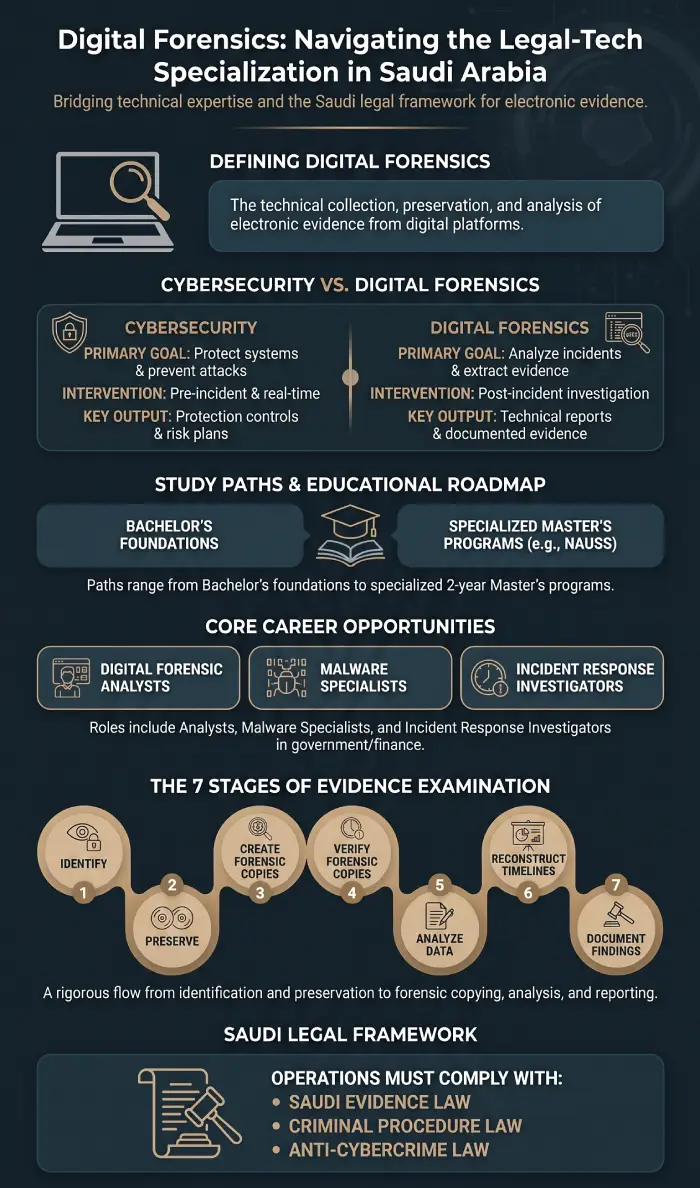
What Is Digital Forensics?
Digital forensics is a technical field concerned with collecting, preserving, analysing, and reporting electronic data using methods that can later be reviewed and verified. Sources may include mobile phones, computers, email accounts, network logs, cloud services, and social media accounts.
The analysis may help reconstruct a sequence of events, identify activity associated with a particular device, or indicate a possible source of communication. However, a technical finding does not by itself establish individual criminal responsibility. Linking the findings to a specific person requires assessment of the remaining evidence, circumstances, and procedures surrounding the incident.
The nature of the examination and the evidence required may differ according to the types of criminal cases in Saudi Arabia. Some cases may depend heavily on messages and login records, while others may require examination of devices, location data, or communication records.
Digital Forensics vs Cybersecurity
The two fields overlap in dealing with technical incidents, but they differ in purpose, timing, and expected outcomes. The table below summarises the main distinctions:
| Comparison | Cybersecurity | Digital Forensics |
|---|---|---|
| Objective | Protect systems and reduce risk | Analyse incidents and extract findings |
| Timing | Before, during, and after an incident | Usually after an incident is discovered |
| Output | Security controls and response plans | Technical reports and documented evidence |
| Core skills | Prevention, monitoring, and risk management | Preservation, analysis, and documentation |
Cybersecurity focuses on preventing attacks and limiting their impact, while digital forensics examines how an incident occurred, how it developed, and what technical traces it left behind. The two teams may work together after a breach: the cybersecurity team may contain the incident, while digital forensic specialists analyse the associated data.
Digital Investigation vs Traditional Criminal Investigation
Traditional criminal investigation may involve witness statements, physical traces, and examination of the scene, while digital investigation deals with data that may be altered, overwritten, or deleted. This means the specialist must document the condition of a device, minimise interaction with the original data, and record each examination step from receipt through final reporting.
Digital evidence may also form part of the broader stages of criminal investigation in Saudi Arabia, alongside statements from the parties, physical evidence, and other circumstances connected to the incident.
How to Study Digital Forensics in Saudi Arabia
When researching criminal investigation studies in Saudi Arabia, it is important to distinguish traditional criminal investigation from technical programmes focused on digital evidence. Saudi educational institutions may offer programmes related to digital investigation, computer forensics, and cybercrime at different academic and professional levels.
The nature of each pathway differs according to duration, academic depth, and intended audience. The following table provides a practical comparison:
| Pathway | Nature of Study | Suitable For |
|---|---|---|
| Bachelor’s Degree | Technical foundation and practical training | Secondary-school graduates seeking a specialised degree |
| Postgraduate Diploma | Applied specialisation after a bachelor’s degree | Technical graduates seeking a focused qualification |
| Master’s Degree | Advanced study and specialised research | Qualified graduates and practitioners |
| Professional Courses | Development of specific skills | Students or professionals seeking targeted training |
Admission Requirements and Choosing a Programme
Admission requirements, tuition fees, language of instruction, and programme duration vary between institutions and may change from one academic year to another. Some postgraduate programmes may require a technical degree, a specified level of English proficiency, and an interview or entrance assessment.
Do not rely on the programme title alone. Review the curriculum, laboratory facilities, practical training, and the experience of the teaching staff. You should also verify current requirements directly through the educational institution’s official website before applying or paying fees, as information published elsewhere may be outdated or relate to a previous intake.
What Does a Digital Forensics Student Study?
A Digital Forensics Specialization in Saudi Arabia usually combines core computing subjects with specialised forensic topics because analysing digital evidence requires an understanding of the technical environment in which the data was created. Subjects may include operating systems, networks, programming, databases, information security, incident response, and professional ethics.
Students may also study mobile device analysis, file recovery, system and network log examination, cloud forensics, and malware analysis. Some programmes may include reverse engineering, Internet of Things forensics, digital forensic laboratory management, and technical report writing.
Practical Training and Laboratories
Practical training enables students to examine educational datasets in an isolated environment while learning how to preserve original data and document every stage of the analysis. It also helps them use forensic tools correctly, recognise the limits of the results, and avoid conclusions that are not supported by the available data.
Training should not involve personal devices or private information without authorisation. Developing technical expertise does not justify privacy violations or unauthorised access. A programme becomes more valuable when it combines theoretical instruction, hands-on laboratory work, and structured technical reporting.
Key Skills for a Digital Forensic Investigator
The quality of a forensic examination depends on methodology, accuracy, and an understanding of the limitations of technical tools—not simply access to specialist software. Digital forensic investigators need a combination of technical, analytical, and communication skills so they can interpret data and present their findings clearly.
Important skills for anyone pursuing a Digital Forensics Specialization in Saudi Arabia include:
- Understanding operating systems, networks, and file systems.
- Analysing logs and constructing event timelines.
- Recovering data and examining mobile devices.
- Analysing malware and suspicious communications.
- Verifying the integrity of forensic copies and examination results.
- Distinguishing relevant evidence from data unrelated to the case.
- Documenting the chain of custody for digital evidence.
- Writing reports that separate facts, interpretations, and limitations.
Programming skills can help with data processing and automation of repetitive tasks, while English proficiency is useful for reading technical documentation and specialist references. However, accurate analysis and documentation remain more important than using sophisticated tools without understanding their outputs or limitations.
Digital Forensics Jobs in Saudi Arabia
Career opportunities in digital forensics vary according to sector, academic qualifications, and experience, and professionals in the field do not all hold the same job title. Graduates may work within cybersecurity teams, incident response units, internal investigation functions, or electronic fraud analysis teams.
Common job titles include Digital Forensic Analyst, Digital Forensic Investigator, Incident Response Specialist, Malware Analyst, and Mobile Device Forensics Specialist. Graduates may also work as Cybercrime Analysts, Internal Investigation Specialists, or Cyber Threat Analysts.
Opportunities may arise in government entities, financial institutions, telecommunications companies, cybersecurity service providers, and large organisations. Companies may require specialists to investigate data breaches, misuse of internal systems, or incidents occurring within the workplace.
There is no single standard salary for professionals in this field. Income may be affected by academic qualifications, years of experience, professional certifications, specialist expertise, and the level of responsibility involved. The employment sector, size of the organisation, and sensitivity of the data being handled may also influence the employment package.
How Is Digital Evidence Examined?
Digital evidence examination begins by defining the scope of the assignment and identifying the authority under which the examination is conducted. The condition of the device or dataset should then be documented before analysis begins. Changes to original data should be minimised because some information may be altered simply by switching on a device or opening an application.
A typical digital forensic examination may involve the following stages:
- Identify the relevant devices and data and document their condition.
- Preserve the original evidence and prevent unauthorised access.
- Create an appropriate forensic copy for analysis.
- Verify that the copy corresponds to the source.
- Examine files, logs, and communications.
- Construct a timeline of relevant events.
- Prepare a report explaining the methodology, findings, and limitations.
Recovering a deleted file does not by itself prove an incident or establish that a particular user was responsible for it. The finding must be interpreted within its context. Examination may also need to consider account ownership, login records, messages, service-provider data, and other evidence connected to the case.
Digital Forensics and Saudi Laws
Saudi Arabia’s Law of Evidence regulates digital evidence derived from data created, stored, communicated, or transmitted through digital means and capable of being retrieved in an understandable form. Digital evidence does not automatically carry the same evidentiary weight in every case, as its value may depend on its source, data integrity, verifiability, and the circumstances of the dispute or criminal proceedings.
Digital evidence may be considered together with witness testimony in criminal evidence, documents, and other circumstantial evidence. Its significance is assessed within the complete factual and evidentiary picture of the case.
The Saudi Law of Criminal Procedure regulates measures such as arrest, search, evidence gathering, and the documentation of seized items, all of which may affect the handling of electronic devices and data. Access to a device or account should therefore be based on appropriate legal authority or a valid procedural basis.
The Saudi Anti-Cyber Crime Law addresses prohibited conduct involving matters such as unauthorised access, blackmail, fraud, and interference with data. Digital forensic work may also engage the Personal Data Protection Law when personal information is collected, stored, processed, or shared.
Technical expertise does not give a person the right to access a private device or account without authorisation or a lawful basis. Exceeding the authorised scope of an examination may create legal or professional issues even when the intended purpose is to obtain information connected to an existing dispute or investigation.
Digital Forensics Specialization and Electronic Evidence Review
This content has been reviewed to verify the accurate distinction between Digital Forensics Specialization, the study of digital evidence, and the related career paths. It also explains the relationship between technical examination and relevant Saudi laws, including the Law of Evidence, the Law of Criminal Procedure, and the Anti-Cyber Crime Law. Each matter involving digital evidence remains subject to the nature of the data, how it was collected, and the procedures taken in relation to it.
Reviewed by
BMS Legal Law Firm & Legal Consultancy
Registration / License No.
7053637679
Last Reviewed
June 2026
Legal Disclaimer
The information provided is general and educational and does not constitute an assessment of a specific case or technical report. Evaluating digital evidence requires reviewing the source of the data, how it was collected, the integrity of its preservation, and its connection to the relevant incident, complaint, or dispute.
BMS Legal Law Firm & Legal Consultancy
Jeddah – Al Mushrifah District – Palestine Street – Al Safir Tower
How to Start a Career in Digital Forensics
Begin with the fundamentals of computing, networking, and operating systems, then move into digital evidence, chain of custody, and incident response. From there, select a more focused area such as mobile forensics, network forensics, malware analysis, or cloud environments.
Build experience through isolated laboratories, training datasets, and projects that clearly document methodology, findings, and limitations. Do not include personal information or real devices obtained without clear authorisation in your professional portfolio.
Professional certifications can add value when they match your current level and intended career path, but they do not replace experience or high-quality reporting. Before enrolling, compare the course content, examination requirements, fees, and relevance of the qualification to the role you intend to pursue.
The Role of the Digital Forensic Expert and Lawyer in a Case
A digital forensic expert examines data and explains the technical findings and their limitations, while a lawyer assesses the legality of the procedure, the evidentiary value of the material, and its legal consequences. The expert does not issue legal judgments, just as a lawyer does not replace specialised technical examination when the underlying data is complex.
Cooperation may become necessary when challenging a technical report, examining how evidence was collected, or interpreting conflicting logs. The lawyer and technical expert may also need to work together when determining whether an account or device can be attributed to a particular person or when assessing how a technical finding may affect legal claims and defences.
Where an incident involves blackmail, hacking, or online fraud, a Cybercrime Lawyer in Jeddah can assist in assessing the procedures and evidence and identifying the appropriate legal route under Saudi law. The English service page is currently available on the BMS Legal website.
Frequently Asked Questions About Digital Forensics Specialization
What is a Digital Forensics Specialization?
It focuses on collecting, analysing, preserving, and documenting digital evidence.
Is Digital Forensics available as a field of study in Saudi Arabia?
Yes. It may appear under titles such as digital forensics, computer forensics, or cybercrime.
What is the difference between Digital Forensics and Cybersecurity?
Cybersecurity protects systems, while digital forensics investigates incidents and analyses evidence.
Is Digital Forensics a technical or legal specialization?
It is mainly technical but closely connected to legal procedures involving digital evidence.
What are the admission requirements for Digital Forensics programmes?
Requirements vary by institution and may include technical qualifications and English proficiency.
How long does it take to study Digital Forensics?
It depends on whether the programme is a bachelor's degree, diploma, master's degree, or professional course.
Does Digital Forensics require programming skills?
Programming is useful, but networking, operating systems, analysis, and documentation are also essential.
Where can Digital Forensics graduates work in Saudi Arabia?
They may work in government, finance, telecommunications, cybersecurity, and large organisations.
Is every form of digital evidence automatically accepted by a Saudi court?
No. Its value depends on integrity, source, collection method, relevance, and verifiability.
When may a case require both a Digital Forensic Expert and a Lawyer?
When technical evidence needs both forensic analysis and legal evaluation.
A Digital Forensics Specialization: 2026 Saudi Guide offers a career path that combines technology, analysis, and professional responsibility rather than simply teaching how to use tools to examine devices. A strong foundation begins with computing and networking, develops through practical training, and progresses toward a focused area that matches the student’s skills and career objectives.
Do not send passwords, login credentials, or a complete copy of your device before receiving appropriate guidance. You can contact our legal team for a confidential initial assessment of a matter involving digital evidence or cybercrime. The English contact page is active on the BMS Legal website.
Official Sources: