
The Public Prosecution investigation duration begins when the arrest or incident report reaches the Public Prosecution. The facts and evidence are then reviewed to determine the proper legal course for the case. Opening an investigation does not mean the charge is proven, because conviction can only be established by a court judgment after examining the evidence and hearing the defenses.
It is important to distinguish between the investigation period and the detention period. They are two separate procedural tracks, each governed by different legal purposes and rules. The investigation may continue after the accused is released, while detention is subject to specific periods and authorities under the Saudi Criminal Procedure Law.
Detention may also end before the investigation is completed, or the procedures may continue until the Public Prosecution issues a decision to dismiss the case or refer it to the competent court.
Public Prosecution Investigation Duration in Brief
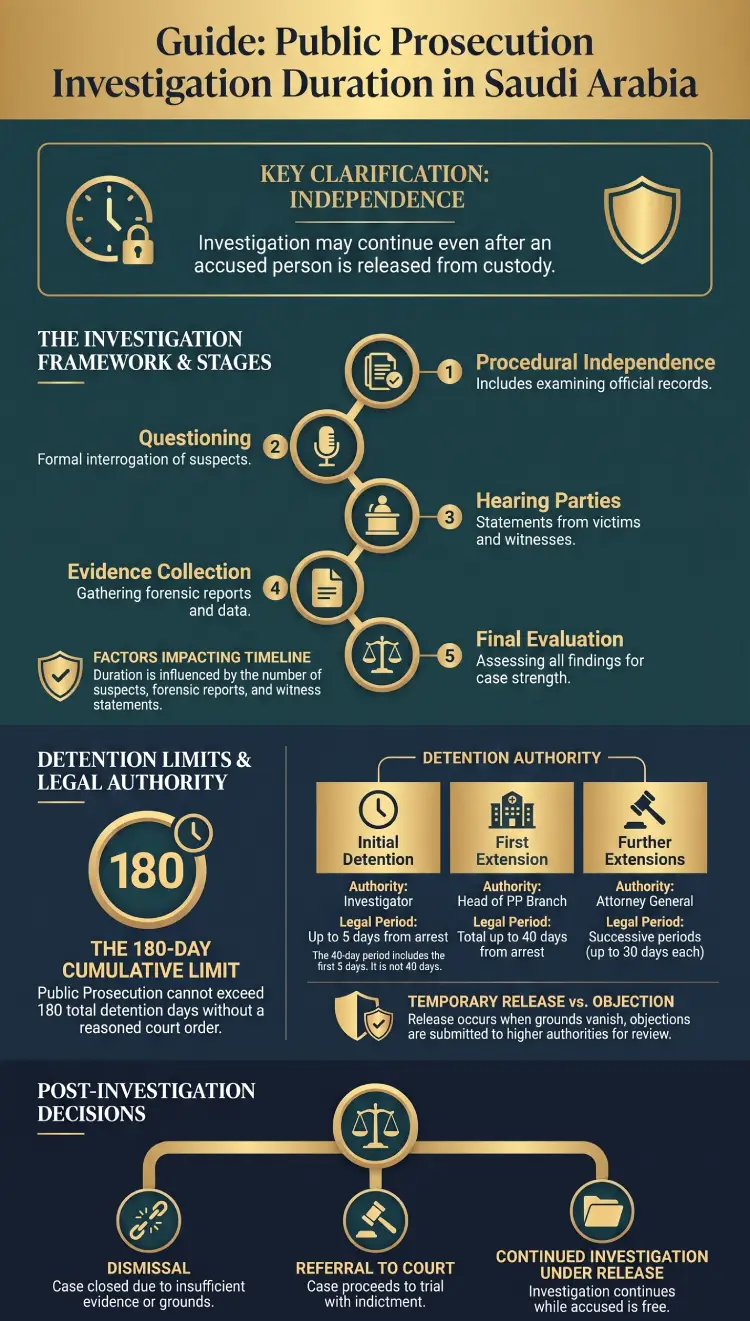
There is no single fixed period that applies to all Public Prosecution investigations. The nature of the case determines the procedures and evidence that must be completed. The 180-day period refers to the general cumulative detention limit within the Public Prosecution’s authority, not a final deadline for closing the investigation file or issuing the final procedural decision.
Initial detention ends after five days from the date of arrest unless a lawful extension is issued before that period expires. After 180 days, the general rule is either to refer the accused to the competent court or release them, with an exceptional judicial extension possible through a reasoned court order.
The investigation may continue while the accused is released if the Public Prosecution needs technical reports, witness statements, or additional documents. Therefore, the case status should be assessed through the latest official procedure, not by counting days alone.
How Long Does a Public Prosecution Investigation Take?
The duration depends on the type of offense, the number of parties, the volume of documents, and the reports needed to form a complete picture of the incident. Some files may be completed within a short period, while others require more time because of technical, financial, or digital procedures.
The main factors affecting how long a case remains with the Public Prosecution include:
- Multiple accused persons or victims requiring separate questioning and confrontations.
- Waiting for forensic, criminal laboratory, or device examination reports.
- Requests for banking data or official information from relevant government authorities.
- New documents or facts that require further questioning or additional witnesses.
- Conducting a procedure outside the investigator’s jurisdiction by assigning another investigator in a different region.
The length of the investigation alone does not reveal the direction or strength of the accusation. A delay may be linked to a neutral technical report. The assessment of witness testimony under Saudi law also depends on how consistent it is with the surrounding evidence and documents.
Stages of Investigation at the Public Prosecution
A criminal case investigation usually passes through five connected stages. The investigator determines the details of each stage based on the nature of the offense, the evidence, and the accused person’s status.
- Reviewing the arrest report: The Public Prosecution reviews the facts, seized items, jurisdiction, and the procedural data linked to the report.
- Questioning the accused: The accused is confronted with the incident and available evidence, and their answers and defenses are recorded in the investigation report.
- Hearing the parties: The Public Prosecution hears the victim and witnesses, and may conduct a confrontation when there is a material conflict in statements.
- Collecting evidence and expert reports: The investigator may request technical, medical, or financial reports and appoint an expert when needed.
- Evaluating the file: The evidence and defenses are reviewed to decide whether the case requires completion, dismissal, or referral.
Decision on the Case File
After the basic procedures are completed, the Public Prosecution determines the proper path based on the available evidence. It may request an additional report, hear another witness, release the accused while the investigation continues, dismiss the case, or refer it to the competent court.
Release does not mean the file is closed, and referral does not mean conviction. Each decision places the case within the broader criminal case stages until a judicial judgment is issued.
Detention Period and Authorities Responsible for Extension
Detention is a precautionary procedure, not a prior punishment. It is issued when its legal grounds exist in connection with the nature of the offense or the needs of the investigation. The investigation may continue without detention, and the accused may be released while remaining obligated to appear when formally requested.
| Stage | Competent Authority | Legal Period |
|---|---|---|
| Initial detention | Investigator | Up to 5 days from the date of arrest |
| Next extension | Head of the Public Prosecution branch or delegate | Total period not exceeding 40 days from the date of arrest |
| Further extension | Attorney General or delegated deputies | Successive periods, each not exceeding 30 days |
| General cumulative limit | Public Prosecution | 180 days from the date of arrest |
| After 180 days | Competent court | Exceptional extension by reasoned judicial order |
The 40-day period includes the first five days. Therefore, the two stages do not add up to 45 days. These periods apply under the general framework of the Saudi Criminal Procedure Law, while some special laws may provide different rules.
What Happens After 180 Days?
After reaching the general cumulative limit, the basic rule is to refer the accused directly to the competent court or release them. Detention does not continue beyond that period except in exceptional cases requiring a reasoned court order.
Reaching this period does not necessarily mean the investigation must be finally closed. Procedures may continue after release or after the case is referred. Extending detention also does not prove the charge; it remains a procedural measure that must be assessed based on the file facts, arrest date, and issued extension decisions.
Legal Content Review
Review of Public Prosecution Investigation and Detention Periods
This article has been reviewed by the legal content team at
BMS Legal for Law and Legal Consultations to clarify the difference between investigation duration, detention limits, release, objection procedures, and referral to court under Saudi criminal procedure.
This content is for general legal awareness only and does not replace legal advice based on the facts and documents of a specific case.
Temporary Release, Objection, and What Happens After Investigation
The accused may be released when the grounds for detention no longer exist, release does not harm the investigation, and there is no valid concern that the accused may flee or disappear. In major crimes, the Implementing Regulations require that the existing evidence not be sufficient, with the accused remaining obligated to appear and provide an address for notifications.
Release does not mean dismissal of the case or the end of the investigation. Evidence may still be collected and parties may still be heard until the final decision is issued. A new arrest or detention order may also be issued if the evidence becomes stronger, the accused breaches release conditions, or new circumstances arise.
A detained person may object to a detention order or its extension before the higher authority according to the source of the decision. The objection should be decided within five days. The request should preferably include the arrest date, extension decisions, current case stage, and the factual and legal reasons supporting release.
Personal appearance bail in criminal cases is linked to the accused person’s status while the proceedings continue. It does not mean that the case has been dismissed or the investigation file closed.
| Decision | Practical Meaning | Case Status |
|---|---|---|
| Temporary release | The accused leaves detention while procedures continue | Investigation remains ongoing |
| Dismissal of the case | Insufficient evidence or no basis to bring the case | It may be reopened if new evidence appears |
| Referral to court | Sufficient evidence to file the case | Trial stage begins |
| Supplementary investigation | Completion of a new procedure or evidence | The report is added to the case file |
If the evidence is insufficient, the investigator may recommend dismissal according to the applicable powers and procedures. If the Public Prosecution considers the evidence sufficient, it files the case through a pleading that includes the offense, evidence, and relevant legal provisions. The parties are notified of the referral decision without that meaning the accused has been convicted.
What Should You Do Based on the Current Case Stage?
The practical step depends on the file’s current status. Start by identifying the latest official procedure before submitting any request or document.
| Current Stage | Practical Step |
|---|---|
| A summons for investigation was received | Review the incident and documents and confirm the attendance date |
| The accused is detained | Check the arrest date and detention or extension orders |
| A release decision was issued | Comply with attendance requirements and release conditions |
| The case is under investigation | Follow up on the file and prepare required documents |
| The case was referred to court | Follow up on registration and hearings through judicial services |
| The case status is unclear | Start with the transaction number and latest official notice |
While the file is still with the Public Prosecution, follow-up is made through its services and official channels. After the case is registered before the court, case data and hearing notifications may be followed through Najiz, depending on the available service.
A delay in the case appearing on Najiz does not necessarily mean that the procedures have stopped. Registration and system updates may take time after the referral decision is issued.
Rights of the Accused During Investigation
The accused has the right to seek assistance from a lawyer during both investigation and trial stages, know the reasons for arrest or detention, and submit documents and defenses. The accused also has the right to review their statements before signing, and the investigator records any refusal to answer or sign without stopping the procedures.
Questioning must take place without coercion or influence over the accused person’s will, because freedom of will is one of the elements affecting the validity of a criminal confession and the possibility of challenging it.
The need to consult an accredited criminal lawyer in Jeddah becomes more important when detention continues, charges multiply, or the file involves complex digital or financial evidence. Legal review also becomes important when a confession is disputed or the case is close to referral to court.
Documents Needed for Legal Review
Prepare the case or transaction number, arrest date, latest recorded procedure, and any available detention or extension orders. Add attendance notices, official notifications, medical, technical, or financial reports, and correspondence showing the timeline of events.
Organizing these documents helps determine the current stage and review the available periods and options. Do not send all sensitive documents at the beginning. Start with a clear summary of the case status and latest procedure, then provide the relevant documents after identifying what the legal review requires.
FAQ on Public Prosecution Investigation Duration
How long does a Public Prosecution investigation take?
There is no single fixed period. The duration depends on the offense, parties involved, evidence, and required reports.
Is 180 days the investigation duration?
No. The 180-day period is the general cumulative detention limit, not a final deadline for closing the investigation.
Are the first 5 days added to the 40-day period?
No. The 40-day period is calculated from the arrest date and includes the first 5 days.
What happens after 180 days of detention?
The general rule is referral to court or release, with exceptional judicial extension by a reasoned court order.
Does detention extension mean the charge is proven?
No. Extension is a precautionary procedure and does not amount to a conviction.
How long does it take to decide an objection to detention?
The objection should be decided within 5 days from submission to the competent authority.
When can the accused be released?
Release may be granted when detention is no longer justified, does not harm the investigation, and there is no flight risk.
Does the investigation continue after release?
Yes. The investigation may continue until the Public Prosecution dismisses the case or refers it to court.
Can the accused be detained again after release?
Yes. This may happen if evidence becomes stronger, release conditions are breached, or new circumstances arise.
When does the Public Prosecution dismiss a case?
A case may be dismissed when evidence is insufficient or there is no legal basis to proceed.
Public Prosecution Investigation Duration: 5 Key Stages is not only a question about days. It is a procedural map that starts with reviewing the arrest report, then moves through questioning, evidence collection, detention or release decisions, and finally dismissal or referral to court.
In Saudi Arabia, the investigation period changes from one case to another, while detention follows specific legal limits. Release does not close the case, referral does not equal conviction, and the 180-day period relates to the general cumulative detention limit, not a fixed deadline for every investigation.
When you need a clear legal review of the investigation, detention, or referral stage, a law firm in Jeddah can help you understand your procedural position and identify the next appropriate step.
Official Sources: