
Article 80 of Saudi Labor Law defines the specific circumstances in which an employer may terminate an employee’s contract without an end-of-service award, notice, or compensation. Simply referring to Article 80 in a termination decision does not automatically make the dismissal lawful. The underlying facts must fall within one of the statutory cases, and the applicable requirements and procedures must be satisfied.
If you have received a termination decision, start by reviewing the stated reason and the specific Article 80 ground relied upon by your employer. You should then examine the supporting evidence, written warnings, investigation record, outstanding financial entitlements, and the termination reason officially recorded against your employment.
Article 80 of Saudi Labor Law: What to Check Before Objecting
Article 80 of Saudi Labor Law allows an employer to terminate an employment contract without an end-of-service award, prior notice, or compensation in nine specified cases. These cover work-related assault, serious breach of essential obligations, misconduct, intentionally causing material loss, forgery used to obtain employment, termination during probation, unauthorized absence beyond statutory limits, unlawful abuse of a position for personal gain, and disclosure of industrial or commercial secrets.
The employer must also give the employee an opportunity to state the reasons for objecting to the termination. Disciplinary measures are subject to additional procedural requirements concerning notification of the alleged violation, questioning the employee, considering the employee’s defense, and documenting the relevant procedure.
These provisions operate within the wider framework governing employment contracts, disciplinary measures, and termination under the New Saudi Labor Law.
Accordingly, dismissal under Article 80 is not automatically valid merely because the employer labels the decision as an Article 80 termination. The applicable statutory ground, its elements, the evidence, and the required procedure should all be reviewed before determining the effect on compensation and other employment entitlements.
Where the legal basis or procedure is unclear, the termination decision, employment contract, warnings, investigation documents, and related records should be reviewed before further action is taken.
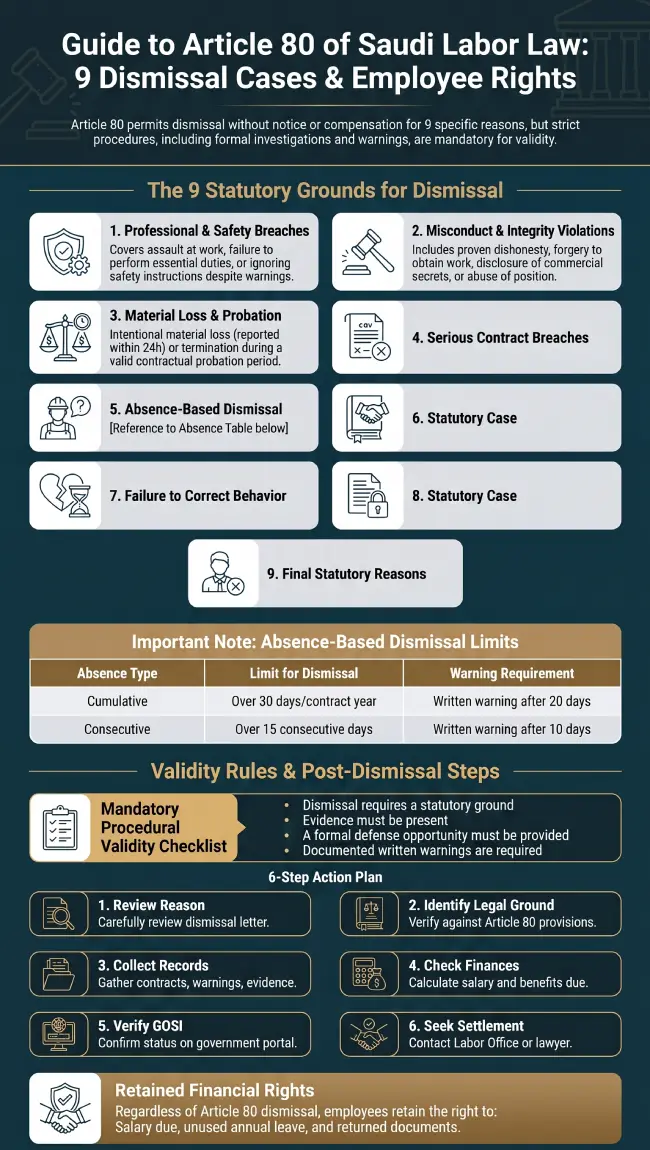
What Are the 9 Cases Under Article 80 of Saudi Labor Law?
The law identifies nine specific grounds under Article 80 of Saudi Labor Law. These grounds should not be treated as a general authorization to dismiss an employee for any workplace violation. The evidence required will depend on the particular ground involved.
| Case | Summary | Key Point to Review |
|---|---|---|
| Assault | Assault by the employee during work or because of work against persons specified by law | The incident and its connection to work |
| Serious breach | Failure to perform essential duties, obey lawful orders, or intentionally comply with safety instructions after warning | Contract, instructions, and warning |
| Misconduct | Proven misconduct or an act involving dishonesty or breach of integrity | Nature of the conduct and evidence |
| Material loss | Deliberate act or omission intended to cause material loss to the employer | Intent and statutory reporting requirement |
| Forgery | Use of forgery to obtain employment | Connection between the forgery and hiring |
| Probation | Termination while the employee is under a valid probation period | Contractual probation clause and duration |
| Absence | Exceeding the statutory absence limits without a legitimate reason | Number of days and written warnings |
| Abuse of position | Unlawfully using the employee’s position to obtain personal gain | Conduct and personal benefit |
| Disclosure of secrets | Disclosure of industrial or commercial secrets relating to the employer | Nature of the information and proof of disclosure |
Where material loss is relied upon, the act or omission must be intentional and aimed at causing loss to the employer. The competent authorities must also be notified within twenty-four hours from the employer becoming aware of the incident.
Forgery must be connected to obtaining the employment itself. Probation is separately regulated and should be expressly stated in the employment contract, subject to the statutory limit applicable to the probation period.
For this reason, the grounds for dismissal under Article 80 require a precise match between the actual conduct and the statutory provision relied upon by the employer.
What Are the Requirements for a Valid Article 80 Termination?
The requirements for applying Article 80 begin with establishing one of the nine statutory grounds. The employer must then consider the evidence and procedural requirements relevant to the particular violation. A termination notice referring to Article 80 cannot compensate for a lack of evidence that the statutory ground actually occurred.
Saudi disciplinary rules regulate how an employee is informed in writing of an alleged violation, questioned about it, allowed to present a defense, and how that process is documented. The employment file should therefore identify the incident, its date, the evidence relied upon, and the steps taken before termination.
Evidence may include the employment contract, attendance records, written warnings, professional correspondence, technical reports, acknowledgments, and other legally admissible material connected to the relevant event. There is no single form of evidence that applies to every Article 80 case.
Written warnings are also not required in exactly the same way for all nine grounds. The law expressly requires warnings in certain situations involving essential obligations, workplace instructions, and absence. The applicable paragraph should therefore be identified before determining whether a warning was required.
For employers, reviewing the legal ground, evidence, investigation, and warnings before issuing the decision can expose procedural weaknesses early. Employees can examine the same elements when assessing whether the termination requirements were properly satisfied.
Where the employment relationship is instead ended because the employer’s conduct gives the employee a statutory right to leave without notice, different rules apply under Article 81 of Saudi Labor Law.
Dismissal for Absence Under Article 80
Absence is one of the most frequently disputed grounds under Article 80 because Saudi Labor Law distinguishes between cumulative absence during the contractual year and consecutive absence. The employee’s absence must also be without a legitimate reason, and the statutory written warning requirements must be observed.
| Type of Absence | Threshold Before Termination | Written Warning |
|---|---|---|
| During one contractual year | More than 30 days | After 20 days of absence |
| Consecutive absence | More than 15 consecutive days | After 10 days of absence |
The numbers alone do not determine whether dismissal for absence under Article 80 is valid. It is necessary to establish whether the absence was consecutive or cumulative, whether the employee had a legitimate reason, and whether the required warning was issued at the correct stage.
For cumulative absence, the rule applies when the employee exceeds thirty days during one contractual year, rather than merely reaching thirty days. For continuous absence, the statutory threshold is more than fifteen consecutive days.
Where the parties disagree, attendance records, written warnings, communications, and documents explaining the absence become particularly important. An error in calculating the days or overlooking a relevant legitimate reason may affect the validity of the termination decision.
What Rights Remain After Termination Under Article 80?
Termination under Article 80 does not necessarily eliminate every financial right owed to an employee. A valid application of Article 80 permits termination without an end-of-service award, notice, or termination compensation, but other amounts may have accrued before the employment relationship ended.
Depending on the circumstances, remaining employee entitlements may include salary due up to the termination date, payment for accrued unused annual leave, and other established amounts that became payable before the employment ended. The employee may also request a service certificate and the return of documents deposited with the employer.
An end-of-service award under Article 80, notice pay, and termination compensation depend directly on whether the employer validly relied on Article 80. If the legal basis for the termination becomes disputed, entitlement to these amounts may need to be reconsidered in light of the facts and supporting documents.
For this reason, employees should not assume that every entitlement disappears merely because Article 80 appears in the termination decision. Salaries, accrued leave, the end-of-service award, compensation, and other amounts should be considered separately before signing any final settlement.
When Can an Employee Object to an Article 80 Dismissal?
An employee may have grounds to challenge an Article 80 dismissal where the alleged conduct is not established, does not fall within one of the nine statutory cases, or where a relevant condition or procedure was not properly followed. Disputes may also arise over written warnings, disciplinary investigations, or the termination reason recorded in official systems.
An objection alone does not make the termination unlawful. Equally, including the words “Article 80” in the employer’s decision does not establish that the termination was valid. The stated reason, supporting evidence, and procedures followed before termination all need to be examined.
The employee should retain the termination decision, employment contract, written warnings, investigation record, attendance records, correspondence, and payroll documents. If the dispute develops into an employment claim, the matter may proceed through the amicable settlement process and, where settlement is unsuccessful, before the Saudi labor court under the applicable procedures.
How Does Article 80 Affect SANED and Social Insurance?
The General Organization for Social Insurance records termination under Article 80 as a specific reason for excluding a contributor when the employment relationship ends. The registered exclusion reason should therefore accurately reflect the actual basis for termination, particularly when the employee disputes the employer’s decision.
For SANED unemployment insurance, one of the eligibility conditions is that the contributor must not have been dismissed for a reason attributable to the contributor. Termination under Article 80 is relevant to this condition. Other SANED eligibility requirements must also be satisfied.
If there is a discrepancy between the termination decision, the registered exclusion reason, or the supporting documents, keep copies of the relevant records. These may become important where an employment dispute overlaps with a GOSI exclusion issue or a claim for unemployment insurance.
Where the dispute concerns the validity of the dismissal, financial entitlements, or the objection process, the decision and supporting documents can be reviewed with a Labor Lawyer in Jeddah to identify the relevant legal issues and the appropriate next step.
Frequently Asked Questions About Article 80 of Saudi Labor Law
What is Article 80 of Saudi Labor Law?
It allows termination without an end-of-service award, notice, or compensation in nine specific cases.
When can an employer apply Article 80?
When one of the statutory cases is proven and its legal requirements are met.
Is mentioning Article 80 in the termination decision enough?
No. The underlying facts must support a valid Article 80 ground.
Is an investigation required before dismissal?
Disciplinary procedures generally require notice, questioning, and an opportunity for the employee to respond.
How many days of absence can lead to dismissal?
More than 30 days annually or more than 15 consecutive days, subject to required warnings.
Does Article 80 eliminate all employee entitlements?
No. Some accrued wages, leave, and other established entitlements may remain due.
When can an employee challenge an Article 80 dismissal?
When the reason is unproven, inapplicable, or a required procedure was not followed.
How can I object to dismissal under Article 80?
Gather the relevant documents and use amicable settlement and labor court procedures when needed.
Can an employee receive SANED after Article 80 dismissal?
Article 80 may affect SANED eligibility, subject to the other applicable conditions.
How does Article 80 affect GOSI?
GOSI records Article 80 as a specific termination reason when applicable.
A termination under Article 80 of Saudi Labor Law should be assessed by examining the statutory ground, the facts, supporting evidence, warnings, investigation procedures, financial entitlements, and the officially recorded termination reason.
If you are an employee, do not assume that every entitlement has been lost simply because your dismissal decision refers to Article 80. If you are an employer, Article 80 should not be treated as a standard dismissal formula without reviewing the legal ground and the required procedure.
When specialized legal review is required, BMS Legal, as a Law Firm in Jeddah, can review the termination reason, relevant documents, and disputed issues before determining the appropriate settlement or claim route.
Official Source: