
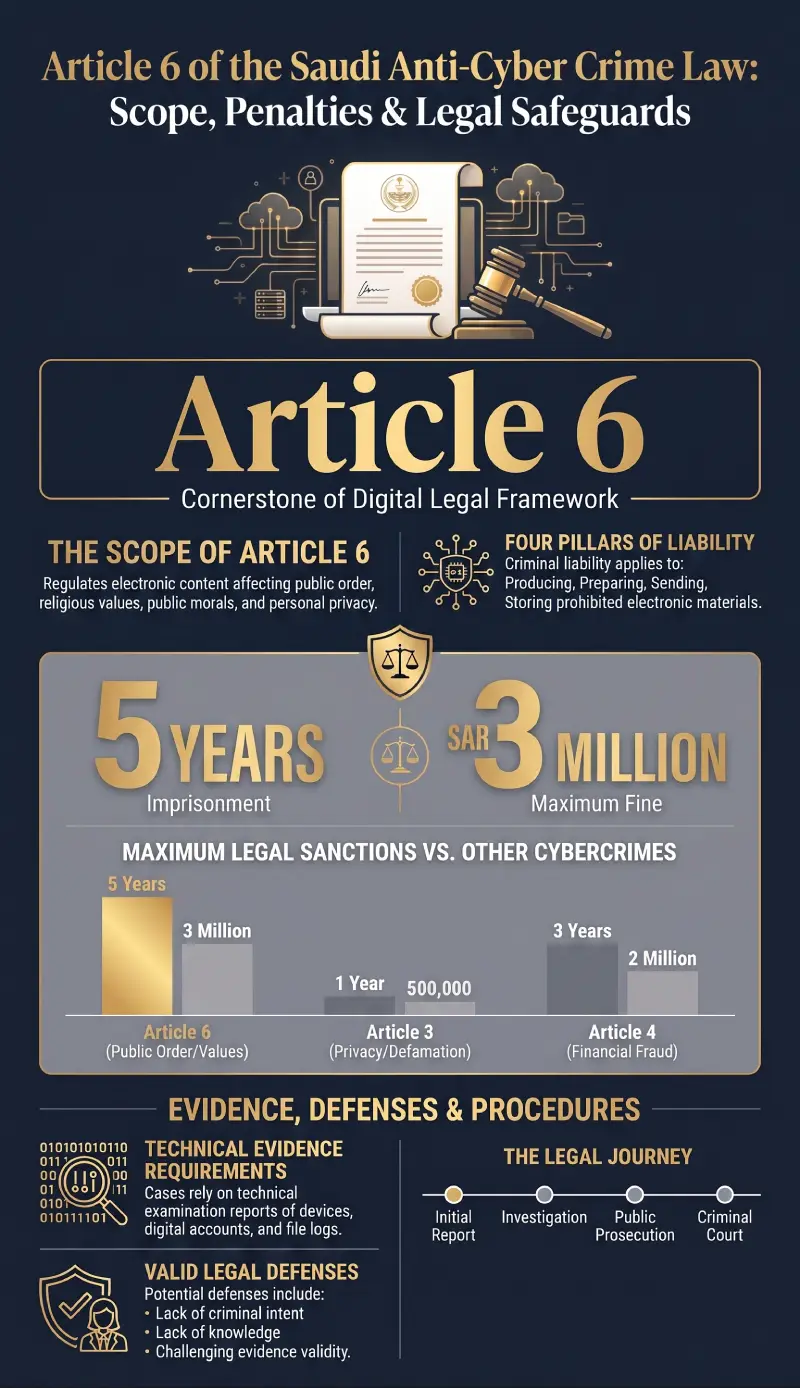
Article 6 of the Saudi Anti-Cyber Crime Law is one of the key provisions related to electronic content offenses. It addresses acts such as producing, preparing, sending, or storing content that affects public order, religious values, public morals, or personal privacy.
The application of Article 6 does not depend only on the existence of electronic content. The nature of the act, the method of obtaining or sharing the content, the intention behind handling it, and the available digital evidence are all considered when assessing the case.
To understand the position of Article 6 within Saudi cybercrime regulations, it is useful to review Types of Cybercrimes in Saudi Arabia and their classifications and related procedures.
Quick Answer: Explanation of Article 6 of the Saudi Anti-Cyber Crime Law
Article 6 of the Saudi Anti-Cyber Crime Law criminalizes producing, preparing, sending, or storing certain electronic materials that affect public order, religious values, public morals, or personal privacy. It also covers certain online activities related to prohibited websites. The penalty may reach up to five years of imprisonment and a fine of up to three million Saudi Riyals.
The application of Article 6 differs according to the circumstances of each case, including the nature of the content, how it was obtained, the purpose of keeping or distributing it, and the strength of digital evidence.
What Is Article 6 of the Saudi Anti-Cyber Crime Law?
Article 6 of the Saudi Anti-Cyber Crime Law identifies electronic acts that may result in criminal liability when they involve prohibited digital content.
The article does not only focus on publishing content. It may also include different stages of dealing with electronic materials, including:
- Producing electronic content.
- Preparing and arranging digital content.
- Sending content through electronic platforms.
- Storing content on devices or electronic systems.
This regulation aims to address online activities that exceed lawful technology use and create legal consequences.
However, the existence of electronic content on a person’s device does not automatically establish criminal responsibility. The circumstances surrounding the content, the method of handling it, and the availability of legal elements must be examined.
Therefore, evaluating the position of an accused person depends not only on the content itself but also on procedural safeguards, including Rights of the Accused During Investigation in Saudi Arabia.
Scope of Application of Article 6 of the Saudi Anti-Cyber Crime Law
Article 6 applies to several types of electronic conduct and prohibited digital content, including:
| Electronic Act | Explanation |
|---|---|
| Producing content | Creating prohibited electronic material |
| Preparing content | Preparing material for publication or circulation |
| Sending content | Transferring content to a person or group through digital means |
| Storing content | Keeping prohibited material on a device or electronic account |
Legal responsibility differs depending on the person’s role in the incident. The person who creates the content may not have the same legal position as the person who sends or stores it.
Penalty Under Article 6 of the Saudi Anti-Cyber Crime Law
The penalty under Article 6 of the Saudi Anti-Cyber Crime Law is considered among the strict penalties because it relates to electronic content that may affect interests protected by law.
The penalties include:
| Penalty | Maximum Limit |
|---|---|
| Imprisonment | Up to five years |
| Fine | Up to three million Saudi Riyals |
| Confiscation | May include tools used in committing the offense according to the judgment |
| Publication of judgment summary | May be ordered after the judgment becomes final |
The court determines the appropriate penalty based on the circumstances of each case, including:
- The nature of the act.
- The extent of harm caused.
- The strength of evidence.
- The circumstances related to the accused person.
Legal Content Review | BMS Legal
This article has been prepared based on the Saudi Anti-Cyber Crime Law and relevant legal principles in Saudi Arabia. It provides general legal information about Article 6, its scope of application, penalties, digital evidence, and possible legal defenses. It does not replace a legal assessment of each individual case.
Reviewed by:
BMS Legal – Licensed Saudi Law Firm
License No.:
7053637679
Location:
Jeddah, Saudi Arabia
Cases Where Article 6 of the Saudi Anti-Cyber Crime Law Applies
The cases covered by Article 6 of the Saudi Anti-Cyber Crime Law vary depending on the nature of the electronic content and the conduct associated with it.
The existence of prohibited content alone is not sufficient to establish liability. Authorities consider how the content was produced, prepared, distributed, or stored, the consequences resulting from it, and whether the legal elements of the offense are fulfilled.
The following are the main situations that may fall within the scope of Article 6:
Content Affecting Public Order
This refers to electronic content or activities that affect public interests protected by law.
The legal assessment depends on the nature of the content, the method of publication, and the consequences resulting from its distribution. Therefore, the content itself cannot be evaluated separately from the circumstances of the case.
Content Affecting Religious Values and Public Morals
Article 6 includes electronic materials that violate protected religious values or public morals.
Determining legal responsibility depends on several factors, including:
- The nature of the published material.
- The method of circulation.
- The intention behind producing or sending the content.
Each case is assessed according to its specific facts and available evidence.
Violation of Personal Privacy
Saudi regulations protect individuals from unlawful interference with their private lives through electronic means.
Examples that may be related to this aspect include:
- Publishing private content without authorization.
- Sharing personal materials belonging to others.
- Circulating content that violates personal privacy.
The legal classification depends on the nature of the content and the circumstances surrounding the incident.
Content Related to Drugs, Pornographic Websites, and Online Gambling
Article 6 covers certain electronic activities involving the use of technology for prohibited purposes, including:
- Creating or operating websites related to prohibited content.
- Promoting drugs or narcotic substances through electronic platforms.
- Using websites or digital platforms for gambling activities.
Legal responsibility is determined according to the actual conduct, its connection to the prohibited activity, and the available evidence.
If the electronic content involved represents an offense requiring reporting, understanding the correct reporting procedure helps individuals take the appropriate legal action. You can learn more about How to Report Cybercrimes in Saudi Arabia and the practical steps involved.
Is Storing or Sending Illegal Content a Crime?
Storing or sending electronic content may result in legal liability under Article 6 of the Saudi Anti-Cyber Crime Law if the required elements of the offense are established and the person’s connection to the content is proven.
The mere existence of a file or electronic material on a device is not sufficient by itself to establish criminal responsibility. The following factors are considered:
- The source of the content and how it reached the device.
- Whether the person knew the nature of the material.
- The purpose of keeping or sharing the content.
- The existence of evidence linking the person to the electronic act.
Difference Between Storage and Sending
The legal effect differs depending on the conduct involved:
Storage:
Keeping electronic content on a device or digital account.
Sending:
Transferring electronic content to another person or group through digital platforms.
Forwarding prohibited content may result in liability if it is proven that the person knew the nature of the material and participated in distributing it.
How Is an Article 6 Cybercrime Offense Proven?
Cybercrime cases rely heavily on digital evidence because the alleged conduct usually takes place through electronic devices or online accounts.
Evidence used to establish the offense may include:
- Electronic devices.
- Digital account information and platform records.
- Electronic conversations and files.
- Technical examination reports.
The value of digital evidence does not depend only on its existence, but also on the integrity of the collection process and the ability to connect it to the accused person.
These cases often rely on specialized technical methods for analyzing data, which relates to Digital Criminal Investigation in Saudi Arabia and its role in handling electronic evidence.
Role of Mobile Phones and Electronic Accounts in Evidence
A mobile phone or electronic account may represent important evidence in the case, but finding content on a device alone does not automatically establish responsibility.
The following factors may be examined:
- Who controls the device or account.
- How the content was accessed.
- The time of creating or sending the material.
- The relationship between the person and the content involved.
Is Article 6 of the Cybercrime Law Subject to Detention?
Being accused of an offense related to Article 6 does not automatically mean that detention will take place in every case.
The procedure depends on the circumstances of the case, the nature of the incident, and the legal reasons supporting such action.
After completing the investigation procedures, the case may move to the next stage through Stages of Criminal Cases in Saudi Arabia.
Role of the Public Prosecution
The Public Prosecution handles investigation procedures in criminal cases. Its responsibilities include:
- Reviewing reports.
- Collecting and verifying evidence.
- Determining the legal classification of the incident.
- Taking appropriate procedures according to applicable regulations.
The duration of procedures varies depending on the nature of each case. More details can be found regarding the Duration of Public Prosecution Investigation in Saudi Arabia and the factors affecting it.
Criminal Court
Once the investigation is completed and sufficient evidence exists, the case may be referred to the Criminal Court, which reviews the facts and evidence before issuing its judgment.
Legal Defenses in Article 6 Cybercrime Cases
Legal defenses in Article 6 of the Saudi Anti-Cyber Crime Law cases depend on the facts of each incident, the available evidence, and the legal classification of the alleged conduct.
There is no single defense that applies to all cases. The appropriate legal approach requires reviewing the digital evidence, the circumstances surrounding the content, and the connection between the accused person and the electronic activity.
You can also review the main Criminal Case Defenses in Saudi Arabia and their impact on criminal proceedings.
Lack of Criminal Intent
This defense focuses on proving that the accused did not intend to commit the prohibited electronic act.
It may apply in situations where the content reached the person without their intention, or where they were unaware of the nature of the material.
The assessment depends on the circumstances of the case and the evidence presented before the competent authorities.
Lack of Knowledge of the Prohibited Content
The accused may argue that they did not know the nature of the electronic material or that they were unaware that it violated the applicable regulations.
This defense requires reviewing how the content was received, stored, or shared, as well as the surrounding facts.
Challenging Digital Evidence
Digital evidence may be challenged by examining:
- The method used to collect electronic devices.
- The procedures followed during technical examination.
- The possibility of unauthorized access to the account or device.
- The accuracy of linking the electronic activity to the accused person.
Difference Between Article 3 and Article 6 of the Saudi Anti-Cyber Crime Law
There is often confusion between Article 3 and Article 6 because both relate to electronic offenses. However, each article addresses different types of conduct and protects different legal interests.
| Comparison | Article 3 | Article 6 |
|---|---|---|
| Nature of offenses | Certain electronic offenses affecting individuals, including privacy-related violations | Electronic content offenses affecting public order, values, morals, and other protected interests |
| Protected interest | Individual rights in specific cases | Public interests protected by law |
| Penalty | Depends on the specific offense | Up to 5 years imprisonment and a fine of up to 3 million SAR |
The applicable article is determined based on the actual facts of the incident, the nature of the electronic content, and the circumstances surrounding the conduct.
Role of a Lawyer in Article 6 Cybercrime Cases
Cybercrime cases require careful legal assessment because they depend heavily on digital evidence and the correct classification of the alleged conduct.
A specialized Cybercrime Lawyer in Saudi Arabia can assist with reviewing the case details, analyzing digital evidence, and identifying the appropriate legal approach.
A lawyer may assist with:
- Reviewing the facts of the case.
- Analyzing digital evidence and technical reports.
- Examining the validity of investigative procedures.
- Preparing appropriate legal defenses.
- Following up with the competent authorities.
If you are facing a cybercrime complaint or investigation, an early legal review can help clarify your position and the available options.
Frequently Asked Questions About Article 6 of the Saudi Anti-Cyber Crime Law
What is Article 6 of the Saudi Anti-Cyber Crime Law?
Article 6 addresses certain electronic content offenses, including producing, preparing, sending, or storing prohibited digital materials.
What is the penalty under Article 6 of the Saudi Anti-Cyber Crime Law?
The penalty may reach up to five years of imprisonment and a fine of up to three million Saudi Riyals.
Does Article 6 include both imprisonment and fines?
Yes. Depending on the circumstances of the case, the court may impose imprisonment, a fine, or both penalties.
Is storing prohibited content considered a cybercrime?
It may be considered a cybercrime if the required legal elements are established, including knowledge of the content and the circumstances surrounding storage.
Is forwarding prohibited content punishable?
Forwarding prohibited content may lead to liability if it is proven that the person knew the nature of the material and participated in distributing it.
How is an Article 6 cybercrime offense proven?
It may be proven through digital evidence, electronic records, technical examination reports, and other supporting evidence.
Are WhatsApp messages considered evidence in cybercrime cases?
They may be considered evidence if their authenticity and legal requirements are established.
Is Article 6 automatically subject to detention?
No. Detention is not automatic and depends on the circumstances of the case and the applicable legal procedures.
What is the difference between Article 3 and Article 6?
Article 3 generally relates to certain electronic offenses affecting individuals, while Article 6 focuses on specific prohibited electronic content and activities.
When should someone consult a cybercrime lawyer?
A person should seek legal advice when facing a cybercrime complaint, investigation, or accusation to review the evidence and determine the appropriate legal response.
Article 6 of the Saudi Cybercrime Law covers prohibited electronic content and may apply to producing, preparing, sending, or storing certain digital materials.
The existence of electronic content alone does not establish liability. The assessment depends on the nature of the material, intent, digital evidence, and the connection between the accused person and the electronic activity.
If you are facing a cybercrime complaint or investigation, consulting a specialized Law Firm in Jeddah can help review the facts, understand your legal position, and identify the appropriate legal steps and available defenses.
Sources: