
The rights of the accused during investigation begin from the moment a person is handled within a criminal procedure, whether summoned, arrested, or detained. An investigation does not mean that the crime is proven. It is a stage for examining facts, hearing statements, reviewing evidence, and deciding the proper direction of the file.
These rights become especially important during questioning, review of the investigation record, and dealing with a confession during investigation. Understanding the criminal investigation process in Saudi Arabiahelps the accused see where these safeguards fit within the full criminal procedure, not only at the moment of signing.
Practical Answer: Rights of the Accused During Investigation
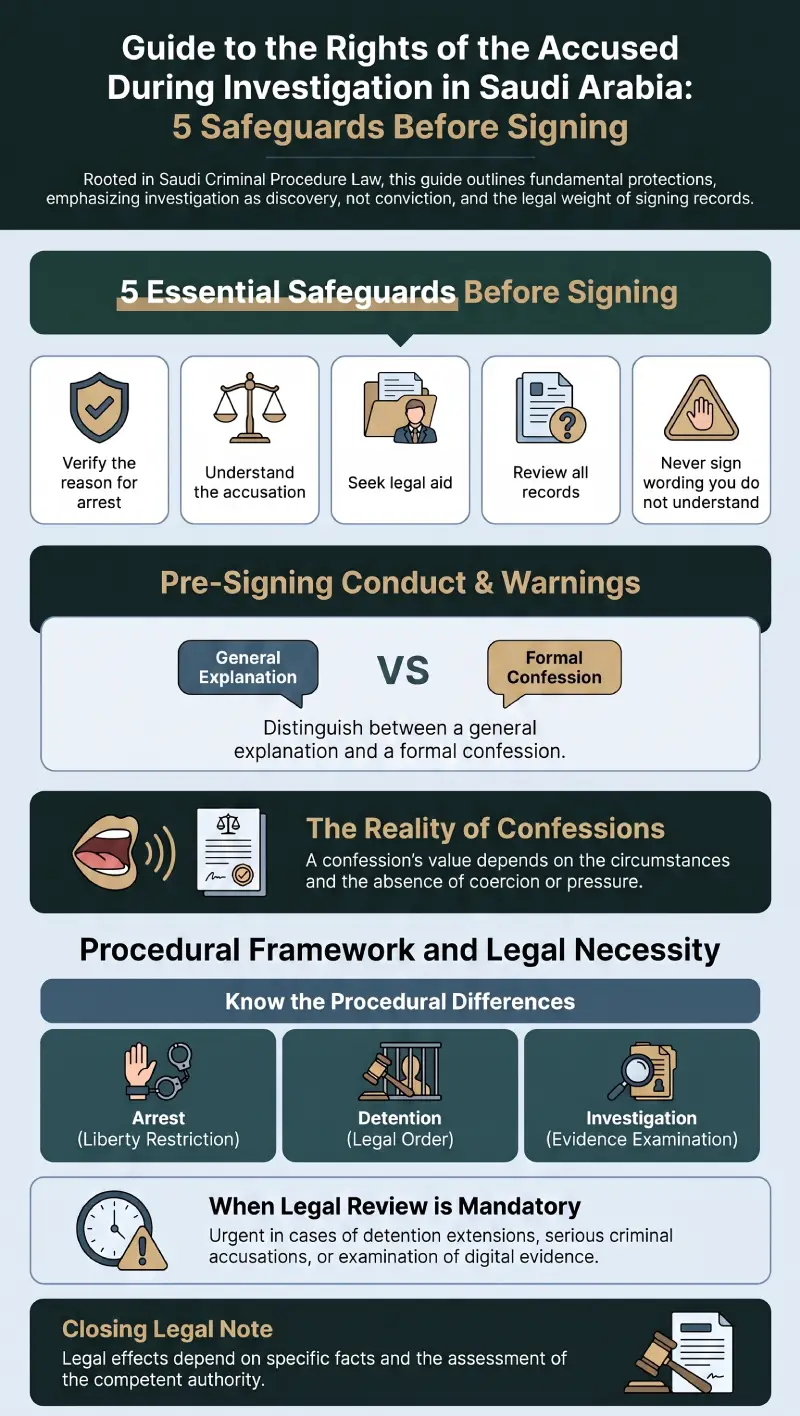
The rights of the accused during investigation are safeguards that protect the accused from giving unaware answers or signing an inaccurate investigation record. They include knowing the reason for the procedure, understanding the accusation, seeking legal assistance, reviewing the record, and not being subjected to pressure affecting will or confession.
| Right | Practical Benefit |
|---|---|
| Knowing the reason for arrest or detention | Helps the accused understand the procedure and respond to specific facts. |
| Understanding the accusation | Prevents confusion between general suspicion and a direct accusation. |
| Seeking legal assistance | Helps in understanding questions, reviewing the record, and preparing defenses. |
| Reviewing the record before signing | Reduces the risk of recording inaccurate or unclear statements. |
| Examining the confession and its circumstances | Clarifies the effect of confession and whether it was free from pressure or coercion. |
If you have a summons, detention, or an investigation record that includes a confession, do not treat signing as a routine step. Read the record, ask for clarification of unclear phrases, and do not sign wording that does not match your statements. A confidential initial assessment from a licensed law firm in Jeddah may be appropriate if your statements or the record may affect your legal position.
What Are the Rights of the Accused During Investigation?
The rights of the accused during investigation are rules and safeguards that regulate how the accused is questioned, how statements are recorded, and how the procedural status of the accused is handled. Their purpose is to balance the public interest in uncovering the truth with the individual’s right to defend himself through proper procedures.
It is important to distinguish between an arrested person, a detained person, and an accused person. An arrested person is someone whose liberty is restricted at the beginning of the procedure. A detained person is someone against whom a detention order has been issued. An accused person is someone to whom a criminal incident has been attributed and is under examination or investigation. This distinction matters because it affects the procedural stage, available rights, and the proper way to request release, object, or review the record.
Investigation does not mean conviction. The file may end with dismissal, release, continued examination, or referral to court. For that reason, the accused should handle the procedure seriously without excessive fear, focusing on the accuracy of statements, understanding each question, and reviewing everything recorded before signing.
The rights of the accused are not limited to questioning or signing. They may also extend to how evidence is handled if the procedure includes seizure of a phone, inspection of a device, or entry into a place connected with the incident. In such cases, understanding judicial search under Saudi criminal procedure is important to know when the procedure is lawful and when its effect on evidence or the record may be disputed.
Key Rights of the Accused Before the Public Prosecution
The rights of the accused before the Public Prosecution arise when there is a summons, detention, or questioning. The most important rights include knowing the reason for arrest or detention and understanding the accusation, because a proper response begins with knowing the specific incident, not guessing under pressure.
Another key right is seeking legal assistance, especially where detention, confession, or an influential record exists. A lawyer is not merely present as a companion; legal assistance helps organize the facts, review wording, and identify defenses that should be recorded at the right time. A consultation with a criminal cases lawyer in Jeddah can help the accused understand the questions, review the wording, and identify the appropriate defenses before taking a position that may later be difficult to change.
The accused also has a practical need to review the investigation record before signing and to confirm that the statements written in it match what was actually said. If the wording includes a confession, partial acknowledgment, or a phrase that can carry more than one meaning, correction or clarification should be requested before the record is approved.
Rights of the Accused During Questioning and Statement Taking
Questioning is a sensitive stage because answers may later become evidence, a presumption, or the basis for further questioning. The accused should answer clearly and specifically, and avoid guesses or general expressions that may carry more than one meaning.
The accused should understand the question before answering and may ask for it to be rephrased if unclear. The accused may also refrain from answering a question that is unclear or requires legal review, but the reason for that position should be clear, such as waiting for a lawyer or requesting clarification.
It is also important to distinguish denial, explanation, and confession. Denial means rejecting the incident or its attribution to the accused. Explanation means presenting context that explains what happened. A confession during investigation is an acknowledgment of a fact that affects the accusation. The difference between saying “I was present” and saying “I participated” can be legally significant.
Common mistakes during questioning include:
- Answering before fully understanding the question.
- Signing the record without careful reading.
- Confusing explanation with confession.
- Using general wording that carries multiple meanings.
- Ignoring the need for a lawyer where the accusation is serious.
Confession During Investigation and Its Impact on the Case
A confession during investigation may be influential, but it is not understood in isolation from its circumstances, wording, and surrounding evidence. Not every explanation or acknowledgment of a side fact is a full confession. An acknowledgment may be partial while the dispute remains over intent, participation, or knowledge.
A confession is influential when it is clear, accurately recorded, and connected to the elements of the accusation rather than a marginal fact. If the confession is vague, conflicts with the evidence, or was made under circumstances the accused claims were improper, its value should be examined and discussed.
Invalidity of confession may be raised where there is pressure, coercion, vague wording, or lack of understanding of what was signed. A later withdrawal of confession is not enough on its own without identifying a specific affecting fact and connecting it to the record and supporting indications.
Invalid Confession or Investigation Record
Invalidity of confession or of the investigation record is not established merely because the accused is dissatisfied with the result. It requires an affecting defect in will, recording, defense rights, or procedural validity. The defect may be formal and limited in effect, or substantial enough to affect the evidentiary value of the record.
Situations requiring careful legal review include:
- Physical or psychological pressure before confession.
- Signing a record the accused does not understand.
- Recording statements that do not match what was actually said.
- Failing to record an essential defense requested by the accused.
- A significant deficiency in the record’s details or signatures.
There is an important difference between invalidity of the record and weakness of its evidentiary value. A record may remain in place while a specific part of it becomes weaker as evidence. For that reason, a lawyer reviews wording, chronology, method of questioning, and the circumstances surrounding signing or confession.
Difference Between Arrest, Detention, and Investigation
Distinguishing between arrest, detention, and investigation helps the accused understand the current stage and related rights. Arrest is an initial procedure restricting a person’s liberty in specific circumstances. Detention is the continuation of that restriction by order of the competent authority. Investigation means hearing statements and examining evidence.
| Procedure | Practical Meaning | What to Watch For |
|---|---|---|
| Arrest | An initial procedure restricting liberty | Knowing the reason and contacting the necessary person. |
| Detention | Continued restriction of liberty by legal order | Reviewing the reason, duration, and options for release. |
| Investigation | Hearing statements and examining evidence | Understanding questions and reviewing the record before signing. |
The duration of investigation before the Public Prosecution is not always the same as the duration of detention. Investigation may continue after release, and detention may end while the file remains under examination.
What Happens After Investigation Before the Public Prosecution?
After investigation, there is no single fixed path. The case may be dismissed, the accused may be released, proceedings may continue, or the case may be referred to the competent court. Understanding the stages of a criminal case in Saudi Arabia helps clarify what changes when the file moves from investigation to court.
Dismissal of the case means the file does not require continuation at that stage, whether due to insufficient evidence or another legal reason. Release may occur while the file is still being examined, so it does not always mean the case is over. If the case is referred to court, a new stage begins for discussing evidence and defenses, and referral itself does not mean conviction.
For this reason, investigation records and documents should be preserved, and previous statements should be reviewed before any later hearing. Consistency between previous statements and defense before court helps create a clearer and more organized position.
When Does the Accused Need a Criminal Investigation Lawyer?
The accused needs a criminal investigation lawyer when statements, records, or detention can affect the path of the case. Contacting a lawyer does not mean the accused is guilty; it is a protective step to understand rights and avoid mistakes in signing or inaccurate confession.
The need for legal assistance increases in the following cases:
- A detention or detention extension order exists.
- A confession was made or pressure was used to obtain one.
- A criminal accusation may affect liberty or reputation.
- A release request is needed.
- An investigation record requires legal review.
- Digital evidence, messages, or accounts are under examination.
Where detention, confession, pressure during investigation, or a record requiring review exists, early action becomes more important. Case details can be submitted through the contact page of our legal team to identify the appropriate legal step without promises of a judicial outcome.
Executive Checklist Before Signing the Investigation Record
Before signing the investigation record, treat it as a legally significant document, not as the end of an ordinary meeting. Read the record fully, ensure your statements are written as you gave them, and request clarification of any unclear phrase before signing.
Review verbs, pronouns, dates, and names. Do not sign wording that gives a broader meaning than what you actually said. If you need to submit a document or clarification, request that it be recorded or submitted through the proper procedure.
If the investigation involves detention, confession, or an influential procedure, early legal review is safer. A mistake at this stage may move into later stages and require greater effort to address.
FAQ About the Rights of the Accused During Investigation
What are the rights of the accused during investigation in Saudi Arabia?
They include knowing the reason for the procedure, understanding the accusation, seeking legal assistance, reviewing the record before signing, and not being subjected to pressure affecting statements.
Does investigation mean the accused is guilty?
No. Investigation is a stage for examining facts, hearing statements, and collecting evidence. Guilt is not established except through the judicial process.
Does the accused have the right to a lawyer during investigation?
Yes. The accused may seek assistance from a lawyer or representative for defense. The effect of absence depends on the case type and procedure.
Does the accused have the right to remain silent during investigation?
The accused may refrain from answering a question that is unclear or requires legal review, while stating the reason as clearly as possible.
When may a confession during investigation be challenged?
A confession may be challenged where there is pressure, coercion, vague wording, or lack of understanding of what was signed.
Is a confession before the Public Prosecution enough for conviction?
A confession may be influential, but it is reviewed with its circumstances, wording, and the other evidence in the file.
When may the investigation record be invalid or weakened?
It may be invalid or weakened where there is an affecting defect in the procedure, recording, or defense rights.
What is the difference between arrest, detention, and investigation?
Arrest is an initial restriction of liberty. Detention is continued restriction by legal order. Investigation is hearing statements and examining evidence.
Is the duration of investigation different from the duration of detention?
Yes. Investigation does not necessarily mean continued detention. Investigation may continue after release, and detention may end while the file remains under review.
When can release be requested?
Release can be requested where there are reasons supporting the end of detention or adequate guarantees for the accused’s attendance.
The rights of the accused during investigation: 5 safeguards before signing are not a slogan; they are practical protection at a moment that may affect the case. Knowing the reason for the procedure, understanding the accusation, seeking legal assistance, reviewing the record, and examining the confession all help protect the accused from rushed answers or signatures.
A confession during investigation remains one of the most sensitive points because it may affect the case if clearly recorded and supported by evidence. The record should be read carefully, unclear wording should be clarified, and nothing should be signed unless it truly reflects what was said.
If your situation involves detention, summons, an investigation record, or an influential confession, early action helps clarify the legal options. BMS Legal for Law and Legal Consultations provides a confidential initial assessment to identify the next step without exaggeration or promises of a result.