
Article 79 of the Saudi Labor Law explains how the death of an employee, an employee’s incapacity to perform their work, and the death of an employer may affect the continuation or termination of an employment contract. The provision becomes particularly important when there is a dispute over whether termination was lawful, whether the medical evidence is sufficient, or what financial entitlements remain after death or incapacity.
Article 79 does not primarily regulate resignation or disciplinary dismissal, as those matters are governed by separate provisions of Saudi labor law. The starting point is therefore to identify the actual event: the death of an employee, medically established incapacity, or the death of the employer.
Quick Answer:
An employment relationship ends upon the employee’s death. It also ends when the employee is proven unable to perform their work through an approved medical certificate under Article 79 of the Saudi Labor Law. By contrast, the employer’s death does not normally terminate the contract unless the employer’s personal identity was a material consideration when the contract was concluded.
These rules form part of the wider framework established by the Saudi Labor Law, while Article 79 specifically addresses employee death, incapacity, and the effect of an employer’s death on the employment contract.
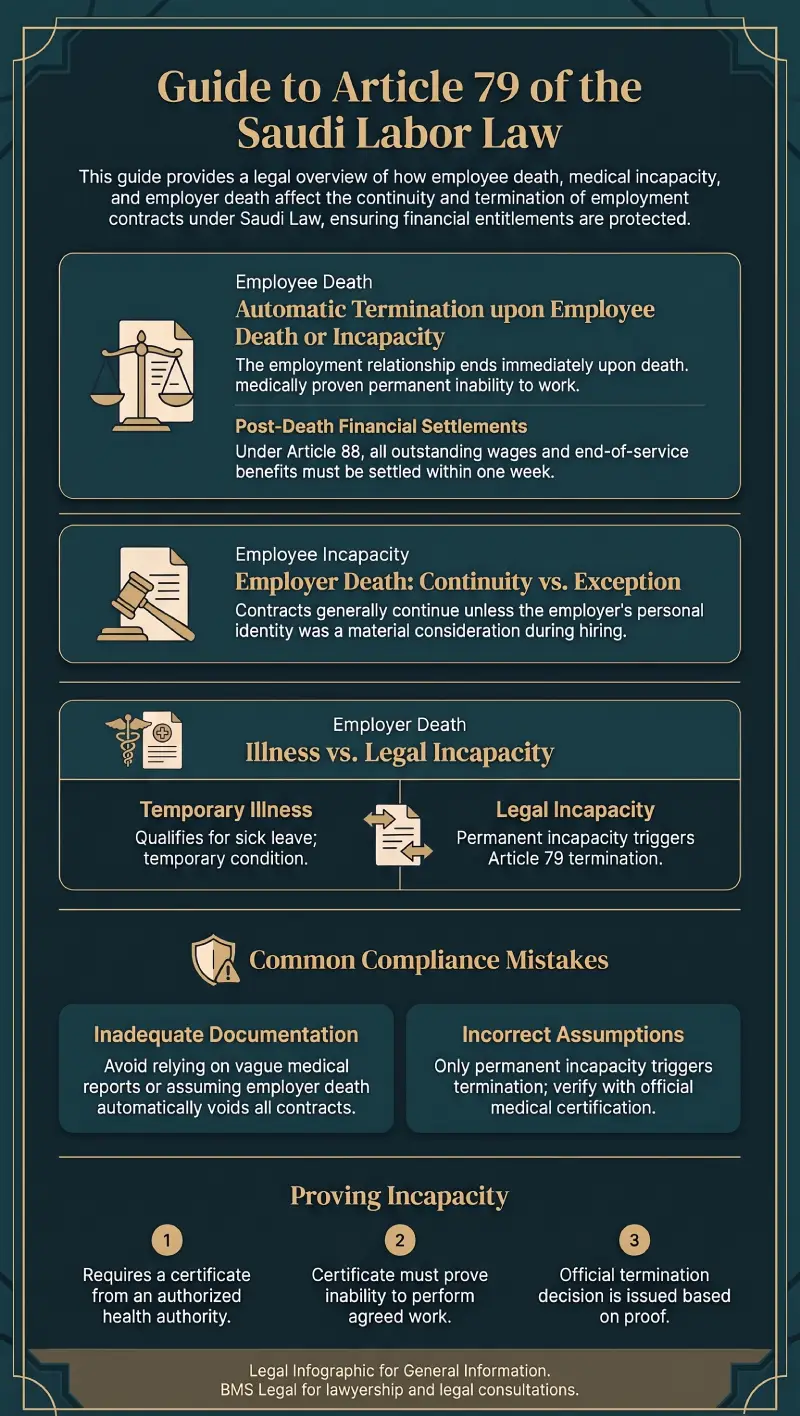
What Does Article 79 of the Saudi Labor Law Provide?
Article 79 addresses three connected issues: termination of the employment contract upon the employee’s death, termination when the employee becomes unable to perform their work and that incapacity is established through the required medical certification, and continuation of the contract despite the employer’s death unless the employer’s personality was specifically taken into account when the contract was formed. (HRSD)
Article 79 should be read within the broader framework governing termination of employment relationships because the reason for termination affects the rights and procedures that follow. Article 74 of the Saudi Labor Law sets out the general grounds on which an employment contract may end, while Article 79 deals specifically with death, incapacity, and the effect of an employer’s death.
| Situation | Main Effect on the Contract | What Should Be Verified? |
|---|---|---|
| Employee death | Employment contract ends | Date of death and outstanding entitlements |
| Employee unable to perform the work | Contract ends when Article 79 requirements are met | Approved medical certificate and extent of incapacity |
| Employer death | Contract generally continues | Whether the employer’s identity was a material consideration |
This distinction helps prevent Article 79 from being confused with resignation rules or compensation for unlawful termination.
Does an Employment Contract End When the Employee Dies?
Yes. An employment contract ends upon the employee’s death because the obligation to perform the work is personal to the employee and cannot be transferred to another person. However, the end of the contract does not extinguish financial rights that accrued before death or became payable as a result of termination. (HRSD)
The practical focus therefore shifts from whether the contract continues to what amounts remain payable, how those amounts are settled, and who has legal standing to claim them.
What Happens to the Deceased Employee’s Financial Rights?
The deceased employee’s entitlements may include unpaid wages up to the end of the employment relationship, end-of-service benefits, compensation for accrued leave where applicable, and any other amounts due under the contract or Saudi labor law.
Article 88 provides that when an employee’s service ends, the employer must pay the employee’s wages and settle their rights within no more than one week from the termination date. It also permits the employer to deduct debts owed by the employee arising from the employment relationship from amounts otherwise payable. (HRSD)
End-of-service benefits are calculated under Article 84 of the Saudi Labor Law based on the employee’s length of service and final wage, with fractions of a year calculated proportionately to the period actually worked.
Who May Receive a Deceased Employee’s Entitlements?
A family member is not automatically entitled to receive the employee’s outstanding amounts merely because of their relationship to the deceased. The legal capacity and supporting documents establishing the claimant’s entitlement or authority to receive payment must first be verified.
In practice, it is useful to gather proof of death, employment records, and documents establishing the claimant’s legal status before requesting settlement. Rights owed by the employer should also be distinguished from any separate entitlements that may arise under the Saudi social insurance system.
When Does an Employment Contract End Because of Employee Incapacity?
Under Article 79, incapacity concerns the employee’s actual ability to perform the work covered by the employment contract. The existence of an illness, injury, or medical condition alone does not automatically mean that the employment relationship ends.
The provision requires incapacity to be established through an approved medical certificate issued by an authorized health authority or by the authorized physician appointed by the employer. (HRSD)
Accordingly, terminating employment on the ground of incapacity requires more than a general description of the employee’s medical condition. The medical finding must be considered in relation to the nature of the employee’s actual work and their ability to continue performing it.
How Is an Employee’s Incapacity to Work Proven?
Proof of incapacity is a central requirement under Article 79 of the Saudi Labor Law. The decision should be supported by a medical certificate that meets the statutory requirement rather than by an employer’s unilateral administrative assessment or a mere assertion by either party.
The following factors should be reviewed:
- The source of the medical certificate.
- The status of the medical authority or physician issuing it.
- The nature of the employee’s agreed work.
- Whether the medical conclusion actually establishes inability to perform that work.
If a report merely confirms that the employee has an illness but does not explain how it affects their ability to work, that fact alone may not be enough to determine whether Article 79 applies.
Does Every Illness or Injury Amount to Incapacity?
No. Illness and incapacity have different legal effects on the employment relationship.
Article 82 protects an employee from termination due to illness before the employee has exhausted the sick-leave periods prescribed by Saudi labor law. It also allows the employee to request that annual leave be connected to sick leave. (HRSD)
It is therefore necessary to distinguish between a temporary illness for which sick leave may be available and medically established incapacity preventing the employee from performing the work within the meaning of Article 79.
A work-related injury may also trigger additional rules concerning occupational injuries and compensation. The Ministry of Human Resources distinguishes between temporary incapacity, permanent total incapacity, and permanent partial incapacity in that context. (HRSD)
Does Partial or Temporary Incapacity Terminate an Employment Contract?
Describing a condition as partial or temporary incapacity does not, by itself, determine whether the employment contract ends.
The central question under Article 79 of the Saudi Labor Law is whether the employee has been medically established as unable to perform the work covered by the employment contract.
The same medical condition may affect a worker performing physically demanding duties very differently from an employee in another role. For that reason, the diagnosis alone should not be assessed in isolation from the employee’s job duties and the conclusions contained in the medical evidence.
Where incapacity results from a work-related injury, the assessment may also fall within separate occupational-injury rules. The issue of contract termination should therefore be distinguished from compensation arising from a workplace injury.
Does the Employment Contract End When the Employer Dies?
As a general rule, no. The employer’s death does not by itself terminate an employment contract.
The exception applies where the employer’s personal identity was specifically taken into consideration when the employment contract was concluded, meaning that continuation of the employment relationship was materially connected to that particular individual. (HRSD)
It would therefore be incorrect to assume that every employee’s contract automatically ends when the owner of an establishment dies. At the same time, the effect should not be generalized across all businesses because the legal structure of the establishment, the contract, and the nature of the role may affect the analysis.
When Is the Employer’s Personal Identity a Material Consideration?
Personal consideration means that the employee entered into the employment relationship because the work was materially connected to the employer as an individual rather than merely to the business or establishment operated by that person.
If the work can naturally continue after the employer’s death, the general rule remains that the employment contract continues. However, where the basis of the employment relationship was inseparably connected to the deceased employer personally, the exception under Article 79 may become relevant.
Determining whether this exception applies requires consideration of the employment contract, the nature of the employee’s role, and the circumstances in which the employment relationship was created. The job title alone is not enough.
How Does Article 79 Differ From Other Contract-Termination Provisions?
Distinguishing Article 79 from neighboring provisions helps avoid applying the correct legal rule to the wrong factual situation.
Article 79 is not a general provision governing every type of employment termination. Its scope is specifically connected to employee death, incapacity, and the effect of the employer’s death.
| Provision | Main Subject |
|---|---|
| Article 74 | General grounds for termination of employment contracts |
| Article 77 | Compensation for unlawful termination, subject to its conditions |
| Article 79 | Employee death, incapacity, and the effect of employer death |
| Article 79 bis | Resignation and its procedures |
| Article 80 | Cases where the employer may terminate the contract under the conditions of the provision |
| Article 84 | Calculation of end-of-service benefits |
| Article 88 | Settlement of wages and employment rights after termination |
This distinction is particularly important where a dispute involves both the reason for termination and the financial consequences that follow.
What Should You Do if Your Case Involves Article 79?
The best starting point is not to select a legal provision first, but to organize the relevant facts and documents.
A situation may initially appear to concern incapacity when the actual dispute is about the validity of the medical report. Likewise, a case involving the death of an employee may ultimately concern the amount of outstanding entitlements or the legal standing of the person seeking payment.
| Situation | Documents to Review First |
|---|---|
| Termination due to incapacity | Employment contract, termination decision, medical reports, correspondence |
| Employee death | Employment contract, wage and service records, proof of death, entitlement statement |
| Employer death | Employment contract, nature of the establishment, job description, documents showing the nature of the relationship |
| Dispute over entitlements | Payroll records, length of service, leave balance, end-of-service benefit calculation |
Where there is a dispute over the reason for termination or the amount of outstanding employment entitlements, having the file reviewed by an employment lawyer in Jeddah before signing a final settlement may help clarify the employee’s or employer’s legal position.
What Common Mistakes Affect the Application of Article 79?
Problems often arise when a termination decision is made before the underlying evidence is properly verified, or when rights arising from termination due to death are confused with social-insurance rights or workplace-injury compensation.
Common mistakes include:
- Treating every illness as sufficient grounds for termination due to incapacity.
- Relying on a medical report that does not clearly explain how the condition affects the employee’s ability to perform the work.
- Confusing Article 79 of the Saudi Labor Law with Article 79 bis governing resignation.
- Assuming that an employer’s death automatically terminates all employment contracts.
- Calculating end-of-service benefits without checking the employee’s length of service and final wage.
- Signing a final settlement before all employment entitlements have been reviewed.
Avoiding these errors starts with identifying the correct legal event and then separating the reason for termination from the financial rights that arise afterward.
✓
This content has been legally reviewed to verify the accuracy of the explanation of
Article 79 of the Saudi Labor Law,
including the rules governing employee death, incapacity to perform work, and the effect of an employer’s death on the employment relationship.
Employment Law Team
BMS Legal for lawyer ship and legal consultations
September 2026
7053637679
This content is provided for general legal information. The application of the law may vary depending on the facts and documents of each case.
Frequently Asked Questions About Article 79 of the Saudi Labor Law
Does an Employment Contract End When the Employee Dies?
Yes. The employment contract ends upon the employee’s death, but financial rights already accrued remain payable and must be settled separately.
How Is an Employee’s Incapacity to Perform Work Proven?
It must be established through an approved medical certificate issued by an authorized health authority or an authorized physician.
Does Illness Alone Allow an Employer to Terminate the Contract?
No. Illness does not automatically amount to incapacity under Article 79. The employee’s ability to perform the work must be medically assessed.
Does the Employment Contract End When the Employer Dies?
Generally, no. The contract continues unless the employer’s personal identity was a material consideration when the employment relationship was created.
Is a Deceased Employee Entitled to End-of-Service Benefits?
The employee’s end-of-service entitlement is settled under the relevant Saudi Labor Law provisions, including Article 84, based on the employee’s service period and final wage.
Article 79 of the Saudi Labor Law: when does an employment contract end, and what rights remain? In practice, the provision focuses on three principal situations: the death of the employee, incapacity preventing the employee from performing their work, and the death of the employer.
An employee’s death ends the employment contract while leaving accrued financial entitlements to be settled. Incapacity requires medical evidence satisfying the statutory requirements. By contrast, an employer’s death does not normally terminate the contract unless the employer’s personal identity was a material consideration when the employment relationship was created.
Where there is a dispute about the medical evidence, the reason for termination, or the amount of outstanding entitlements, the employment contract, supporting documents, and surrounding facts should be reviewed before any final settlement or other step is taken.
If the dispute requires review of the employment contract, medical reports, or outstanding entitlements before action is taken, the team at a law firm in Jeddah can assess the documents and explain the appropriate legal route based on the circumstances.
Request an initial assessment of your employment matter before taking the next step.