
Understanding Article 7 of the Saudi Anti-Bribery Law begins with identifying the circumstances in which the law prohibits the use of force, violence, or threats against a public official.
A disagreement or confrontation with a government employee is not, by itself, enough for Article 7 to apply.
The conduct must instead be connected either to obtaining an unlawful act from the public official or to preventing the official from performing a duty legally assigned to them.
Understanding these requirements helps clarify the applicable penalty, the evidentiary issues, and the defenses that may arise depending on the facts of each case.
What Does Article 7 of the Saudi Anti-Bribery Law Mean in Brief?
Article 7 of the Saudi Anti-Bribery Law criminalizes the use of force, violence, or threats against a public official in order to obtain an unlawful act from that official or to cause the official to refrain from performing a duty legally assigned to them.
For the applicable penalty, Article 7 refers to Article 1 of the Saudi Anti-Bribery Law, which provides for imprisonment for up to ten years, a fine of up to SAR 1 million, or either of these penalties.
What Does Article 7 of the Saudi Anti-Bribery Law Cover?
The wording of Article 7 connects the method of pressure with its intended purpose.
The prohibited method may involve force, violence, or threats. The purpose, however, must be either to obtain an unlawful act from the public official or to cause the official to refrain from performing a duty legally assigned to them.
This distinguishes Article 7 from conventional forms of bribery that usually involve an offer, promise, gift, or other benefit.
A financial payment is therefore not required for Article 7 to apply. The offence addressed here concerns pressure exerted against a public official through one of the methods expressly identified by the law.
Other forms of bribery, and the penalties that may apply to the bribe-giver, bribe-taker, intermediary, or participant, fall within the broader framework explained in our article on the bribery penalty in Saudi Arabia.
What Are the Requirements for Article 7 of the Saudi Anti-Bribery Law to Apply?
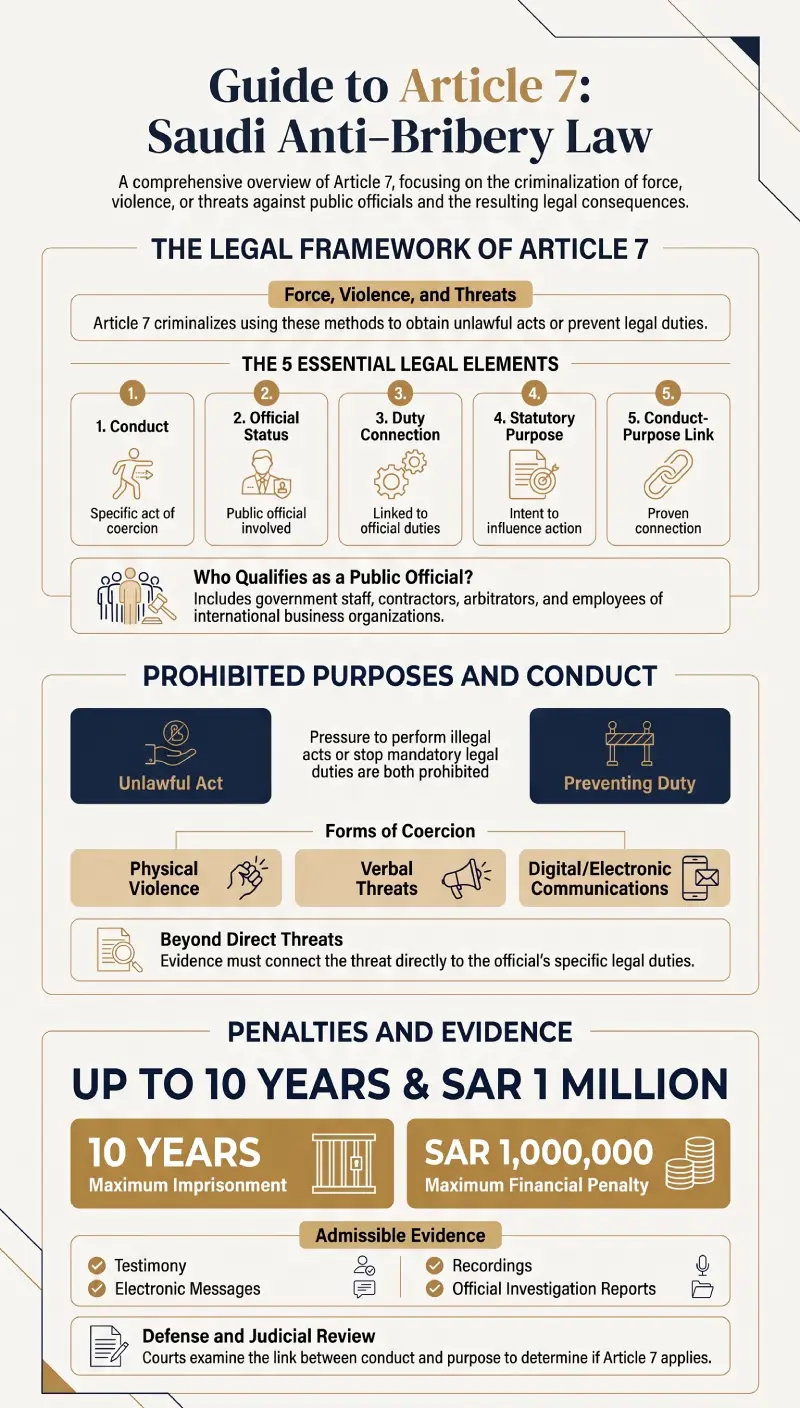
When applying Article 7 of the Saudi Anti-Bribery Law in practice, five main elements should generally be examined.
The existence of only one of these elements is not sufficient, by itself, to determine that Article 7 applies to a particular incident.
| Requirement | What Should Be Examined? |
|---|---|
| 1. Prohibited conduct | The use of force, violence, or threats |
| 2. Status of the person targeted | Whether the person is a public official or treated as one under the law |
| 3. Connection with official duties | Whether the conduct relates to the official’s work or assigned function |
| 4. Statutory purpose | Obtaining an unlawful act or preventing the official from performing a legally assigned duty |
| 5. Connection between conduct and purpose | Whether the facts and evidence show that the force or threat was used to achieve that purpose |
These elements help distinguish conduct that may fall within Article 7 from an argument, confrontation, or other act that may carry a different legal classification.
1. Use of Force, Violence, or Threats
Article 7 is not limited to physical assault. It separately refers to force, violence, and threats.
The nature of the conduct must therefore be examined, whether it occurred physically, through spoken words, written communications, or another method capable of conveying a threat.
However, an aggressive statement or heated argument alone does not necessarily establish the offence. The purpose behind the conduct must also be considered.
2. The Conduct Must Target a Public Official or a Person Treated as One
The legal status of the person against whom the conduct was directed is a central element.
Under the Saudi Anti-Bribery Law, the concept of a public official is not limited to permanent government employees. Article 8 identifies additional categories of persons who are treated as public officials for the purposes of the Law.
The person’s employer, legal status, and the nature of the function they were performing should therefore be identified before concluding that Article 7 applies.
3. There Must Be a Connection With the Official’s Duties
The incident must be related to the work or function being performed by the public official.
A personal dispute unrelated to the person’s official duties is different from conduct intended to pressure an official during an administrative procedure, enforcement action, inspection, or other task falling within their official responsibilities.
The nature and timing of the official act may therefore be important when assessing this connection.
4. One of the Two Statutory Purposes Must Exist
Article 7 identifies two purposes: obtaining an unlawful act from the public official, or causing the official to refrain from performing a duty legally assigned to them.
Both purposes do not need to exist at the same time.
The relevant form of the offence may arise where the evidence establishes that the conduct was connected to either one of these purposes, depending on the facts of the case.
5. The Conduct Must Be Connected to the Intended Purpose
Establishing the existence of a threat in isolation is not enough.
The facts and evidence should also help determine whether the threat, force, or violence was actually used to influence the public official in the manner addressed by Article 7.
Messages, statements, the sequence of events, and the nature of the underlying official procedure may therefore be significant when reviewing the case file.
Who Is Considered a Public Official Under Article 7?
Understanding Article 7 of the Saudi Anti-Bribery Law also requires identifying who is considered a public official, because the concept is broader than a permanent government employee.
Article 8 of the Saudi Anti-Bribery Law identifies categories that are treated as public officials for the purposes of the Law.
These include persons working for the State or public legal entities, as well as certain arbitrators and experts and persons assigned a specific task by a government authority or administrative body.
Paragraph 7 of Article 8 was also amended to include foreign public officials and employees of international institutions and organizations in relation to the conduct of international business transactions.
The amendment was issued under Council of Ministers Resolution No. 255 and Royal Decree No. M/38 of 1443H. See the amendment to the Anti-Bribery Law published by Umm Al-Qura.
What Is Meant by Force, Violence, or Threats Against a Public Official?
Using force against a public official does not necessarily require that physical injury occur.
Article 7 separately refers to force, violence, and threats, which means that the nature, content, and purpose of the conduct must all be examined.
A threat may appear in a direct conversation or through written or electronic communications. Its existence alone, however, does not automatically establish an offence under Article 7.
A threat intended to force an official to stop a lawful procedure is different from a personal disagreement or statement that cannot be shown to have been connected to the performance of official duties.
Likewise, objecting to an administrative procedure or asking an official to recognize a legal right does not, by itself, amount to an offence under Article 7.
The legal assessment depends on the method used and the purpose toward which the conduct was directed.
What Is Meant by Obtaining an Unlawful Act or Preventing an Official From Performing Their Duty?
Article 7 of the Saudi Anti-Bribery Law addresses two distinct situations, and it is important to identify which one is relevant before assessing a particular incident.
The first involves attempting to obtain an unlawful act from a public official.
This may concern an act that is not permitted under the applicable law or regulations, or an outcome that cannot lawfully be obtained by pressuring the official.
The second involves using force, violence, or threats to cause a public official to refrain from performing a duty legally assigned to them.
In this situation, identifying precisely what the official was doing at the time of the incident becomes important.
The timing of the conduct may also help establish the connection.
For example, an attempt to stop an official procedure while it is being carried out differs from a later dispute where the surrounding circumstances do not indicate that the purpose was to prevent the official from performing their duty.
What Is the Penalty Under Article 7 of the Saudi Anti-Bribery Law?
The penalty under Article 7 of the Saudi Anti-Bribery Law may reach imprisonment for up to ten years and a fine of up to SAR 1 million, or either of these penalties.
This is because Article 7 expressly refers to the penalty provided under Article 1 of the Saudi Anti-Bribery Law.
The court considers the facts, evidence, and applicable legal classification before issuing its judgment.
These amounts represent the statutory maximum and do not mean that every case results in the maximum sentence. The court examines the facts, evidence, and legal characterization before issuing a judgment.
Penalties or legal consequences arising from other forms of bribery should also not be applied automatically to Article 7 cases.
The nature of the conduct, the status of the persons involved, and the statutory provisions applicable to the particular incident determine the consequences that may follow.
Saudi Anti-Bribery Law, with particular focus on the
requirements of Article 7, the legal status of public officials,
applicable penalties, evidentiary issues, and potential defenses.
This educational content does not replace an individual review of the
case file where an investigation, dispute, or criminal proceeding is ongoing.
How Is the Offence of Using Force Against a Public Official Proven?
From an evidentiary perspective, applying the Saudi Anti-Bribery Law requires evidence addressing the conduct, its purpose, and its connection to the public function involved.
Depending on the circumstances of the case, relevant evidence may include:
- Statements made by the persons involved.
- Witness testimony.
- Messages and electronic communications.
- Recordings or video footage connected with the incident.
- Arrest, investigation, or official incident reports.
- Documents relating to the official procedure or task involved.
- Circumstantial evidence arising from the sequence of events.
Proof of a threatening statement alone does not necessarily establish that Article 7 applies.
Its content and purpose, the legal status of the official, and the duty being performed should also be considered.
A message or recording may therefore prove one aspect of the incident without independently establishing every element of the offence.
The court evaluates the evidence in light of the complete case file and the facts presented.
When Does Article 7 Not Apply and What Are the Main Defenses?
There is no single defense that applies to every case involving Article 7 because the defense will depend on the disputed element and the evidence available.
A defense may concern the absence of proof that force, violence, or threats occurred.
It may instead concern the absence of a proven connection between the conduct and either of the purposes identified by the Law.
A dispute may also arise regarding whether the person concerned legally qualifies as a public official or whether the task being performed was connected to their official duties.
Other issues may concern the nature of the request directed to the official, whether a message or recording can legally and factually be attributed to the accused, inconsistencies between witness statements, or insufficient evidence connecting the conduct with the alleged purpose.
Raising one of these issues does not automatically result in acquittal.
Rather, these matters help identify which aspects of the case file require closer examination before a legal defense position is developed.
What Should You Do if You Are Summoned in a Case Involving Article 7?
If you receive a summons or become aware of an allegation involving force or threats against a public official, begin by identifying precisely what conduct has been attributed to you and the current procedural stage of the case.
Preserve any relevant correspondence, documents, recordings, or video material.
Prepare a clear timeline of events and identify the official duty being performed and what was said or done by each party.
Avoid deleting or altering any material connected with the incident before understanding its potential significance to the case.
The Saudi Law of Criminal Procedure recognizes the accused person’s right to seek the assistance of an attorney or representative for their defense during both the investigation and trial stages.
The importance of legal involvement depends on the stage of the proceedings and the nature of the evidence. This is particularly relevant when considering the role of a lawyer in criminal cases, from reviewing investigation records to preparing the defense before the court.
For active cases in Jeddah, reviewing the file may require identifying the correct legal characterization of the incident and examining the evidence before taking a procedural position.
These are among the issues that may be assessed by a criminal lawyer in Jeddah according to the facts and procedural stage of each case.
Frequently Asked Questions About Article 7 of the Saudi Anti-Bribery Law
What does Article 7 of the Saudi Anti-Bribery Law prohibit?
It prohibits using force, violence, or threats against a public official to obtain an unlawful act or prevent the official from performing a legal duty.
What is the penalty under Article 7?
The penalty may reach 10 years' imprisonment, a SAR 1 million fine, or either penalty.
Is a threat against a public official enough to establish the offence?
Not necessarily. The threat must also be connected to the official's duties and one of the prohibited purposes stated in Article 7.
Who is considered a public official under the Anti-Bribery Law?
The definition includes government employees and other categories treated as public officials under Article 8 of the Saudi Anti-Bribery Law.
Does Article 7 require payment or a financial benefit?
No. Unlike traditional bribery offences, Article 7 focuses on force, violence, or threats rather than a payment, gift, or financial benefit.
Article 7 of the Saudi Anti-Bribery Law: 5 key elements provides a practical framework for understanding the incident before focusing on the level of punishment: the existence of force, violence, or threats; the person’s status as a public official; the connection with official duties; the statutory purpose; and the connection between the conduct and that purpose as supported by the facts and evidence.
For this reason, understanding Article 7 of the Saudi Anti-Bribery Law does not stop at knowing that the penalty may reach ten years’ imprisonment and a SAR 1 million fine.
The analysis begins by examining all of the elements of the incident together.
Where a summons or active investigation exists, organizing these elements early may help identify the issues that require proof, the potential defense points, and the appropriate next legal step.
Have you received a summons or are you facing an investigation connected with Article 7?
Where a case file needs to be reviewed before a procedural step is taken, you may contact our Jeddah law firm to assess the facts and evidence and clarify the appropriate path based on the circumstances of the case.