
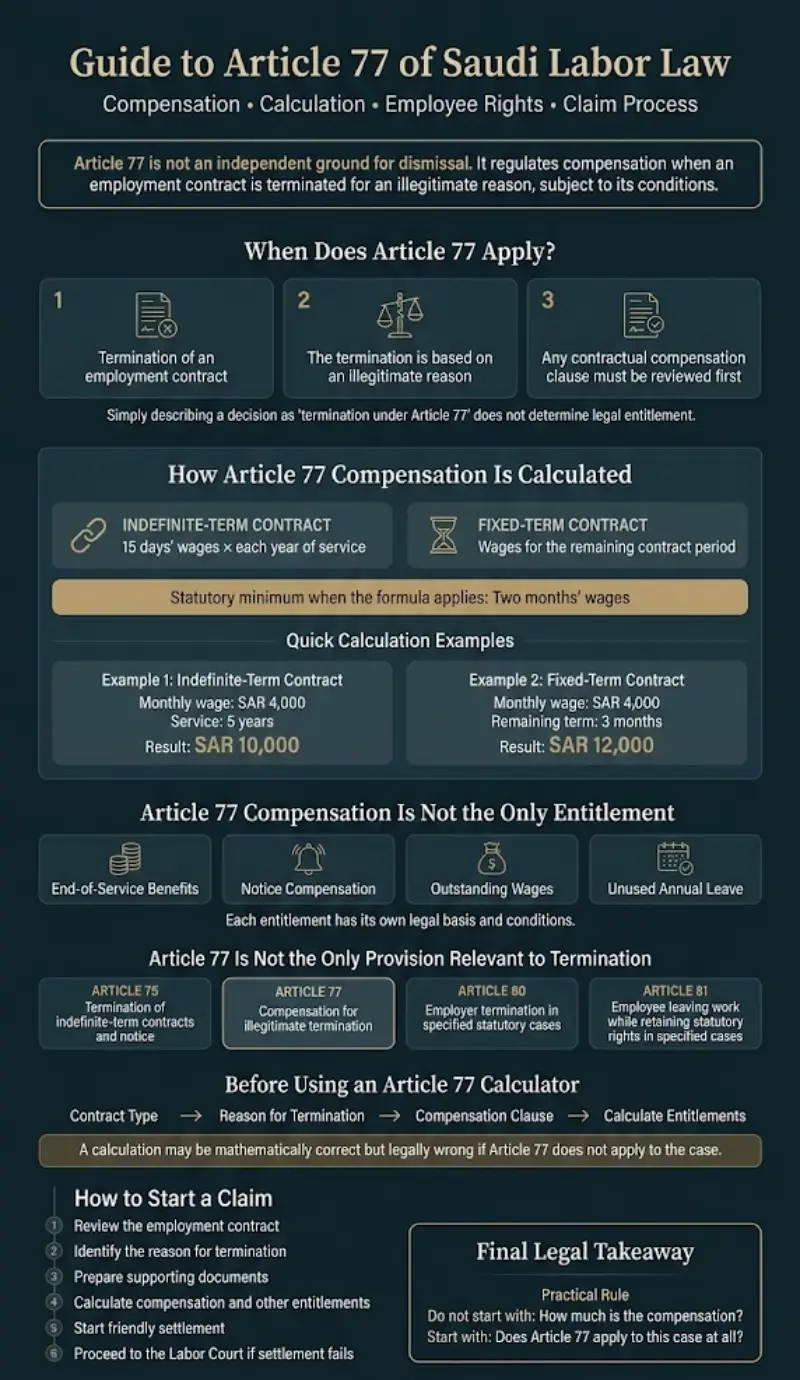
Article 77 of Saudi Labor Law regulates the compensation that may become payable when an employment contract is terminated for an illegitimate reason and the contract does not specify compensation for that situation. The Article is not, by itself, an independent legal ground for dismissing an employee. The correct analysis therefore begins with the reason for termination, the type of employment contract, and any contractual compensation clause before a figure is calculated.
The provision becomes particularly important when a fixed-term contract is ended before its expiry, an indefinite-term contract is terminated, or the parties disagree over the amount of compensation and other employment entitlements. Salary alone is therefore not enough to determine the legal outcome.
Quick Answer: What Does Article 77 of Saudi Labor Law Do?
Article 77 does not give either party an unrestricted right to end an employment contract. Instead, it determines compensation where the contract is terminated for an illegitimate reason, unless the contract already specifies compensation for that situation. The calculation differs between fixed-term and indefinite-term contracts, and Article 77 compensation should be distinguished from other employment entitlements.
What Is Article 77 of Saudi Labor Law?
Article 77 addresses the financial consequence of terminating an employment contract for an illegitimate reason. Where the contract does not provide a specified amount of compensation, the Article applies a different calculation according to the type of contract.
For an indefinite-term contract, compensation is calculated at 15 days’ wages for each year of service. For a fixed-term contract, the calculation is based on the wages for the remaining contractual period. Where these statutory formulas apply, compensation must not be less than two months’ wages.
That is the core of understanding Article 77 of Saudi Labor Law: the first question is not “How much will I receive?” but rather “Why did the employment relationship end, and was the termination legally justified?”
Article 77 forms part of the wider framework of the New Saudi Labor Law, which governs employment contracts, termination, notice, resignation, dismissal, end-of-service benefits, and labor disputes in Saudi Arabia.
When Does Article 77 Apply?
Before calculating compensation under Article 77, three matters should be established:
- An employment contract was terminated by one of the parties.
- The termination was based on an illegitimate reason.
- The employment contract should be reviewed to determine whether it already contains a specific compensation clause for illegitimate termination.
Simply writing “termination under Article 77” in a termination letter does not establish or defeat the right to compensation. The legal classification depends on what actually occurred, the contract terms, and the available evidence.
What Is Termination for an Illegitimate Reason?
An illegitimate reason is a reason that does not provide a valid statutory or contractual basis for ending the employment relationship in the circumstances of the case.
It is therefore important to distinguish between a contract ending under a recognised statutory ground, termination of an indefinite-term contract under the applicable rules, cases where the employer may lawfully terminate under other provisions, and termination that may trigger Article 77 compensation.
In particular, Article 75 of Saudi Labor Law regulates the termination of indefinite-term employment contracts and the related notice requirements.
What If the Employment Contract Specifies Compensation?
Where the employment contract contains a specific compensation clause for termination based on an illegitimate reason, that clause should be examined before the statutory calculation is applied.
Its wording, scope, the party to whom it applies, and its compatibility with the Saudi Labor Law may all affect the result.
It is therefore incorrect to assume that every Article 77 case automatically leads to either the 15-day-per-year formula or payment for the entire remaining contractual period without first examining the contract.
Does Termination Under Article 77 Amount to Unfair Dismissal?
The expressions unfair dismissal and wrongful termination are often used to describe an illegitimate termination. However, the correct legal analysis begins with the actual reason and circumstances of termination before deciding which provision governs the case.
Article 77 is a consequence of illegitimate termination; it is not an independent ground for dismissal.
It should not therefore be understood as giving an employer an unrestricted right to terminate an employee simply by paying compensation.
Is Article 77 an Independent Ground for Dismissing an Employee?
No. Article 77 does not contain a list of reasons that permit dismissal. Instead, it determines the financial consequence where an illegitimate termination has occurred and its conditions are satisfied.
By contrast, the circumstances in which an employer may terminate an employment contract without an end-of-service award, notice, or compensation are separately regulated under Article 80 of Saudi Labor Law and depend on specific statutory requirements.
When Does the Right to Article 77 Compensation Arise?
The question of Article 77 compensation arises when one party has terminated the contract for an illegitimate reason.
The assessment normally requires reviewing the contract type, stated reason for termination, steps taken before the decision, any compensation clause, and the available evidence.
Relevant documents may include the employment contract, termination notice, written warnings, workplace correspondence, payroll records, and bank transfers. No single document is sufficient in every employment dispute.
Does Paying Article 77 Compensation Make the Termination Lawful?
No. Payment of compensation does not turn an illegitimate reason into a legitimate one. Compensation addresses the financial consequence arising when the conditions of Article 77 are satisfied.
The more useful question is therefore not:
“Can an employer dismiss an employee by paying two months’ salary?”
It is:
“What was the reason for termination, which statutory provision governs it, and what rights arose as a result?”
How to Calculate Article 77 Compensation
The Article 77 compensation calculation begins with identifying the type of employment contract.
The wage used in the calculation must also be assessed in light of the Saudi Labor Law and the employee’s contract. It is not always appropriate to rely solely on basic salary or automatically include every item appearing on a payslip without considering its legal nature.
| Contract Type | Article 77 Compensation Formula |
|---|---|
| Indefinite-term contract | 15 days’ wages for each year of service |
| Fixed-term contract | Wages for the remaining contractual period |
| Statutory minimum | The calculated compensation must not be less than two months’ wages |
Compensation for an Indefinite-Term Contract
Where Article 77 applies to an indefinite-term contract, compensation is calculated at 15 days’ wages for each year of service.
Example:
An employee has an applicable wage of SAR 4,000 and five years of service.
SAR 2,000 × 5 years = SAR 10,000
The resulting amount is higher than two months’ wages of SAR 8,000.
Compensation for a Fixed-Term Contract
For an Article 77 fixed-term contract, compensation is linked to the wages payable for the remaining term of the contract.
If the employee’s applicable wage is SAR 4,000 and three months remain:
SAR 4,000 × 3 months = SAR 12,000
If only one month remained, the initial calculation would be SAR 4,000. Where the statutory Article 77 formula applies, the minimum compensation rule must also be taken into account.
Is Article 77 Compensation Always Two Months’ Salary?
No.
The frequently searched expression “Article 77 two months’ salary” refers to the statutory minimum where the Article 77 formulas apply. It is not a fixed compensation amount for every case.
Compensation may be considerably higher where a fixed-term contract has a substantial period remaining or where an employee under an indefinite-term contract has a long period of service.
Article 77 Compensation According to the Type of Employment Contract
Before using any Article 77 calculator, the case should first be classified correctly.
| Question | Why It Matters |
|---|---|
| Is the contract fixed-term? | Compensation may depend on the remaining contractual period |
| Is it indefinite-term? | The calculation is linked to length of service |
| Is there a compensation clause? | It should be reviewed before using the statutory formula |
| Was the termination legitimate? | Article 77 may not apply at all |
| Are other rights outstanding? | They should be assessed separately from Article 77 compensation |
This assessment is more important than simply entering figures into an Article 77 compensation calculator. A calculator may produce a mathematically correct figure while still producing the wrong legal result if the contract or reason for termination has been classified incorrectly.
What Other Rights May Arise When Employment Ends?
Article 77 compensation is not a collective term for every amount payable to an employee after termination.
Other entitlements may arise independently and should be assessed under their own statutory rules.
End-of-Service Benefits
Article 84 of Saudi Labor Law establishes the basic calculation framework for end-of-service benefits, taking into account the employee’s service period and the circumstances in which the employment relationship ended.
Article 77 compensation and end-of-service benefits should therefore not automatically be treated as the same entitlement.
Notice Compensation
Compensation for failure to observe a required notice period is different from Article 77 compensation.
Failure to provide the statutory notice required in an applicable case may create a separate financial consequence from compensation arising because the termination itself was based on an illegitimate reason.
Each claim should therefore be assessed on its own legal basis rather than being combined under the general label of “dismissal compensation.”
Outstanding Wages
Any wages or financial amounts relating to work already performed but remaining unpaid at the end of employment should also be reviewed as part of the final settlement.
Unused Annual Leave
An employee may also be entitled to payment for qualifying unused annual leave when employment ends. Article 111 of Saudi Labor Law regulates payment for accrued annual leave that remains unused when the employment relationship ends.
Does Article 77 Compensation Include All Employee Entitlements?
No.
Article 77 compensation should be distinguished from:
- end-of-service benefits;
- notice compensation where applicable;
- outstanding wages;
- unused annual leave; and
- any other separately established employment entitlement.
This distinction prevents a common mistake: comparing the employee’s entire final settlement with Article 77 compensation as though they were the same figure.
Article 77 Compared With Articles 75, 80, and 81 of Saudi Labor Law
Understanding the surrounding provisions helps avoid one of the most common errors in labor disputes: applying the correct rule to the wrong factual situation.
| Article | Main Subject |
|---|---|
| Article 75 | Termination of an indefinite-term contract and notice requirements |
| Article 76 | Financial consequence of failing to observe the required notice period |
| Article 77 | Compensation for termination based on an illegitimate reason |
| Article 80 | Employer termination in specified statutory circumstances |
| Article 81 | Employee leaving employment without notice while retaining statutory rights |
Article 75 vs Article 77
Article 75 concerns the termination of an indefinite-term employment contract subject to its statutory requirements and notice period.
Article 77, by contrast, addresses compensation when termination is based on an illegitimate reason and the conditions of the Article are satisfied.
Article 77 vs Article 80
Article 80 identifies specific situations in which an employer may terminate an employee without an end-of-service award, notice, or compensation when the statutory conditions are met.
Article 77 concerns compensation for illegitimate termination.
Simply referring to Article 80 in a dismissal letter does not establish that the termination satisfies Article 80. The underlying facts and applicable requirements must still be established.
Article 77 vs Article 81
Saudi Labor Law Article 81 regulates specified situations in which an employee may leave work without notice while retaining statutory rights.
It therefore serves a different function from Article 77.
Notice Compensation vs Article 77 Compensation
Notice compensation relates to failure to observe the applicable notice period.
Article 77 compensation relates to termination for an illegitimate reason.
The two concepts should therefore not be treated as different names for the same legal entitlement.
Does Article 77 Apply If the Employee Terminates the Contract?
The party harmed by an illegitimate termination may be either the employee or the employer, depending on the circumstances and legal classification of the termination.
This does not mean, however, that every resignation creates a compensation claim for the employer.
Termination by the Employee
A distinction should be made between an ordinary resignation, leaving employment in circumstances permitted by law, ending a fixed-term contract before expiry without a legally sufficient basis, and a contract ending for another recognised statutory reason.
The correct classification matters because the financial consequences may differ substantially.
Article 77 and Resignation
Resignation is regulated separately under the Saudi Labor Law. Article 77 should therefore not be assumed to apply merely because an employee submitted a resignation.
The manner in which the employment relationship ended and whether the termination was legitimate must first be determined.
When May an Employer Claim Compensation?
An employer may potentially have a compensation claim where it is the party harmed by an illegitimate termination and the conditions of Article 77 are met.
Any additional financial claim, however, requires its own contractual or statutory basis and should not automatically be added to Article 77 compensation.
How Can an Employee Claim Article 77 Compensation?
A well-structured claim begins by organising the facts before calculating the amount.
Review the Contract and Reason for Termination
The first step is to identify the contract type, commencement and expiry dates, the party that terminated the relationship, the stated reason, the employee’s final working date, any compensation clause, and relevant warnings or notices.
Article 77 compensation should then be separated from any other employment entitlements.
Prepare the Relevant Documents
Documents commonly relevant to the assessment include the employment contract and amendments, the termination letter or decision, evidence of wages, warnings and notices, correspondence connected to the reason for termination, evidence of service length, and documents supporting the financial claims in dispute.
Sensitive documents unrelated to the employment dispute do not normally need to be shared at the initial stage.
Begin With Friendly Settlement
Saudi labor disputes generally begin through the official Friendly Settlement for Labor Disputes service. This is the first stage for attempting to resolve a dispute between an employee and employer before referral to the labor court where settlement cannot be reached.
When Does the Dispute Move to the Labor Court?
If the dispute cannot be resolved through friendly settlement, it may proceed to the labor court in accordance with the applicable procedures.
Statutory time limits should also be considered, and a party should avoid delaying action where a genuine dispute exists over termination or employment entitlements.
What Must Be Proven?
The evidence required depends on the individual case. It may involve proving the employment relationship, how the contract ended, the termination reason, the wage used for the calculation, length of service or the remaining contract period, and the financial entitlements being claimed.
When Should You Seek Advice From a Labor Lawyer?
Legal review becomes particularly important where the parties dispute the reason for dismissal, the employer relies on Article 80, a fixed-term contract still has a substantial period remaining, a contractual compensation clause requires interpretation, the correct wage is disputed, several financial entitlements are being claimed together, or the employee is being asked to sign a final release.
Reviewing the position before signing a release can be important because the dispute may not be about whether a right exists at all. It may concern its correct value or the legal effect of broad settlement wording.
Where the dispute concerns the reason for termination, compensation, or associated employment entitlements, a Labor Lawyer in Jeddah can review the employment contract, termination decision, and relevant documents before the appropriate legal route is selected.
Frequently Asked Questions About Article 77 of Saudi Labor Law
What is Article 77 of Saudi Labor Law?
Article 77 regulates compensation where an employment contract is terminated for an illegitimate reason and the contract does not specify compensation for that situation.
Does Article 77 Allow an Employer to Dismiss an Employee?
No. Article 77 is not an independent statutory ground for dismissal. It regulates the financial consequence that may follow an illegitimate termination when its conditions are met.
How Much Is Article 77 Compensation?
For an indefinite-term contract, the statutory formula is based on 15 days’ wages for each year of service. For a fixed-term contract, it is based on wages for the remaining contract period, subject to the applicable minimum.
Is Article 77 Compensation Always Two Months’ Salary?
No. Two months’ wages represent the minimum under the statutory formulas where they apply. The final compensation may be higher depending on length of service or the remaining term of a fixed-term contract.
Is the End-of-Service Benefit Separate From Article 77 Compensation?
Yes. They have different legal bases. Article 77 compensation, end-of-service benefits, notice compensation, unused leave, and outstanding wages should therefore each be assessed under their own applicable rules.
How Do I Claim Article 77 Compensation?
Start by reviewing the employment contract, termination reason, applicable wage, and supporting documents. The claim should identify each entitlement separately, and labor disputes generally begin through the friendly settlement process before proceeding to the labor court if no settlement is reached.
Article 77 of Saudi Labor Law: 7 Compensation Rules is more than a formula used to calculate money after employment ends. Its effect depends on the reason for termination, the type of contract, any contractual compensation clause, and which party ended the relationship. The correct analysis therefore starts with whether the termination was legitimate and which statutory provision governs the facts.
Where Article 77 applies, compensation differs between fixed-term and indefinite-term contracts. Other rights may also arise alongside it, including end-of-service benefits, notice compensation, outstanding wages, and unused annual leave. Combining all of these amounts into a single figure—or relying on an automated calculator without reviewing the contract—can produce an inaccurate assessment.
For employees, the employment contract and termination decision should be reviewed before signing a final release. For employers, reviewing the termination reason, notices, contractual provisions, and supporting documents before issuing the decision can reduce the risk of later disputes.
Where the parties disagree over the reason for termination or the amount payable, a Jeddah law firm can review the contract and relevant documents, identify the applicable rights, and clarify the appropriate legal route before the next step is taken.