
Criminal intent under Saudi law is not a secondary issue. It is often one of the most significant elements affecting how a criminal case is classified, the scope of attribution, and the direction of either the defense or prosecution. Criminal participation also becomes particularly important where several individuals are involved, because the distinction between a principal offender and an accomplice may directly affect the legal characterization and potential penalty.
A fundamental principle in Saudi Arabia is that criminal punishment is personal. An accused person also has the right to seek the assistance of a lawyer during both the investigation and trial stages.
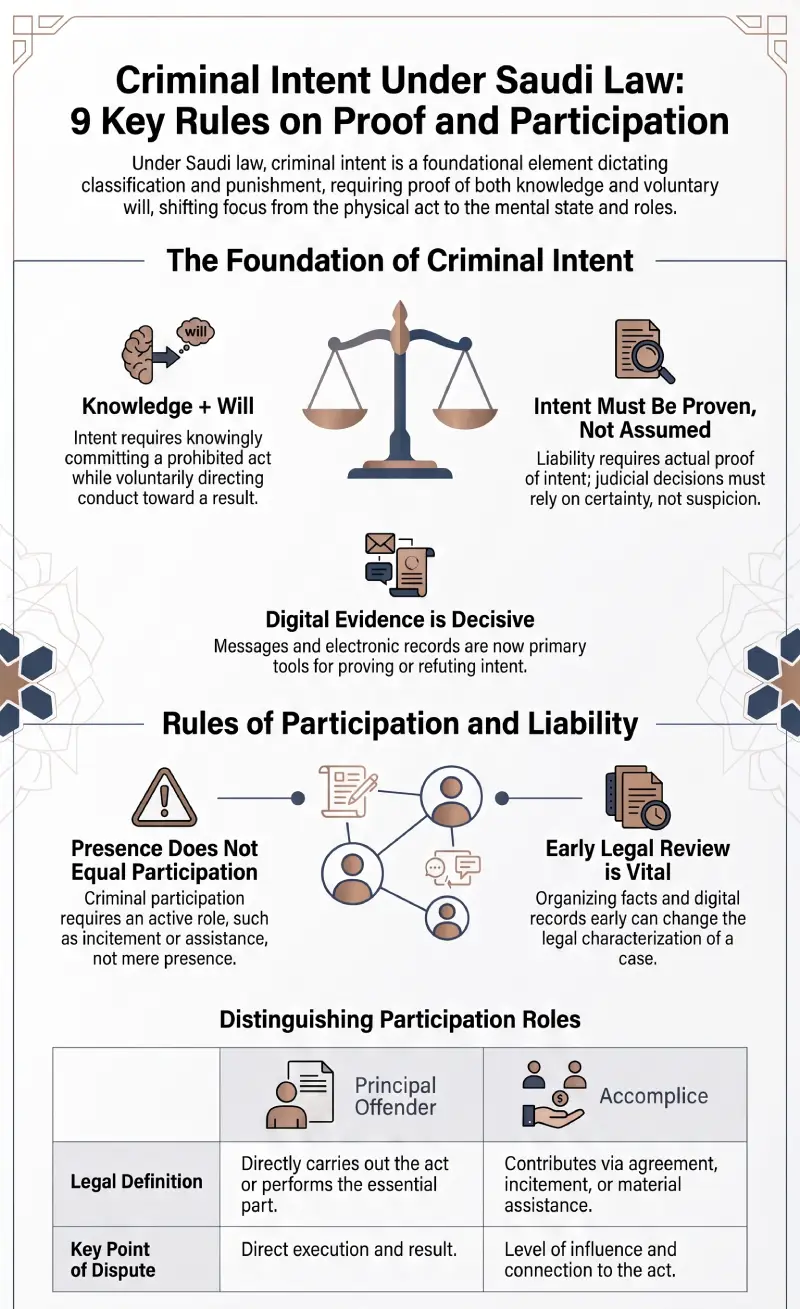
Quick Answer: 9 Rules Governing Criminal Intent Under Saudi Law
Criminal intent under Saudi law generally refers to a person knowingly and voluntarily engaging in conduct constituting a criminal offence, with awareness of its essential elements. Criminal participation, by contrast, involves more than one person contributing to the same offence through different roles, such as execution, incitement, agreement, or assistance, depending on the applicable law and the facts of the case.
This is where many disputes in criminal cases begin. The central question is not merely whether an act occurred, but whether the required intent existed, what role each person played, and how those elements can be proved.
The key principles are:
- Criminal intent generally involves both knowledge and will.
- The occurrence of an act alone does not establish intentional wrongdoing in every case.
- The mental element is broader than criminal intent, although intent is one of its principal forms in intentional offences.
- The type of intent may affect legal characterization and the way evidence is assessed.
- Absence of criminal intent may change the legal characterization but does not automatically result in acquittal in every case.
- Intent may be established through circumstantial evidence, context, and digital evidence, not only through a confession.
- Criminal participation is not established merely by presence at the scene or general knowledge of the offence.
- The distinction between a principal offender and an accomplice may affect attribution and punishment.
- Organizing the facts, messages, and official records at an early stage can materially affect how the case is understood.
What Is Criminal Intent Under Saudi Law?
Criminal intent is one of the clearest forms of the mental element in intentional offences. In practical terms, this means that conduct is not assessed merely as a physical act. It is considered in light of the person’s knowledge, will, and the surrounding circumstances that may reveal the purpose behind the conduct.
For this reason, intent is rarely established from a single isolated statement. It is usually assessed through an integrated reading of the facts, circumstances, and evidence throughout the stages of a criminal case under Saudi law, from preliminary evidence gathering and investigation through to trial.
Criminal intent under Saudi law generally revolves around two main elements:
- Knowledge: awareness of the nature of the act or of an essential element of the offence to the extent required by the applicable law.
- Will: the voluntary direction of a person’s conduct toward the act or its result.
Where intent is disputed, the analysis usually focuses on these two questions: Did the person actually know the relevant facts? And did their will extend to the conduct or result that occurred? Or is the case more accurately characterized as mistake, negligence, poor judgment, or a less serious form of responsibility?
This distinction is not merely academic. It may directly affect the legal characterization of the conduct and the way a defense is structured.
Criminal intent should also not be confused with the broader concept of the mental element. The mental element can extend beyond intent, while criminal intent is particularly associated with intentional offences. Some cases may instead involve disputes over negligence, recklessness, or carelessness rather than deliberate wrongdoing.
Accordingly, a harmful result should not automatically be treated as proof of intent, just as every mental element should not automatically be treated as full criminal intent without examining the applicable legal requirements.
Legal analysis also commonly distinguishes between general and specific intent, as well as direct and indirect intent. These distinctions help identify what must actually be established in a particular case.
The classification is therefore more than academic terminology. It helps define the real issue in dispute: whether proof of the prohibited act and knowledge is sufficient, or whether the applicable provision also requires proof of an additional purpose or acceptance of a particular consequence.
| Type | Practical Meaning | Relevance to the Analysis |
|---|---|---|
| General intent | Intentionally committing the prohibited act with the required knowledge | Common in many intentional offences |
| Specific intent | Committing the act with an additional specific purpose | Relevant where the law requires a particular objective |
| Direct intent | The person’s will is directly aimed at producing the result | May strengthen the inference of intentional conduct |
| Indirect intent | The person anticipates or accepts a possible result and continues the conduct | May be relevant in certain complex factual situations |
When Can Criminal Intent Be Absent, and How Is It Proven in Court?
The absence of criminal intent under Saudi law can significantly affect the characterization of a criminal case. It does not, however, necessarily produce an automatic acquittal.
Depending on the applicable provision, facts, and evidence, absence of intent may result in the intentional characterization being excluded, responsibility being narrowed, or the conduct being considered under a different or less serious legal characterization.
It is therefore more accurate to say that absence of intent may alter the legal classification of the case rather than produce one fixed outcome in every situation.
Issues that may weaken or exclude an inference of criminal intent can include:
- lack of knowledge of an essential element of the relevant facts;
- absence of effective voluntary conduct in circumstances where this is legally significant;
- a material mistake concerning the facts;
- circumstances indicating that the conduct is closer to negligence or carelessness than deliberate wrongdoing.
Proof of criminal intent also rarely depends on one item of evidence alone. Intent may be inferred from admissions, circumstantial evidence, witness testimony, digital evidence, and the overall factual context.
This becomes particularly important when assessing the validity of a confession in criminal cases and the circumstances in which it may be challenged.
The Saudi Evidence Law recognizes digital evidence within the statutory evidentiary framework and gives digital evidence the evidentiary effect prescribed by law. Published judicial materials also illustrate the importance of digital evidence where its integrity and reliability are established, although its weight will depend on its authenticity, context, and the circumstances of each case.
An inference of criminal intent may be weakened where:
- the circumstances reasonably support more than one interpretation;
- there is no clear connection between the conduct and the alleged result;
- the conduct can reasonably be understood as mistake or poor judgment;
- digital evidence or communications have not been properly established or attributed.
For this reason, one message or isolated event may not be sufficient in some cases. The evidence should instead be assessed as a whole and connected to the broader factual sequence.
Where a case involves messages, records, or facts relevant to criminal intent or its absence, organizing that material early may directly affect the legal characterization and the way the defense is developed.
This article addresses criminal intent under Saudi law, how intent may be proven or disputed, and how the distinction between a principal offender and an accomplice may affect legal characterization and liability.
- An ongoing criminal investigation or police summons
- Disputes about intent, knowledge, or voluntary conduct
- Digital evidence, messages, or electronic records
- Multiple parties and questions about each person’s role
Criminal Participation: Principal Offender vs Accomplice
Criminal participation refers to situations in which more than one person contributes in a legally relevant way to the commission of the same offence.
The involvement of several individuals, however, does not automatically mean that they all bear the same degree or type of responsibility. The relevant question is not simply whether a person was present, but what role they actually performed, how significant that role was, and how it was connected to the prohibited conduct.
Responsibility should therefore not be extended through broad assumptions based merely on presence, general knowledge, or proximity to the events. The underlying principle remains that punishment is personal, and criminal attribution must rest on a specific and established basis.
A principal offender is generally the person who directly carries out the prohibited act or performs an essential part of its execution.
An accomplice, by contrast, contributes in a legally relevant way to the commission of the offence without necessarily carrying out the principal act themselves.
Accordingly, circumstances such as mere silence or a relationship with the persons involved do not, by themselves, establish complicity. What matters is whether there was an actual role connected to the offence, its facilitation, encouragement, or an agreement relating to its commission.
Forms of criminal participation may include:
- prior agreement;
- incitement;
- material assistance;
- psychological or other assistance having an actual effect on the commission of the offence.
Certain Saudi criminal statutes expressly address forms of conduct where assistance, facilitation, or coordinated participation may become relevant.
The Saudi Anti-Cyber Crime Law, for example, criminalizes specified acts involving unauthorized interception, access, or other conduct involving computer systems or information networks. In such digital cases, the applicable statutory provision and the specific facts determine whether another person’s conduct amounts to execution, agreement, assistance, or facilitation.
| Element | Principal Offender | Accomplice |
|---|---|---|
| Position in the offence | Directly carries out the act or performs an essential role in its execution | Makes a significant contribution without carrying out the principal act |
| How the role is proved | Direct conduct, circumstances, and contextual evidence | Incitement, agreement, assistance, or other relevant contribution |
| Main disputed issue | Attribution of the execution and result | Significance of the person’s contribution and its connection to the offence |
In cases involving several individuals, the challenge is therefore not only proving that an offence occurred. It is also preventing the roles of different individuals from being improperly conflated across the various types of criminal cases in Saudi Arabia and the different legal consequences that may follow.
Where the central dispute concerns who actually carried out the prohibited act and whose role was limited to assistance or incitement, that distinction may materially change the scope of criminal attribution.
How Does Criminal Intent Affect Criminal Liability?
In intentional offences, criminal liability is not based solely on the occurrence of a harmful result. The conduct and result must be properly attributed to a particular person, taking into account that person’s act, role, and required state of mind.
Weakness in proving either criminal intent or the accused person’s role may therefore directly affect attribution, legal characterization, and punishment.
This is one of the circumstances in which consulting a criminal lawyer in Jeddah may become relevant where an investigation or criminal accusation is already underway.
The distinction between criminal and civil liability is also important in practice.
Criminal liability relates primarily to the public-law consequences of a criminal offence. Civil liability generally concerns compensation and redress for harm. Both forms of liability may arise from the same set of facts, but each has its own purpose, requirements, and legal consequences.
The practical importance of criminal intent under Saudi law is particularly clear in cybercrime cases. Certain forms of digital conduct cannot be properly understood merely by looking at the resulting harm. The person’s knowledge, authorization, purpose, and role may all be relevant to determining whether criminal liability arises.
The Saudi Anti-Cyber Crime Law criminalizes specified forms of unauthorized interception and other conduct involving information transmitted through computer systems or networks.
In the digital environment, technical evidence, electronic communications, and system records may therefore play a central role in establishing or disputing criminal intent and in identifying whether a person’s conduct amounted to direct execution, assistance, or facilitation.
Similarly, in cases involving alleged forgery, electronic communications, or digital evidence, the existence of a document or conversation is not necessarily sufficient by itself.
Relevant questions may include:
- Who created the material?
- Who used it?
- Who knew its nature or purpose?
- Who performed the legally significant act?
In many cases, the surrounding context can therefore be more important than one isolated event.
This is why general answers are often insufficient in cases involving criminal intent and participation. A meaningful assessment usually requires a careful examination of the complete factual record.
When Does a Criminal Case Require Early Legal Review?
Early legal review becomes particularly important when the real dispute concerns criminal intent or the role of each person rather than the occurrence of the underlying event itself.
This commonly arises where:
- an investigation or summons has been issued;
- several persons are involved;
- messages or digital evidence form part of the case;
- an allegation involves prior agreement or incitement;
- the dispute concerns whether the conduct was intentional or accidental.
Saudi criminal procedure also recognizes an accused person’s right to seek the assistance of a lawyer during the investigation and trial stages. This highlights the practical importance of understanding the role of a criminal lawyer in criminal cases at the appropriate stage.
Material that can be useful to organize at an early stage includes:
- a concise chronological account of the events;
- relevant messages and electronic records;
- arrest, investigation, or notification records;
- names of the parties and key dates.
Preparing these materials does not guarantee any particular outcome. It can, however, make the next procedural step clearer and reduce early mistakes that may later affect the person’s position.
Frequently Asked Questions About Criminal Intent Under Saudi Law
What is criminal intent under Saudi law?
Criminal intent generally means knowingly and voluntarily committing a prohibited act while being aware of its essential elements.
How is criminal intent proven in Saudi Arabia?
It may be proven through admissions, circumstantial evidence, witness testimony, digital evidence, messages, and the overall context of the case.
Does the absence of criminal intent mean automatic acquittal?
No. It may change the legal characterization or reduce the scope of liability, depending on the applicable law and facts.
What is the difference between a principal offender and an accomplice?
A principal offender directly carries out the offence, while an accomplice contributes through conduct such as incitement, agreement, or assistance.
Is being present at the scene enough to establish criminal participation?
No. Mere presence or general knowledge is not usually sufficient without evidence of an actual and legally relevant contribution.
Can digital evidence prove criminal intent?
Yes. Messages, electronic records, and other digital evidence may help establish or challenge criminal intent when their authenticity and context are properly established.
Criminal Intent Under Saudi Law: 9 Rules on Proof and Participation addresses an element that can materially change the characterization and direction of a criminal case.
Criminal participation is likewise not established merely because several people are connected to the same events. It requires a careful assessment of each person’s role and the proper limits of criminal attribution.
Distinguishing intentional conduct from mistake, a principal offender from an accomplice, and direct evidence from circumstantial evidence can therefore be central to assessing the strength or weakness of a criminal case.
In matters involving digital evidence or multiple parties, organizing the facts and supporting records at an early stage becomes particularly important. Many disputes in these cases concern not only what ultimately happened, but how the events occurred and which person’s knowledge, conduct, or participation produced the relevant result.
Where the matter is already the subject of an investigation, complaint, or criminal accusation, understanding the approach of BMS Legal Law Firm to reviewing facts and supporting documents may help determine the appropriate next step before further action is taken.
Official References: