
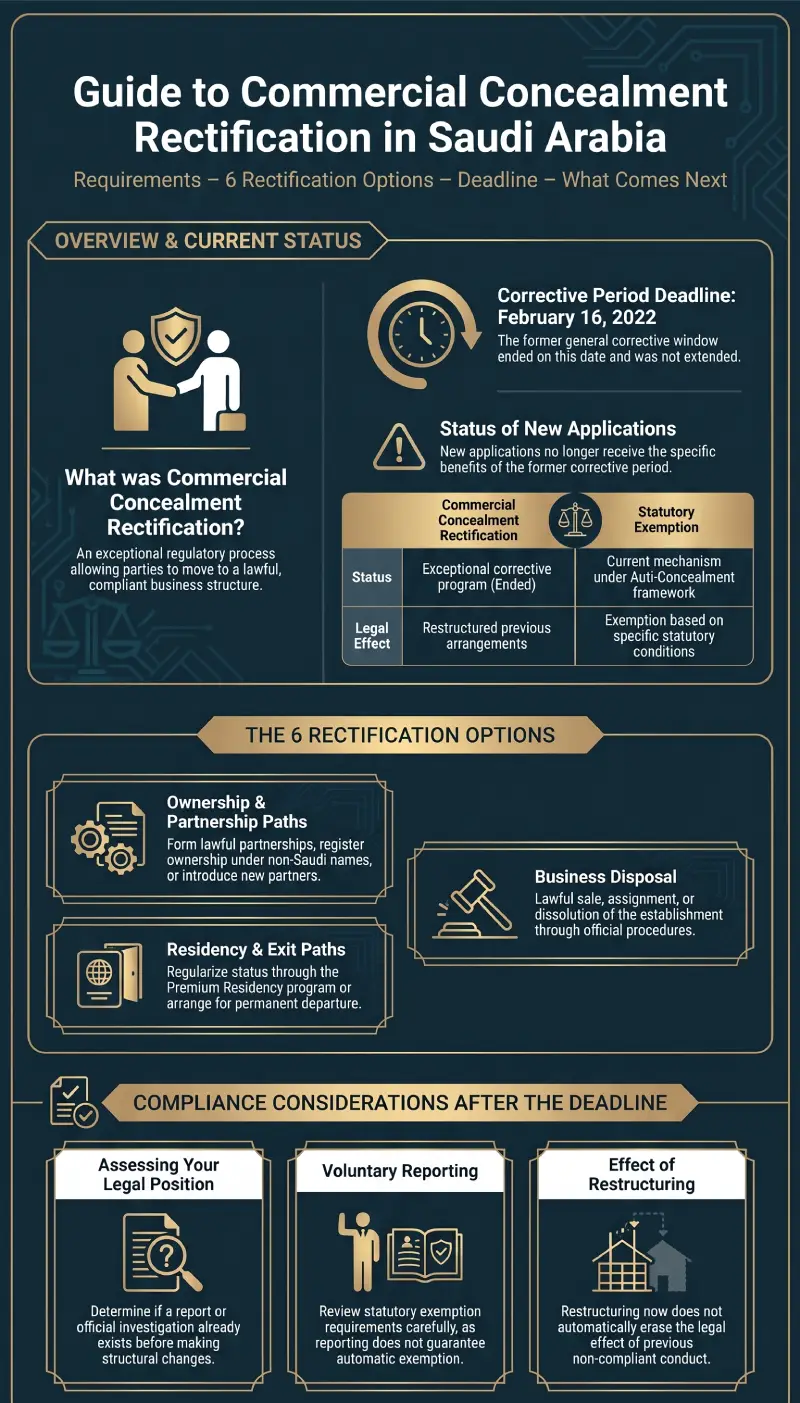
Commercial Concealment Rectification in Saudi Arabia was linked to an exceptional corrective period that allowed violators of the Anti-Concealment Law to regularize their business arrangements through specific options established by the applicable regulation. That period ended on February 16, 2022, so the former rectification route is no longer open with the same benefits.
A business may still need to reorganize its current ownership or management structure, assess the effect of an existing report or investigation, or determine whether the statutory exemption rules could apply in the case of voluntary reporting.
This guide explains what Commercial Concealment Rectification meant, the requirements of the former corrective period, the six available options, and what may need to be considered after the deadline.
Commercial Concealment Rectification After the Deadline
The general corrective period ended on February 16, 2022, and new applications no longer benefit from the advantages attached to that period.
What happens after the deadline depends on the actual position of the business. The appropriate course may involve regularizing the current structure, addressing an existing commercial concealment report, or assessing whether the statutory requirements for exemption from penalties may apply.
What Does Commercial Concealment Rectification Mean?
Under the Saudi Anti-Concealment Law, commercial concealment generally involves an agreement or arrangement that enables a non-Saudi person to engage in an economic activity they are not licensed to conduct by using another person’s licence, approval, commercial registration, or business position.
The presence of a non-Saudi manager or employee does not, by itself, establish commercial concealment. The business activity, licensing position, actual authority, financial control, and the persons who effectively manage revenue and business decisions must all be considered.
The separate guide on Commercial Concealment Evidence in Saudi Arabia explains how bank transfers, authorizations, documents, communications, and actual management arrangements may be assessed when determining whether concealment exists.
Commercial Concealment Rectification, by contrast, referred to an exceptional regulatory route that enabled Saudi and non-Saudi parties to move from a non-compliant arrangement to a recognized legal structure during the corrective period.
A rectification application required disclosure of information concerning the establishment, the activity, and the parties involved, followed by selecting an available corrective option and completing its requirements within the applicable period.
Today, dealing with a potentially problematic structure begins by identifying any issue in licensing, ownership, partnership arrangements, or actual management. The legal effect of earlier conduct must then be assessed separately. This is why restructuring a business after the corrective period is not the same as using the former Commercial Concealment Rectification program.
What Were the Requirements and Rectification Options?
The requirements for Commercial Concealment Rectification arose from the exceptional corrective framework established for violators of the Anti-Concealment Law.
Applicants were required to submit their request within the corrective period, disclose the necessary information, select an available legal route, and complete the requirements applicable to that route.
The benefits of the former corrective period did not extend to a person who had already been detected committing an offence or violation governed by the Law before applying, or whose matter had already been referred to the Public Prosecution or the court before the application was submitted.
The corrective framework provided six principal options:
| Option | How It Worked During the Corrective Period |
|---|---|
| Lawful partnership | A Saudi and non-Saudi party could enter into a compliant partnership after satisfying the applicable requirements |
| Registration of ownership | Ownership of the establishment could be registered in the name of the non-Saudi after satisfying the relevant ownership requirements |
| Introduction of a new partner | The Saudi owner could continue the activity by introducing a Saudi partner or a licensed foreign investor |
| Disposal of the business | The Saudi owner could sell, assign, or dissolve the establishment in accordance with the applicable procedures |
| Premium Residency | A non-Saudi could obtain Premium Residency and complete the required regularization |
| Permanent departure | A non-Saudi could permanently leave the Kingdom after satisfying the applicable requirements relating to private rights |
A lawful partnership was therefore one of the former corrective options, but it required more than simply changing the description of the relationship on paper.
Where the relationship between partners, management powers, ownership rights, or internal authority needs to be reorganized, corporate contracts and shareholder arrangements may help define the parties’ rights and powers more clearly.
When Was a Lawful Partnership a Rectification Option?
A lawful partnership was one of the options available during the corrective period. It allowed a Saudi and a non-Saudi party to continue the activity through a legally recognized commercial relationship after satisfying the applicable investment, ownership, and licensing requirements.
The purpose was not simply to rename an existing arrangement or sign a new agreement while leaving the underlying practice unchanged. The business structure itself had to be brought into compliance with the requirements applicable to the activity and the parties.
This could require amendments to licences, establishment data, ownership arrangements, or the organizational structure.
The fact that partnership was available as a rectification option does not mean that every partnership involving a non-Saudi constitutes commercial concealment. Whether concealment exists depends on the actual activity, licensing position, authority, and commercial relationship between the parties.
When Did the Corrective Period End, and What Happens After It?
The deadline for Commercial Concealment Rectification was February 16, 2022. The National Anti-Commercial Concealment Program confirmed the end of the corrective period while government authorities continued processing applications that had already been submitted within the permitted period.
Processing an application submitted before the deadline is therefore different from opening a new corrective period.
After the deadline, a business should review its articles of association, licences, shareholder or partner agreements, banking powers, management authorities, and actual operational arrangements. A later amendment to ownership or contractual documents should not automatically be treated as removing the legal effect of earlier conduct.
The appropriate response depends on the procedural stage:
- No report or official action exists: review the current relationship and identify any aspect that requires lawful restructuring.
- A report or official communication has been received: determine the procedural stage before submitting statements or making substantial changes.
- Inspection or investigation has begun: distinguish between regularizing the future business structure and assessing responsibility for previous conduct.
- Voluntary reporting is being considered: examine the statutory exemption conditions before assuming that reporting alone guarantees exemption.
Where a report has already been filed, the guide on commercial concealment reporting procedures explains the reporting route and what may happen during subsequent verification.
What Is the Difference Between Rectification and Exemption?
Commercial Concealment Rectification was an exceptional program available during a defined corrective period. Exemption from penalties, however, is a separate statutory mechanism governed by the Anti-Concealment Law and the applicable exemption rules.
The expiry of the corrective period therefore does not mean that the statutory exemption framework ceased to exist. At the same time, filing a report does not automatically entitle the reporting person to exemption.
A person seeking exemption must satisfy the applicable statutory conditions and the circumstances of the case must support the request. The separate article on commercial concealment penalties in Saudi Arabia explains the penalties and legal consequences that may arise when the offence is established.
The exemption rules include conditions such as ceasing the offence when reporting, reporting before the competent authorities discover it, not being preceded by another offender’s report, cooperating with the authorities throughout the relevant procedures, providing useful evidence or information, and refraining from destroying, falsifying, or concealing evidence. The report must also produce the result required under the applicable rules.
| Issue | Former Corrective Period | Statutory Exemption |
|---|---|---|
| Legal basis | Rectification regulation | Anti-Concealment Law and exemption rules |
| Current status | Corrective period has ended | May apply where statutory conditions are satisfied |
| Purpose | Regularizing the business structure | Exemption linked to qualifying reporting |
| Decision-making authority | Relevant rectification process | Criminal court |
| Zakat and tax liabilities | The former program included specific benefits | Exemption does not remove zakat and tax liabilities |
Rectification and exemption should therefore not be treated as interchangeable concepts, particularly where a report, investigation, or other official procedure is already underway.
When Should You Seek Legal Review?
Legal review may be appropriate where the actual management of the establishment differs from its contracts or licences, financial authority is unclear, or a report or summons has been received.
It may also become relevant before voluntary reporting, changing ownership, amending management arrangements, or restructuring the relationship between business partners.
If the actual management structure differs from the contractual or licensing position, or if a commercial concealment report or summons has been received, consulting a Commercial Lawyer in Jeddah may help identify the procedural stage and the documents that should be reviewed before changing the structure or submitting a statement.
Frequently Asked Questions About Commercial Concealment Rectification
Can commercial concealment be rectified after the deadline?
The former corrective period has ended. Current options depend on the business structure and any existing legal procedures.
What were the requirements for Commercial Concealment Rectification?
Applicants had to file within the deadline, disclose the required information, and complete an approved rectification route.
What rectification options were available?
Six options were available, including lawful partnership, ownership registration, a new partner, business disposal, Premium Residency, or permanent departure.
Can the situation be addressed after a report is filed?
Possibly, but the procedural stage must be reviewed before making major changes.
What is the difference between rectification and exemption?
Rectification was a temporary program. Exemption is a separate legal mechanism with its own conditions.
Commercial Concealment Rectification: 6 Options & Deadline is ultimately about understanding what the former corrective period allowed and what changes once that period has expired, rather than treating the previous rectification window as an option that remains continuously available.
The corrective period ended on February 16, 2022, and the six options described above belonged to that specific regulatory framework.
After the deadline, the appropriate course depends on the actual business activity, licensing position, relationship between the parties, and the procedural stage of any report or investigation. Regularizing the future structure of the establishment should be distinguished from the legal effect of earlier conduct.
Exemption from penalties is also a separate statutory route governed by its own requirements and is not obtained automatically merely by filing a report.
Where the matter requires a coordinated review of the business structure, agreements, and existing procedures, a Jeddah law firm can assess the file and explain the available legal routes before the next step is taken.
Official Sources: