
Many families and convicted individuals seek a clear answer to the question: does the royal pardon cover drug cases in Saudi Arabia? The answer cannot be determined from the name of the case alone. The legal classification of the offence, the stage of proceedings, the criminal record, and the time already served may all affect the outcome.
A case may involve drug use, possession for personal use, promotion, importation, or trafficking. Each classification carries different legal consequences. It is also necessary to verify whether the judgment is final, whether other judgments exist, and whether the sentence includes a fine, confiscation, travel restrictions, or deportation.
A proper review therefore begins with the written judgment and the official sentence record. These details must then be compared with the pardon rules applicable at the time of implementation.
Direct Legal Answer: Does the Royal Pardon Cover Drug Cases?
A royal pardon may cover some individuals convicted in drug cases when the applicable conditions are met. However, it does not automatically cover every drug-related conviction. Release under a pardon also does not necessarily cancel the judgment, erase the criminal record, or terminate every supplementary penalty.
Eligibility depends on the offence established in the judgment, the stage of the case, the portion of the sentence served, previous convictions, and conduct during imprisonment. A general answer about whether drug offences are covered by a royal pardon is therefore insufficient without reviewing the case documents.
It is equally inaccurate to assume that drug use is always covered or that promotion is always excluded unless the applicable pardon rules expressly provide so.
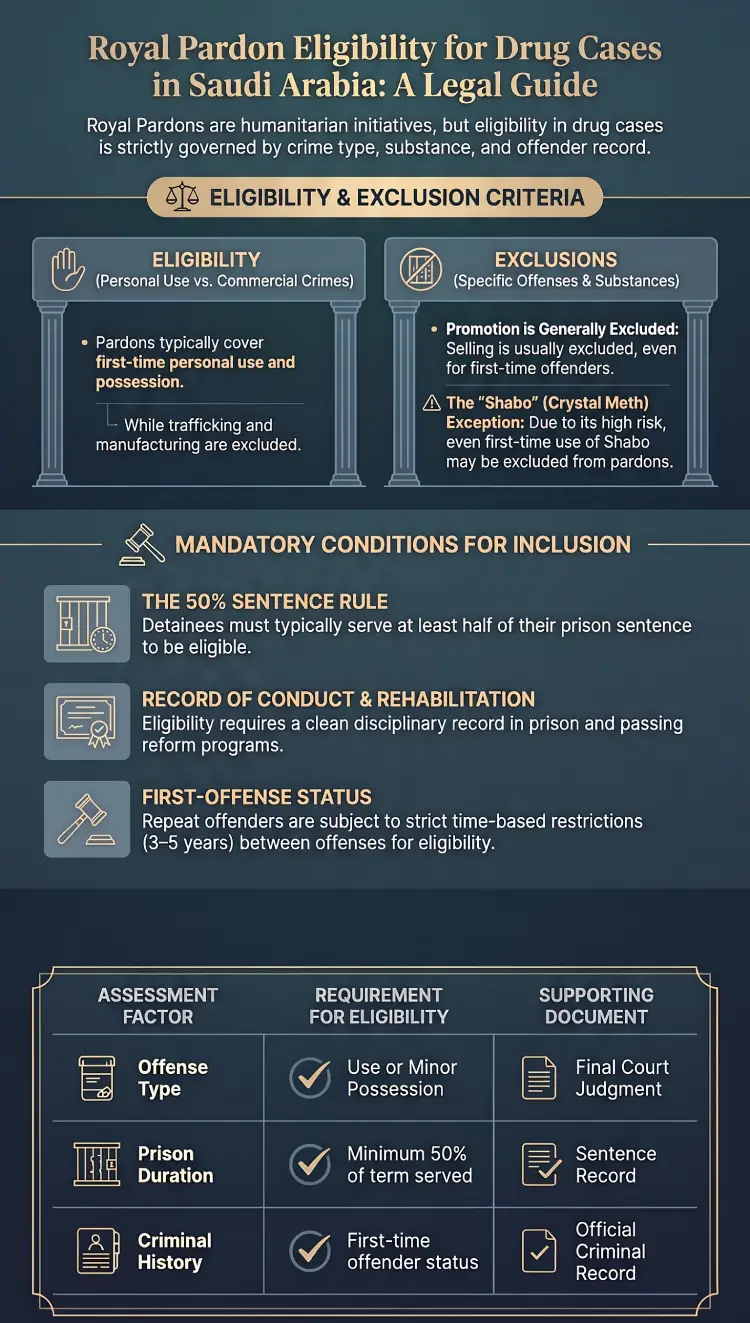
7 Factors That Determine Whether a Drug Case May Be Covered
Drug cases that may qualify for a royal pardon are assessed through seven connected factors. None should be considered in isolation when reviewing an individual case.
- Classification of the offence: Drug use, possession, promotion, importation, trafficking, or another drug-related act.
- Established intent: Possession for personal use differs from promotion or trafficking in its legal classification and consequences.
- Stage of the case: An investigation differs from a trial, while a non-final judgment differs from a final and enforceable judgment.
- Time already served: This must be assessed under the applicable pardon rules without assuming that one fixed percentage applies to every case.
- Previous convictions: A first offence or repeated offending may affect the assessment of eligibility.
- Conduct in prison: Disciplinary breaches, good conduct, and participation in rehabilitation programmes may form part of the official review.
- Other judgments and legal effects: The individual may have another judgment, a fine, confiscation order, travel restriction, or deportation order.
| Factor | What Must Be Verified? | Relevant Document |
|---|---|---|
| Classification of the offence | The judicial classification and the intent attached to the act | Judgment and statement of claim |
| Stage of proceedings | Investigation, trial, non-final judgment, or final judgment | Detention order or judgment |
| Time served | Sentence commencement date and time already served | Official sentence record |
| Record and prison conduct | Previous convictions and recorded prison violations | Official records |
| Supplementary consequences | Fine, confiscation, travel restriction, and deportation | Operative part of the judgment |
What Types of Drug Cases May Be Covered by a Royal Pardon?
Drug offences in Saudi Arabia are not treated as one single category. Their legal classification differs according to the conduct, intent, and evidence established in the judgment.
For this reason, the answer to whether the royal pardon covers drug cases may differ between drug use, possession, promotion, and trafficking. The stage of the case and the convicted person’s criminal record must also be considered.
Each case should be assessed through the operative part of the judgment and the facts formally established by the court, rather than through the case label used by relatives or general assumptions.
Drug Use and Possession for Personal Use
When reviewing the conditions of a royal pardon for drug offences, it is important to distinguish between use, possession, and promotion. Whether a pardon covers drug use depends on the classification ultimately adopted in the judgment, not merely on how the family describes the incident.
The same principle applies when asking whether a pardon covers drug possession. Possession may be connected to personal use or to another proven purpose. A first offence may support the convicted person’s position, but it does not create an automatic entitlement to a pardon.
The facts, judgment, and applicable pardon rules must therefore be reviewed together. The result should not be based solely on the quantity or type of substance. Where no official rule expressly addresses a particular situation, the case should not be described as conclusively covered or excluded.
Promotion, Trafficking, and More Serious Offences
A common question is whether a royal pardon covers a person convicted of promoting drugs, particularly where it was the first offence or no financial payment was involved.
These factors alone do not determine eligibility. The legal classification of promotion is derived from the facts, evidence, and operative wording of the judgment.
Importation, trafficking, and manufacturing also differ from drug use and possession in terms of seriousness and prescribed penalties. The relevant exclusions in the applicable pardon rules must therefore be reviewed instead of relying on broad claims that such offences are always covered or permanently excluded.
Where no official information expressly addresses a particular substance or classification, no definitive result should be stated. The type of drug alone is also insufficient without examining the proven intent, judicial classification, and procedural stage.
Does the Royal Pardon Cover a First Drug Offence?
A first drug offence does not automatically mean that the convicted person will be included in the pardon. However, the absence of previous convictions may influence the assessment.
The sentence and other factors affecting a first offence can be understood more fully through guidance on the penalty for a first-time drug use offence in Saudi Arabia.
Similarly, a second offence does not necessarily result in automatic exclusion unless the applicable rules provide so. Repeated offending may nevertheless affect the authorities’ assessment of the case.
A royal pardon is also different from conditional release. Serving half of the sentence should not be treated as a universal condition for a pardon involving drug prisoners. Each process has its own legal basis, conditions, and consequences.
Before requesting a case assessment, collect the following information:
- The offence as stated in the operative part of the judgment.
- The judgment date and whether it has become final.
- The prison term and the period already served.
- The number and type of previous convictions.
- Any other judgment or supplementary penalty.
- Conduct and disciplinary violations recorded during imprisonment.
Can a Detainee Be Covered, and How Is an Application Submitted?
The position of a detainee depends on whether the case is at the investigation, trial, judgment, or enforcement stage. Understanding the criminal case procedures in Saudi Arabia helps identify the current stage before assessing the possible effect of a royal pardon.
Where no judgment has been issued, essential information about the final legal classification and sentence may still be incomplete. If the judgment is not final, the appeal stage and whether the judgment has become enforceable must be verified before determining its legal effects.
A government service may be available for submitting an application for exemption from the remaining sentence. The submission channel may vary according to the regional emirate and the service available.
The application commonly includes:
- The prisoner’s name.
- National identification number.
- Case number.
- Name of the prison.
- Length of the sentence.
- Applicant’s details.
- Applicant’s relationship to the prisoner.
The authority may request the written judgment or additional documents. There is no single form that necessarily applies to every region and every case.
The application should be followed through the same official channel used for submission. It is also necessary to verify that no separate judgment or enforceable sentence prevents release.
Does a Pardon Remove the Judgment and Criminal Record?
A pardon from punishment is not the same as an acquittal. An acquittal removes the basis for conviction, while a pardon may apply only to the sentence or the remaining part of it.
The judgment and its recorded effects may therefore remain unless a separate legal provision or procedure changes them.
A royal pardon does not automatically extinguish private claims. A victim’s private claim differs from the punishment imposed in respect of the public right. The public right protects the interests of society, while the private right concerns the injured party’s personal claim.
The same applies to:
- Fines.
- Confiscation.
- Travel restrictions.
- Deportation.
The operative part of the judgment and the precise scope of the pardon must be reviewed to determine which consequences remain enforceable.
A pardon also differs from rehabilitation. Rehabilitation concerns the effects of the conviction and criminal record after its conditions are satisfied.
It likewise differs from conditional release, which is connected to the portion of the sentence served, prison conduct, and continuing obligations following release.
The conditions of one procedure should therefore not be used to interpret another, and release should not be assumed to terminate every legal effect arising from the judgment.
When Does a Drug Case Require Legal Review?
Legal review becomes particularly important where the case contains more than one possible classification, involves promotion or trafficking, or includes several previous convictions.
Review is also important where:
- It is unclear whether the judgment is final.
- Another enforceable judgment exists.
- The sentence includes a travel restriction.
- Property has been confiscated.
- A non-Saudi resident faces deportation.
Where the facts may fall between personal use and promotion, or where the convicted person has multiple judgments or previous offences, consulting a drug crimes lawyer in Jeddah can help organise the judgment, sentence, and remaining legal consequences before the next step is taken.
A legal review can help arrange the relevant documents, explain the procedural stage, and identify the appropriate authority for an application without promising a particular result.
It can also distinguish between the principal sentence, supplementary penalties, and other rights or obligations arising from the judgment.
The BMS Legal team can review the classification of the offence, the stage of the judgment, and the time already served. The team can then explain the documents required and the appropriate procedural step.
Initial contact should begin with a brief summary of the case. Sensitive identity documents or confidential case records should not be sent in the first message.
Frequently Asked Questions About Royal Pardons in Drug Cases
What drug cases may fall within a royal pardon?
Eligibility depends on the offence, procedural stage, previous convictions, time served, and the rules applicable when the pardon is implemented.
How is a first-time drug use offence treated?
A first offence may support the case, but it does not guarantee inclusion without reviewing the judgment and the remaining conditions.
When is possession treated as being for personal use?
This depends on the intent established in the judgment and the facts and evidence relied upon by the court.
Can a first-time drug promoter benefit from a pardon?
A first offence alone is insufficient. The promotion classification and applicable exclusions must also be reviewed.
What happens if the detainee has not yet been sentenced?
The position depends on the scope of the pardon and the stage of proceedings, as a detainee differs from a convicted prisoner.
Is serving half the sentence required for a pardon?
Half of the sentence should not be treated as a universal requirement. The rules applicable at the time must be reviewed.
How can I tell whether my brother has been included in the pardon?
Check the case details with the prison administration and the competent authority, then follow the application through the official government channel.
When must a prisoner submit a pardon application?
Some files may be reviewed through official procedures, while other cases may require an application to the competent authority.
What legal effects may remain after release?
The criminal record, fine, confiscation, travel restriction, or deportation may remain depending on the pardon and the judgment.
What documents are needed to assess possible eligibility?
The main documents include the judgment, official sentence record, time served, previous convictions, and any supplementary penalties.
Does the Royal Pardon Cover Drug Cases? 7 Key Factors the answer—not the case label or unofficial information alone.
The assessment begins with the classification of the offence, the established intent, procedural stage, finality of the judgment, time served, previous convictions, and any other enforceable judgments.
The written judgment, official sentence record, and supplementary consequences should therefore be collected and compared with the applicable pardon rules before expecting a particular result or submitting an application.
Where a family requires a comprehensive review of the judgment, criminal record, and supplementary penalties, it may contact a law firm in Jeddah to identify the required documents and appropriate legal route.
Source