
How to choose the right property in Saudi Arabia is not answered by looking at the design or advertised price alone. The right decision starts by checking the purpose of purchase, location, price, title deed, sale contract, and financing position before paying a deposit.
Buying property for residential use or investment is both a financial and legal decision. It may turn from an opportunity into a dispute if you rely only on an attractive listing or a verbal promise. You need to treat the property as a complete file, not as a quick viewing.
How to Choose the Right Property Before Paying a Deposit?
Choosing the right property means checking nine elements before making a commitment: purpose, location, price, technical condition, title deed, ownership, sale contract, financing, and risk cases such as mortgage, heirs, agency, tenancy, or dispute.
Before paying a deposit, review these nine checks in order:
- Purpose of purchase: Decide whether the property is for living, investment, or resale.
- Location suitability: Compare nearby services, access, and the future of the area with your needs.
- Price logic: Check the price against similar properties in the same neighborhood.
- Technical condition: Watch for visible defects and request expert inspection when warning signs appear.
- Title deed clarity: Make sure deed data is clear and matches the offered property.
- Seller capacity: Confirm whether the seller is the owner or an authorized agent.
- Sale contract: Review deposit, termination, delay, transfer, and handover clauses.
- Financing and mortgage: Understand how financing or mortgage affects ownership transfer.
- Special cases: Watch for heirs, tenants, disputes, or obligations that may delay the transaction.
If any of these points remains unclear, it is safer to delay payment until the documents are complete and the risks are understood.
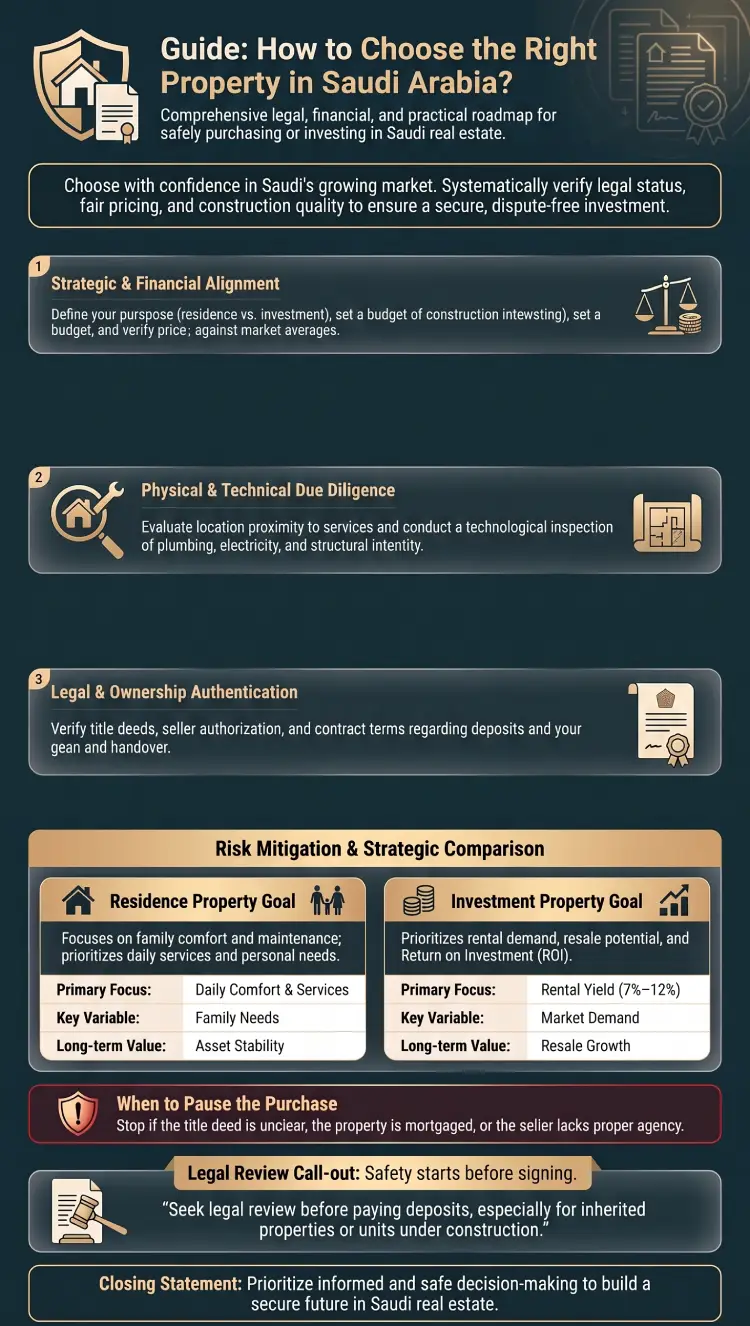
How to Choose the Right Property in Saudi Arabia?
Choosing the right property in Saudi Arabia depends on balancing personal need with legal safety. It is not enough for the property to be in a desirable area or offered at an attractive price. It must be transferable, capable of registration, and supported by clear documents.
A property is suitable when it serves your purpose without exposing you to uncalculated risks. If the goal is residential use, comfort, services, access, and maintenance costs become priorities. If the goal is investment, rental demand, expected return, and resale ability become more important.
A visually attractive property may hide problems in waterproofing, plumbing, electricity, or finishing. A low price may also hide an issue with ownership, mortgage, or agency authority. The right property is the one that withstands financial, technical, and legal checks.
Define Your Goal First: Residence or Investment?
Before searching for the best location to buy property, decide whether you want it for residence or investment. This decision changes the way you evaluate the whole transaction, because residential property is not measured by the same tools as investment property.
If your goal is residence, check proximity to work, schools, essential services, parking, room layout, calm surroundings, and ease of access. Do not make size your only criterion. A smaller apartment in an organized location may be better than a larger villa in an inconvenient area.
If your goal is investment, treat the property as an asset that should generate income or preserve value. Review demand in the area, maintenance costs, rental potential, resale ability, and avoid relying on promises of high returns without verifiable figures.
If the purpose of buying is to operate the property or invest in it with another party, reviewing a real estate investment contract template can help clarify obligations before signing any agreement.
How to Choose the Right Property Location?
Location is one of the most important criteria when choosing the right property, but it does not mean the neighborhood name only. It includes the street, services, population density, ease of access, future development, and suitability for your residential or investment purpose.
Ask about schools, health centers, markets, parking, main roads, and the surrounding environment. When buying an apartment, check the number of units in the building, entrances, and elevators. When buying a villa, check street width, utilities, surrounding services, and access.
| Factor | Developed Area | Emerging Area | Key Point |
|---|---|---|---|
| Services | Existing and clear | May still be developing | Check reality, not promises |
| Price | Usually higher | Usually lower | Do not rely on price alone |
| Demand | Faster for living or renting | Builds gradually | Check resale ability |
| Risk | Usually lower | Relatively higher | Review deed, utilities, and location |
If you ask how to choose the right property location, start with your daily needs, then assess future value, then check the property documents. A good location does not fix a weak contract or unclear title deed.
How Do You Know If the Property Price Is Fair?
A fair property price does not mean the lowest price. It means a price that can be justified when compared with similar properties in the same location. A low price may be a real opportunity, but it may also signal a mortgage, defect, or unexplained urgency.
Compare the property by area, age, façade, street width, finishing quality, parking, and services. Do not compare an apartment in an organized building with another in an overcrowded building merely because both have similar size.
| Checkpoint | Impact on Price | Risk Point |
|---|---|---|
| Location | Raises or lowers value | Relying only on the neighborhood name |
| Title deed | Affects trust and transfer | Data mismatch or unclear ownership |
| Technical condition | Affects repair cost | Hidden defects after occupation |
| Mortgage | Affects transfer speed | Unclear mortgage release process |
| Contract | Protects obligations | Missing deposit and termination clauses |
If you wonder how to know whether the property price is suitable, do not rely only on the listed price. Review the property condition, ask why it is being sold, and check whether any obligation may affect value or transfer.
Property Inspection Before Purchase
Property inspection before purchase protects you from costly surprises after ownership. Inspection is not limited to finishing. It includes utilities, moisture, electricity, plumbing, insulation, parking, entrances, rooftops, and elevators.
Start with a calm viewing and do not rely on a quick visit. Watch for moisture marks, cracks, sewage odor, weak ventilation, water accumulation, and visible repairs that may hide a deeper problem.
Before signing, check:
- Plumbing condition and water leaks.
- Electrical safety and circuit breakers.
- Moisture marks on walls and ceilings.
- Waterproofing in rooftops and bathrooms.
- Parking, entrances, and elevators.
- Match between reality and the advertisement.
If a technical warning sign appears, request a specialized inspection before paying the deposit. The cost of inspection may prevent much larger losses after ownership.
Checking the Property Title Deed and Ownership
Checking the property title deed and ownership is the most important legal step before buying. A copy of the deed alone is not enough. You need to know whether it proves transferable ownership and whether it matches the property being offered.
Review the owner’s name, deed number, property description, area, boundaries, and ownership status. If the property is an apartment, floor, or annex, make sure the sold area is clearly documented and not merely a marketing description.
Checking property ownership means identifying who has the legal right to sell. If the seller is the sole owner, the review is simpler. If the property belongs to heirs, partners, or is sold through an agent, the need to review authority and approvals becomes stronger.
Do not sign a contract that relies on general statements such as “the property is known” or “the boundaries are clear.” The property data must be precise in the contract and consistent with the deed and available documents.
Reviewing the Real Estate Sale Contract Before Paying the Deposit
Reviewing the real estate sale contract before paying the deposit protects you from unclear obligations. The contract is the reference point in disputes over price, transfer, termination, handover, or deposit recovery.
The contract should define the property description, price, payment method, transfer date, mortgage status, and seller obligations before ownership transfer. Saudi real estate sale conditions do not stop at verbal agreement between buyer and seller.
Before signing, review:
- Property description, boundaries, and area.
- Deed and owner details.
- Price and payment method.
- Transfer and handover date.
- Mortgage or financing status.
- Deposit treatment if the transaction fails.
- Termination and delay clauses.
- Seller obligations before transfer.
Do not accept a general phrase such as “the deposit is non-refundable” without details. It is better to link the deposit to document review, financing possibility, and absence of material obstacles to transfer.
Apartment or Villa? And How to Compare Ready Property with Off-Plan Property?
Choosing between an apartment and a villa depends on budget, family needs, maintenance, and location. An apartment may suit someone looking for lower cost and proximity to services, but it requires checking parking, elevators, service fees, and management of shared facilities.
A villa offers more privacy and space, but it usually requires a higher maintenance budget and more responsibility for external areas. Before buying a villa, check structural age, waterproofing, plumbing, electricity, and any additions not clearly reflected in the documents.
A ready property allows you to inspect the actual unit, finishing, and services. However, it may carry previous defects or unclear modifications. An off-plan property may be attractive in terms of price, but it requires a stronger understanding of real estate development cases before evaluating the developer, contract, specifications, and delivery date.
If specifications or delivery dates are unclear, do not treat a lower price as enough reason to buy. A good price does not compensate for an unclear contract or uncertain project path.
Buying Property Through a Bank or Real Estate Financing
Buying property through a bank does not mean the risks are over. Financing helps with ownership, but it adds long-term obligations related to income, installment, mortgage, financing terms, and valuation differences.
Do not look at the installment only. Review financing duration, margin, down payment, additional costs, and your ability to handle maintenance and emergencies. If the installment heavily pressures your budget, the property may not be suitable even if the price looks attractive.
If the property is mortgaged, you need clearer arrangements for mortgage release and ownership transfer. A mortgaged property sale requires careful coordination before transferring ownership.
Cases That Require Extra Caution Before Buying
Some transactions require deeper review because they do not involve only one owner and one buyer. This appears when buying mortgaged property, inherited property, property sold by an agent, or property subject to a dispute or tenancy.
Buying Property with Mortgage, Heirs, or Agency
Buying a mortgaged property is not impossible, but it requires a clear arrangement for mortgage release, transfer, and payment. Buying inherited property requires confirming the heirs, their approvals, and the authority of any agent acting on their behalf.
A sale through an agent requires checking the agency before paying the deposit. The agency should include the authority to sell, receive payment, and complete procedures. Do not rely on personal trust alone, because a defect in the seller’s authority may affect the validity of the process.
Buying Property with a Dispute or Tenant
The existence of a tenant or dispute does not always prevent buying, but it changes how the transaction should be assessed. You should know the lease term, tenant rights, type of dispute, and its impact on handover and use.
Do not buy an occupied property without knowing when you will actually receive it. Do not rely on a promise that the property will be vacated after sale. The contract should clearly state the property’s condition, so you do not become involved in a problem that was not considered at signing.
When Do You Need a Lawyer Before Buying Property?
You need a lawyer before buying property when a legal issue cannot be resolved by viewing the property or receiving general reassurance. A lawyer does not replace technical inspection, but a real estate lawyer in Jeddah can help review the deed, contract, ownership, mortgage, and agency before commitment.
Legal review becomes more important when there is a mortgage, heirs, agent, unclear contract, off-plan property, or large deposit. It is also needed when the advertisement differs from the contract or when transfer may be delayed.
A lawyer does not replace technical inspection, but consulting a real estate lawyer in Jeddah can help review the title deed, contract, ownership, mortgage, and agency before commitment.
FAQs About How to Choose the Right Property
How do you choose the right property in Saudi Arabia?
You choose the right property by checking purpose, location, price, technical condition, title deed, contract, and financing before paying a deposit.
What are the most important criteria for choosing the right property?
The main criteria are location, price, build quality, title deed clarity, ownership safety, and contract or mortgage status.
How do I know if a property is right for me?
A property is right for you if it matches your budget and goal, and has no clear legal or technical risks.
How do I know if the property price is fair?
Compare the price with similar properties in the same area, and review size, age, services, and title deed status.
What should be checked before buying property?
Check the deed, ownership, mortgage, agency, sale contract, deposit, visible defects, and transfer conditions.
Do I need a lawyer before buying property?
You need a lawyer when there is a mortgage, heirs, agent, unclear contract, large deposit, or title deed requiring review.
What are the risks of buying a mortgaged property?
The risk appears when mortgage release, transfer, and payment procedures are not clear before paying a material amount.
.
Is buying inherited property safe?
It may be safe if heirs’ documents, approvals, and agencies are complete, but it needs review before paying the deposit.
Is an apartment or villa better?
An apartment may suit budget and services, while a villa offers more independence and usually higher maintenance costs.
When is buying property a wrong decision?
It becomes wrong when the price is unjustified, the deed is unclear, the contract is weak, or financing is burdensome
Before paying a deposit or signing a real estate sale contract, BMS Legal for Law and Legal Consultations can review the title deed, sale contract, ownership, mortgage, and agency confidentially, then clarify the risk points and next step before commitment.
Do not make your decision title “How do I find the cheapest property?” Make it: How to Choose the Right Property? 9 Checks Before Deposit. The right property is not the cheapest or most beautiful, but the clearest in terms of purpose, location, price, deed, contract, and financing.
Start by defining the purpose of purchase, then compare location and services, then check price and future costs. After that, review the deed, ownership, contract, mortgage, agency, and the status of heirs or tenant if any.
If you are in Jeddah, Makkah, Taif, or Madinah and need legal review of property documents before purchase, contacting a law firm in Jeddah is a practical step before paying a deposit.
Official Sources: