
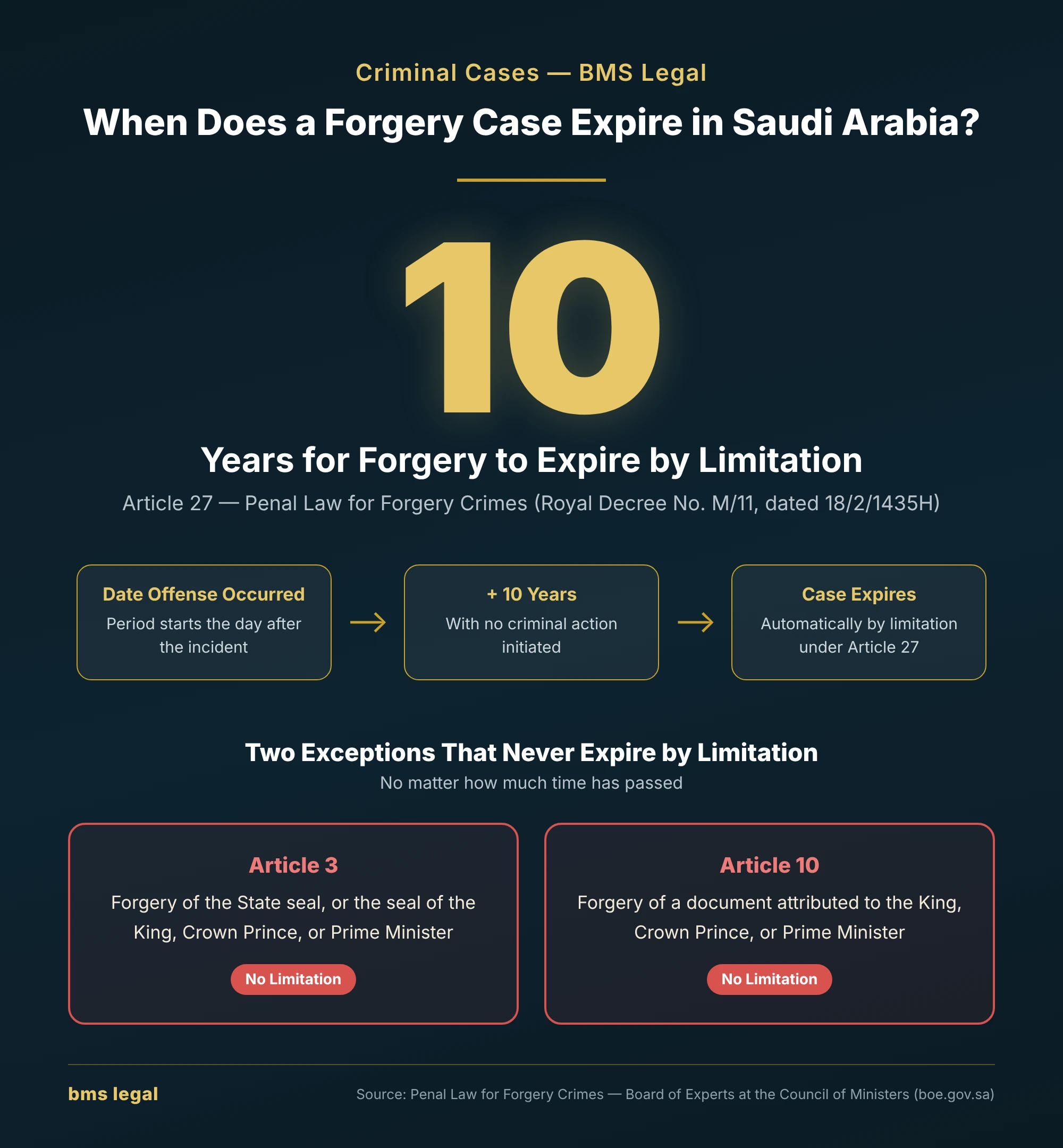
When does a forgery case expire in Saudi Arabia? The forgery statute of limitations in Saudi Arabia is set out in Article 27 of the Penal Law for Forgery Crimes: the criminal action expires after ten years beginning on the day following the commission of the offense, except for the offenses set out in Articles 3 and 10. The mere passage of time is therefore not enough on its own to settle a forgery case without first identifying the type of offense and the date it occurred.
The question becomes more important when a forged contract or signature is discovered years later, when a forged document is used in a new transaction, or when a question arises about the effect of a waiver or a pardon. Each situation requires a careful legal distinction between expiry of the criminal action, exemption from punishment, and the private right.
This guide explains the statutory period and its exceptions, how the ten-year period is calculated, the effect of using a forged document, and the practical steps for handling an old forgery case.
Quick answer: The criminal action in forgery offenses covered by Article 27 expires after ten years beginning on the day following the commission of the offense, except for the offenses set out in Articles 3 and 10. This expiry does not automatically mean the accused is innocent, that every private right is extinguished, or that the forged document becomes legally valid.
General Rule: When Does a Forgery Offense Expire by Limitation?
The term forgery statute of limitations in Saudi Arabia is commonly used to refer to the expiry of the criminal action because the period set by law has passed. The more precise legal term is the expiry of the criminal action in forgery offenses, since the mere passage of time does not erase the act or make the forgery lawful.
Article 27 of the Penal Law for Forgery Crimes (sometimes referred to as Saudi Arabia’s Anti-Forgery Law), issued by Royal Decree No. M/11 dated 18/2/1435H, provides for the expiry of the criminal action after ten years beginning on the day following the commission of the offense, excluding the offenses covered by Articles 3 and 10.
This rule applies to the offenses covered by the provision, including forms of forgery involving official and private documents, seals, marks, and stamps, provided the act does not fall within the two exceptions identified below.
What Does Expiry of the Criminal Action Mean?
Expiry of the criminal action — the expiration of criminal proceedings once the statutory period has passed — is the termination of the case for a statutory reason that prevents it from continuing under the applicable rule.
This differs from acquittal, since acquittal concerns the outcome of deciding the accusation, while expiry through the passage of time relates to the fulfilment of the time condition set by law.
It should also not be confused with the lapse of a penalty already imposed by a judgment. Article 27 governs the expiry of the criminal action and is not, by itself, a general rule cancelling sentences imposed after ten years.
A case still at the accusation or trial stage should therefore be distinguished from a case in which a final judgment has already been issued.
Does Every Form of Forgery Expire After Ten Years?
The general rule is that the ten-year period in Article 27 applies to the offenses it covers, but this cannot be generalized to every form of forgery without exception.
Some offenses involve seals or documents specifically identified by law and excluded from the ten-year rule.
The exception does not depend solely on the severity of the harm or the status of the injured person, but on the legal characterization of the act.
A document may be official without falling within the exception, just as forgery may concern a document attributed to one of the persons identified in Article 10, in which case the rule differs.
The first step in determining the forgery statute of limitations in Saudi Arabia is therefore identifying which article applies to the facts, before calculating the period.
Statutory source: Penal Law for Forgery Crimes, Article 27.
The Two Exceptions to the Forgery Statute of Limitations in Saudi Arabia
Article 27 excludes the offenses covered by Articles 3 and 10 from the rule that the criminal action expires after ten years.
This exception must be understood within its precise limits; it does not mean that every official forgery is excluded, but only the offenses that satisfy the elements of these two articles.
| Article | Excluded offense | Does the ten-year period apply? |
|---|---|---|
| Article 3 | Forgery of the State seal or the senior seals identified in the article | Article 27 does not apply |
| Article 10 | Forgery of documents attributed to the persons identified in the article | Article 27 does not apply |
First: Forgery of the Seals Covered by Article 3
Article 3 addresses forgery of the State seal, or the seal of the King, the Crown Prince, the Prime Minister or one of his deputies, or the seal of the Royal Court or the Crown Prince’s Court.
These offenses differ from forging the seal of an ordinary public authority or a private entity, since the law singled out the seals listed in Article 3 for a separate rule.
Where the facts concern a seal attributed to a particular authority, its exact status must first be identified.
Describing a seal as “official” is not, by itself, enough to conclude that it falls within the exception, since other authorities’ seals may be governed by different provisions of the law.
Once it is established that the offense falls within Article 3, the ten-year period cannot be applied to it under Article 27.
Second: Forgery of the Documents Covered by Article 10
Article 10 addresses forgery of a document attributed to the King, the Crown Prince, the Prime Minister, or one of his deputies.
The decisive element here is the status of the person to whom the document is attributed, and whether the statutory description of the offense applies.
Not every document issued by a public authority falls within this article, since other provisions separately address the forgery of official documents.
A distinction must therefore be drawn between forging an ordinary official document and forging a document that specifically falls within Article 10.
The result is that the Article 27 exception is limited to the offenses the provision identifies, and should not be extended simply because of the importance of the document or the scale of the resulting harm.
How Is the Ten-Year Forgery Limitation Period Calculated?
The limitation period for forgery offenses begins on the day following the commission of the offense, under Article 27.
However, determining the date of commission may require examining the documents, since the date a document was created does not necessarily match the date it was forged.
The Difference Between the Document’s Date, the Date of Forgery, and the Date of Discovery
A forgery file may involve four different dates:
| Date | What it means | Its legal significance |
|---|---|---|
| Date the document was created | The day the original document was drafted | Does not, by itself, prove the date of forgery |
| Date the forgery occurred | When the criminalized act took place | The basis for starting the period under Article 27 |
| Date the forgery was discovered | When the alteration became known | Does not automatically replace the date of occurrence |
| Date the document was used | When it was used in a later transaction | May relate to an act requiring independent assessment |
This distinction matters in contracts, powers of attorney, and commercial instruments, especially when a different version appears years after the original document was drafted.
A Practical Example of Calculating the Forgery Limitation Period
Suppose a person forged a signature on a private document on 1 January 2015, and it is established that the act falls within the offenses covered by Article 27.
In this case, the statutory period begins on the day following the commission of the offense, i.e. 2 January 2015.
Once the prescribed ten years have passed, the effect of expiry is examined according to the established date of the act and its legal characterization.
If, however, the document was created in 2015 but the suspected signature was added in 2018, the document’s creation date cannot be treated as conclusive proof of the date of forgery.
The alteration might only be discovered in 2024 or later, without that discovery date becoming the start of the period.
These examples are for illustration only; the final calculation in any case depends on the date established by the evidence and the nature of the act attributed to the accused.
Does the Limitation Period Stop or Restart During Investigation?
Grounds for suspending or interrupting the Article 27 period should not be assumed without referring to a specific statutory provision that establishes them.
The article sets out the period, its starting point, and the two exceptions to it, and it is not permissible to add time conditions from other laws or undocumented interpretations.
In cases where an investigation has begun or a judgment has been issued, the procedural stage and the relevant statutory provisions must be examined independently, rather than relying solely on calculating the ten years.
Does Using a Forged Document Expire by Limitation? Article 19
Using a forged document while knowing it is forged is an act addressed by the Penal Law for Forgery Crimes in Article 19, alongside other provisions concerning importing and possessing forged items.
The article provides for punishing anyone who uses something the law criminalizes forging, while knowing it is forged, with the penalty prescribed for the related forgery offense.
It also addresses importing certain items into the Kingdom or possessing them while knowing they are forged, but only within the items expressly identified by the provision.
Does the Date of Use Differ From the Date of Forgery?
Yes. The forgery may occur on one date, while the document is used on a later date.
Illustrative example: an amount in a 2014 contract was altered, and the amended version was then used in a financial claim in 2023.
Here there are two separate acts that must be distinguished:
- The suspected alteration made to the contract.
- The use of the amended version in the later claim.
It cannot be assumed that ten years passing from the date of forgery automatically resolves every potential liability for the later use.
Nor is it correct to say that every new use automatically restarts the limitation period for the original forgery.
The question is whether the use constitutes an independent act satisfying the conditions of Article 19, and then examining its date and the applicable rule.
Is Merely Producing the Document Enough to Prove the Offense of Use?
The mere presence of the document among a transaction’s papers is not enough to establish criminal liability.
Article 19 requires knowledge of the forgery within the scope of the act of use it governs.
This means distinguishing between a person who used a document believing it genuine and a person proven to have known it was forged and used it in the manner the law criminalizes.
Assessing knowledge and the related evidence is a matter tied to the facts of the case and cannot be settled merely because two versions of the document differ.
Answering the question of the forgery statute of limitations in Saudi Arabia may therefore require separating the date of forgery from the date of use, rather than treating different acts as a single incident without basis.
Exemption From the Forgery Penalty Under Article 25
Exemption from punishment differs from expiry of the criminal action by limitation, since it is tied to conditions set by law rather than the mere passage of time.
Article 25 of the Penal Law for Forgery Crimes sets out two cases of exemption.
Exemption for Reporting Before the Offense Is Discovered
The article provides that the competent court shall rule on exemption from punishment for an offender who reports their offense before it is discovered and before the forged item is used.
It follows that the report must meet the conditions set out in the provision.
Not every confession or report made after discovery is a ground for mandatory exemption.
Nor should a voluntary report of the offense be confused with a report made by one of the injured parties, since the provision concerns the offender’s own conduct and the statutory conditions linked to it.
Exemption After the Offense Is Discovered
The article permits the competent court to exempt the offender from punishment after the offense is discovered if they identify the remaining offenders and facilitate their arrest.
This is a different case, since it concerns the court’s discretion to grant exemption under the conditions set out in the provision.
Mere cooperation or providing general information is not, by itself, sufficient to guarantee exemption.
| Point of comparison | Expiry by limitation | Exemption from punishment |
|---|---|---|
| Statutory basis | Article 27 | Article 25 |
| Reason | Passage of the prescribed period | Fulfilment of the reporting or cooperation conditions |
| Main focus | Expiry of the criminal action | Exemption from punishment |
| Does it apply to all cases? | Subject to the Article 3 and 10 exceptions | Subject to the Article 25 conditions |
| Is it a guaranteed outcome on request? | Requires proof that the rule applies | Requires the statutory conditions to be met |
For anyone wishing to learn about the penalties prescribed according to the type of offense, see our comprehensive guide to forgery penalties in Saudi Arabia, without confusing the penalty with the grounds for exemption or expiry of the action.
Does the Victim’s Waiver Extinguish the Forgery Offense?
A waiver by the injured party does not automatically end the public criminal action in forgery offenses.
The Saudi Law of Criminal Procedure distinguishes between the public criminal action and the private criminal action, and sets separate rules governing when each expires.
The Effect of a Pardon on the Private Criminal Action
Article 23 of the Saudi Law of Criminal Procedure governs the expiry of the private criminal action, including through a final judgment or a pardon by the victim or their heir.
However, the same article clarifies that a pardon by the victim or their heir does not prevent the public action from continuing.
A waiver of the private right should therefore not be treated as a waiver by society or the State of criminal prosecution.
When Does the Public Criminal Action Expire?
Article 22 of the Saudi Law of Criminal Procedure identifies the grounds on which the public action expires, including a final judgment, a pardon by the ruler within its scope, cases where repentance extinguishes the punishment under its Sharia conditions, and the death of the accused.
The article also clarifies that expiry of the public action does not necessarily prevent the private action from continuing.
These provisions are read together with the special provisions governing particular offenses, including Article 27 of the Penal Law for Forgery Crimes.
The result: a pardon by the injured party, a pardon relating to the public right, and expiry of a forgery case after ten years must not be confused with one another.
For an explanation of the grounds for ending cases generally, see our article on the criminal statute of limitations in Saudi Arabia.
Source: Saudi Law of Criminal Procedure, Articles 22 and 23.
Does a Forged Document Become Valid Once the Case Expires?
Expiry of the criminal action does not mean the forged document automatically becomes valid or acquires an evidentiary weight it did not previously have.
Criminal liability for forgery differs from the question of whether the document a party relies on to prove a right or obligation is valid.
There may be a civil or commercial case in which a disputed document is submitted, raising the question of alleging forgery under the rules of evidence.
What Is the Difference Between a Criminal Forgery Case and an Allegation of Forgery Against a Document?
A criminal case aims to examine liability for a criminalized act and apply its penalties.
An allegation of forgery against a document in a pending case, by contrast, relates to the document’s validity and its evidentiary weight.
Article 44 of the Saudi Law of Evidence sets out the procedure for alleging forgery, including identifying the disputed parts of the document and the supporting evidence, and the investigative measures required, whether through a memorandum submitted to the court or by recording it in the hearing minutes.
Article 47 further provides that an order to investigate an allegation of forgery suspends the enforceability of the disputed document, without prejudice to precautionary measures.
It should therefore not be assumed that the end of the criminal process automatically resolves the dispute over the document’s validity.
Does the Right to Compensation Survive?
A forged document may cause financial or reputational harm, and an independent claim may arise depending on the nature of the right and the facts involved.
It cannot be assumed that the right to compensation survives, or lapses, based on Article 27 alone, since it concerns the expiry of the criminal action within its own scope.
The matter requires reviewing the statutory basis of the private claim, the evidence relating to the harm, and any other provisions that may affect it.
Two separate questions should therefore be asked when reviewing a case: has the criminal action expired? and is there a private claim that can still be pursued under the applicable law?
Source: Saudi Law of Evidence, Articles 39, 44 and 47.
Practical Steps for Handling an Old Forgery Case
If you are asking about the statute of limitations for forgery in Saudi Arabia because of a matter affecting you, it is best to start by establishing the facts that can be proven, rather than calculating the period based solely on the document’s date.
Step One: Identify the Type of Suspected Act
Start by identifying the nature of the act:
Was a signature altered? Was an amount changed? Was false information added? Was a seal imitated? Was a document used while knowing it was forged?
This helps distinguish between the acts covered by the law and identify the article that may apply to the facts.
Step Two: Gather Documents and Determine the Date of the Offense
Keep the relevant documents, including:
- The original document in question, if available.
- Earlier and later copies of it.
- Correspondence relating to its drafting or amendment.
- Technical data relevant to the electronic document.
- Records of the document being sent or received.
- Any report or investigation records.
- Available technical expert reports.
The evidence must be preserved without alteration or tampering, while distinguishing between the date the document was created, the date the forgery occurred, and the date it was discovered.
Step Three: Identify the Applicable Article and Exceptions
After gathering the information, the legal characterization of the act is examined.
Does the act fall within the offenses covered by Article 27? Or does it concern an offense under Articles 3 or 10?
It is also necessary to check whether the document was later used, and whether this constitutes an independent act requiring separate examination.
Step Four: Determine the Appropriate Legal Path
Procedures differ depending on whether the person wants to report a forgery, defend against an accusation, object to a document submitted in a case, or claim a private right.
In a criminal matter, the facts are submitted to the competent authorities under the Saudi Law of Criminal Procedure, and the investigation may require examining the document or obtaining technical expertise.
If the dispute concerns the evidentiary weight of a document submitted in a pending case, the rules on alleging forgery under the Saudi Law of Evidence may be relevant.
Not every case follows the same procedure, and submitting a particular document does not guarantee that a report will be accepted or that the offense will be proven.
Step Five: Review the File Before Relying on the Limitation Defense
Where there is a dispute over the date or characterization of the act, it is important to review the full file before relying on expiry of the action.
You may consult a forgery lawyer in Jeddah at BMS Legal to assess the facts and relevant documents and determine the appropriate legal path without assuming a judicial outcome in advance.
Practical Guide: How to Check Whether the Ten-Year Period Applies
The following table helps identify the information that should be gathered before considering whether a forgery case has expired by limitation.
| Check | Question to answer | Why it matters |
|---|---|---|
| Type of offense | Is this a forged document, a forged seal, or use of a forged item? | Identifies the applicable provision |
| Description of the document | Is it official, private, or a special category? | Clarifies the scope of criminalization |
| Exceptions | Does Article 3 or 10 apply? | Determines whether Article 27 can apply |
| Date of occurrence | When did the suspected act take place? | Determines the start of the period |
| Date of discovery | When did the forgery become known? | Distinguishes it from the date of occurrence |
| Later use | Was the document used on a different date? | Assesses whether an independent act exists |
| Status of the case | Is there a pending case, a judgment, or a private claim? | Determines the procedural path |
This list is a guide for organizing information and is not a formal legal test or sufficient proof, by itself, of expiry of the action.
Example One: Forgery of a Private Contract More Than Ten Years Ago
If it is established that the forgery of a private contract occurred more than ten years ago, falls within Article 27, and does not fall within its exceptions, expiry of the criminal action can be examined under this provision.
But the age of the contract alone is not enough, since the alteration may have occurred on a later date.
Example Two: Forgery of a Seal Covered by Article 3
If the act falls within the offenses set out in Article 3, the ten-year period in Article 27 does not apply to it.
Here, identifying the status of the seal and the legal characterization of the offense matters more than simply calculating the age of the act.
Example Three: Using a Forged Document Years Later
A document may be forged on an old date, then used in a later transaction.
In this case, the act of forgery must be distinguished from the act of use, and the conditions of liability for each act must be verified separately, rather than assuming the period starts or ends the same way in every case.
Trust & Legal Review
This content is based on the Penal Law for Forgery Crimes and the Saudi Law of Criminal Procedure in force in the Kingdom of Saudi Arabia, distinguishing between expiry of the criminal action by limitation and exemption from punishment, and between the public right and the private right, taking into account that outcomes vary with the facts of each case.
Statutory Basis
References include the Penal Law for Forgery Crimes and its related provisions on expiry of the criminal action by limitation and exemption from punishment, together with the Saudi Law of Criminal Procedure regarding expiry of the public and private actions, and the Saudi Law of Evidence regarding the procedure for alleging forgery, depending on how the provisions apply to the facts.
Publisher: BMS Legal for Law and Legal Consulting
Office: Jeddah – Al-Mushrifah District – Palestine Street – Al-Safeer Tower
This content explains general legal rules and does not replace an assessment of the facts, documents, and rulings issued in each individual case.
Frequently Asked Questions About the Forgery Statute of Limitations in Saudi Arabia
How many years does it take for a forgery case to expire in Saudi Arabia?
The criminal action in forgery offenses covered by Article 27 expires after ten years beginning on the day following the commission of the offense. The provision excludes the offenses set out in Articles 3 and 10. It is therefore not enough to know the age of the document; the criminalized act, its date, and the applicable article must be identified.
Does forging a signature expire after five years?
Article 27 does not set a general five-year period for forging a signature. The rule it establishes is ten years for the offenses it covers, excluding Articles 3 and 10. The type of document and the act committed must be identified before applying the period, since a signature may be linked to a document whose legal nature differs depending on the case.
Does the forgery limitation period begin from the date of discovery?
The rule under Article 27 is to calculate the period from the day following the commission of the offense, not from the date of discovery merely because it became known later. Determining the correct date may require reviewing document copies, correspondence, and technical evidence, particularly where the alteration occurred after the original document was created.
Does using a forged document after ten years create a new case?
This depends on the nature of the use and the conditions of liability set out in Article 19, including knowledge of the forgery. It cannot be assumed that every later use constitutes an independent offense, nor can the date of the original forgery be treated as decisive for every subsequent act without examining the facts and the evidence.
Does the victim’s pardon end the public right in a forgery case?
A pardon or waiver by the victim does not automatically end the public criminal action. The Saudi Law of Criminal Procedure distinguishes between the public and private actions, and Article 23 clarifies that a pardon by the victim or their heir does not prevent the public action from continuing. This differs from expiry by limitation under Article 27.
Legal Conclusion: When Does a Forgery Case Expire in Saudi Arabia?
The criminal action in forgery offenses covered by Article 27 expires after this ten-year limitation period, beginning on the day following the commission of the offense, except for the offenses set out in Articles 3 and 10.
But determining whether this period applies to a particular case requires identifying the type of offense, the date it occurred, whether the forged document was later used, and the nature of the rights involved.
Expiry of the criminal action also does not automatically mean the accused is innocent, that the document is valid, or that every private claim has ended.
The precise answer to the question of the forgery statute of limitations in Saudi Arabia therefore begins with establishing the facts and identifying the applicable statutory provision, not merely counting the years since the document was drafted.
Legal Notice: This article provides general legal information on the rules governing expiry of the criminal action in forgery offenses under Saudi law, and does not constitute legal advice on any specific matter. Assessing any case depends on its documents, circumstances, and the applicable statutory provisions.