
If you are looking for information about wife’s rights after Khula in Saudi Arabia, you probably want a practical answer before making an important decision. You may need to know which rights can be waived, which remain protected, whether Khula affects the mahr or deferred mahr, what happens to household belongings, and whether child custody or child support can be affected.
Khula is regulated under the Saudi Personal Status Law. Where both spouses agree, the Saudi Ministry of Justice also provides a Khula documentation service through Najiz. If there is no agreement, or if the parties dispute the compensation or related rights, the matter may proceed through the appropriate judicial process.
Before examining individual rights, it may help to understand the overall procedure for filing a Khula case from the initial steps through documentation or court proceedings.
wife’s rights after Khula in Saudi Arabia: Quick Answer
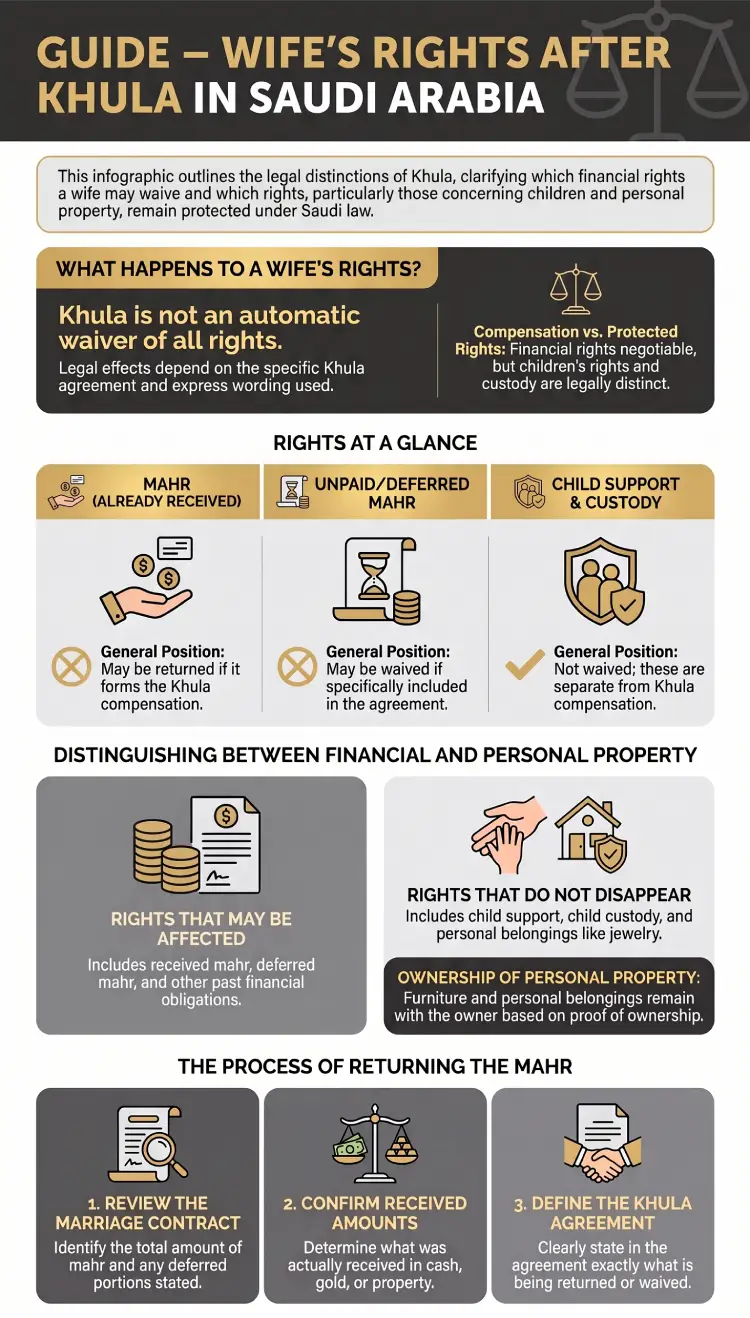
Khula is a form of marital separation initiated by the wife and agreed to by the husband in return for compensation. If the agreed Khula compensation is the mahr, the wife returns the part of the mahr she actually received, while any unpaid portion is waived.
However, compensation for Khula cannot consist of waiving a child’s rights or custody. Khula also results in a minor irrevocable separation, meaning the former spouses cannot resume the marriage merely through revocation. They would need a new marriage contract, a new mahr, and mutual consent.
Here is a quick overview of the main issues:
| Issue | General Position |
|---|---|
| Mahr already received | May be returned if it forms the Khula compensation |
| Unpaid deferred mahr | May be waived if included in the Khula compensation |
| Rights arising solely from marriage | Generally cease once the marriage ends |
| Child custody after Khula | Does not automatically end because of Khula |
| Child support | Is not waived by Khula |
| Furniture and personal belongings | Depends on ownership and evidence |
| Returning to the marriage | Requires a new marriage contract and new mahr |
To understand the legal basis of Khula itself, review the Khula requirements under Saudi law and the rules governing what may lawfully form part of the compensation.
Understanding wife’s rights after Khula in Saudi Arabia
Khula should not automatically be understood as a complete waiver of every financial or family-related right. The more accurate questions are: what compensation was agreed upon, and which rights cannot legally be included in that compensation?
Rights that may be affected commonly include:
- The mahr if it forms the agreed compensation for Khula.
- The deferred mahr if it is expressly included in the agreement.
- Any other financial obligation clearly and lawfully agreed upon by the parties.
By contrast, rights that cannot simply be bargained away as Khula compensation include:
- Children’s legal rights.
- Child support.
- Child custody where the legal conditions and the child’s best interests are satisfied.
- Property that can be established as belonging personally to the wife.
This distinction is essential when assessing wife’s rights after Khula in Saudi Arabia, because a wife’s marital rights, children’s rights, and personal property are not legally identical categories.
Returning the Mahr After Khula
Returning the mahr is one of the most frequently misunderstood issues in Khula cases.
Under the Saudi Personal Status Law, where the mahr itself constitutes the Khula compensation, the wife returns what she actually received, while the portion that she did not receive is waived.
For that reason, the question is not simply whether the wife must “return the mahr.” The relevant facts must first be identified:
- What mahr was stated in the marriage contract?
- How much of it was actually received?
- Is the deferred mahr included in the Khula compensation?
- Is there a dispute over whether payment occurred or over the amount received?
These details matter because liability for returning the mahr after Khula depends on the marriage contract, the Khula agreement, and evidence of what was actually paid.
If there is a genuine dispute over the mahr, deferred mahr, or the amount received, consulting a Khula lawyer in Jeddah may help clarify the appropriate legal approach before any agreement is signed.
What Happens to Furniture and Personal Belongings After Khula?
Household furniture and personal belongings can form an important part of wife’s rights after Khula in Saudi Arabia, but ownership must be distinguished from marital status.
If furniture, jewellery, or other belongings can be established as belonging to the wife, having formed part of her personal property, or having been purchased with her own money, they generally remain her property.
Evidence that may assist in an ownership dispute includes:
- Purchase invoices issued in her name.
- Bank transfers.
- Account statements.
- Messages or correspondence showing who purchased the property.
- Witness evidence where relevant.
If there is a dispute over furniture, jewellery, or personal possessions, the Khula agreement should not use broad or ambiguous wording that could unintentionally affect disputed property rights.
Child Custody and Wife’s Rights After Khula in Saudi Arabia
Child custody after Khula is one of the main concerns for wives considering ending the marriage.
Under the Saudi Personal Status Law, custody is treated as a right connected to the child. Following separation between the parents, the mother generally has priority in custody, subject to the statutory requirements and, above all, the best interests of the child.
In practical terms:
- Requesting Khula does not automatically cause the mother to lose custody.
- Child custody cannot be surrendered as compensation for Khula.
- Child support and the child’s other rights remain legally separate from the Khula compensation.
When negotiating a Khula agreement, child custody should therefore be kept separate from any financial rights that may lawfully form part of the compensation. Saudi law also prevents the waiver of children’s rights or custody from being used as consideration for Khula.
If the dispute extends beyond Khula to custody, maintenance, or visitation, a family lawyer in Jeddah can assess these issues as part of the wider family-law case.
Husband’s Rights in Khula
Understanding the husband’s rights is also important when considering wife’s rights after Khula in Saudi Arabia, because the legal consequences should be assessed for both parties.
Khula is not a mechanism for cancelling either spouse’s rights without legal basis. It is a marital separation involving compensation governed by the agreement between the parties or, where relevant, the resulting judicial determination.
The husband’s rights may include:
- Receiving the legally valid compensation agreed for Khula.
- Challenging the nature or amount of the compensation where a genuine dispute exists.
- Producing evidence as to whether disputed money formed part of the mahr or another financial obligation.
- Requiring a new marriage contract if both parties later wish to remarry.
These rights do not, however, extend to using a child’s rights or custody as Khula compensation.
Can the Spouses Remarry After Khula?
Yes, the former spouses may marry each other again after Khula, but not through the same mechanism that applies to a revocable divorce.
Khula results in a minor irrevocable separation. The husband therefore cannot unilaterally restore the previous marriage.
If both parties later wish to resume the relationship, they must enter into a new marriage contract with a new mahr and renewed consent from both parties.
The practical answer is therefore that remarriage is possible, but it is a new marriage rather than an automatic revocation of the Khula.
If you are comparing Khula, divorce, and judicial annulment in terms of financial consequences, remarriage, and legal rights, a divorce lawyer in Jeddah can help distinguish the legal routes that may apply to your circumstances.
wife’s rights after Khula
When discussing a woman’s rights in Khula, it is important to separate rights arising directly from the marriage from children’s rights and independently owned property.
A wife should understand:
- Which financial rights may form part of the Khula compensation.
- Which rights cannot legally be waived as compensation.
- Which property claims require separate evidence.
- Whether the circumstances are more appropriately dealt with through Khula or judicial annulment.
For this reason, wife’s rights after Khula in Saudi Arabia cannot be reduced to a single question about returning the mahr. The analysis may also involve custody, child support, furniture and personal property, and the precise wording of the Khula agreement.
Legal Effects of Khula on the Husband
Rather than describing Khula as causing “harm” to the husband, it is more legally accurate to consider its consequences.
Those consequences may include:
- Termination of the existing marital relationship.
- Loss of the ability to restore the marriage unilaterally.
- Continued obligations toward the children.
- Possible disputes over custody or property where those matters have not been clearly resolved.
These are legal consequences of ending the marriage rather than separate penalties imposed on the husband.
When May Judicial Annulment Be Better Than Khula?
Khula is not necessarily the appropriate legal route for every marital dispute.
In some circumstances, judicial annulment may be more suitable, particularly where there is serious and provable harm, such as:
- Domestic violence.
- Failure to provide maintenance.
- Serious harm.
- Persistent conduct that makes continuation of the marriage harmful.
- A material defect affecting the marital relationship.
An early legal assessment can therefore be important. The choice between Khula and judicial annulment may affect compensation, evidentiary requirements, and the procedural route.
If you would like to provide details of the case or request direct contact, visit our contact us page to identify the appropriate next step.
How Is Khula Completed in Saudi Arabia?
Where the spouses agree on Khula, the Saudi Ministry of Justice provides a Khula documentation service through the Najiz platform.
Where no agreement exists, or where there is a dispute over compensation or related rights, the appropriate court process remains available.
The Ministry of Justice lists Khula documentation among its social-status services. Its guidance explains how to access Najiz, select the relevant service, submit the application, and attach the required documents.
If there is no agreement or the compensation remains disputed, review the steps for filing a Khula case to understand the process step by step.
What Should You Do Before Starting a Khula?
Before taking action, organise the relevant documents and facts:
- Review the marriage contract and the stated mahr.
- Identify which part of the mahr was received and which remains unpaid.
- Collect evidence showing ownership of furniture, jewellery, and personal belongings.
- Separate your own financial rights from the children’s rights.
- Determine whether the circumstances are better classified as Khula or judicial annulment.
- Avoid signing a broad or unclear waiver.
- Identify whether the appropriate route is consensual documentation or court proceedings.
When Do You Need a Khula Lawyer?
Legal advice may be particularly useful where there is a dispute involving:
- Return of the mahr after Khula.
- Child custody after Khula.
- Child support.
- Furniture, jewellery, or personal belongings.
- Whether the case should proceed as Khula or judicial annulment.
- An unclear agreement or pressure to sign immediately.
If you are still deciding which legal specialisation is most appropriate for your case, you may consider consulting a Jeddah lawyer experienced in Saudi family-law matters.
This article has been reviewed for legal accuracy and clarity with reference to the Saudi Personal Status Law and the official procedures published by the Saudi Ministry of Justice.
Khula compensation, mahr, child custody, child support, personal property, and the legal consequences of Khula.
Saudi Arabia
The legal outcome of a Khula case may differ according to the marriage contract, the agreed compensation, available evidence, and the specific circumstances of each case.
September 2026
Frequently Asked Questions About Wife’s Rights After Khula
What rights does a wife keep after Khula in Saudi Arabia?
Khula does not automatically cancel all rights. Child custody, child support, and personal property remain separate from the Khula compensation.
Does a wife have to return the mahr after Khula?
If the mahr is the agreed Khula compensation, she generally returns the amount she actually received, while any unpaid portion may be waived.
Does Khula affect child custody?
No. Requesting Khula does not automatically cause the mother to lose custody. Custody remains subject to the child’s best interests and legal requirements.
Is child support cancelled after Khula?
No. A child’s right to financial support is separate from the Khula agreement and is not waived merely because Khula takes place.
Can spouses remarry after Khula?
Yes. However, they must enter into a new marriage contract with a new mahr and renewed consent from both parties.
If you want to understand wife’s rights after Khula in Saudi Arabia in 2026, including which rights may be waived and which remain protected, begin by correctly classifying the legal situation.
What forms part of the Khula compensation? Which rights cannot legally be waived? Is Khula the appropriate route, or would judicial annulment better fit the circumstances?
Answering these questions first can make the decision clearer and reduce the risk of signing an agreement that may affect important rights later.
Do you have a dispute involving the mahr, child custody, or personal belongings following Khula?
You can visit BMS Legal Law Firm and Legal Consultations to learn more about its family-law services, working process, and available contact options.
Official References: