
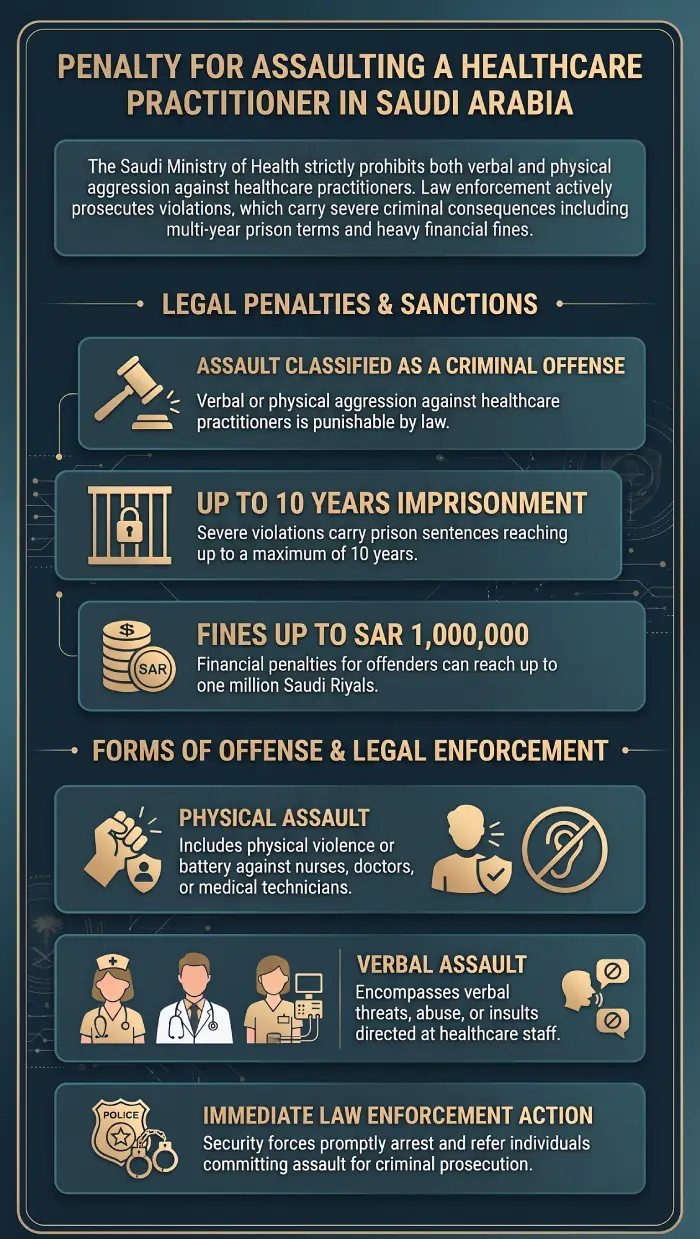
The penalty for assaulting a healthcare practitioner in Saudi Arabia depends on the nature of the conduct, the practitioner’s legal status, the purpose behind the assault, and the evidence establishing what occurred. The Saudi Ministry of Health has stated that verbal or physical assault against a healthcare practitioner is a criminal matter and that the penalty may, in applicable cases, reach ten years’ imprisonment and a SAR 1 million fine.
That maximum penalty does not automatically apply to every argument, confrontation, or assault occurring inside a healthcare facility. The incident must first be legally classified according to its specific facts.
Three questions therefore matter from the outset: What exactly happened? Does the incident satisfy the requirements of the aggravated statutory provision? And what evidence and procedures can preserve the healthcare practitioner’s rights?
The penalty for assaulting a healthcare practitioner may reach
ten years’ imprisonment and a SAR 1 million fine, or either penalty, when the
requirements of Article 7 of the Saudi Anti-Bribery Law are met. These include
using force, violence, or threats against a public official or a person treated
as one to obtain an unlawful act or prevent the performance of a legally assigned
duty. Other incidents are classified according to their facts and the applicable law.
What Is the Penalty for Assaulting a Healthcare Practitioner in Saudi Arabia?
There is no single penalty that applies to every form of assault against a healthcare practitioner. The court considers the conduct itself, the legal status of the person assaulted, the connection between the incident and the practitioner’s work, the purpose of any force or threat, and the consequences of the act.
The legal classification may therefore differ between an incident satisfying Article 7 of the Saudi Anti-Bribery Law and a physical assault, threat, or verbal incident that must be assessed under another applicable legal provision.
This distinction matters because the widely cited figure of “10 years and SAR 1 million” is a maximum penalty associated with a specific statutory situation. It is not an automatic penalty merely because a doctor, nurse, or other healthcare practitioner was assaulted.
When Can the Penalty Reach 10 Years and SAR 1 Million?
Article 7 of the Saudi Anti-Bribery Law addresses the use of force, violence, or threats against a public official in order to obtain an unlawful act from that official or cause the official to refrain from performing a duty legally assigned to them. The provision refers to the penalty prescribed under Article 1 of the Law.
Applying this provision requires several elements to be examined together:
- The existence of force, violence, or threats.
- The victim’s status as a public official or a person treated as one.
- A connection between the incident and the official function.
- The specific purpose identified by the Law.
- Evidence linking the conduct to that purpose.
For example, threatening a healthcare employee in order to force them to issue an improper medical report may be legally different from a personal confrontation unrelated to the performance of official duties. The classification depends on whether the conditions of Article 7 of the Saudi Anti-Bribery Law are actually satisfied.
Why Does the Penalty Vary From One Incident to Another?
“Assault” covers very different forms of conduct. It may involve physical violence, threats, abusive language, or an attempt to force a healthcare practitioner to take a particular action.
For that reason, cases should not be mechanically divided into “minor assault” and “serious assault” with a fixed penalty assigned to each category unless an applicable legal provision supports that distinction.
The legal outcome may instead be affected by the nature of the conduct, any resulting injury, the method used, the victim’s legal status, the connection with their work, and the evidence presented.
The judge determines the applicable legal characterization and penalty from the facts and evidence before the court rather than from a general label given to the incident.
What Forms Can Assault Against a Healthcare Practitioner Take?
Assault may be physical, verbal, or take the form of a threat. These categories do not necessarily carry the same legal consequences because the circumstances and evidence may lead to different legal classifications.
The distinction between verbal assault against a healthcare practitioner and physical assault against a healthcare practitioner therefore depends on more than the name of the conduct. The resulting harm, any threat or interference with the practitioner’s work, the circumstances of the incident, and its purpose may all affect the applicable law.
Physical Assault and Hitting a Healthcare Practitioner
Physical assault includes conduct that affects the bodily integrity of a doctor, nurse, or other healthcare practitioner.
Relevant factors may include the injury documented in a medical report, how the injury occurred, any object or instrument used, CCTV footage, and statements from people who witnessed the incident.
There is no single fixed penalty for assaulting a doctor in every physical confrontation. The penalty depends on the act, the proven injury, and the surrounding circumstances. Similar considerations are relevant when assessing the penalty for assault and battery in Saudi Arabia, including the evidence and the injured person’s private rights.
Verbal Assault and Threats
The Ministry of Health has treated protection against assault as extending to both verbal and physical conduct. However, a heated discussion or raised voice alone does not establish a particular criminal offence or penalty.
The actual words, context, and surrounding conduct must be considered, including whether the incident involved a threat or another form of unlawful conduct.
Threats become particularly relevant to Article 7 when they are directed against a public official or a person treated as one for one of the purposes specified by the Law: obtaining an unlawful act or preventing the official from performing a legally assigned duty.
Who Is Considered a Healthcare Practitioner?
The Saudi Health Professions Practice Law covers licensed healthcare professions including physicians, dentists, pharmacists, nursing professionals, technicians, specialists, and other persons licensed to practise a healthcare profession.
Protection is therefore not limited to doctors. Depending on the relevant legal status and the facts of the incident, it may also concern nurses, pharmacists, paramedics, healthcare technicians, and other licensed practitioners.
A distinction must nevertheless be made between being a “healthcare practitioner” and being a “public official or a person treated as one.”
Article 8 of the Saudi Anti-Bribery Law identifies categories treated as public officials for the purposes of that Law, including persons working for the State or public legal entities and other categories expressly covered by the provision.
A professional healthcare licence alone is therefore not enough to conclude that Article 7 automatically applies.
Where the dispute concerns whether the incident amounts to a criminal matter and which procedural route applies, the broader distinction is explained in types of criminal cases in Saudi Arabia.
How Is an Assault Against a Healthcare Practitioner Proven?
The strength of a case does not depend solely on the practitioner’s account of what happened. Evidence should, where possible, connect the incident to a particular time, place, person, and consequence.
Preserving evidence early is therefore one of the most important practical steps after an assault on a healthcare practitioner.
Procedures for gathering information, hearing statements, and documenting criminal incidents are governed by the Saudi Criminal Procedure Law. Depending on the circumstances, CCTV recordings, medical reports, witness statements, and official incident records may all be relevant to proving the facts.
What Evidence Can Help Prove the Assault?
The available evidence differs from one case to another. Relevant material may include:
- CCTV footage from the healthcare facility.
- A medical report documenting an injury.
- Photographs showing the effects of the assault.
- Statements from witnesses who were present.
- An incident report prepared by hospital security or administration.
- Threatening messages or communications connected with the incident.
- Documents showing when the incident occurred and the practitioner’s role and workplace.
Not every case requires all of these forms of evidence. What matters is the reliability of each item and its direct connection to the incident in question.
How Should Evidence Be Preserved After the Incident?
Where CCTV cameras cover the relevant area, it is important to request preservation of footage for the specific time and location before it is lost through the facility’s normal retention cycle.
Any injury should also be medically documented as soon as reasonably possible. Messages, digital files, photographs, and recordings should be preserved in their original form.
It can also be useful to record witness names and contact details, retain report or case reference numbers, and avoid editing the original videos or images.
Questions about timing, the source of a digital file, or whether a recording is complete may later become relevant when the evidence is examined.
If CCTV footage, a medical report, or witnesses are available but it is unclear what the file still needs, an early review can help identify evidentiary gaps before another procedural step is taken.
How Do You Report an Assault Against a Healthcare Practitioner?
The process begins with personal safety and documenting the incident, followed by reporting it through the appropriate channel according to the nature of the conduct.
Where the incident may constitute a criminal offence, an internal verbal complaint to the healthcare facility should not be treated as a substitute for the appropriate official report.
The Ministry of Health also operates its 937 Service around the clock for Ministry-related notifications and complaints.
What Should a Healthcare Practitioner Do Immediately After an Assault?
The practical steps can be arranged as follows:
- Move away from any immediate danger and protect personal safety.
- Notify facility security or administration and document the incident internally.
- Obtain a medical report where an injury has occurred.
- Request preservation of relevant CCTV footage.
- Preserve messages, witness information, and other evidence.
- Submit the appropriate report and retain its reference or incident number.
An internal facility report or communication with 937 does not replace a report to the competent authority where the incident involves suspected criminal conduct requiring criminal investigation procedures.
What Happens After the Report Is Filed?
The competent authority gathers information, statements, and evidence relating to the incident.
If the matter proceeds to the investigation stage, the authorities assess the sufficiency of the evidence and determine which legal provisions may apply. The case may then be referred to the competent court where the legal requirements for referral are satisfied.
The Criminal Procedure Law provides for the referral documentation to identify matters such as the alleged offence, relevant circumstances, legal provisions, evidence, and witnesses where applicable.
Organizing the chronology and evidence from the beginning may therefore become particularly important where there is disagreement over intent, the practitioner’s legal status, or the reason force or threats were allegedly used.
Does a Healthcare Practitioner Have a Private Right to Compensation?
An incident may involve both the public criminal action and a private claim belonging to the injured healthcare practitioner.
Under the Saudi Criminal Procedure Law, a complaint made by a person who has suffered harm as a result of an offence is treated as a claim for their private right unless that person expressly waives it before the investigator.
A healthcare practitioner may also have a compensation claim where the wrongful act, the resulting harm, and the causal connection between them can be established.
The Saudi Civil Transactions Law regulates liability for harmful acts and allows compensation for material and moral damage where the statutory requirements are met.
What Types of Harm May Be Included in a Compensation Claim?
There is no fixed amount of compensation for a doctor or healthcare practitioner who has been assaulted.
The claim is based on harm that can actually be established in the individual case. Depending on the circumstances, this may include:
- Financial loss resulting from the injury.
- Lost earnings where the connection with the injury can be established.
- Bodily harm.
- Moral damage.
The Civil Transactions Law expressly recognizes compensation for moral damage, including sensory or psychological harm arising from interference with the body or reputation, while the amount is assessed by the court according to the circumstances of the case.
A compensation claim therefore depends on proving the damage and its direct connection to the assault, together with documents supporting its nature and consequences. These issues also arise in a compensation claim for assault in Saudi Arabia.
Does Waiving the Private Right End the Public-Right Proceedings?
Waiving a personal claim does not automatically terminate the public criminal action.
Under the Saudi Criminal Procedure Law, the claimant’s withdrawal of the private-right claim does not by itself affect the public criminal proceedings.
The wording of any waiver should therefore be examined carefully before it is signed. Relevant questions include whether it is limited to the private right, whether it includes compensation or settlement terms, and whether its wording extends beyond what the practitioner intends to waive.
These details may materially affect the practitioner’s personal claims even where the public prosecution of the matter continues.
If the case has reached the stage of a summons, investigation, or proposed waiver, reviewing the current procedural position may be more useful than considering the abstract penalty alone. At that stage, a criminal lawyer in Jeddah can assess the case stage, the available evidence, and the procedural options.
Frequently Asked Questions About the Penalty for Assaulting a Healthcare Practitioner
1. Is the penalty for assaulting a healthcare practitioner always 10 years?
No. Ten years’ imprisonment and a SAR 1 million fine are maximum penalties that apply only when the requirements of Article 7 of the Saudi Anti-Bribery Law are met.
2. What is the penalty for verbally assaulting a healthcare practitioner?
There is no single fixed penalty. It depends on the words used, the context, any threats involved, and the legal classification of the conduct.
3. Can hospital CCTV footage prove the assault?
Yes. CCTV footage may help establish the time, place, sequence of events, and persons involved, especially when supported by medical reports or witness statements.
4. How do I report an assault against a healthcare practitioner?
Document the incident, preserve available evidence, notify the healthcare facility, and submit the appropriate report to the competent authority. Ministry of Health complaints may also be submitted through 937.
5. Can a doctor claim compensation after an assault?
Yes. Compensation may be claimed where the wrongful act, resulting harm, and causal connection are established. It may cover proven financial, physical, or moral harm.
6. Does waiving the private right end the criminal case?
Not automatically. Waiving the private right does not by itself terminate the public criminal action, although it may affect the practitioner’s personal claims.
Penalty for Assaulting a Healthcare Practitioner: 7 Rules can be understood through seven issues that determine the legal path: the nature of the assault, the practitioner’s legal status, the purpose of the conduct, the applicable legal provision, the evidence, the reporting process, and the private right together with the effect of any waiver.
The case therefore does not begin with the question, “How long is the prison sentence?” The more accurate starting point is to identify what occurred, preserve CCTV footage, medical reports, and witness information, and determine the legal classification before making a claim or signing a settlement or waiver.
If you have an active report, medical report, CCTV footage, or a summons connected with an incident inside a healthcare facility, a Jeddah law firm such as BMS Legal can review the current stage of the matter and the available evidence before explaining the legal options and the next procedural step without promising a predetermined outcome.