
The penalty for not repaying a real estate loan in Saudi Arabia does not usually mean immediate imprisonment or one fixed procedure. The matter normally starts with a late instalment, may become a financial default, and then credit or enforcement consequences can appear, depending on the contract, the instruments and the notices.
It is wrong to treat non-payment of a real estate bank loan as one situation for every borrower. The result differs between someone who is a few days late, someone with accumulated arrears, someone who has received a message from Najiz, and someone who owns a mortgaged property that secures the finance.
If your question is what happens if you do not repay, the answer starts by identifying your current stage. Do you have only a claim from the bank, a default notice, an enforcement request, or a seizure or travel-ban decision?
If the problem has not yet reached default, understanding the conditions of real estate loans in Saudi Arabia helps you see the basic obligations that begin before signing and continue after repayment.
Late on instalments, or an enforcement notice has arrived?
The right step depends on your stage: a demand, a default notice, an enforcement request or a seizure. A BMS Legal lawyer in Jeddah can give your documents an initial review before you pay, object or sign a settlement.
Enquiries are handled confidentially · No specific court outcome can be guaranteed
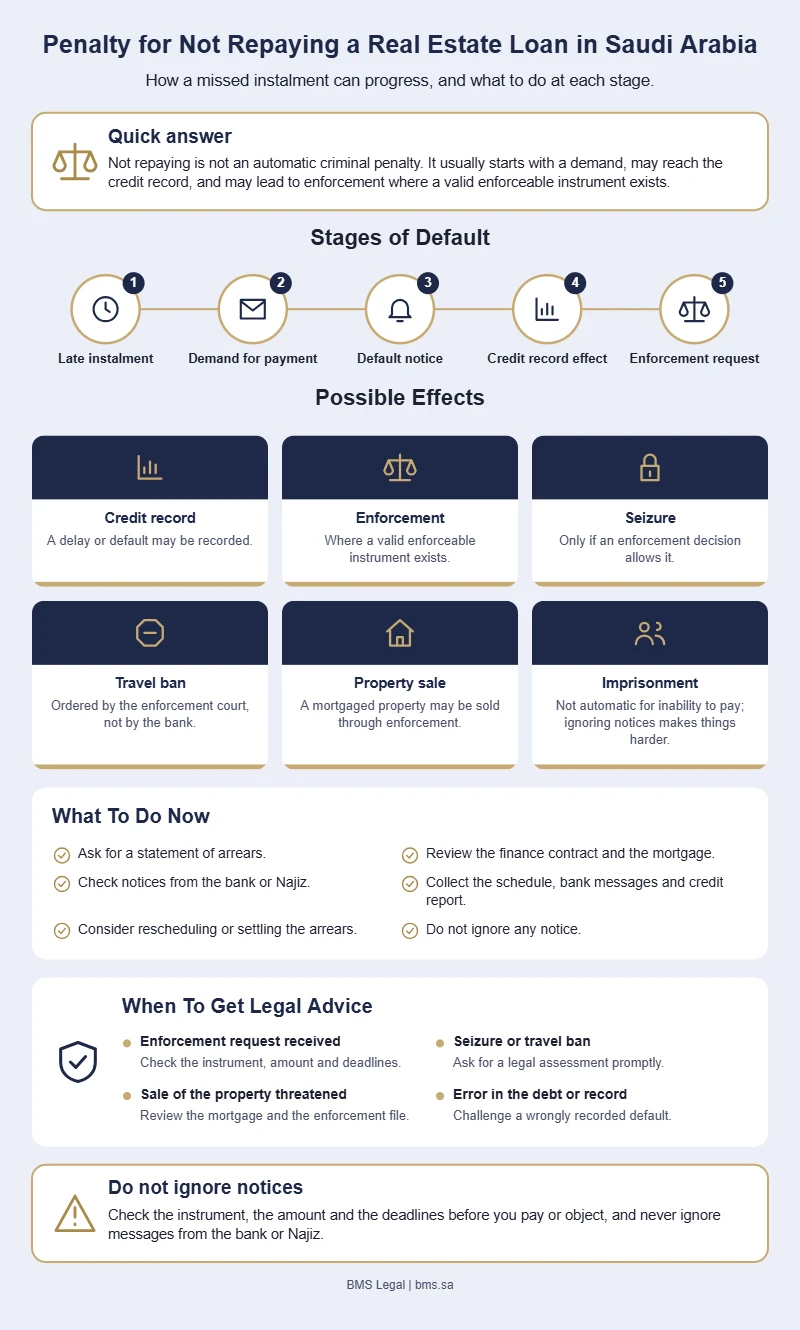
Penalty for Not Repaying a Real Estate Loan: A Quick Answer Before Escalation
The “penalty” for not repaying a real estate bank loan is a set of possible financial and enforcement consequences, not an automatic criminal penalty. It usually begins with a demand for payment, may extend to the credit record, and then to an enforcement request where a valid enforceable instrument exists.
If you are asking what the solution is when you have not repaid, do not start by ignoring messages or negotiating verbally. Ask for a statement of arrears, review the finance contract and the mortgage, and check whether there is an official notice through Najiz or from the financier.
The right first step is to collect documents: the finance contract, the repayment schedule, the debt statement, the bank’s messages, the credit report, and any notices from Najiz. Then assess your position before paying, objecting or asking for time.
When you review the contract and the mortgage, the difference between a real estate bank loan and finance shows up in identifying the creditor, the nature of the obligation, and the terms of repayment or default.
Stages of Default and Their Practical Effects
A real estate loan file usually moves through successive steps; it does not jump from a minor delay straight to enforcement or the sale of a property. It is therefore important to understand the difference between delay and default, and then the effects that may follow at each stage.
What is the difference between delay and default on a real estate loan?
Delay in repaying a real estate loan means not paying an instalment when it falls due. Default is a more serious stage, usually tied to repeated delay or continued non-payment under the finance contract and the financier’s notices.
Some finance contracts define default by reference to the number or length of late instalments; the exact criteria are those written in your contract. Such criteria are not read alone, but with the contract, the length of delay, the notices, and the borrower’s behaviour after a demand.
The different types of real estate loans in Saudi Arabia may also affect how the obligation is read, especially where finance is subsidised, where there is a mortgage, or where the product relates to a ready home or a self-build.
| Situation | Practical meaning | Expected effect |
|---|---|---|
| A minor delay | An instalment not paid on time | A demand or notice |
| Repeated delay | More than one instalment or a longer period | Credit and collection pressure |
| Actual default | Continued non-payment under the contract | Registration of default and possible escalation |
| Enforcement | An instrument exists and a request is made to the court | Enforcement steps according to the decision |
If the delay is temporary, dealing with the arrears early may reduce the effect. If instalments have accumulated, it is better to ask for a written rescheduling or to provide a document showing why you cannot pay.
Seven Possible Effects: The Penalty for Not Repaying a Real Estate Loan in Saudi Arabia
Not every effect will appear in every case, because the result depends on how long the delay lasts, the wording of the finance contract, and whether there is a mortgage or an enforceable instrument. In practice the risk revolves around seven main effects.
| Effect | When it appears | What it means |
|---|---|---|
| Demand for payment | When an instalment is late | A reminder or contact from the financier |
| Default notice | When the delay continues | A formal warning to cure the arrears |
| Credit record effect | When the delay or default is recorded | A possible effect on the credit record |
| Enforcement request | Where an enforceable instrument exists | The file moves to the enforcement court |
| Financial seizure | After an enforcement decision | Seizure of an account or funds, depending on the case |
| Action on the property | Where there is a mortgage and continued default | Possible enforcement against the mortgaged property |
| Settlement or rescheduling | Before or after escalation | A written arrangement for the arrears |
These effects do not mean every borrower in arrears will face enforcement or the sale of the property straight away. The right step is to identify the stage of the file, then review the contract, the debt statement, and any notice issued by the bank or by Najiz.
Received an enforcement notice or a seizure?
A late instalment is not the same as an enforcement decision. Check the instrument, the amount and the deadlines before you pay or object, and do not ignore messages from Najiz or the financier.
Enquiries are handled confidentially · No specific court outcome can be guaranteed
Does Non-Payment Lead to Imprisonment?
Financial inability does not automatically mean imprisonment. As a rule, a loan is a contractual financial obligation, dealt with through demand and enforcement, and not as a separate crime merely because of a delay.
However, ignoring official notices can put you in a harder position. Once a file reaches enforcement, the matter is no longer tied only to the instalment: it becomes tied to compliance with decisions, disclosure, and proving payment, inability, or a ground for objection.
A distinction should be drawn between a person who is insolvent and one who deliberately delays. An insolvent person proves their position through income, obligations and documents, while a person who delays may have the means to pay and then avoids payment or hides their assets.
Enforcement, Seizure and Sale of the Property
When a real estate loan file moves to enforcement, the effects differ according to the instrument and the decision issued by the enforcement judge. It is therefore necessary to distinguish between the bank’s demand, an enforcement request, and the decisions that may follow.
An important question arises here: does the real estate bank stop your services or file a case?
The bank does not itself stop services, and it does not itself issue seizure or travel-ban decisions. If the file moves to enforcement, the procedures are issued by the competent authority according to the instrument, the request and the stage of the transaction.
Before treating a measure as issued directly by “the real estate bank”, understand the requirements of the real estate bank in Saudi Arabia and tell apart the Sakani platform, the Real Estate Development Fund and the financier that follows up the debt.
The phrase “the real estate bank stopped my services” needs checking. It may mean there is an enforcement request or a decision from the enforcement court, not a direct step by the bank, and the effect may concern particular accounts or financial dealings rather than all services.
As for whether the real estate bank files a case, the creditor may resort to a demand or to enforcement if default continues. That depends on the contract, the instrument, the amount of the debt, and whether a documented settlement or partial payment exists.
When Does a Real Estate Loan Reach the Enforcement Court?
A real estate loan may reach enforcement if the creditor holds a valid enforceable instrument and a complete enforcement request is filed. That does not mean every late instalment goes straight to the enforcement court.
An enforcement request for a real estate loan means the creditor asks that the debtor be compelled to pay on the basis of an enforceable instrument. The instrument may be a judgment, a promissory note, a notarised document, or a document the enforcement court accepts depending on the type of relationship.
When an enforcement notice arrives, review the amount claimed, the type of instrument, the due date, any partial payment, the status of the mortgage, and any earlier settlement. After that you can decide whether the better course is to pay, to settle, to ask for time, or to object.
Enforcement Notices and Stages Over a Real Estate Loan
Once an enforcement request is filed, the debtor is notified and the file moves through stages set by the enforcement judge. The notice you receive states the stage you have reached and the time allowed to respond. Ignoring it may open the way to wider enforcement steps, especially if you do not make payment, settle, or reply appropriately.
Where there is non-compliance after notification, the measures may include disclosure, seizure, a travel ban, or other steps the enforcement court considers suitable. Enforcement decisions are sometimes referred to by number in everyday usage, but the numbers are not relied on here: rely on the wording and date of the notice you actually receive.
Do not assume that every defaulting real estate loan leads at once to the harshest measures. They belong to a specific enforcement stage, and not simply to a late instalment or a collection call from the bank.
Suspension of Services, Seizure and Travel Bans
Suspension of services because of a real estate bank is not an automatic effect of every late instalment. It is more accurate to say that some enforcement measures may appear where an enforcement request has been filed and the enforcement court has issued a decision, with the effect varying by stage and decision.
Seizure of accounts or funds may occur if an enforcement decision allows it. A travel ban may appear in some enforcement files, but it is not treated as an inevitable result for every defaulter on a real estate loan.
A salary seizure needs review of the type of debt, the amount claimed and the scope of the decision issued. It is not enough to hear the word “seizure” without knowing whether it is on an account, a salary, assets, or a mortgaged property.
Can the Bank Sell My House If I Do Not Repay?
Selling a mortgaged property because of non-payment is possible in some cases, but it is not an immediate step at the first delay. A real estate mortgage gives the creditor strong security, but it does not remove the legal procedures for notification, enforcement and valuation.
If the property is mortgaged and default continues, the creditor may seek enforcement against the property. The process may pass through notification, review of the debt, valuation of the property, and then sale under enforcement procedures once its conditions are met.
If the sale price exceeds the debt and expenses, the debtor may have a right to the surplus. If the price does not cover the whole debt, a claim for the difference may remain, depending on the contract, the instruments and the procedures. Our guide to selling a mortgaged property explains how a sale works where a mortgage exists.
Where the property is mortgaged or a sale or eviction has been threatened, examining the title deed and the mortgage with a real estate lawyer in Jeddah helps you understand the effect of enforcement before taking any step. See also property eviction in Saudi Arabia.
The Credit Record and Ways to Cure the Position
The effects of non-payment do not stop at a bank demand or enforcement steps. They may extend to the credit record, and may affect future finance, rescheduling, or the customer’s ability to obtain new facilities.
Delay or default may appear in the credit record according to the financier’s reports and the length of the delay. So do not treat a late instalment as a minor matter without effect.
The credit record and a real estate loan are linked to your ability to obtain new finance later. Default may affect approvals, the profit margin, or the customer’s ability to refinance.
If you pay the arrears or agree a settlement, keep the clearance letter or proof of payment. Then follow your credit report, and object if incorrect or outdated data continues to appear.
What Is the Solution If I Have Not Repaid a Real Estate Loan?
If you have not repaid a real estate loan, start by finding the true amount and the stage of the file. Do not rely on a short message or a collection call alone: ask for a statement showing the arrears, the balance, the fees and the earlier payments.
Before enforcement, focus on a written amicable solution. Ask for time or rescheduling if you have a stable income, and make sure any agreement is documented. Do not rely on verbal promises, and do not pay an amount without proof showing its effect on the arrears.
Once the file reaches enforcement, examine the instrument, the amount and the deadlines. You may need to prove payment, make an objection, ask for time, or negotiate a settlement that ends the procedure or limits its effects.
Rescheduling a Real Estate Loan and Settling Arrears
Rescheduling a real estate loan means rearranging repayment under a new agreement with the financier. A settlement may include a payment plan, a treatment of the arrears, or an agreement on a specific amount depending on the position of the file.
Before signing any rescheduling or settlement, review the total debt, the effect of the agreement on enforcement, the date a seizure is lifted, its effect on the credit record, and any extra fees or profit. A new agreement may solve the problem, but it may also fix a debt that was not clear to you.
If a settlement is made after an enforcement request has been issued, it should be documented so that it takes effect on the enforcement file. Paying an amount is not enough without clear proof linking it to the enforcement request or the disputed debt.
Common Mistakes When a Real Estate Loan Is Not Repaid
Many problems become worse through avoidable mistakes made early. Avoid these:
- Ignoring messages from the financier or from Najiz.
- Relying on verbal promises of a postponement.
- Paying an amount without a receipt or a statement of how it was applied.
- Signing a settlement without understanding the total debt.
- Assuming that a late instalment automatically means a travel ban or a sale of the property.
- Waiting for the enforcement stage before asking for rescheduling.
When Do You Need Legal Advice?
You need legal advice when the matter goes beyond a late instalment, or when enforcement notices or direct financial effects appear. At that stage delay in responding may narrow the options available.
Ask for a legal assessment in particular when an enforcement request arrives, when an enforcement decision is issued, when there is a seizure, when a travel ban appears, when a sale of the mortgaged property is threatened, when there is an error in the debt, or when a default is wrongly recorded in the credit record.
If you have received an enforcement message or face a seizure or a threat to sell your property, start by preparing the contract, the debt statement and your Najiz messages, then contact our legal team to assess the documents and identify the best route.
Trust and Legal Basis
Trust and Legal Basis
Legal basis
This guide is based on the Saudi Central Bank’s rulebook page on delay or default in repayment and the Ministry of Justice enforcement-request service page listed below, and is written for general legal awareness rather than as advice on a specific case. Consequences depend on your contract, the enforceable instrument, the notices received and the enforcement judge’s decisions.
Published by: BMS Legal Law and Legal Consultancy Company.
Address: Jeddah, Al-Mishrifah District, Palestine Street, Al-Safeer Tower
Frequently Asked Questions About the Penalty for Not Repaying a Real Estate Loan
What is the penalty for not repaying a real estate bank loan?
It is not an automatic criminal penalty. It may begin with a demand and credit default, and may reach enforcement where a valid instrument exists.
Does not repaying a real estate loan lead to prison?
Financial inability does not automatically mean prison, but ignoring enforcement orders or showing deliberate delay may bring harsher steps.
When is a real estate loan considered in default?
Default is judged by the finance contract, the number of late instalments, the length of delay and the notices sent by the financier.
Does the real estate bank stop services?
The bank does not stop services itself. Enforcement measures come from the competent authority where an enforcement request and a suitable decision exist.
Can the bank sell the house if I do not repay?
The creditor may seek enforcement against a mortgaged property if default continues, but a sale follows procedures and does not happen at every delay.
What should I do if I receive an enforcement request?
Review the instrument, the amount and the notification date, collect proof of payment, then decide whether the best route is payment, settlement or objection.
Conclusion
The penalty for not repaying a real estate bank loan, with its seven effects and solutions, summarises the practical path for dealing with delay and default before escalation. The effects begin with a demand, and may extend to default, the credit record, enforcement, seizure, the mortgage, and then settlement or rescheduling.
If you are at the stage of a minor delay, curing the arrears or asking for rescheduling may be enough before escalation. If Najiz messages have arrived or enforcement decisions have been issued, the instrument, the deadlines and the amount must be examined at once.
To have your enforcement notices or finance documents reviewed, contact BMS Legal in Jeddah for a preliminary review of your file.
Seizure, travel ban or threat to sell your property?
Send us your finance contract, the debt statement and any Najiz messages, and a BMS Legal lawyer in Jeddah will tell you which documents and deadlines to check first.
Enquiries are handled confidentially · No specific court outcome can be guaranteed
Official Legal and Government Sources
- Saudi Central Bank: provisions on delay or default in repayment (Arabic-language official rulebook)
- Ministry of Justice: filing an enforcement request through Najiz (Arabic-language official service page)
Disclaimer: This article is for general legal awareness and is not advice on an individual case, and reading it does not create a lawyer–client relationship. The legal assessment varies with the facts, the documents and the rules that apply to each case.