
Transferring a mortgaged property in Saudi Arabia begins with examining the deed, learning the amount of the debt, and obtaining the mortgagee’s approval or a release of the mortgage before the conveyance. A mortgage does not always prevent a sale, but it makes the transfer of ownership conditional on dealing with the right of the bank or financing body, and then completing the procedure through the competent judicial or real estate channels.
Signing a sale contract or paying a deposit is not enough for ownership to pass officially. A sale is an agreement between seller and buyer, whereas the conveyance is the procedure that moves ownership in the statutory records, and its details vary with the property’s status, as our guide to transferring property ownership in Saudi Arabia explains.
Mortgaged property? Check the bank’s position first.
A real estate lawyer can review the deed, the debt statement and the mortgagee’s approval before you pay a deposit or sign.
Enquiries are handled confidentially · No specific court outcome can be guaranteed
Conditions for Transferring a Mortgaged Property: The Quick Answer
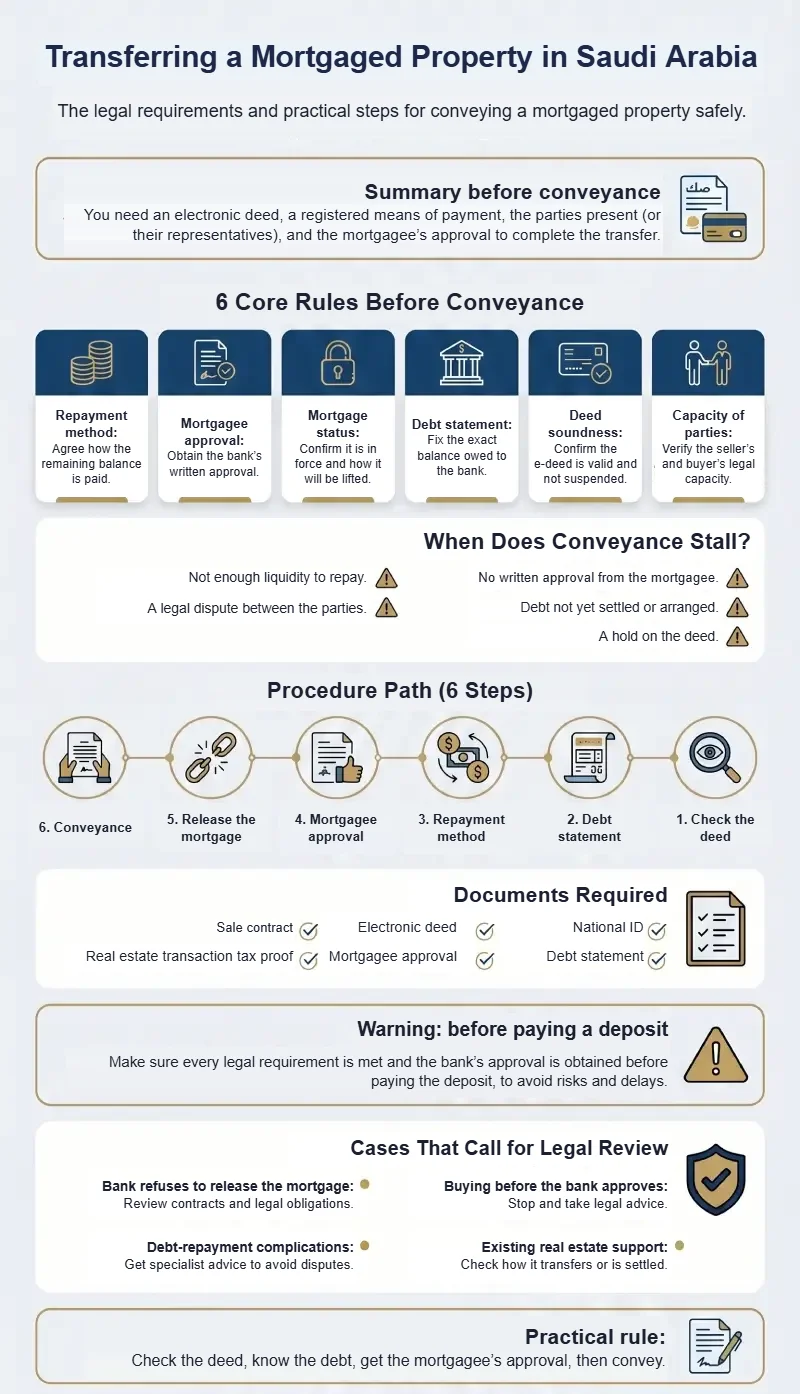
A mortgaged property can be transferred in Saudi Arabia if the core requirements are met: an electronic deed, a registered means of payment, the presence of the parties or their representatives, and the mortgagee’s approval. The Ministry of Justice lists these requirements for conveying a mortgaged property, and states that registering ownership, once the requirements are met, takes no more than 60 minutes in cases that qualify, according to the Ministry’s registration-requirements page.
Put more simply: a mortgaged property is in principle saleable, but the conveyance is not completed before the right of the mortgagee is protected. That may be through repaying the debt, a mortgage-release letter, or the bank’s approval of another arrangement acceptable to it.
Can a Mortgaged Property Be Transferred to the Real Estate Bank?
Yes, an agreement to sell a mortgaged property is permitted, but the official transfer of ownership depends on the state of the mortgage and the position of the mortgagee. A mortgage does not cancel the seller’s ownership, but it places a restriction that protects the right of the bank or financing body. That is why the rules for selling a mortgaged property in Saudi Arabia differ from an ordinary sale once you reach the conveyance stage. Our guide to selling a mortgaged property covers the sale side in detail.
A distinction between sale and conveyance is essential. The parties may sign a preliminary contract, but that does not mean a new deed is issued in the buyer’s name. The transfer of ownership needs the mortgagee’s approval or a release of the mortgage, together with the completion of the conveyance conditions.
The conveyance usually stalls in these cases:
- There is no written approval from the mortgagee.
- There is a debt that has not been settled or arranged for repayment.
- There is a seizure or hold on the deed.
- The deed has not been updated or its data differ.
- There is a dispute between the seller and buyer, or among heirs.
For that reason, it is not advisable to pay a large deposit before learning the bank’s position, examining the deed, and fixing how the debt will be repaid.
The mortgage does not transfer by mere agreement
A mortgage in favour of the bank means the conveyance needs a clear legal arrangement before the sale, so that ownership transfer is not delayed and no unexpected obligations fall on either party.
- Examine the deed and the state of the mortgage: check the deed data, the property description, and the existence of the mortgage or any restriction that prevents a direct conveyance.
- Know the debt precisely: it is not enough to know the property is mortgaged; what matters is the repayment amount, the settlement mechanism, and who bears the obligation.
- The mortgagee’s approval: the transfer may depend on the bank’s approval, a release of the mortgage, or repayment from the sale price before the conveyance.
The practical summary: before signing the sale contract or paying the deposit, confirm the mortgage route in writing. Will the mortgage be released before the conveyance? Will repayment come from the sale price? Or is prior approval from the bank required?
6 Core Rules for Transferring a Mortgaged Property to the Real Estate Bank
The conditions rest on six practical rules, starting from examining the deed, the mortgage and the financing before looking at the price or signing the contract. The price may suit you, yet the conveyance stalls if the approvals and documents are not ready.
The key practical rules are:
- Capacity of the parties: verify the identity of seller and buyer and the validity of any power of attorney used in the sale or conveyance.
- Soundness of the deed: make sure the deed has clear data, is updated where needed, and is not suspended because of a dispute.
- State of the mortgage: know the mortgagee, the type of financing, and whether there is one mortgage or more.
- Statement of the debt: fix the remaining amount owed to the bank or financing body before the final agreement.
- The mortgagee’s approval: this is the decisive element in conveying a mortgaged property or arranging its release.
- Repayment mechanism: document who repays the debt, when, and how it affects the price.
You should also watch the real estate transaction tax before the conveyance, because the details of the property transfer tax in Saudi law may affect the cost of the deal before the contract is signed.
The Bank’s or Mortgagee’s Approval of the Conveyance
The mortgagee is the body that holds a mortgage right over the property as security for an existing debt. It may be a bank, a financing company, or another body, depending on the financing and mortgage contracts.
The mortgagee’s approval is necessary because it prevents the property passing in a way that harms the security of the debt. The approval of seller and buyer is therefore not enough if the bank has not yet approved the release of the mortgage or the repayment mechanism.
The bank usually looks at specific elements before approving, including:
- The amount of the remaining debt.
- Regularity of previous repayments.
- How the debt will be repaid from the sale price.
- The buyer’s eligibility if the financing is being transferred.
- Any additional restrictions on the deed.
- Whether the documents match the property data.
Approval should be distinguished from release of the mortgage. Approval may be permission to complete a particular procedure, whereas release is the lifting of the restriction after the obligation is repaid or settled. Whether the bank charges anything for releasing the mortgage is a point to confirm with it in writing before the conveyance.
Procedures for Transferring a Mortgaged Property After the Rules Are Met
Procedures for transferring a mortgaged property to the bank need a clear order, because any missing document may delay the conveyance. It is best for the process to follow this sequence:
| Step | What happens |
|---|---|
| Examine the deed | Confirm the property data, ownership, the mortgage and other restrictions |
| Request a debt statement | Learn the amount remaining to the bank or financing body |
| Fix the repayment method | Agree on repayment by the seller, the buyer, or from the sale price |
| Request the mortgagee’s approval | Obtain written approval or an approved route from the bank |
| Release or arrange transfer of the mortgage | As accepted by the financing body in the case presented |
| Complete the conveyance | Transfer ownership through the competent channels after the requirements are met |
The procedures begin with examining the deed, the property data and the mortgage, because an inquiry about a property deed helps reveal the ownership data and restrictions before entering into sale commitments. Our guide to a Saudi property deed inquiry explains how.
The procedure may be quick if the documents are complete and the mortgagee’s approval is ready. If the debt statement is late, the deed needs updating, or another restriction exists, the path may extend until the cause is dealt with.
Must the Mortgage Be Released Before Transfer of Ownership?
Not in every case in the same form. Sometimes release of the mortgage is a direct condition before the conveyance, and sometimes the financing body accepts repayment from the sale price. There may also be cases where transferring the financing to the buyer is considered, but that remains tied to the bank’s approval.
Three common routes appear in practice:
- Release before the conveyance: the debt is repaid, then the restriction is lifted before ownership is transferred.
- Repayment from the sale price: part of the price is allocated to repay the bank, and the seller receives the remainder.
- Transfer of the financing or mortgage: the buyer steps into the seller’s place if the financing body agrees.
The problem is not only choosing the route but documenting it. The contract should show how the debt is repaid, when the conveyance occurs, and what happens if the bank refuses or the procedure is delayed. For more on how a mortgage moves between parties, see our guide to the real estate mortgage transfer conditions.
Transferring Property Supported by the Real Estate Development Fund or Sakani
Some people confuse the Real Estate Bank, the Real Estate Development Fund and the financing bank. The type of support or financing should therefore be checked before agreeing on the sale.
If the property is supported or tied to a housing programme, there may be extra conditions about the support, the debt, or the buyer’s eligibility. It should not be assumed that the support passes automatically to the buyer, because that depends on the type of product and the terms in force at the time of sale.
Before transferring a supported property, review these points:
- Identify the body tied to the financing, and whether it is a commercial bank or a real estate support body.
- Check whether there is monthly support attached to the property at the time of sale.
- Know the buyer’s eligibility to benefit from the support when ownership moves.
- Review the financing body’s position on full repayment of the debt before the conveyance.
- Calculate any possible financial effect of an early sale on the support or financing.
If the documents are unclear, it is better to ask for a written statement from the financing body before signing the final contract.
Documents Required to Transfer a Mortgaged Property
The documents vary with the type of financing and the state of the deed, but the following list is the practical foundation before the conveyance:
| Document | Purpose |
|---|---|
| ID or power of attorney | Verify the capacity of the parties and the authority to dispose |
| Electronic deed | Prove ownership and examine restrictions and the mortgage |
| Debt statement | Determine the remaining amount on the property |
| Mortgagee’s approval | Allow the conveyance or arrange release of the mortgage |
| Mortgage-release letter | Lift the restriction after the obligation is repaid |
| Sale contract | Show the price, deposit and repayment mechanism |
| Proof of real estate transaction tax | Meet the tax requirement where it applies |
Each document has a clear function. The deed proves ownership, the debt statement exposes the financial obligation, and the mortgagee’s approval opens the path to the conveyance.
Trust and Legal Basis
Legal basis
This guide is based on the Ministry of Justice and Zakat, Tax and Customs Authority pages listed below, and is written for general legal awareness rather than as advice on a specific case. Figures should be confirmed with the relevant authority before any transaction.
Published by: BMS Legal Law and Legal Consultancy Company.
Address: Jeddah, Al-Mishrifah District, Palestine Street, Al-Safeer Tower
Time and Fees for Transferring a Mortgaged Property
There is no single time that suits every transfer of a mortgaged property. If the documents are complete, the deed up to date and the mortgagee’s approval ready, the procedure may be quick. If there is a shortfall or a difference in data, the time may extend until the cause is dealt with.
The main factors affecting the time:
- How quickly the debt statement is issued.
- Readiness of the mortgagee’s approval.
- Updating of the deed and clarity of its data.
- Absence of any seizure or hold.
- Clarity of the payment method between the parties.
As for fees, government fees must be distinguished from financing-related fees. The Ministry of Justice requirements page lists no fee for the conveyance service itself, but the real estate transaction tax under the Zakat, Tax and Customs Authority’s rules is generally 5% of the value of the disposition, and any charges your bank applies for releasing the mortgage or processing a transfer of financing are set by the bank. Confirm the tax position with the Authority and the charges with the bank before any transaction.
Risks of Buying a Property Mortgaged to the Bank
Buying a mortgaged property may be safe if the documents are checked early, but it becomes risky when relying on verbal promises. Most problems begin when the buyer pays a deposit before the bank approves or before the real debt is known.
Watch in particular for these mistakes:
- Paying a large deposit before the mortgagee’s approval.
- Signing a contract that does not say what happens to the deposit if the bank refuses.
- Not specifying who repays the debt and when.
- Ignoring other restrictions on the deed.
- Relying on an unwritten statement from a broker or an employee.
- Paying outside official channels or without clear proof.
The contract for selling a mortgaged property should therefore contain clear clauses on the mortgage, the debt and the bank’s approval. In complex cases, advice from a real estate lawyer in Jeddah helps examine the deed and the agreement before a dispute arises. See also our real estate sale agreement template for the structure of such a contract.
When Do You Need Real Estate Legal Advice?
You need real estate legal advice when the deal is not a simple sale between an owner and a buyer. This appears in cases of mortgage, financing, real estate support, heirs, or conflicting deed data.
Legal review is important in these cases:
- Buying a mortgaged property before the bank’s approval is issued.
- An existing loan or real estate support.
- The seller wants to repay the debt from the deposit.
- The bank refuses to release the mortgage or transfer the financing.
- Heirs or agents are involved in the deal.
- A sale contract needs to be drafted to protect both parties.
If you have an outstanding debt, a letter from the bank, or a deed that needs review, you can contact us and send the deed and the debt statement to identify the suitable route before paying a deposit or signing the contract.
Frequently Asked Questions About Transferring a Mortgaged Property
Can ownership of a mortgaged property be transferred to the Real Estate Bank?
Yes, if the mortgage is dealt with by the mortgagee's approval, a release of the mortgage, or settlement of the debt before the conveyance.
Does a mortgage prevent the sale of a property?
A mortgage does not always prevent agreeing to a sale, but it may prevent the official conveyance until the mortgagee approves.
What are the conditions for transferring a mortgaged property?
The most important conditions are an updated deed, a debt statement, the mortgagee's approval, a clear repayment mechanism, and no restriction preventing the conveyance.
Must the loan be repaid before ownership is transferred?
Not always; repayment may occur before the conveyance or from the sale price, provided the financing body accepts that arrangement.
What documents are needed to transfer a mortgaged property?
They include the deed, IDs, a debt statement, the mortgagee's approval, the sale contract, and proof of the real estate transaction tax where it applies.
When might a bank refuse the sale of a mortgaged property?
It may refuse where there is default, missing documents, an unclear repayment plan, or the buyer is not creditworthy when financing is transferred.
Conclusion
Conditions for transferring a mortgaged property to the Real Estate Bank in Saudi Arabia: 6 rules are not just a search heading but a summary of the safe route before selling or buying. They begin with examining ownership, then learning the debt, then obtaining the mortgagee’s approval or a release of the mortgage, then documenting repayment and the conveyance.
If the property is supported, financed, or tied to an existing mortgage, do not rely on a verbal agreement or a deposit alone. Make every step written, and examine the deed, the financing and the tax before the final commitment.
For an initial review, contact a law firm in Jeddah and send the deed and the debt statement, so the file can be examined and directed to the right step before the deposit or the contract, without promising any result in advance.
Is your property mortgaged? Send us the deed and the debt statement for an initial review before you pay a deposit or sign.
Is your property mortgaged?
Speak with a BMS Legal lawyer in Jeddah for an initial review of your deed and debt statement before you pay or sign.
Enquiries are handled confidentially · No specific court outcome can be guaranteed
Official Legal and Government Sources
- Ministry of Justice: mechanism and requirements for registering real estate ownership (Arabic-language official page).
- Zakat, Tax and Customs Authority: executive regulation of the real estate transaction tax (Arabic-language official page).
Disclaimer: This article is for general legal awareness and is not advice on an individual case, and reading it does not create a lawyer–client relationship. The legal assessment varies with the facts, the documents and the rules that apply to each case.