
The penalty for rape in Saudi Arabia is one of the most sensitive criminal law topics, and it cannot be reduced to one general answer. A case does not begin with the punishment alone. It begins with how the incident is legally described, how the report is filed, the strength of evidence, the stages of criminal investigation, and the court’s final assessment.
The outcome differs from one case to another depending on the victim’s age, the presence of coercion or threats, the medical report, digital evidence, witnesses, and whether the incident involved kidnapping, recording, or blackmail. For that reason, the case should be handled calmly, because rushed conduct may weaken the evidence or confuse statements.
If the incident is ongoing or there is an official summons, the priority is to preserve evidence, avoid deleting conversations, and avoid confronting the other party before understanding the legal process. If there is immediate danger, the competent authorities should be contacted at once.
Before Reporting: A Brief View of the Penalty for Rape in Saudi Arabia
The penalty for rape in Saudi Arabia may be severe, but it is not determined in one fixed way for every case. It depends on judicial classification, the strength of evidence, the victim’s age, and aggravating circumstances such as threats, kidnapping, recording, blackmail, or multiple offenders.
It is not enough to ask about the rape punishment in Saudi Arabia without understanding the details of the incident. A case involving a child is different from a case involving adults, and an assault accompanied by recording or threats is different from a case with no digital evidence.
Before taking any step, keep messages as they are, do not destroy any physical evidence if the incident is recent, do not send evidence to non-specialists, and do not sign any waiver before understanding its legal effect. A strong case often begins with the first decision made after the incident.
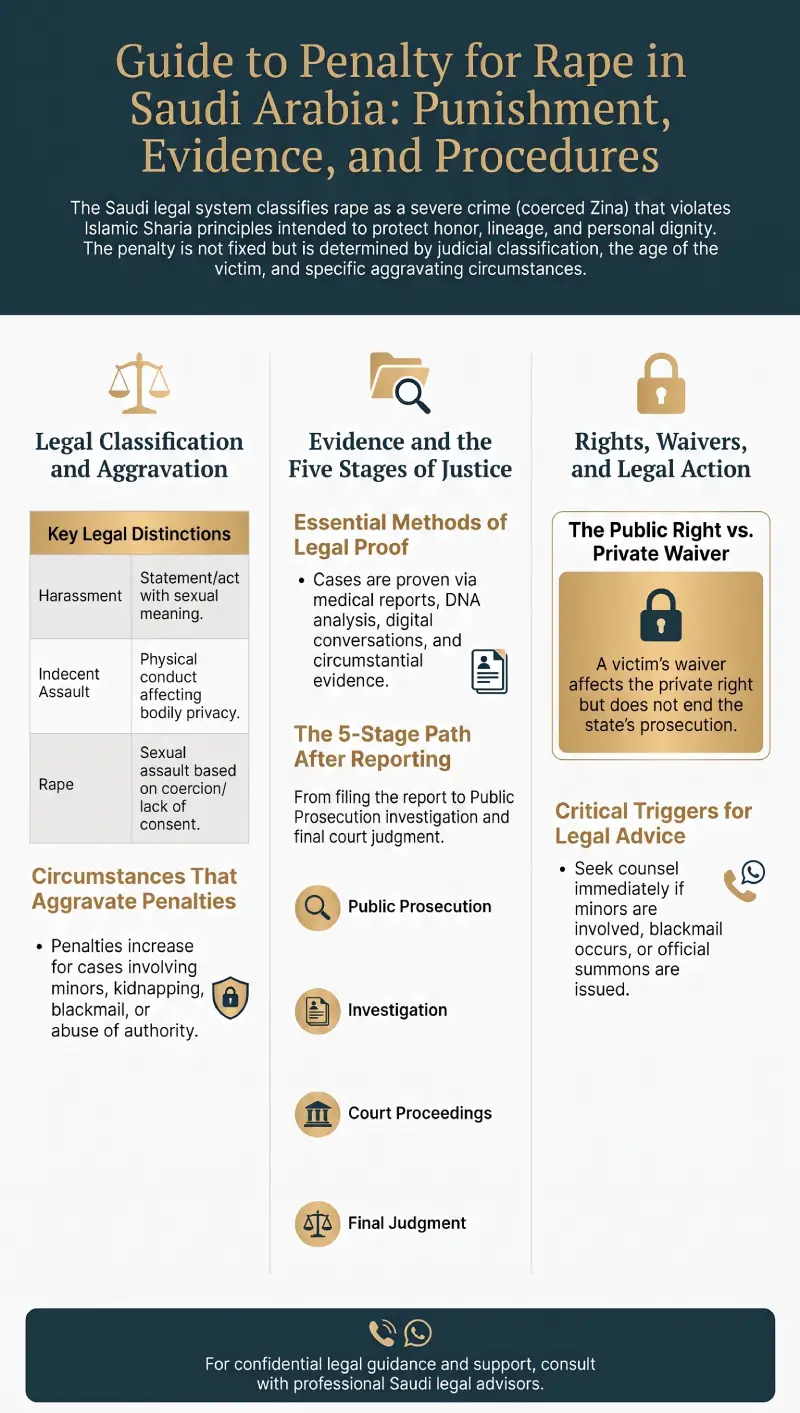
What Is Considered Rape?
Rape is a sexual assault based on coercion or lack of consent, and the competent authorities assess it through facts, evidence, and surrounding indicators. Coercion may be physical through force, psychological through threats, or based on exploiting the victim’s weakness or inability to resist.
The court does not rely only on how people describe the incident. It looks at what is proven in the file. For this reason, the legal classification may differ between rape, indecent assault, harassment, sexual assault, or an accusation that requires precise legal defense.
The incident should be arranged chronologically: when did it begin, where did it happen, what form of coercion was used, are there messages or witnesses, and is there a medical report? Each answer helps identify the closest legal classification.
When Is the Penalty Aggravated?
The penalty for rape in Saudi Arabia is aggravated when circumstances increase the seriousness of the act or show clear exploitation of the victim. These circumstances may include the victim being a child or a minor, or the incident being linked to threats, kidnapping, detention, recording, blackmail, multiple offenders, or abuse of authority within the family or workplace.
In some serious cases, the punishment may reach severe levels, but it is not legally accurate to assume one outcome for every incident. The court considers the evidence, procedural validity, statements of the parties, technical reports, and defenses submitted in the case.
In child-related cases, the issue is not merely a search for the child rape penalty in Saudi Arabia. It concerns the protection of a person who often lacks the full ability to defend themselves or assess danger. The authorities therefore examine the child’s age, level of awareness, form of coercion or exploitation, and the evidence surrounding the incident. This is why child rape cases are especially serious; the legal concern is tied to the victim’s vulnerability, not the act alone.
The Difference Between Rape, Harassment, and Indecent Assault
Distinguishing between these terms helps in filing a clear report or preparing an organized defense. Harassment may be a statement, act, or gesture with sexual meaning, while indecent assault usually involves physical conduct affecting bodily privacy or honor without necessarily amounting to rape. Rape, however, involves a more serious sexual assault based on coercion or lack of consent.
| Description | Nature | Key Evidence |
|---|---|---|
| Harassment | A statement or act with sexual meaning | Messages, cameras, witnesses, indicators |
| Indecent assault | Physical conduct affecting bodily privacy or honor | The act, location, statements, indicators |
| Rape | Sexual assault based on coercion | Medical report, DNA, witnesses, messages, indicators |
The existence of prior harassment does not automatically prove rape, and the absence of a direct witness does not make the file worthless. Criminal cases are often built on several supporting pieces of evidence, not always on one standalone proof.
Circumstances That Increase the Seriousness of the Incident
A case becomes more serious when the assault involves a child or minor, because age affects both the legal classification and procedures. The seriousness also increases when the victim is exploited within the family, by a person in authority, or through an employment or social dependency that makes resistance more difficult.
The case becomes more complex if it involves recording or blackmail, because digital evidence in criminal cases requires organized preservation and a method of presentation that does not harm the reporting party.
In cases involving kidnapping or detention, precise details matter: location, time, means of transportation, names of persons involved, prior messages, and possible cameras. These details may help connect each person to their role in the incident.
Evidence and Procedures After a Rape Report
Proving a rape case in Saudi Arabia does not always depend on one piece of evidence. The file may include a medical report, forensic examination, DNA analysis, messages, conversations, witnesses, cameras, or indicators connected to the sequence of events.
The medical report is important because it documents physical condition and possible traces, but it does not settle every case by itself. DNA analysis may be influential technical evidence, but it must be collected, preserved, and examined properly. Messages may also prove threats, luring, admission, or blackmail connected to the incident.
Common mistakes that weaken a case include deleting conversations, delaying examination without reason, confronting the other party, publishing details on social media, or giving inconsistent accounts to different authorities. It is better to preserve evidence, arrange it chronologically, and seek legal guidance before submitting it.
What Happens After a Rape Report?
The process usually begins by filing a report with the competent authority, followed by collection of preliminary evidence. The case may then move through the criminal claim process when there is a basis for referring the file to the Public Prosecution or the court.
During the investigation stage, the Public Prosecution examines statements, reports, and evidence, and may request technical procedures or witness testimony. Accuracy in statements is important at this stage, because any imprecise wording may affect how the file is understood.
If the case is referred to the criminal court, the court reviews the claim, evidence, and defenses, then issues its judgment based on what is proven before it. Referral does not automatically mean the crime is proven, and the report alone does not automatically mean conviction.
There is no fixed duration for all rape cases. The timeline depends on the number of parties, medical reports, digital evidence, witnesses, and whether the file needs additional examinations.
Does a Waiver End the Case?
A waiver does not always end a rape case, because some incidents involve public right in addition to private right. The private right relates to the victim and compensation, while the public right relates to protecting society and prosecuting the crime if it is proven.
A waiver may affect the private claim or compensation, but it does not necessarily stop the public path of the case. For that reason, no waiver should be signed under pressure, fear, or an unclear promise, and no settlement should be accepted before understanding its impact on your rights.
Compensation may be considered when physical, psychological, or financial harm can be proven. It may require medical, psychological, or documentary evidence showing the effect of the incident, and it does not replace criminal punishment if the crime is proven.
The Role of a Lawyer in Rape Cases
The lawyer’s role begins with organizing the incident before filing a report or responding to a summons. For the victim, the lawyer helps preserve evidence, draft the report, understand procedures, and identify private-right claims when there is proven harm.
For the accused person, the lawyer reviews procedural validity, strength of evidence, contradictions in statements, legality of evidence, and the appropriate defense strategy. Defense does not mean denying the victim’s rights. It means ensuring a fair process and careful review of the accusation.
Legal advice is needed when the case involves a child or minor, threats, recording, blackmail, an official summons, or a request for waiver. In these situations, a specialized criminal lawyer helps clarify the path before any step is taken.
FAQ: Penalty for Rape in Saudi Arabia
What is the penalty for rape in Saudi Arabia?
The penalty may be severe depending on legal classification, evidence, victim’s age, threats, and aggravating circumstances.
Can the penalty reach the death penalty?
In some serious cases, punishment may reach the death penalty, but this depends on the facts and what is proven before the court.
When is the punishment aggravated?
It may be aggravated when the case involves a child, kidnapping, threats, recording, blackmail, multiple offenders, or abuse of authority over the victim.
What is the penalty for child rape in Saudi Arabia?
Child rape cases are among the most serious sexual assault cases because the victim’s age is a key aggravating factor.
What is the difference between rape and harassment?
Harassment may be a statement or act with sexual meaning, while rape is a sexual assault based on coercion or lack of consent.
How is rape proven?
It may be proven through medical reports, forensic examination, DNA, messages, witnesses, and indicators linked to the sequence of events.
Is the medical report enough by itself?
A medical report is important, but it is not always enough alone. The court reviews the entire evidentiary file.
Can messages prove the crime?
Messages may prove threats, luring, admission, or blackmail, but they are assessed alongside the rest of the evidence.
Does a waiver end the case?
A waiver may affect the private right, but it does not necessarily end the public right or stop the case path.
When do I need a lawyer?
You need a lawyer when there is a report, summons, child victim, threat, recording, blackmail, or sensitive digital evidence.
The question is not limited to: what is Penalty for Rape in Saudi Arabia: 5 Stages After Reporting? It also extends to what happens after the report, how evidence is preserved, when the file moves to investigation, what effect a waiver may have, and when legal advice becomes necessary.
This is why the title of this guide focuses on the penalty for rape in Saudi Arabia through five post-report stages. It does not offer a generic answer about punishment only, but explains the practical path from the first step to assessing the legal position.
If there is an active incident or an official summons, do not act under fear or anger. Preserve evidence, avoid random confrontation, and seek official help if there is immediate danger. After that, early legal review with a Jeddah law firm can provide a clearer path for understanding options, organizing evidence, and choosing the right legal step before any action.
Official Sources: