
A Real Estate Rent Claim arises when rent becomes due under a lease agreement and the tenant fails to make the required payment. However, unpaid rent does not always mean that filing a court claim should be the first step. A standardized electronic lease may qualify for direct enforcement, allowing the landlord to proceed through the enforcement route instead.
The correct approach therefore starts with reviewing the lease, identifying overdue installments, deducting any payments already made, and determining whether the matter requires court proceedings or an enforcement application through Najiz. The amount claimed should correspond precisely to the relevant rental period and payment records, particularly where partial payments or objections from the tenant are involved.
Real Estate Rent Claim: Lawsuit or Enforcement?
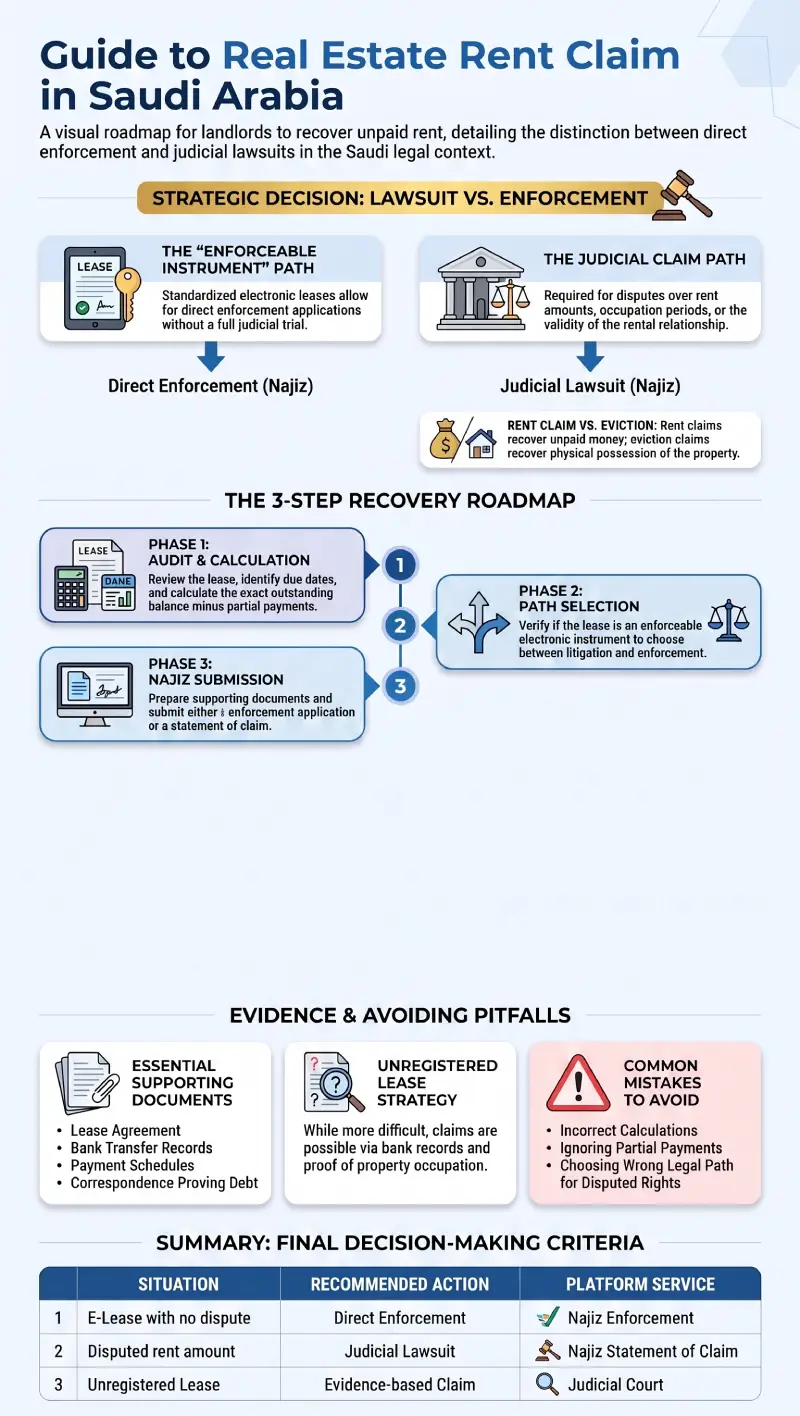
If a tenant fails to pay rent, begin with seven practical steps: review the lease, identify the due date, calculate the unpaid rent, check previous payments, examine the legal status of the lease, select the appropriate route, and prepare the supporting documents.
Where a standardized electronic lease retains its enforceable status, an enforcement application may be the appropriate first route for recovering a fixed amount. By contrast, if there is a genuine dispute over entitlement to the rent, the amount due, or the validity of the rental relationship, a judicial claim may be required before enforcement can proceed.
Do not rely solely on the title or electronic format of the agreement. Special terms or later amendments may affect whether the lease can be enforced directly.
What Is a Real Estate Rent Claim?
A Real Estate Rent Claim is a financial claim seeking payment of rent that has become due but remains unpaid by the tenant. It may arise from complete non-payment, late payment, partial payment leaving an outstanding balance, or rental amounts that remain due after the tenancy has ended.
The tenant is expected to pay rent according to the agreed payment schedule. For that reason, a successful unpaid rent claim should clearly identify the relevant rental period, amount due, payment date, and outstanding balance.
If you are asking how to recover unpaid rent from a tenant, start by preparing a payment schedule showing each installment, its due date, the amount actually paid, and the remaining balance.
A rent claim may also overlap with other property-related issues, including eviction, possession, and enforcement of contractual obligations. Understanding real estate claims in Saudi Arabia can therefore help place an unpaid rent dispute within the wider framework of Saudi property litigation.
When Does Rent Become Due for Recovery?
Rent becomes due according to the payment date and schedule agreed in the lease, whether payments are monthly or follow another agreed cycle. When a tenant falls behind, each unpaid period should be identified separately before any claim is submitted.
If the tenant has paid some installments, verified payments should be deducted from the outstanding amount. Any later amendment to the lease or payment mechanism should also be reviewed because the most recent valid terms may affect the obligation.
Where the amount itself is disputed, bank transfers, invoices, receipts, and relevant correspondence become important evidence for determining the actual balance.
Rent Claim or Lease Enforcement?
The main difference between litigation and enforcement is whether the landlord still needs a court to establish the right or already holds an enforceable instrument.
A standardized Ejar electronic lease may qualify as an enforceable instrument. Where the relevant requirements are satisfied, the landlord may not need a separate judgment establishing the debt before seeking enforcement. However, an electronic lease should still be reviewed carefully because special conditions or amendments may affect its enforceability.
Where the tenant disputes the existence of the rental debt, the amount claimed, or the duration of occupancy, court proceedings may be required to determine the underlying right first.
| Case | Route to Consider First |
|---|---|
| Standardized electronic lease retaining enforceable status | Lease enforcement application |
| Dispute over entitlement or amount of rent | Appropriate judicial claim |
| Disputed partial payments | Review payment records and evidence |
| Unregistered lease | Examine the rental relationship and evidence |
| Rent claim combined with eviction | Assess each remedy separately |
Requirements and Evidence for Recovering Unpaid Rent
A rent recovery claim generally depends on proving the rental relationship, showing that rent became due, establishing non-payment, and identifying the exact amount and period claimed.
The file will normally begin with the lease agreement, followed by the payment schedule, bank transfers, invoices, receipts, and any correspondence relevant to payment or default.
Proof of entitlement starts with the terms governing the amount of rent, payment cycle, duration, and other relevant conditions. Reviewing the Real Estate Lease Agreement Template is therefore important before calculating the amount to be claimed.
To prove unpaid rent, it is not enough simply to state that the tenant has failed to pay. The amounts that became due should be compared against payments actually received. If the tenant claims that payment was made, the supporting evidence should be reviewed against the date, amount, and rental period concerned.
Amounts already paid should never be included in the claim, and other charges should not be combined with rent unless their legal basis is clearly identified.
What Documents Are Most Important?
The key documents usually include the lease and any amendments, the payment schedule, a clear statement of paid and unpaid amounts, bank transfer records, invoices, and available receipts.
Where the lease is registered through Ejar, the payment and invoice information connected to the contract should be reviewed before the outstanding balance is finalized.
Some cases may also require documents establishing the landlord’s capacity or the authority of a representative acting on the landlord’s behalf.
A concise payment table linking every installment to its date and rental period is usually clearer than submitting extensive financial records without explanation.
How to Recover Rent Through Najiz
Before accessing Najiz, determine whether the matter requires a statement of claim or an enforcement application.
If the landlord holds a valid enforceable instrument for a fixed and due amount, the enforcement service may be considered, with the relevant instrument, claim amount, and supporting documents submitted as required.
If the dispute requires a judgment establishing the right or determining its amount, the statement of claim service is used instead. The parties, facts, relief sought, and supporting documents must then be entered appropriately.
When filing a Real Estate Rent Claim through Najiz, arrange the facts in a logical sequence: the lease, payment obligation, default, and remaining balance.
When seeking lease enforcement through Najiz, the amount requested should reflect the true outstanding balance after deducting all verified payments.
Evicting a Tenant While Claiming Unpaid Rent
A claim for unpaid rent seeks payment of a financial debt, while eviction seeks recovery of the property and termination of the tenant’s occupation under an applicable contractual or legal ground.
Both remedies may arise from the same circumstances, but they should not automatically be combined without reviewing the lease, the basis for eviction, and the status of the tenancy.
A rent recovery action focuses on the debt, while an Real Estate Eviction Lawsuit focuses on recovering possession of the property where the requirements for eviction are satisfied.
If the tenant neither pays nor vacates the property, distinguish between rent already due and the separate right to recover possession. Outstanding rent from earlier periods may remain payable even after the property is returned.
Termination of the lease for non-payment should also be assessed against the contractual terms and relevant circumstances before being included among the remedies sought.
Recovering Rent Without a Registered Lease
The absence of a registered lease does not automatically eliminate the possibility of recovering rent, but it makes evidence significantly more important.
Start with any written lease, correspondence, bank transfers, or documents showing the rental amount, period of occupation, and payment arrangement. These records should then be assessed to determine whether they establish the rental relationship and the amount claimed under the applicable evidentiary rules.
Where a specific contractual rent cannot be established, the concept of fair rental value may become relevant in some circumstances. However, fair rental value is legally distinct from agreed contractual rent and should not be treated as a substitute term for unpaid rent.
An unregistered Ejar lease should therefore not automatically be converted into a claim for fair rental value without first examining the underlying relationship and available evidence.
Mistakes That Can Weaken a Real Estate Rent Claim
One of the most damaging mistakes is calculating the amount incorrectly, ignoring partial payments, or submitting a claim that does not correspond with the lease and supporting records.
A case may also be weakened by filing court proceedings where an enforceable instrument already exists, or by seeking enforcement where the underlying dispute first requires a judicial determination.
The passage of five years should not automatically be described as extinguishing the underlying right. Saudi civil law contains a rule concerning non-hearing of certain recurring claims against a denying defendant after five years, including property rent, subject to the rules affecting how that period is calculated.
Landlords should also avoid adding compensation, costs, or eviction requests without a clear factual and legal basis.
Where an unpaid rent claim becomes intertwined with contractual defenses, enforcement issues, or eviction proceedings, reviewing the matter with a law firm in Jeddah can help identify the appropriate route before claims are submitted under an unsuitable procedure.
Frequently Asked Questions About Real Estate Rent Claims
Is an electronic lease agreement an enforceable instrument?
A standardized electronic lease registered through Ejar may qualify as an enforceable instrument. The actual agreement and its terms should be reviewed before filing an enforcement application.
Should I file a lawsuit or submit an enforcement application?
Review the legal status of the lease first. If it is an enforceable instrument and the amount due is clearly determined, enforcement may be appropriate.
How can I prove that the tenant has not paid the rent?
Compare the payment schedule with bank transfers, invoices, and receipts, then calculate the outstanding balance for each rental period clearly.
Can I claim unpaid rent without a registered lease?
Other evidence may establish the rental relationship and the amount due. The method of proof depends on the available documents, the value of the obligation, and the circumstances of the case.
Can I claim unpaid rent and seek eviction at the same time?
Both remedies may be available in some cases, but the grounds for eviction and the appropriate procedural route should be reviewed before combining them.
What if the tenant has paid only part of the rent?
Any verified payment should be deducted, and the claim should be limited to the remaining unpaid balance for the relevant rental periods.
What is the effect of five years passing on an unpaid rent claim?
Saudi law includes a rule concerning the non-hearing of certain recurring claims against a denying defendant after five years. The starting date and any factors affecting that period should be reviewed for the specific case.
Real Estate Rent Claim: 7 Steps to Recovery and Enforcement reflects the practical route for organizing an unpaid rent matter before taking legal action.
Begin by reviewing the lease, identifying the due date, calculating the outstanding balance, checking previous payments, assessing the enforceability of the lease, choosing between litigation and enforcement, and preparing the required documents before submitting the appropriate application.
Following this sequence helps determine whether the unpaid rent requires a judicial judgment or whether enforcement of the lease can begin directly. It also avoids confusing rent recovery with eviction or fair rental value, which may arise from related facts but involve different legal grounds, evidence, and procedures.
If the rent amount, payment records, or enforceability of the lease is disputed, the matter should be reviewed before filing. BMS Legal approaches these cases by examining the lease and supporting records first, then identifying the procedural route that best matches the facts.
Where the lease, outstanding balance, or enforceability of the instrument is disputed, a real estate lawyer in Jeddah can review the documents and help determine the appropriate route before filing a claim or enforcement application.
Official Sources: