
A real estate investment contract template provides an initial framework for defining the relationship between a property owner and an investor. However, a standard template may not address the property title, each party’s contribution, profit calculations, management authority, or project-specific risks.
The arrangement may constitute an investment, partnership, development agreement, or long-term usufruct structure. Each form creates different legal and financial consequences under Saudi law. A real estate investment contract in Saudi Arabia should therefore be preceded by checks covering ownership, mortgages, restrictions, signing authority, and required licences.
Funding should also be linked to measurable project stages. The agreement must regulate management powers, financial oversight, default, termination, and property handover. A generic Word or PDF template cannot replace clauses tailored to the property, project structure, and supporting documents.
What a Real Estate Investment Contract Template Must Include
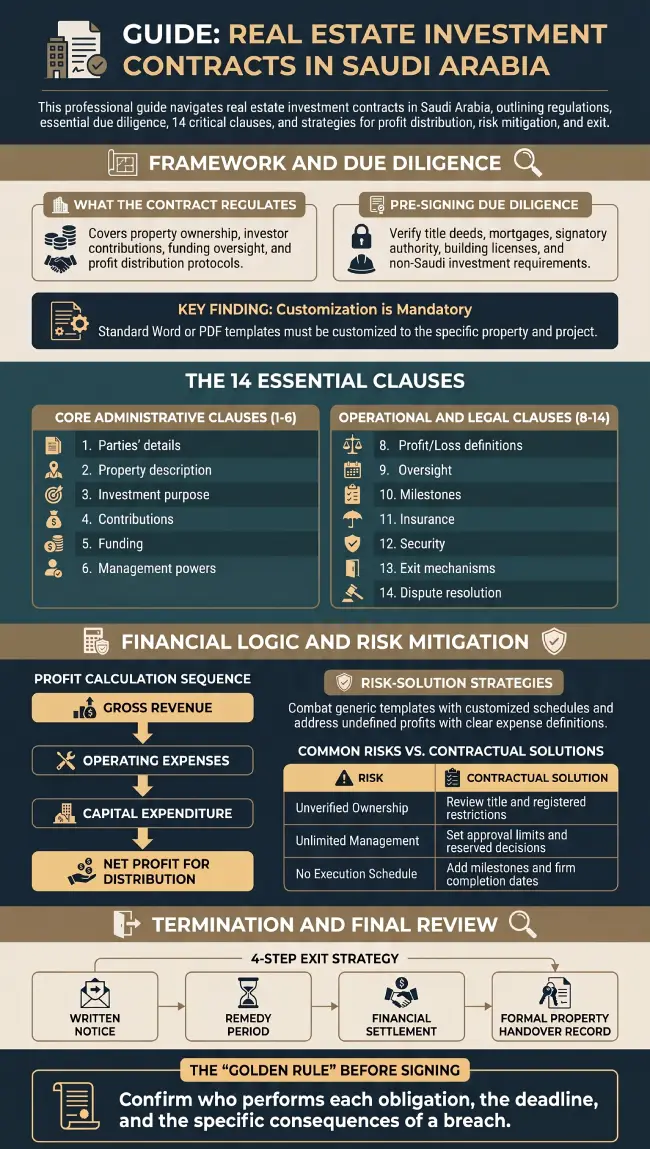
A real estate investment contract template should identify the parties, describe the property, define the investment purpose, and state the owner’s and investor’s contributions. It should also regulate funding, management, profits, expenses, duration, licences, guarantees, delays, assignment, termination, property handover, and dispute resolution.
Simply referring to “profit distribution” is insufficient unless the agreement defines revenue and the expenses deducted before distribution. A general “right to terminate” is also inadequate without specifying notice requirements, a remedy period, financial settlement, and the treatment of buildings or improvements.
Each material clause should answer three questions:
- Who is responsible for performance?
- When must the obligation be completed?
- What happens if the responsible party fails to perform?
What Is a Real Estate Investment Contract?
A real estate investment contract regulates the use of property or the financing of a property-related project in return for an agreed return or share. The owner may contribute land or a building, while the investor may provide funding, development services, management, or operational expertise.
The agreement must reflect the relevant form of real estate investment in Saudi Arabia. The parties should determine the project structure, expected return, and division of responsibilities before selecting or adapting a template.
An investment arrangement differs from a partnership when the relationship creates jointly held interests, shared management rights, or ownership in the project entity. It differs from a development agreement when the main purpose involves construction, improvement, rehabilitation, or marketing activities.
It may also differ from a lease when the consideration depends on project performance rather than a fixed payment for occupying or using the property. The true nature of the parties’ obligations is more important than the title placed at the top of the agreement.
A standard real estate investment agreement template is not suitable for every off-plan sale, off-plan lease, or real estate contribution involving funds from several investors. Such projects may require separate licences, agreements, accounts, and regulatory procedures beyond a bilateral arrangement between an owner and investor.
What Should Be Checked Before Signing?
Legal protection begins before the agreement is drafted. Carefully written clauses cannot correct defective ownership documents, insufficient signing authority, or a project that cannot lawfully proceed. The parties, property, and proposed activity should be examined before funds are transferred or possession is delivered.
Before relying on title deed information, verify real estate ownership and identify any mortgage, attachment, restriction, usufruct right, or third-party interest through the relevant official documents and channels.
Review each party’s identification, Commercial Registration, Articles of Association, power of attorney, and any resolution authorising a company representative to sign. Where the property has several owners or forms part of an estate, confirm the approval of all authorised persons and the limits of their representative’s authority.
Examine the title deed or Real Estate Registry title deed, together with the property’s location, area, boundaries, designated use, and registered interests. Confirming the owner’s name alone is insufficient; the description of the property must also match the proposed project.
Building and operating licences, permitted land use, funding stages, and each party’s financial capacity should also be reviewed. Where an owner or investor is not Saudi, the applicable ownership and investment requirements should be examined before signing.
The 14 Essential Contract Clauses
The required detail depends on the property, each party’s contribution, and the proposed management structure. Nevertheless, the following clauses provide a practical framework for reducing uncertainty before funding begins or the property is handed over.
| No. | Clause | What Should Be Defined |
|---|---|---|
| 1 | Parties’ details | Names, legal capacity, status, and authority to sign |
| 2 | Property description | Title deed, location, area, use, and restrictions |
| 3 | Investment purpose | Activity, scope, and intended project outcome |
| 4 | Owner’s contribution | Property, delivery obligations, and agreed services |
| 5 | Investor’s contribution | Funding, development, management, or operation |
| 6 | Funding and expenditure | Instalments, stages, account controls, and expense approval |
| 7 | Management | Powers and decisions requiring joint approval |
| 8 | Profits and losses | Definitions, percentages, and distribution dates |
| 9 | Reporting and oversight | Reports, audits, records, and access rights |
| 10 | Term and implementation | Start date, stages, delays, and extensions |
| 11 | Licences and insurance | Issuance, renewal, responsibility, and coverage |
| 12 | Security and default | Guarantees, notice, remedy period, and compensation |
| 13 | Exit and termination | Assignment, sale, termination, and treatment of improvements |
| 14 | Dispute resolution | Negotiation, competent court, or arbitration |
Ready-to-Customise Real Estate Investment Contract Template
The following wording may be used as an initial reference. It is not a final agreement suitable for every transaction. The parties must complete the information, schedules, and supporting documents according to the property and project.
Preamble: The First Party, in its capacity as the property owner, and the Second Party, in its capacity as the investor, agree to use and invest in the property under the following provisions. The preamble and schedules form an integral part of this agreement.
- Parties and property: The agreement shall record the parties’ details, legal status, and signing authority. The property shall be described using the title deed or Real Estate Registry title deed number, location, area, permitted use, and registered restrictions.
- Purpose of the agreement: The property shall be used for the implementation of [describe the activity]. The activity may not be changed without written approval and satisfaction of the applicable regulatory requirements.
- Parties’ contributions: The owner shall provide [the property, usufruct, or agreed services]. The investor shall provide [funding, development, management, or operation]. The value and delivery date of each contribution shall be specified.
- Funding and expenditure: Funding shall be deposited according to the agreed project stages. Any expenditure exceeding the approved budget requires prior written approval from both parties.
- Management and oversight: [Name of party] shall manage day-to-day operations. Material decisions, including borrowing, increasing the budget, or changing the activity, require joint written approval.
- Profits and expenses: Net profit means revenue actually received after deducting approved and documented expenses. Profits shall be distributed at [percentage] to the owner and [percentage] to the investor.
- Term and implementation: The agreement shall begin on [date] and end on [date]. The project shall be implemented according to an attached schedule identifying each stage and completion date.
- Default and termination: The defaulting party shall receive written notice and a period of [number] days to remedy the breach. Accounts shall be settled, and the property shall be delivered when the agreement ends.
- Disputes: The parties shall first attempt negotiation for [number] days. Any unresolved dispute shall then be referred to the competent court or arbitration where a valid arbitration agreement applies.
How to Regulate Profits and Expenses
The agreement should distinguish gross revenue, operating expenses, capital expenditure, and net profit. It must identify who approves expenses, the budget limits, responsibility for cost overruns, and the financial closing date.
It should also state each party’s percentage, the distribution schedule, required cash reserves, and the deadline for objecting to financial reports. A dedicated project account may improve control, particularly where funding is paid in several instalments linked to construction or operating stages.
The parties should not assume that one rule governs all project losses. The outcome depends on the legal structure, the nature of each contribution, and the cause of the loss. Ordinary commercial loss differs from damage caused by a proven breach, negligence, or unauthorised conduct.
Responsibility for Zakat, taxes, government fees, maintenance, and insurance must also be allocated according to the project and the parties’ legal status. Attaching a budget, funding schedule, and periodic reporting requirements can reduce later disagreements over project accounts.
Common Risks and Contractual Solutions
Early review can identify risks that may delay the project or lead to a dispute. The following table highlights common concerns, their likely consequences, and the provisions that may reduce exposure before signing.
| Risk | Possible Effect | Contractual Response |
|---|---|---|
| Using a generic template | Terms do not match the project | Customise the agreement and attach project schedules |
| Unverified ownership | Delay, invalid authority, or dispute | Examine title, authority, mortgages, and restrictions |
| Undefined profits | Disagreement over distributions | Define revenue, expenses, and net profit |
| Unrestricted management powers | Unilateral financial decisions | Limit authority and identify reserved decisions |
| No implementation schedule | Difficulty proving delay | Set stages, dates, and completion criteria |
| No exit mechanism | Capital or property becomes tied up | Regulate assignment, sale, termination, and liquidation |
Other significant risks include ignoring licensing requirements, failing to determine the ownership of improvements when the agreement ends, or allowing one party unrestricted spending authority. Difficulties may also arise when a new investor or partner enters without provisions governing management rights and financial entitlements.
Documentation, Termination, and Dispute Resolution
Not every agreement requires the same formal procedure. Depending on the transaction, the parties may need notarisation, registration of a real right, mortgagee approval, or a specific project licence. Contract authentication should be distinguished from registering ownership, a mortgage, or a usufruct right.
A notarised contract does not automatically become directly enforceable in every circumstance. Direct enforcement may require an enforceable instrument meeting the applicable requirements and containing a specific obligation that is already due. A dispute concerning the agreement’s validity or interpretation may require a separate court claim.
Termination provisions should address notice, the remedy period, unused funds, outstanding profits and expenses, property delivery, and the ownership or removal of improvements. The agreement should also explain how delay, insolvency, or the suspension of required licences affects continuation.
When the relationship ends, the parties should prepare a property handover form recording the condition of the property, buildings, keys, records, and outstanding obligations at the delivery date.
Court jurisdiction depends on the nature of the agreement, the legal status of the parties, and the relief requested. The parties may also agree to arbitration through a clearly drafted clause after considering its cost, rules, seat, and procedural requirements.
When Is Legal Review Necessary?
Legal review becomes particularly important when the investment value is substantial, the term is long, or the project includes construction and staged financing. It is also important where there are several owners, an existing mortgage, a non-Saudi party, or an arbitration clause.
For high-value projects or properties with several owners, consulting a real estate lawyer in Jeddah can help align the agreement with title documents, licences, financial arrangements, and the agreed allocation of risk.
For high-value projects or properties with multiple owners, consulting a real estate lawyer in Jeddah can help align the agreement with the title deed, licences, funding structure, and agreed allocation of risk.
Legal review is not limited to correcting language. It should examine consistency with ownership records, licensing requirements, project budgets, security arrangements, and termination procedures. It may also reveal conflicts between clauses or management powers that are wider than the parties intended.
Prepare the draft agreement, ownership documents, project description, each party’s proposed contribution, expected budget, and current negotiation status. These materials allow the lawyer to define the review scope and identify the clauses requiring amendment.
Frequently Asked Questions
Is a Word real estate investment contract template sufficient?
Usually not. A Word template does not reflect the particular title, restrictions, licences, funding structure, and project-specific risks.
Can a PDF template be used?
It may be used as a reference, but its provisions should be customised and legally reviewed before signing.
Must the agreement be notarised?
That depends on the transaction and the rights created. Notarisation, registration, or additional approvals may be required.
How should profit percentages be determined?
The agreement should first define revenue, deductible expenses, net profit, the reporting period, and the distribution date.
Who pays maintenance and licensing costs?
The contract should allocate each cost, identify the responsible party, and state the consequences of delay or non-payment.
When may the agreement be terminated?
Termination may follow an agreed event or material breach, subject to the required notice, remedy period, and settlement consequences.
What happens to improvements after termination?
The agreement should state their ownership, valuation, delivery, retention, or removal when the investment relationship ends.
Which court has jurisdiction?
Jurisdiction depends on the nature of the relationship, the parties’ legal status, and the claims brought before the court.
A sound property investment does not begin with signing a downloaded file. It begins with an agreement that reflects the title, project structure, funding plan, and identified risks. This is why the practical focus remains on a real estate investment contract template with 14 key clauses before signing, rather than a generic document containing broad promises.
BMS Legal provides contract drafting and review services as a law firm in Jeddah serving property owners, investors, and businesses across Saudi Arabia. The review process examines the supporting documents, defines the scope of work, and identifies the clauses requiring amendment before a financial commitment is mad
Official Sources: