
A document may be described as a Real Estate Allocation Agreement, but its title alone does not determine the legal right it creates. It may relate to an allocation decision concerning state real estate, a certificate documenting that decision, or a private agreement requiring separate legal characterization.
The proper review therefore begins with the property itself, the authority that issued the document, the purpose of the allocation, and the scope of use granted. Allocation must also be distinguished from ownership because an allocation decision or certificate does not automatically transfer title to the beneficiary.
Understanding Real Estate Allocation Rights
When state real estate is allocated, the property is placed at the disposal of the designated entity for use or benefit according to a specified purpose. An allocation decision is issued, followed by an allocation certificate carrying a unique number to document that decision after the required procedures are completed.
Allocation does not, by itself, give the beneficiary all the powers of an owner. A decision to sell, lease, assign, or otherwise deal with the property should therefore not be based solely on the document’s title.
Before relying on a Real Estate Allocation Agreement in Saudi Arabia, examine the type of document, property description, beneficiary, intended purpose, use restrictions, and circumstances in which the property may be recovered.
Where a private contract is described as a real estate allocation agreement, its substance must be reviewed independently. Its legal effect may differ from state real estate allocation, and no single contractual format applies automatically to every property transaction.
What Is a Real Estate Allocation Agreement in Saudi Arabia?
The expression Real Estate Allocation Agreement may be used to describe an arrangement connected with allocating property or allowing its use for a defined purpose. In the context of state real estate, however, the principal legal instruments include the allocation request, allocation decision, allocation certificate, and formal handover record.
Allocating state real estate means placing the property at the disposal of the designated entity for use or benefit according to the approved purpose. This differs from a sale, lease, or investment arrangement because each transaction creates different rights and legal consequences.
Where the intention is to sell the property and transfer ownership, the relationship and contractual terms must instead be addressed through an appropriate real estate sale agreement.
Similarly, a private real estate allocation agreement template or contractual form cannot be understood from its title alone. The obligations, duration, purpose, granted rights, and governing legal framework must all be examined before determining its actual effect.
Property allocation should also not be confused with the Civil Transactions Law concept of a movable asset treated as immovable by allocation. That concept concerns movable property permanently dedicated by the owner to serving the real estate.
When Is Property Allocation Used and What Are Its Requirements?
State real estate allocation is used where an eligible entity has an actual need for a property suitable for a particular purpose. The property’s area, specifications, and intended use must correspond with that need and the applicable planning and regulatory requirements.
Key requirements for the allocation of state real estate include:
- The intended use must comply with approved urban plans.
- The property must be vacant or unused where the applicable rules require this.
- There must be no existing dispute over the property at the time of allocation.
- The property must be free from third-party rights where required.
- A building must satisfy the relevant technical requirements and licensing conditions.
- The request must provide adequate information about the need, project, area, and location.
Where a specific government plot is requested, the application may also require property details, reasons for selecting the location, geographical coordinates, and the required aerial imagery.
Government land allocation procedures therefore differ from a private agreement between two parties concerning the use of privately held land.
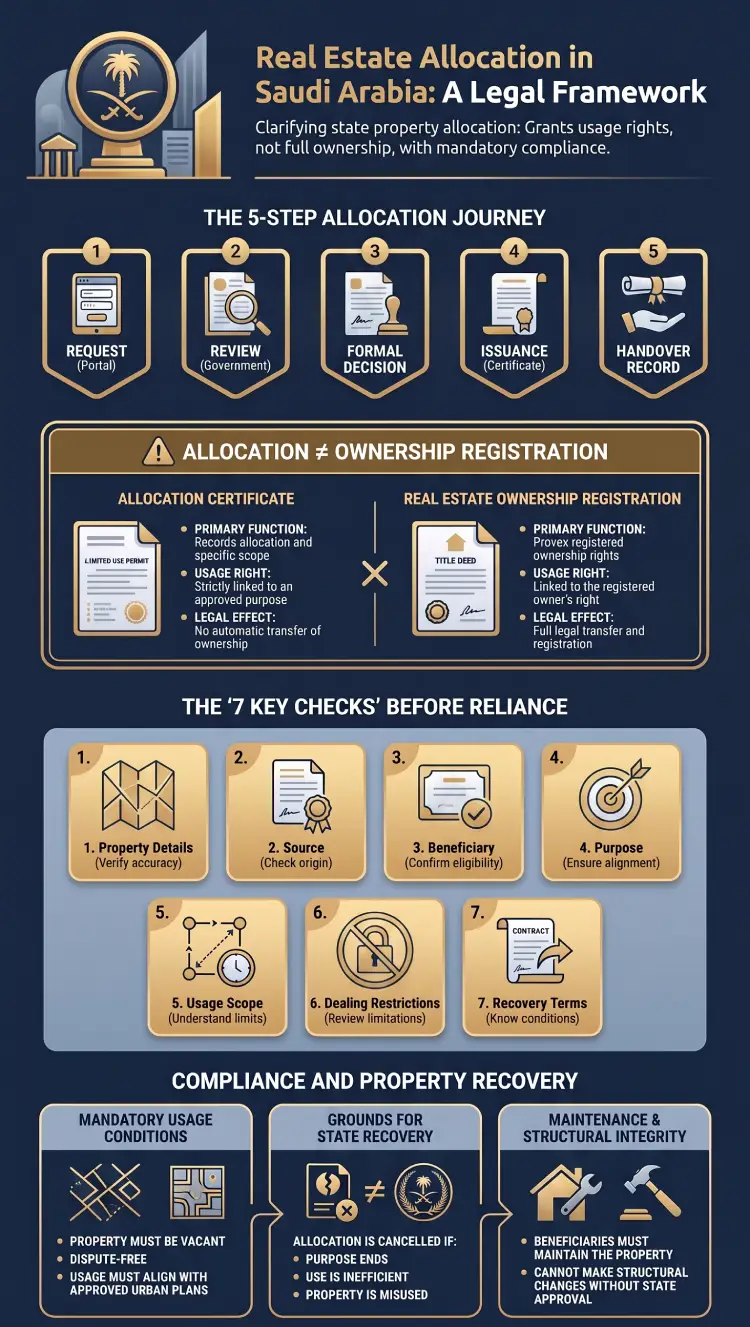
7 Points to Check in a Real Estate Allocation Agreement or Document
Before relying on a Real Estate Allocation Agreement, decision, or allocation certificate, review seven points that determine the practical scope and legal significance of the document.
- Property details: Verify the location, area, description, and boundaries against the relevant official property records.
- Source of the allocation: Determine whether you are dealing with an allocation decision, allocation certificate, private agreement, investment arrangement, or right-of-use document.
- Beneficiary: Confirm the identity of the entity for which the property was allocated and do not assume the allocation automatically transfers to another person or entity.
- Purpose of the allocation: Check the approved use because allocated state real estate must be used for the purpose for which it was designated.
- Scope of use: Determine whether the right covers the entire property, part of it, or only a specific benefit or use.
- Restrictions on dealings and alterations: Review the limits applicable to sale, lease, assignment, construction, or modification before entering into obligations with another party.
- Termination and recovery: Examine the circumstances in which the allocation ends or the property may be recovered, particularly where a project depends upon continuing use of the property.
Where any of these points remains unclear, it should be resolved before financial obligations are created around the property. If the property will support an investment project, the real estate investment agreement should reflect the actual scope of the right granted by the allocation document.
Does a Real Estate Allocation Agreement Prove Ownership?
A Real Estate Allocation Agreement or allocation certificate does not automatically transfer ownership. Allocation and sale are distinct forms of dealing with state real estate, so ownership, registration, and the legal nature of the document must be verified before treating the beneficiary as the property owner.
An allocation certificate documents the allocation decision, while ownership, registered rights, and restrictions are reflected through the applicable property ownership and registration framework.
Before selling the property or creating obligations over it, verifying property ownership helps identify the registered right holder, the relevant property details, and any restrictions that may affect the proposed transaction.
| Issue | Allocation Decision or Certificate | Real Estate Ownership Registration |
|---|---|---|
| Purpose | Records the allocation and its scope | Records ownership and registered rights |
| Transfer of ownership | Does not occur merely through allocation | Depends on the relevant legal transaction and registration |
| Use | Tied to the approved purpose and beneficiary | Depends on the registered right and applicable restrictions |
| What to review | Decision, certificate, and allocation rules | Registry information and ownership documents |
Allocation also differs from leasing, usufruct, and investment. The title of the document therefore cannot, by itself, determine the nature of the relationship or the beneficiary’s power to deal with the property.
Likewise, an existing allocation does not automatically mean the underlying right may be transferred to another party. Where an assignment is intended, the transferability of the right should first be established before the terms and legal consequences are addressed in a real estate assignment agreement.
How Does the Real Estate Allocation Process Work in Saudi Arabia?
The allocation of state real estate begins with an allocation request submitted through the approved portal together with the information and documents relating to the need and the property.
If the request requires correction or additional information, it is returned to the applicant entity for completion within the period prescribed by the applicable rules.
Once complete, the request is referred to the relevant committee to assess whether the property is suitable for the entity’s needs and to evaluate the actual requirement.
The committee then submits its recommendation within thirty days from referral. A decision approving or rejecting the allocation is subsequently issued, and a rejection must state its reasons.
Following approval, an allocation certificate with a unique number is issued to document the allocation decision. The property is then delivered under an approved handover record signed by the representatives of the relevant entities.
Where an allocation request is returned for correction and is not completed within sixty days, the request is treated as though it had not been submitted.
When Can an Allocation Be Cancelled and the Property Recovered?
Allocated state real estate may be recovered where the need for the property no longer exists, the purpose for which it was allocated has ended, or the efficiency of its use has declined.
Recovery may also arise where the property is used for a purpose different from the approved allocation or remains vacant for more than six months in the circumstances covered by the applicable rules, unless an acceptable reason applies.
Once a recovery decision is issued, the property is returned to the competent authority under an approved record. Depending on the circumstances and the decision, recovery may concern the whole property or only part of it.
Recovery provisions should therefore be reviewed before establishing a long-term project or commitment that depends upon continuing use of allocated real estate.
When Should You Consult a Real Estate Lawyer About Property Allocation?
Legal review becomes particularly important when the document does not clearly identify the nature of the right, its details differ from the property records, or restrictions affect how the property may be used.
A real estate lawyer in Jeddah can also review the document before a sale, lease, or assignment, or where a dispute concerns the scope of an allocation or the recovery of allocated property.
The review should identify the document type, source of the right, property details, approved purpose, and applicable restrictions. From there, the available legal options and any missing requirements can be determined before creating further obligations.
Frequently Asked Questions About Real Estate Allocation Agreements
1. What is a Real Estate Allocation Agreement?
A document governing property allocation for a specific purpose.
2. Does it transfer ownership?
No. Allocation does not automatically transfer ownership.
3. What is an allocation certificate?
A document confirming an approved allocation decision.
4. Is an allocation certificate a title deed?
No. It documents allocation, not ownership.
5. What should be checked?
Property details, purpose, beneficiary, restrictions, and recovery terms.
6. Can allocated property be sold or leased?
Not automatically. The applicable rights and approvals must be checked.
7. When can allocated property be recovered?
When the purpose ends, use changes, or regulatory recovery conditions arise.
8. When should a lawyer review it?
Before selling, leasing, assigning, investing, or disputing the allocation.
Real Estate Allocation Agreement: 7 Key Checks captures the essential review needed before relying on an allocation document. Check the property details, source of the document, beneficiary, approved purpose, scope of use, restrictions on dealings, and recovery conditions before making a decision.
An allocation decision or certificate should not automatically be treated as proof of ownership, and a private agreement should not be interpreted only by its title. Where the document will support a sale, investment, assignment, or objection, its actual legal effect should be established before proceeding.
Where the allocation document will support a sale, investment, assignment, or objection, early legal review can clarify the limits of the right before further steps are taken. A law firm in Jeddah can assess the relevant document together with the underlying facts to determine the appropriate legal pathway.
Regulatory Sources: