
Types of Real Estate in Saudi Arabia are not just market labels. They help you understand how a property may be used, what must be checked, and what could restrict you before buying. Before looking at the price or location, ask first: is the property residential, commercial, agricultural, industrial, or investment-oriented?
This classification affects the title deed, mortgage status, restrictions, ownership transfer, and whether the property is suitable for your actual purpose. A property may look attractive in an advertisement, but the issue may appear later during licensing, transfer, or document review.
This guide helps you read the property before buying it, not after the problem appears. You will understand how to distinguish classification from use, when a property is relatively safer, and when legal review is needed before paying a deposit or signing a contract.
Quick Guide: 5 Main Types of Real Estate in Saudi Arabia
Real estate in Saudi Arabia is commonly divided into five broad categories: residential, commercial, agricultural, industrial or logistics, and investment-oriented property. Calling a property “investment real estate” does not always mean it has a separate legal classification. It may still be an apartment, land plot, shop, office, building, or warehouse.
The practical rule is simple: classification explains the use, while investment explains the financial purpose of ownership. For example, you may buy a residential apartment to rent it out, but it remains residential unless its approved use changes.
| Classification | Common Use | What to Check Before Buying |
|---|---|---|
| Residential | Housing and living | Title deed, mortgage, subdivision, unit status |
| Commercial | Shops, offices, and business activity | Approved use, permits, contracts, restrictions |
| Agricultural | Farming or related use | Title deed, use, restrictions, land location |
| Industrial and logistics | Factories, warehouses, and operations | Licensing, safety, access, activity type |
| Investment-oriented | Income or value growth | Contracts, restrictions, transferability |
Before buying any property, do not ask only about the price or location. Ask about the approved use, recorded restrictions, and whether ownership can be transferred without legal or procedural obstacles.
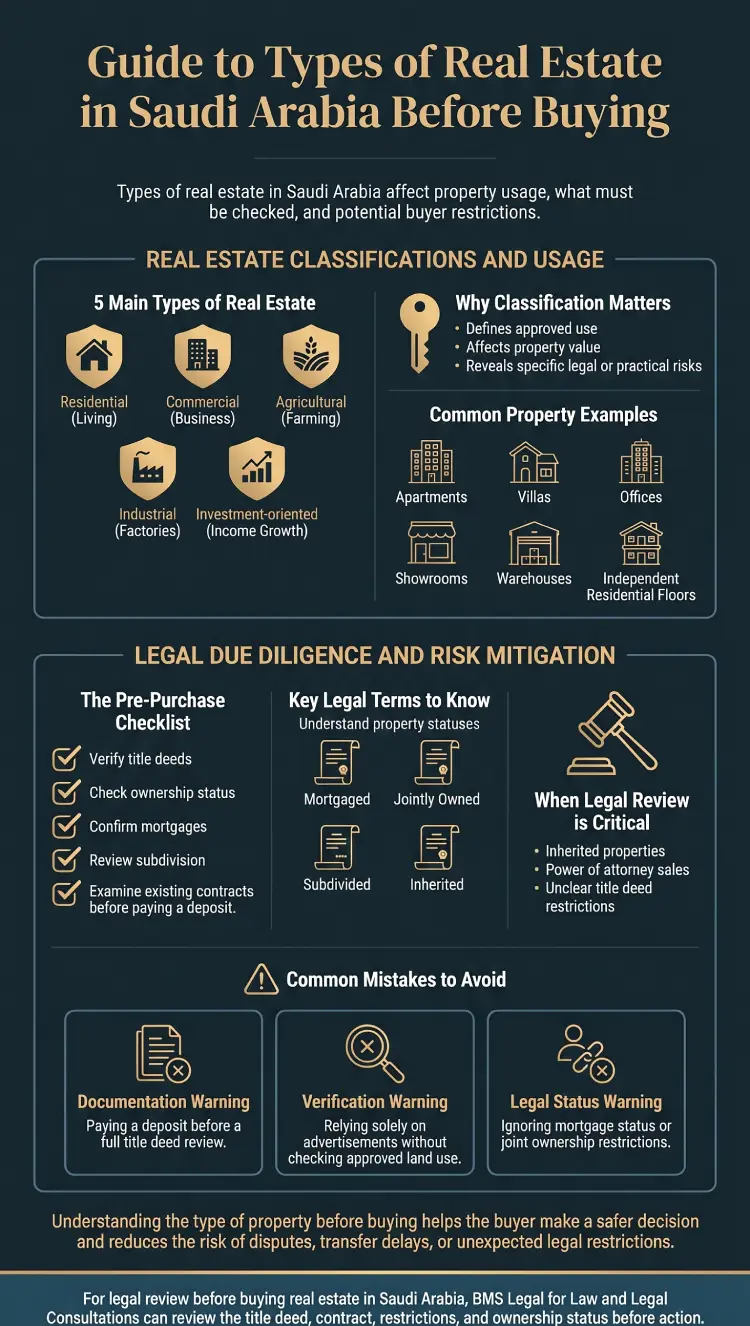
Why Classification Matters Before Buying
Property classification determines what you can do after purchase and what may require further approvals. A property may be suitable in price and location, yet unsuitable because of its legal use or restrictions.
That is why understanding how to choose the right property in Saudi Arabia should come before paying a deposit or relying on the advertised features alone.
Its importance appears in four practical areas:
- Use: residential property is for living, commercial property is for business, industrial property is for production or storage, and agricultural land is for agricultural use.
- Value: price is not based on area alone; use, location, restrictions, and existing contracts all affect value.
- Risk: a property may be mortgaged, jointly owned, inherited, subject to usufruct, or affected by regulatory limits.
- Review: inspecting a villa is different from reviewing a warehouse, agricultural land, or leased commercial shop.
Risks appear quickly when you buy a property for a purpose that differs from its approved use. You may buy a residential unit to operate a business, then discover that licensing or municipal requirements do not allow it easily.
For this reason, paying a large deposit before reviewing the title deed, contract, and seller’s capacity is not recommended. The mistake is not only choosing the wrong property, but moving too fast before understanding its legal position.
Main Real Estate Classifications in Saudi Arabia
Residential Real Estate in Saudi Arabia
Residential real estate is property designated for living and accommodation. It may be an apartment, villa, floor, duplex, or residential building. This is one of the most searched real estate types in Saudi Arabia because it relates to family housing, personal ownership, and residential financing.
Common examples include:
- Apartments within shared buildings.
- Detached or attached villas.
- Duplex units, often across two levels.
- Independent floors within residential buildings.
- Residential buildings with multiple units.
| Residential Unit | Nature | Key Legal Note |
|---|---|---|
| Apartment | Unit in a shared building | Check shared areas and management rules |
| Villa | Usually independent property | Review title deed, plans, and compliance |
| Duplex | Often a two-level unit | Verify boundaries and subdivision |
| Independent floor | Floor within a building | Check entrances and shared rights |
| Residential building | Multiple-unit property | Review leases and obligations |
Apartments are often more affordable, but they involve shared areas such as entrances, parking, elevators, and facilities. Villas provide greater privacy, but may carry higher maintenance and compliance responsibilities.
Before buying residential real estate in Saudi Arabia, verify the title deed, seller details, area, mortgage status, and subdivision status. If the property involves heirs, joint ownership, or mortgage, legal review becomes important before transferring any amount.
Commercial Real Estate in Saudi Arabia
Commercial real estate is property designated for business or service activity, such as shops, offices, showrooms, and commercial centers. It differs from residential property in use, contracts, operational risk, and licensing requirements.
Commercial leases may include obligations different from residential leases, so reviewing a real estate lease agreement template helps clarify rent, use, maintenance, renewal, and termination before relying on expected income.
Examples of commercial real estate include individual shops, offices, showrooms, commercial towers, malls, and commercial land. You should verify that the approved use matches the intended activity before buying or leasing.
The difference between residential and commercial property is not limited to the name. It includes several points:
- Residential property focuses on living, while commercial property relates to business and income.
- Commercial property requires review of permits, requirements, and existing contracts.
- Commercial leases may include obligations different from residential leases.
- Operational risks in shops and offices are usually higher than in residential property.
Commercial real estate may be suitable for investment when the approved use is clear, the contract is well drafted, the location supports the activity, and restrictions are not disruptive. General return estimates are not enough without reviewing the contract, market, location, and operating obligations.
Agricultural and Industrial Real Estate in Saudi Arabia
Agricultural and industrial property relate more to productive use than direct residential or commercial use. Each requires a specific review that goes beyond price or area.
Agricultural real estate is land or property designated for farming or related agricultural activity. Its value may depend on location, water, roads, title deed, and the ability to benefit from it according to the approved use.
Risk appears when someone buys agricultural land for residential or recreational purposes without checking the rules. If the intended use differs from the classification, the possibility of changing that use must be reviewed before committing to the purchase.
Industrial real estate includes factories, workshops, warehouses, and sites connected to production, storage, or supply chains. This type requires checking licensing, location, access, safety requirements, and activity type.
Before buying or leasing industrial real estate, verify that the activity matches the location, permits can be obtained or transferred, and operational responsibilities are clearly stated in the contract.
Investment Real Estate in Saudi Arabia
Investment real estate is not always a separate classification in the title deed. It usually describes the buyer’s purpose. It may be land, an apartment, a shop, a building, an office, or a warehouse.
When the purpose is income or value growth, the legal review should not stop at classification; a clear real estate investment agreement template can help define profit, obligations, exit terms, and risk allocation before the deal moves forward
There is no single best property type for every investor. The result depends on location, price, approved use, contracts, and restrictions. Common investment choices include land, apartments, buildings, shops, and warehouses.
Investment choices can be viewed as follows:
- Land: may suit long-term value growth, but requires review of use, utilities, and possible fees.
- Apartments: may suit faster rental use, but involve building management and shared areas.
- Buildings: provide multiple units, but require review of leases and maintenance obligations.
- Shops: may produce good income, but depend heavily on location, activity, and licensing.
- Warehouses: relate to commerce and storage, and require operational and safety checks.
The question “Is land better than an apartment?” has no universal answer. The right decision starts with the title deed, purpose, budget, and risk review.
Types of Land in Saudi Arabia
Types of land in Saudi Arabia are linked to approved use, such as residential, commercial, agricultural, and industrial land. Other practical descriptions may also appear, such as raw land, developed land, or white land.
Residential land is designated for residential construction according to applicable requirements. It should not be assumed suitable for another activity. Commercial land is designated for business activity and may have higher value because of location and use.
Agricultural land is linked to agricultural use and may not suit residential construction or commercial activity without further procedures. Industrial land relates to production, operation, and storage, and requires checking permits and location.
Other descriptions should also be understood before buying:
- Raw land: land not fully serviced or ready for direct construction.
- Developed land: land usually prepared with basic facilities and divisions.
- White land: vacant land within an urban area that may be subject to conditions or fees when requirements apply.
- Jointly owned land: land owned by more than one person without clear subdivision.
- Mortgaged land: land connected to a financial right that must be reviewed before transfer.
Key Real Estate Terms Before Ownership
Understanding real estate terms protects you from signing a contract that does not fit the property’s actual status. Terms such as mortgaged, jointly owned, subdivided, or inherited property are not secondary descriptions. They affect sale, review, and transfer.
A mortgaged property is subject to a security right for a lender or creditor, often because of financing or financial obligation. The existence of a mortgage does not always prevent a sale, but it requires a clear understanding of how the mortgage will be released before transfer.
Jointly owned property is owned by more than one person without each owner having an independently separated part. This often appears in inherited property or partnership ownership, and selling may require clear approvals.
A subdivided property is a unit or part with separate boundaries and data. This concept often appears in apartments and units within shared buildings, where subdivision affects ownership and disposal.
Inherited property is property that passed to heirs after the owner’s death. It often requires deeper review than an ordinary sale because approvals, minor heirs, powers of attorney, or disputes between owners may exist.
Title Deed Review and Ownership Verification
Reviewing the title deed is the most important practical step before buying real estate in Saudi Arabia. Risk does not always appear during inspection; it appears in ownership, mortgage, restrictions, powers of attorney, and the ability to transfer.
Check the owner’s name, deed number, property area, boundaries, location, mortgage status, recorded rights, and any suspension or restriction if found. If the seller is acting through a power of attorney, verify its validity and whether it grants authority to sell and receive the price.
You may need a real estate lawyer when the property is high-value, mortgaged, jointly owned, inherited, or commercial. The need increases when the contract is complex, payments are staged, a penalty clause exists, or there is disagreement about transfer.
When Should You Request Legal Review?
Not every real estate transaction needs the same level of legal review. However, some situations require document review before signing. The more restrictions, parties, or value involved, the more important early legal review becomes.
| Situation | Potential Risk | When to Request Review |
|---|---|---|
| Mortgaged property | Transfer delay or payment dispute | Before paying the deposit |
| Inherited property | Missing approvals or authority | Before signing the contract |
| Jointly owned property | Difficulty in sale or subdivision | Before final agreement |
| Commercial property | Wrong use or weak contract | Before buying or leasing |
| Agricultural land | Use not suitable for purpose | Before transferring money |
| Sale by power of attorney | Insufficient or expired authority | Before signing any document |
If mortgage, joint ownership, heirs, or conflicting use appears, do not let speed alone control the decision. Legal review does not mean blocking the deal; it helps organize it before it turns into a dispute.
Common Mistakes When Choosing a Property
Many buyers make avoidable mistakes because they do not review documents and use early enough. These mistakes are not limited to beginners; they may also occur in high-value transactions.
- Buying land without knowing its approved use in the title deed or plan.
- Confusing commercial property with investment property when assessing returns.
- Buying a mortgaged property without a clear release and transfer mechanism.
- Ignoring joint ownership between owners or heirs before paying a deposit.
- Relying on the broker’s advertisement instead of checking the title deed and restrictions.
- Buying commercial property without reviewing permits or tenant contracts.
- Signing a brief contract that does not clarify responsibilities, dates, and penalties.
Frequently Asked Questions About Types of Real Estate in Saudi Arabia
What is the difference between residential and commercial real estate?
Residential real estate is intended for living, while commercial real estate relates to shops, offices, business activity, and commercial contracts.
What does investment real estate mean?
Investment real estate is property purchased to generate income or value growth. It is not one fixed physical form.
What is the difference between commercial and investment real estate?
Commercial describes the approved use, while investment describes the ownership purpose. The same property may be both commercial and investment-oriented.
What does mortgaged property mean?
It is property subject to a security right for a lender or creditor, and the mortgage release method should be clear before purchase.
What does jointly owned property mean?
It is property owned by more than one person without a separately subdivided part for each owner.
What is the most important step before buying property in Saudi Arabia?
The most important step is reviewing the title deed and verifying ownership, mortgage, restrictions, and approved use before signing.
When do I need a real estate lawyer?
You may need one when buying mortgaged, jointly owned, inherited, commercial, or high-value property.
Types of Real Estate in Saudi Arabia: 5 classes before buying, and one decision that should not be rushed. A safe transaction does not begin with price or location only. It begins with classification, title deed review, restrictions, and transferability.
If you are buying residential, commercial, agricultural, industrial, or investment-oriented property, start by checking the title deed, seller’s capacity, and approved use. Do not pay a deposit or sign a binding contract before understanding the limits of risk.
BMS Legal for Law and Legal Consultations is a law firm in Jeddah that reviews real estate transactions before purchase or investment, with a method based on clarity before action, document review, and realistic explanation of available options.
Sources: