
Types of real estate loans in Saudi Arabia cannot be understood from the monthly instalment alone, but from identifying the type of financing that suits your goal. You may need to buy a ready unit, build a home on land you own, buy a unit under construction, or benefit from housing support.
Many people use the phrase “real estate loan” when buying a home through a bank, while the term “real estate financing” appears in contracts and bank products. What matters here is not only the common name but knowing when each kind of real estate product suits you before entering a long-term commitment.
Before choosing a product, separate two different tracks: the type of financing on one side, and acceptance of the application on the other. The effect of terminology on the contract, the cost and the mortgage is clearer in the difference between a real estate loan and financing, while this guide focuses on classifying the types: ready, self-build, under construction, supported, unsupported, and mortgage.
Comparing real estate financing offers?
A real estate lawyer can review the contract, the deed and any mortgage before you sign a long-term commitment.
Enquiries are handled confidentially · No specific court outcome can be guaranteed
Quick Answer: What Are the Main Types of Real Estate Loans in Saudi Arabia?
The types of real estate loans in Saudi Arabia include seven main options: financing a ready unit, self-build financing, financing units under construction, supported real estate financing, unsupported financing, a real estate mortgage or financing against a property, and debt transfer or refinancing.
Choosing a type does not mean the application is automatically accepted. A product may suit your goal, but final approval depends on the financier’s conditions, income, obligations and the status of the property.
The choice can be simplified like this:
- You want to move in quickly: financing a ready unit.
- You own land and want to build: self-build financing.
- You can wait until handover: financing a unit under construction.
- You are eligible for housing support: supported real estate financing.
- You do not meet the support conditions: unsupported financing.
- You own a property and need liquidity: a real estate mortgage or financing against a property.
- You have existing financing: debt transfer or refinancing.
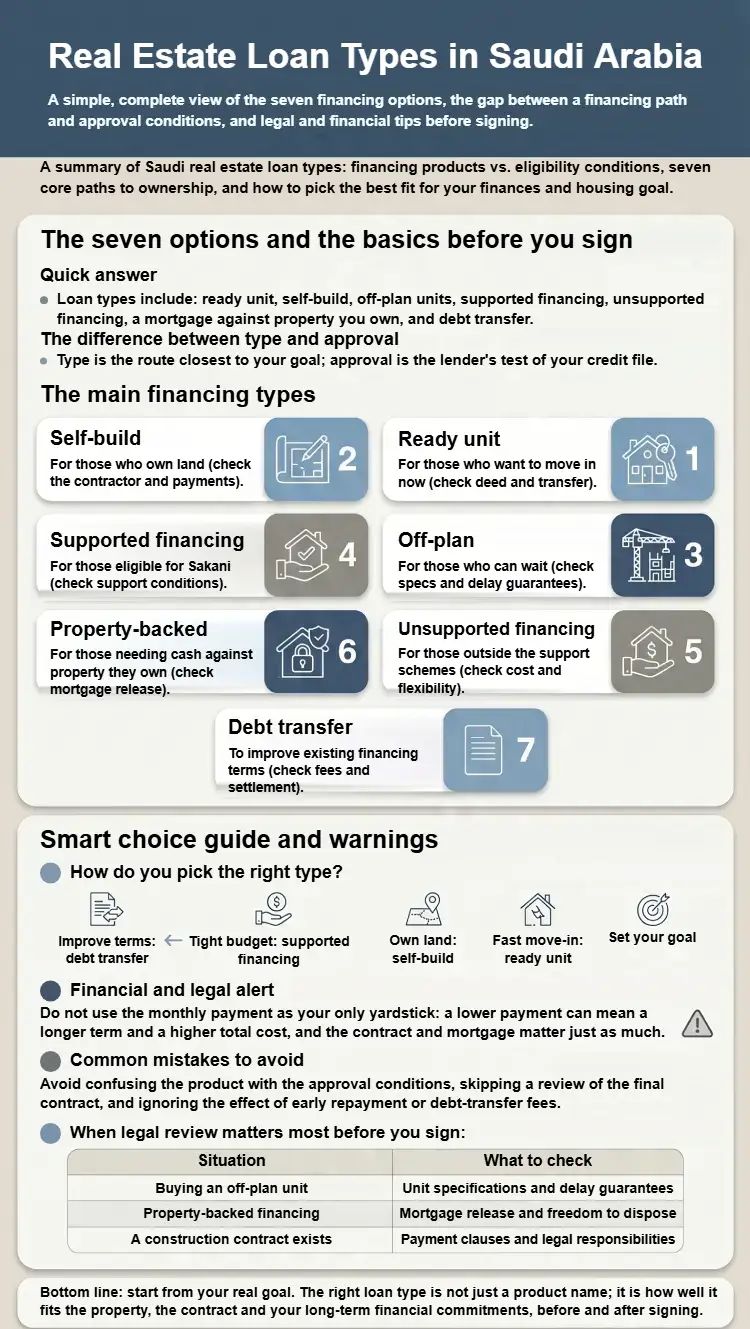
Types of loans are not acceptance conditions
Knowing the types of financing helps you identify the right product, but it does not mean you have become eligible for financing. The choice answers the question: what is the closest route to my goal? The acceptance conditions themselves are covered in a clearer way in our guide to the mortgage conditions, from the angle of eligibility and obligations.
You may find self-build suits you because you own land, but the application may stall if the building permit is incomplete. Or you may choose a ready unit, and then a restriction in the deed or a mortgage appears and delays the conveyance.
Table of Real Estate Loan Types in Saudi Arabia
Before choosing a financing offer, identify the product type closest to your case. The table below summarises the practical differences between the types, so the comparison starts from your goal and not from the instalment alone.
| Type of financing | Main use | When it suits you | What to review before signing |
|---|---|---|---|
| Ready unit | Buying an existing apartment or villa | When you want to move in quickly | The deed, the conveyance, any mortgage |
| Self-build | Building a home on owned land | When you own land and want your own design | The permit, the contractor, the payments |
| Unit under construction | Off-plan purchase | When you can wait until handover | Specifications, guarantees, delay |
| Supported financing | Owning a home with housing support | When eligibility is met | Support conditions and the financier |
| Unsupported financing | Direct financing from the bank | When you do not use support | Cost, fees, flexibility |
| Real estate mortgage | Financing secured by a property | When you own a real estate asset | Release of the mortgage, disposal, sale |
| Debt transfer | Adjusting existing financing | When you want better terms | Fees, discharge, transfer conditions |
This table helps with a first comparison between the types of real estate loans, but it does not replace reading the financing offer and the final contract.
The Main Types of Real Estate Loans by Use
The types differ with the purpose of the financing and the nature of the property. One suits someone who wants to move in quickly, another someone who owns land and wants to build, a third someone who accepts buying a unit under construction. The right choice is therefore not always the lowest instalment, but the type that fits the property’s status, the waiting period, and the documents required before signing.
Financing the purchase of a ready unit
Financing a ready unit means buying an existing property that can be inspected before signing, such as an apartment, a villa or a finished house. This option suits someone who wants to move in quickly or does not wish to follow construction and contractors.
The advantage of this type is that the property exists, so the deed, the area, the location and the possibility of conveyance can be checked before the final commitment. That makes verifying the property’s ownership documents part of the decision itself, before a large deposit is paid or a long-term financing offer is signed.
Before accepting the offer, check that the deed and the owner’s data are clear and that the property is free of any influential restriction or mortgage. Also confirm that the price matches the valuation, that the conveyance is possible, and what the effect of early repayment or a later sale would be.
Self-build financing
Self-build financing suits someone who owns land and wants to build a home on it. It differs from buying a ready unit, because the financing is tied to execution stages, a permit, a contractor and a payment schedule.
This type gives you more flexibility in design and area, but needs closer follow-up. Delay in execution or a weak contracting agreement may affect the release of payments or raise the cost.
Before choosing self-build, check that ownership of the land is clear, that a suitable building permit exists, and that the contracting agreement defines scope and duration. The progress schedule should match the payments, with a clear mechanism for handling delay or defects.
In self-build, accepting the financing offer alone is not enough, because the relationship with the contractor and the supervisor needs written control of payments, delay and responsibilities, which falls under drafting contracts before work starts.
Financing units under construction and off-plan sales
Financing a unit under construction means buying a unit that is not yet complete, under a contract that sets specifications and a handover date. This type appears in off-plan products and new residential projects.
This option suits you if you are not in a hurry for handover and want wider choices in location, area or price. But it requires a careful reading of the contract, since you are not inspecting a finished unit.
Before signing, check the final handover date, the unit area, its specifications, the payment schedule and the guarantees tied to the project. The contract should explain the effect of the developer’s delay, the right to rescind or claim compensation, and the financier’s relationship to the project.
Here the cheapest real estate loan is not always the best choice. The better option is the contract that is clearest on handover, specifications, guarantees and the limits of the developer’s responsibility.
Trust and Legal Basis
Legal basis
This guide is based on the Real Estate Development Fund product page listed below and general market practice, and is written for general legal awareness rather than as advice on a specific case. It is not an offer of financing or a recommendation of any product.
Published by: BMS Legal Law and Legal Consultancy Company.
Address: Jeddah, Al-Mishrifah District, Palestine Street, Al-Safeer Tower
Supported real estate financing
Supported real estate financing is usually tied to the beneficiary’s eligibility for housing support and to the Sakani programmes or the Real Estate Development Fund. A user may search for it in forms such as “supported real estate loan” or “real estate loan from Sakani”.
This type suits someone who meets the support conditions and wants to own a home through a product compatible with the programme. But support does not remove the existence of a financing contract with a financier.
Before choosing supported financing, ask about eligibility for support, whether the product suits the property you want, and where the support appears in or outside the contract. If the dispute concerns the support or the Fund’s procedures rather than the type of financing itself, that becomes a separate procedural subject, such as how to file a complaint against the Real Estate Fund.
Unsupported real estate financing
Unsupported financing is direct financing that does not rely on eligibility for housing support. It usually appears for those who do not benefit from support, for investors, or for those who want a property that does not fall under a supported programme.
This type is not always cheaper or dearer than the supported one. It may give flexibility in choosing the property or the financier, but it makes cost, fees and the repayment period more sensitive elements.
When asking “what is the lowest real estate financing rate in Saudi banks?” or “what are the real estate loan rates?”, do not rely on the advertisement alone. Compare the total cost, the repayment period, the fees, the mortgage and the early-repayment conditions.
Unsupported financing suits someone who does not benefit from support, who buys an investment property, or who wants a more flexible product. Files linked to military employers have special considerations in the conditions of the real estate bank for military personnel, because they concern requirements and not the classification of financing types.
Real estate mortgage and financing against a property
A real estate mortgage may be security within a financing contract, and it may appear as an option for obtaining financing secured by an existing property. In both cases its effect should be understood before signing.
A mortgage usually does not prevent you using the property, but it may restrict sale, transfer of ownership or disposal until repayment or the financier’s approval.
Some people search for formulas such as a real estate mortgage against a loan from a particular bank. But what matters is not the bank’s name alone, but the mortgage terms, the cost, the release mechanism and the right to sell.
Before accepting a mortgage, ask how it appears in the deed or the property data, when it is released, and whether you can sell before the end of the financing. This point quickly moves from the idea of security to the conditions for selling a mortgaged property and the approvals and debt treatment that follow. See our guides on selling a mortgaged property and the real estate mortgage transfer conditions.
Debt transfer or real estate refinancing
Debt transfer or refinancing usually starts from an existing financing contract. Its aim is to improve the terms, rearrange the commitment, or move to another financier.
This option does not always mean lower cost. It may reduce the monthly instalment, but lengthen the repayment period or add new fees. The old and new commitments should therefore be compared as a whole.
Before transferring the debt, review the remaining financing amount, the fees for repayment or termination, the discharge mechanism, and the effect of releasing or transferring the mortgage. If what is required is transferring or assigning the obligation, the angle changes to the form of a letter of assignment of the real estate loan and its effects on the parties.
Practical Comparison: Which Type Suits Your Case?
After understanding the types of real estate loans, link each option to your actual situation. This table helps turn the information into a first decision, before reviewing the conditions, the contract and the documents.
| Your situation | Closest type | Reason |
|---|---|---|
| You want to move in quickly | Ready unit | The property exists and can be inspected |
| You own land | Self-build | Financing is tied to execution stages |
| You are in no hurry for handover | Unit under construction | Gives wider options with waiting |
| You are eligible for support | Supported financing | Linked to housing support |
| You do not benefit from support | Unsupported financing | Depends on the financier’s conditions |
| You own an existing property | Financing against a property | The property is used as security |
| You have earlier financing | Debt transfer | Reviews the chance to improve terms |
Do not make the monthly instalment your only yardstick. The instalment may be lower because of a longer period, while the total cost is higher.
Check the contract, not the headline, before choosing a type of financing
The instalment alone does not show the full picture, because the effect of the mortgage, sale and early repayment may change the decision entirely.
- Check first: the financing summary and the total cost over the term.
- Do not overlook: the deed, the mortgage and restrictions on disposal.
- Ask about it explicitly: early repayment and the effects of default.
The right type is not settled by a bank advertisement, but by how far the contract matches the property’s status and your actual obligations.
When Is a Legal Review Needed When Choosing the Type of Financing?
You need legal review when the problem is not only obtaining financing but choosing the right type for the property and the documents. This appears where there is a mortgage, a unit under construction, a contracting agreement, or more than one party to the financing.
The need grows when comparing a ready unit with a unit under construction, or with self-build tied to a contracting agreement. It also appears when buying a property with a mortgage, using an existing property as security, or holding an off-plan sale contract.
Such review is common in property purchases in Jeddah and nearby cities, especially where a deed, a mortgage or a unit under construction is involved. At that point, reviewing the contract with a real estate lawyer in Jeddah is closer to a preventive decision than a step after default. Our real estate sale agreement template shows the structure of a sale contract.
Frequently Asked Questions About Types of Real Estate Loans
What are the types of real estate loans in Saudi Arabia?
They include a ready unit, self-build, units under construction, supported financing, unsupported financing, a mortgage, and debt transfer.
What is the difference between financing a ready unit and self-build?
A ready unit is an existing property that can be inspected, while self-build is tied to land, a permit and execution stages.
When does financing a unit under construction suit me?
It suits you if you accept waiting and want to buy a future unit with defined specifications and a handover date.
Is supported real estate financing a separate type?
It is a route tied to housing support, but it usually works within a financing contract with a financier.
What is the difference between supported and unsupported financing?
Supported financing is linked to support programmes, while unsupported financing depends on the financier's policy and the customer's solvency.
Does choosing a financing type mean my application is accepted?
No. The choice defines the route, while acceptance depends on income, obligations, credit record and the property.
Conclusion
Types of real estate loans in Saudi Arabia: 7 options before you sign help you understand the right product before going into the conditions and acceptance. Your goal may be to buy a ready unit, build a home, buy a unit under construction, benefit from housing support, or use an existing property as security.
Do not start from the instalment alone, and do not confuse the type of financing with the conditions of approval. The choice of type defines the route, while eligibility, the contract, the deed and the mortgage decide how suitable the decision is for you.
If you hold a draft contract, a financing offer or a property deed, legal review places these documents in a clearer context before a long commitment. For that reason, you can contact us before signing.
Comparing financing offers? Send us the draft contract or the offer for an initial review before you sign.
Comparing financing offers?
Speak with a BMS Legal lawyer in Jeddah for an initial review of your draft contract or financing offer before you sign.
Enquiries are handled confidentially · No specific court outcome can be guaranteed
Official Legal and Government Sources
- Real Estate Development Fund: support programmes and financing solutions (Arabic-language official page).
Disclaimer: This article is for general legal awareness and is not advice on an individual case, and reading it does not create a lawyer–client relationship. The legal assessment varies with the facts, the documents and the rules that apply to each case.