
Article 88 of the Saudi Labor Law sets the period within which an employer must pay an employee’s wages and settle their financial entitlements after the employment relationship ends. It forms part of the Saudi Labor Law provisions governing financial rights upon termination of employment.
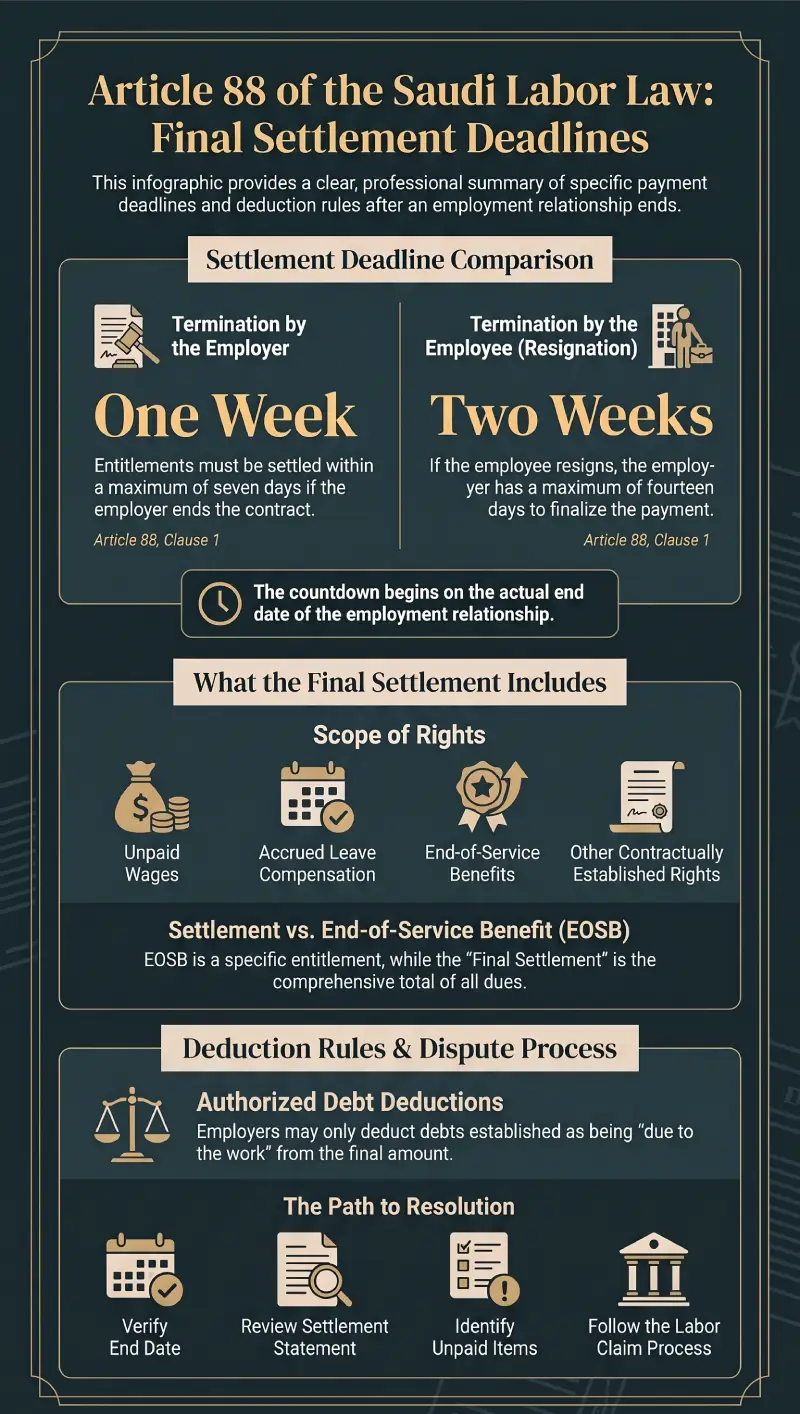
As a general rule, the employer must complete the final settlement within no more than one week from the end of the employment relationship. If the employee is the party who terminates the contract, the period may extend to no more than two weeks. Article 88 also allows the employer to deduct a debt owed by the employee arising from the employment relationship.
Quick Answer:
Under Article 88 of the Saudi Labor Law, an employer must settle an employee’s entitlements within no more than one week after the employment relationship ends. If the employee terminates the contract, the employee’s entitlements must be settled within no more than two weeks. A debt owed to the employer because of the employment relationship may also be deducted from the employee’s dues.
What Does Article 88 of the Saudi Labor Law Provide?
Article 88 governs the financial stage that follows the end of employment. It does not independently determine how every individual entitlement should be calculated. Instead, it sets the deadline for the final settlement, explains the rule when the employee is the party ending the contract, and allows certain work-related debts owed to the employer to be deducted.
According to the official text of Article 88 of the Saudi Labor Law, the employer must pay the employee’s wages and settle all entitlements within no more than one week from the end of the employment relationship. If the employee terminates the contract, the deadline extends to no more than two weeks.
This differs from Article 84 of the Saudi Labor Law, which sets the basis for calculating the end-of-service benefit. Article 84 helps determine the amount of the benefit, while Article 88 regulates when the employee’s financial entitlements must be settled.
What Is Meant by the Final Settlement of Employee Entitlements?
A final settlement means identifying all amounts that have become payable to the employee by the date the employment relationship ends, reviewing any deductions that may lawfully apply, and determining the net amount due.
The final settlement is therefore broader than the end-of-service benefit alone. Depending on the employee’s circumstances, it may include unpaid wages, accrued leave compensation, an end-of-service benefit where applicable, and other financial rights arising from the employment contract or the manner in which employment ended.
Article 88 does not determine the value of each of these items. Its primary function is to set the timeframe within which established entitlements must be settled.
When Must Employee Entitlements Be Paid Under Article 88?
The final settlement deadline first depends on who ended the employment relationship and the date on which the contract actually came to an end. The date of a resignation letter or termination notice is not necessarily decisive if employment continued beyond that date.
The basic rule can be summarized as follows:
| How the Employment Relationship Ends | Final Settlement Deadline |
|---|---|
| Employment ends without the employee being the party who terminated the contract | No more than one week |
| The employee terminates the contract | No more than two weeks |
This distinction is important when determining the deadline for payment of end-of-service entitlements, because the same settlement period does not apply to every form of employment termination.
When Does the Final Settlement Period Start?
Article 88 links the deadline to the date on which the employment relationship actually ends. The first step is therefore to identify the effective end date of the contract rather than merely the date on which termination procedures began.
For example, if a termination notice is issued but the employee continues working until a later date, the later date is relevant for calculating the settlement period. The same principle applies to resignation where the employment contract remains in force after the resignation request is submitted.
Keeping evidence of the actual termination date can be important if a dispute later arises over whether the employer complied with the deadline under Article 88.
When Are Employee Entitlements Paid After Resignation?
If the employment contract ends because the employee resigns, the final settlement after resignation must be completed within no more than two weeks from the date the employment relationship actually ends.
This does not mean that the two-week period automatically begins on the date the resignation request is submitted. The relevant date is the effective termination date after applying the rules governing resignation and the continuation of the employment relationship.
Where employment ends through resignation, the amount of the end-of-service benefit depends on the employee’s length of service and the applicable entitlement rules under Article 85 of the Saudi Labor Law, while Article 88 determines the deadline within which the final settlement must be completed.
The amount an employee is entitled to and the deadline for paying that amount are therefore two separate legal issues.
What Happens After Dismissal or Expiry of a Fixed-Term Contract?
If the employer terminates the employment relationship, the general rule is that the employee’s established entitlements must be settled within no more than one week from the end of the contract.
Article 88 does not, however, determine whether an employee is entitled to an end-of-service benefit or compensation in every dismissal case. The financial outcome depends on the reason for termination and the application of the relevant provisions of the Saudi Labor Law.
The same principle applies to fixed-term contracts. If a fixed-term contract expires and is not renewed, the employee’s financial rights must first be identified before the Article 88 settlement deadline is applied.
The reason employment ended should therefore be distinguished from the deadline for paying established entitlements. The first affects what the employee may be entitled to, while Article 88 primarily regulates when those established amounts must be settled.
What May Be Included in an Employee’s Final Settlement?
An employee’s entitlements after termination vary depending on the length of service, salary, reason for termination, and rights that had accrued by the final day of employment.
Depending on the individual case, the final settlement may include:
- Wages due up to the end of employment.
- Compensation for accrued leave where payable.
- End-of-service benefits where the entitlement conditions are met.
- Allowances or other amounts whose entitlement conditions have been satisfied.
- Other financial rights established by the contract or the Saudi Labor Law.
- Deductions that may lawfully be made.
The fact that an amount appears in a final settlement statement does not necessarily mean that it has been calculated correctly. The figures should be compared with the employment contract, salary, length of service, and supporting records before the settlement is accepted.
What Is the Difference Between a Final Settlement and an End-of-Service Benefit?
An end-of-service benefit may form one part of the final settlement, but it does not represent all amounts that may be due to the employee.
The final settlement brings together the employee’s established financial rights and any lawful deductions to determine the final amount payable. The end-of-service benefit, by contrast, is a separate financial entitlement governed by specific rules concerning calculation and eligibility.
It is therefore possible for the end-of-service benefit itself to be calculated correctly while a separate dispute remains over unpaid wages, accrued leave, or a deduction included in the final settlement.
When May an Employer Deduct Amounts From an Employee’s Entitlements?
Article 88 of the Saudi Labor Law permits an employer to deduct a debt owed by the employee arising from the employment relationship. This does not mean that every financial claim made by an employer automatically justifies a deduction.
Where a deduction appears in the final settlement, three matters should be reviewed:
- The reason for the debt or amount being deducted.
- The document or event establishing the alleged debt.
- The legal basis governing that type of deduction.
This helps distinguish between an established employment-related debt and a financial claim that remains disputed between the employer and employee.
What About an Employee Advance or Company Property?
A dispute may arise where an employee has an unpaid advance or where the employer alleges that company property entrusted to the employee has been lost or damaged. The description of an amount as an “advance” or “company property” does not by itself determine the legal outcome in every case.
For an advance, the remaining amount and evidence of the obligation should be identified. In cases involving company property, the disputed item, the reason for its loss or damage, and the employee’s responsibility must be considered.
A deduction from the final settlement therefore requires a clear and verifiable basis. The existence of company property or a financial claim should not automatically be treated as a reason to withhold all of the employee’s entitlements.
What Should You Do If Your Employer Does Not Pay Your Entitlements?
If the final settlement deadline has passed and your entitlements remain unpaid, begin by organizing the claim around clear amounts and documents rather than relying on a general estimate.
Identify:
- The effective date on which the employment relationship ended.
- Which party terminated the contract.
- The amounts you believe are due.
- Any amounts already paid.
- Any deductions shown in the final settlement statement.
Keep copies of the employment contract, resignation letter or termination notice, wage records, bank transfers, the final settlement statement, and correspondence relating to the disputed amount.
If the dispute remains unresolved, a claim may be initiated through the amicable settlement of labor disputes, which is the initial stage for attempting to resolve a labor dispute between an employer and employee before the matter proceeds to the labor court if settlement cannot be reached.
Where the dispute concerns the calculation of entitlements, deductions, or delayed payment, reviewing the file with a labor lawyer in Jeddah can help identify the main issue, the relevant documents, and the appropriate legal step.
Common Mistakes When Applying Article 88
Many problems arise when the final settlement is treated as a single accounting exercise, even though the correct outcome requires distinguishing between the reason for termination, the employee’s established entitlements, and the deadline for payment.
Common mistakes include:
- Calculating the settlement deadline from the date a resignation was submitted rather than the effective termination date.
- Assuming that the two-week deadline applies to every termination scenario.
- Treating the end-of-service benefit as the entire final settlement.
- Accepting a deduction without reviewing its basis or supporting documents.
- Failing to check accrued leave or unpaid wages.
- Signing a final settlement before reviewing the amount in detail.
- Failing to retain evidence of the termination date and amounts already paid.
Avoiding these mistakes helps employees define their claims more accurately and allows employers to prepare clearer final settlements that reduce disputes over timing and amounts.
Frequently Asked Questions About Article 88 of the Saudi Labor Law
What is Article 88 of the Saudi Labor Law?
It regulates when an employer must pay wages and settle an employee’s financial entitlements after the employment relationship ends.
When are employee entitlements paid after resignation?
If the employee ends the contract by resignation, the final settlement must be completed within no more than two weeks from the effective end of employment.
What is the difference between Article 84 and Article 88?
Article 84 governs the calculation of the end-of-service benefit, while Article 88 governs when wages and final entitlements must be settled.
Can an employer deduct amounts from an employee’s final settlement?
Article 88 allows deduction of a debt owed to the employer because of the employment relationship, subject to the applicable legal rules.
What should I do if the settlement deadline passes without payment?
Confirm the employment end date, calculate the unpaid amount, gather supporting documents, and use the amicable settlement process if the dispute remains unresolved.
Article 88 of the Saudi Labor Law: When Are Dues Paid? The answer begins by identifying who ended the employment relationship and the date on which the employment contract actually ended. As a general rule, entitlements must be settled within no more than one week, while the period may extend to no more than two weeks if the employee is the party who terminated the contract.
The payment deadline alone does not determine the final amount due. Salary, length of service, accrued leave, end-of-service benefits, the reason for termination, and the basis of any deduction may all affect the employee’s final settlement.
If there is a difference between the final settlement statement and the amount you believe is due, or if the payment deadline has passed without settlement, review the contract, dates, figures, and supporting documents before signing a final settlement or filing a claim. The team at our law firm in Jeddah can review the employment file, identify the source of the dispute, and clarify the appropriate legal steps based on the circumstances.