
Maintenance after divorce in Saudi Arabia is not simply a question of how much money must be paid. It concerns the existence of a legal right, its scope, who is entitled to receive it, and the correct way to claim or enforce it when a dispute arises.
In many cases, the difficulty does not begin with determining whether maintenance is due. The real questions are who is entitled to it, what expenses it covers, how the amount is assessed, when a new claim should be filed, and when the matter should instead move directly to enforcement because payment has stopped.
This guide goes beyond spousal or child maintenance alone. It also addresses housing, education, medical expenses, past maintenance, enforcement, the Maintenance Fund, and the relationship between maintenance and custody. Understanding these distinctions from the outset helps separate the underlying right from the procedure used to claim or enforce it.
The issue becomes particularly important when maintenance overlaps with custody, housing, or non-payment. In such cases, the question is not merely whether maintenance exists, but what type of maintenance is being sought. Is the claim for spousal maintenance or child maintenance? Is a new case required, or does an existing judgment need to be enforced? And what documents should be prepared from the beginning?
Maintenance After Divorce in Saudi Arabia: What You Need to Know
Maintenance after divorce in Saudi Arabia is a financial obligation connected to the rights of those who are legally entitled to support following separation. This may include a former wife, depending on her legal position, as well as children and their essential needs.
Maintenance generally covers food, clothing, housing, and other basic necessities. Its amount is assessed according to the circumstances of the person entitled to maintenance and the financial means of the person responsible for paying it. The amount may also be increased or reduced when circumstances materially change.
As a general rule, ongoing maintenance is linked to the date on which the claim is filed.
Legal Framework and Entitlement After Divorce
Saudi maintenance law is based on a clear principle: maintenance is not an arbitrary amount. It is a legal right linked to need, responsibility, and financial capacity.
For that reason, maintenance after divorce should not be approached in exactly the same way in every case. Entitlement may relate to the former wife, to the children, or to both, while the method of receiving or calculating maintenance can vary according to the facts.
In practice, post-divorce maintenance generally appears through two main tracks. The first concerns a former wife’s entitlement within the circumstances recognized by Saudi law. The second concerns child maintenance where the children do not have sufficient funds of their own and remain in need of support.
This distinction can affect how the claim is drafted, which documents are required, and which expenses should be included.
It is equally important to distinguish between the person who legally owns the right to maintenance and the person who receives the payment in practice. The maintenance may legally belong to the children while being received and managed by the custodial parent responsible for their daily expenses.
This does not change the identity of the person entitled to the maintenance. It only explains how the maintenance is practically administered. Correctly identifying the claimant’s legal capacity from the beginning helps prevent confusion between spousal maintenance and child maintenance.
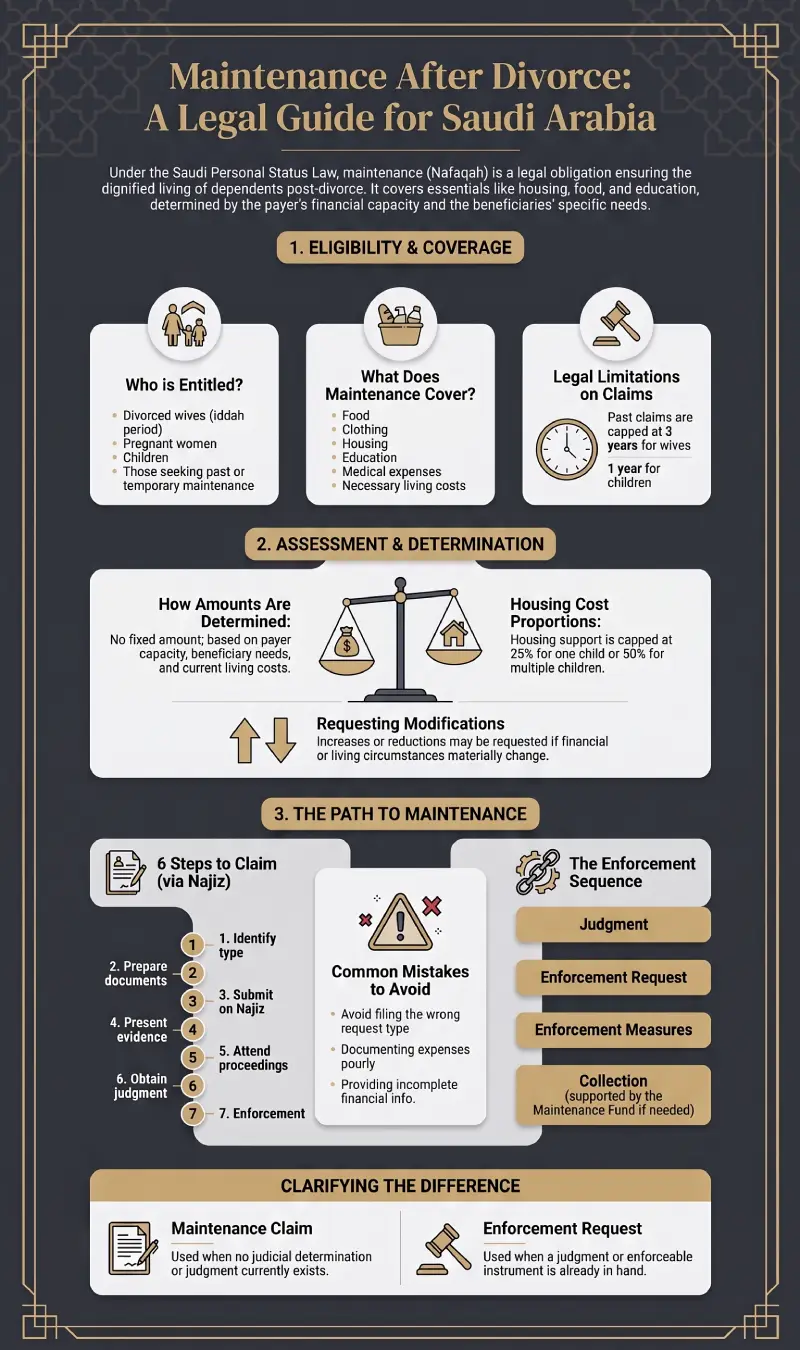
A Former Wife’s Entitlement After Divorce
A former wife’s entitlement to maintenance after divorce cannot be reduced to one rule applicable to every case.
It may vary according to the type of divorce, the woman’s legal status, and the facts established in the case. It is therefore more accurate to say that entitlement depends on the circumstances recognized by law and established before the court rather than to state categorically that every divorced woman is, or is not, entitled to maintenance.
Where the claim concerns the former wife, it is important to identify the type of divorce, any facts that may affect entitlement, and whether the claim concerns basic maintenance, housing, or particular expenses.
Maintenance owed to a wife while the marriage remains legally in force should also be distinguished from maintenance after divorce, since each arises within a different legal framework even though both are based on the broader concept of financial support.
A former wife’s entitlement can vary depending on the nature and legal consequences of the separation. Understanding the type of divorce and its legal effects can therefore help define the claim more accurately from the outset.
Child Maintenance and Payment Through the Custodial Parent
Under child maintenance under Saudi law, the practical focus is on the children’s needs and interests rather than the personal dispute between their parents.
Where children do not have sufficient funds of their own, the question becomes who is legally responsible for their maintenance and what essential needs should be covered. Depending on the case, those needs may include housing, education, and medical treatment.
In practice, maintenance may be received through the custodial parent because that parent is responsible for the children’s daily affairs. The legal right to maintenance should therefore not be confused with the practical receipt of the money used to meet the children’s expenses.
This distinction becomes particularly important when the issue of waiving maintenance in exchange for custody is raised. Rights belonging to children should not be treated merely as personal financial rights that may be disposed of without considering the child’s interests and the identity of the actual right-holder.
When child maintenance overlaps with custody, housing, or visitation arrangements, reviewing personal status cases involving maintenance and custody can provide a broader understanding of how the issues interact.
The following table highlights key differences between spousal and child maintenance after divorce:
| Point of Comparison | Spousal Maintenance After Divorce | Child Maintenance After Divorce |
|---|---|---|
| Basis of entitlement | Legal status following divorce | Parent-child relationship and need for support |
| Typical dispute | Entitlement itself or its duration | Amount and expenses covered |
| Payment | Usually paid directly to the entitled person | Commonly received through the custodial parent |
| Scope of claim | Varies according to the circumstances | May expand according to the children’s needs |
What Does Maintenance Cover?
Spousal maintenance after divorce in Saudi Arabia and child maintenance may cover considerably more than a single monthly payment.
Depending on the circumstances, maintenance may extend to housing, education, and medical expenses. The Saudi Personal Status Law connects the basic concept of maintenance with food, clothing, accommodation, and essential needs.
A properly formulated claim should therefore not simply state that the claimant wants “full maintenance.” Instead, it should identify the specific expenses in dispute.
The basic maintenance obligation may not itself be contested, while disagreement may continue over housing, school fees, treatment costs, or recurring expenses. The more accurately these elements are identified, the clearer the claim becomes before the court.
In practice, maintenance may include ordinary daily necessities as well as additional expenses depending on the actual needs and established circumstances. Not every expense should automatically be assumed to fall within maintenance, but an important expense should not be excluded merely because it was not initially considered.
The claim should be connected to the actual need, the available evidence, and the type of expense that can properly form part of maintenance in the particular case.
Housing, Education, and Medical Expenses
Housing is a fundamental component of many maintenance cases, but the obligation may be fulfilled in different ways.
The dispute may concern whether suitable accommodation must be provided, whether a monetary housing allowance is appropriate, or whether existing accommodation is adequate. Housing therefore forms part of the broader maintenance framework, although the way it is addressed depends on the facts.
Education expenses may also fall within maintenance depending on the nature of the children’s schooling, their established circumstances, and the financial resources available.
Medical expenses are similarly important, particularly where there is an ongoing medical condition or recurring treatment costs. Where the real dispute concerns education or medical treatment, the claim should clearly identify those expenses rather than relying only on a general request for maintenance.
| Expense | Generally Within Maintenance? | Can Assessment Vary by Case? |
|---|---|---|
| Food and clothing | Yes | Yes |
| Housing | Yes | Significantly |
| Education | May be included | Yes |
| Medical treatment | May be included | Yes |
| Recurring expenses | Depends on the need | Yes |
How Is Maintenance Calculated in Saudi Arabia?
If you are asking how maintenance after divorce in Saudi Arabia is calculated, the starting point is that there is no single amount that applies to every case.
The assessment is connected to the circumstances and needs of the person entitled to maintenance and the financial means of the person responsible for paying it. Maintenance may also be adjusted if those circumstances later change.
For this reason, expectations should not be based on a commonly quoted figure or a fixed percentage of salary. Each case is assessed according to its own financial and personal circumstances.
Factors that may affect the assessment include the needs of the recipient, the number and ages of the children, the type of maintenance being claimed, any special medical or educational requirements, and the financial position and relevant obligations of the person responsible for payment.
Income should therefore not be considered in isolation from the surrounding circumstances. Likewise, need must be considered within the context of actual financial capacity.
Maintenance after divorce is also not necessarily fixed permanently.
If the circumstances on which a previous assessment was based materially change, a request may be made to increase or decrease the maintenance. A previous judgment may therefore remain relevant to a later reassessment rather than operating as an unchangeable figure regardless of subsequent circumstances.
Financial Means and the Recipient’s Needs
Income is important when maintenance is assessed, but it is not the only consideration.
The court considers the financial capacity of the person responsible for maintenance as part of a broader factual picture. It also considers the recipients’ needs and whether fixed expenses or particular circumstances require a different assessment.
For that reason, presenting a fixed percentage of salary as a universal rule does not accurately reflect how maintenance is assessed.
Similarly, the absence of declared employment does not necessarily end the inquiry. The actual financial position, capacity to earn, and evidence available in the case may remain relevant.
If the other party claims an inability to pay or a reduction in income, the case should be prepared around available records, documents, and provable facts rather than assumptions or informal estimates.
Filing a Maintenance Claim in Saudi Arabia
If maintenance after divorce has not been agreed or the amounts due have not reached the persons entitled to them, the usual legal route may involve filing a maintenance claim in Saudi Arabia.
The correct starting point is not a general demand for maintenance. The nature of the claim should first be identified.
Is the claim for spousal maintenance, child maintenance, modification of existing maintenance, housing expenses, or medical expenses?
This distinction directly affects the clarity and structure of the claim.
The Statement of Claim service is available electronically through Najiz and provides the official route for filing a maintenance claim before the court with jurisdiction.
Preparing the file before using the platform can reduce the need for later amendments or unnecessary delays. The clearer the facts, claims, and supporting documents are, the more coherent the case will be from the beginning.
As for how long a maintenance case after divorce takes, it is not advisable to rely on a fixed period commonly quoted online.
The duration may depend on the completeness of the documents, service of process, clarity of the claims, and the nature of the dispute. A realistic assessment therefore requires reviewing the actual procedural status of the case rather than relying solely on the type of claim.
If maintenance has not been agreed or paid and the underlying facts are complex, consulting a maintenance lawyer in Jeddah may help clarify the appropriate legal step before the claim is filed.
Documents and Filing the Statement of Claim
The documents required vary according to the facts, but certain categories commonly arise.
These may include documents establishing the family relationship, evidence of the divorce where relevant, documents concerning the children, and evidence supporting the claimant’s needs or the other party’s financial capacity.
Where the claim concerns housing, medical treatment, or education, documents supporting those expenses should preferably be prepared from the outset.
Procedurally, the process generally begins by accessing the Statement of Claim service, selecting the appropriate classification, entering the relevant information, attaching the necessary documents, and monitoring subsequent notices and procedures relating to the case.
The electronic platform is important, but it cannot correct an incorrectly characterized claim or unclear requests. The statement of claim should therefore be precise and based on properly organized facts.
Enforcement, Salary Deductions, and the Maintenance Fund
Once a judgment or another appropriate enforceable instrument exists and the maintenance remains unpaid, the matter moves from establishing the right to enforcing it.
At that stage, the issue is no longer simply whether maintenance is due. The question becomes how the person entitled to maintenance can actually receive the amount that has already been established.
This transition is important because some cases remain unnecessarily delayed when they continue to be approached as substantive disputes even though the appropriate next step is enforcement.
Najiz officially provides a Request for Enforcement service. There is also a separate service for requesting a decision to deduct future maintenance from a monthly salary.
Where this mechanism is suitable, the application and supporting documents should be prepared accordingly.
The Maintenance Fund may also provide an important route where maintenance is not reaching those entitled to it despite an ongoing need for financial support. Government services connected to the Fund include application, payment, updating information, and extension services subject to the applicable requirements.
In practice, where a judgment already exists, the first question should be whether the case requires general enforcement, a salary deduction request, or consideration of the Maintenance Fund because maintenance is still not reaching its recipients.
Distinguishing between these mechanisms prevents unnecessary movement between unrelated procedures and helps identify the next appropriate step.
The Difference Between a Judgment and Enforcement
A judgment determines or confirms the right to maintenance and may establish its amount.
Enforcement concerns the actual collection of that right after it has been established.
If there is no judgment yet, the matter may still be at the claim stage. If a judgment exists but has not been complied with, the matter has generally moved into the enforcement stage.
This distinction helps define the procedural route and prevents confusion between obtaining a maintenance decision and enforcing one.
Salary deduction is also not merely a theoretical possibility. An official service exists for requesting the deduction of future maintenance from a monthly salary.
Where the circumstances allow the use of this mechanism, the appropriate enforcement procedure may be more relevant than reopening the underlying question of entitlement.
Past Maintenance, Modification, and Termination
Timing is particularly important in maintenance cases.
There may be future or ongoing maintenance that is being claimed, unpaid maintenance that has already been established, and past maintenance relating to a period before the claim was filed.
Saudi law connects ongoing maintenance to the date on which the claim is filed. The time period covered by the request should therefore be defined carefully.
Maintenance is also not necessarily fixed indefinitely.
Where circumstances change, it may be possible to seek an increase or reduction based on the factors on which the previous assessment was made.
If the case concerns modifying maintenance after divorce, the starting point should be identifying and proving what has changed.
Have the children’s needs increased? Has the payer’s financial position changed? Have new medical or educational expenses arisen?
These changes provide the practical basis for requesting a reassessment.
The circumstances in which spousal maintenance may cease should not be presented as a rigid list that applies identically in every case.
The more accurate approach is to distinguish between the type of maintenance, the person entitled to it, the applicable legal status, and the specific facts.
Child maintenance differs from spousal maintenance in this respect because it relates to the children’s rights and continuing needs for as long as the relevant legal basis for support remains.
| Type | Practical Meaning | Why It Matters |
|---|---|---|
| Future maintenance | Amount sought for the period following the claim | Determines ongoing payments |
| Unpaid maintenance | Amount already established but not paid | Usually linked to enforcement and collection |
| Past maintenance | Amount claimed for an earlier period | Requires precise identification of the relevant period |
| Modified maintenance | A request to change a previous amount | Depends on a change in circumstances |
Modification and Termination in Practice
If you are seeking to modify maintenance after divorce, begin by establishing the change in circumstances rather than simply requesting a higher or lower amount.
If the issue concerns termination of maintenance, it should be analyzed according to the type of maintenance, the person holding the right, and the facts before the court rather than according to a broad social assumption.
The effect of events such as the mother’s remarriage, children beginning employment, or a change in custody should not be reduced to one universal rule. Their legal consequences depend on the particular right being considered and the circumstances of the case.
Custody, Common Mistakes, and the Next Step
Custody and maintenance are legally distinct, although they frequently overlap in practice.
Custody concerns the child’s daily care and the person responsible for providing it, while maintenance concerns the financial obligation and the expenses it covers.
A separate judicial service exists for obtaining a custody decision, illustrating that custody is an independent legal issue even though it may intersect with maintenance in the facts and supporting documents.
This is particularly important where a proposal is made to waive maintenance in exchange for custody.
If the dispute arises from Khula rather than divorce alone, reviewing a wife’s rights after Khula in Saudi Arabia can help distinguish financial rights from rights connected with custody.
Common mistakes that may weaken a maintenance case include making vague or undefined claims, confusing spousal maintenance with child maintenance, failing to organize events chronologically, providing insufficient evidence of need or income, confusing the judgment stage with the enforcement stage, and delaying enforcement after the right has already been established.
Where the facts overlap between maintenance, custody, housing, enforcement, or the Maintenance Fund, early legal assessment can help identify the correct procedural route and the appropriate next step.
If your circumstances involve both maintenance and custody, or you already have a judgment that has not been enforced, begin by collecting the essential documents and then contact us now to determine whether the next step should be a new claim, enforcement proceedings, or consideration of the Maintenance Fund services.
This content has been legally reviewed to clarify the main rules governing maintenance after divorce in Saudi Arabia, including eligibility, assessment factors, maintenance claims, unpaid amounts, and enforcement procedures.
BMS Legal
Frequently Asked Questions About Maintenance After Divorce
1. Is a divorced wife entitled to maintenance in Saudi Arabia?
A divorced wife may be entitled to maintenance in specific cases, depending on the type of divorce, her legal status, and the circumstances of the case.
2. How is maintenance after divorce calculated?
There is no single fixed amount. The court considers the payer’s financial capacity, the claimant’s needs, living costs, and supporting evidence.
3. Can a divorced wife claim unpaid maintenance?
Yes, unpaid maintenance may be claimed when a legal entitlement exists and the amounts can be supported by the relevant facts and evidence.
4. Does child maintenance continue after divorce?
Yes. Divorce does not generally end a parent’s financial obligations toward children. The amount depends on their needs and the payer’s financial circumstances.
5. Can the amount of maintenance be increased or reduced?
Yes. A request to increase or reduce maintenance may be made when there is a material change in financial circumstances, needs, or relevant expenses.
A maintenance after divorce in Saudi Arabia case generally moves through four main stages: entitlement, assessment, the claim itself, and enforcement.
Organizing these stages from the beginning makes it easier to determine whether you need to file a new maintenance claim, enforce an existing judgment, request a modification, or address an issue connected with housing, medical expenses, or custody.
Start by identifying who holds the legal right. Then determine what expenses the maintenance should cover, organize the supporting documents, and select the appropriate legal route.
Where the circumstances overlap between maintenance, custody, enforcement, or the Maintenance Fund, early legal assessment can reduce procedural confusion and provide a clearer understanding of what should be done next.
Official References: