
How to file a maintenance claim in Saudi Arabia is not simply a matter of completing an online form. The process begins with identifying the correct legal route from the outset. Many claims encounter difficulties not because the underlying right is weak, but because the wrong procedure is chosen, the relief requested is unclear, or the supporting documents do not properly establish the claim.
For this reason, understanding how to file a maintenance case involves more than knowing which service to select on Najiz. You also need to identify the type of maintenance being claimed, the competent authority, what should be included in the statement of claim, and whether the matter requires a new lawsuit or enforcement of an existing judgment.
This guide explains the process in practical terms: when a maintenance claim is the appropriate route, how to initiate the proceedings through Najiz, what the claim should contain, which documents may support it, and what happens if the dispute proceeds to hearings or enforcement.
The aim is to help you identify the next procedural step without confusing the original claim with enforcement or mixing spousal maintenance with child maintenance. For a broader understanding of the subject, you may also review maintenance after divorce under Saudi law before proceeding with the detailed filing steps.
How to File a Maintenance Claim: Where to Start
The practical starting point for a maintenance claim is usually the Najiz platform through the Statement of Claim service.
Before filing, however, you should identify the nature of the claim, prepare the essential supporting documents, and review the information and attachments before the case is referred to the competent judicial authority.
If a judgment or judicial order is later issued, the matter may then move to enforcement or to a request for maintenance deductions. The Maintenance Fund may also become relevant at a later stage, depending on the circumstances of the case and the applicable official requirements.
It is important not to confuse three separate stages. The first is filing the claim and establishing the right. The second is the court’s consideration of the case. The third begins after a judgment has been issued and involves enforcement.
You should also determine whether you are seeking ongoing maintenance, amounts relating to an earlier period, or urgent temporary maintenance. Another important question is whether the dispute concerns the existence or amount of the maintenance right itself, or whether maintenance has already been awarded but remains unpaid.
The clearer these issues are before filing, the easier it becomes to understand how to file a maintenance claim in Saudi Arabia correctly and keep the proceedings properly structured from the beginning.
Early assessment can save time and prevent common procedural errors caused by incorrectly identifying the nature of the case.
When Is Filing a Maintenance Claim the Correct Route?
A maintenance claim may be appropriate where there is a failure or refusal to provide maintenance that is legally due. In such circumstances, the claimant may need to submit a properly structured claim before the competent authority, identifying her legal capacity, the nature of the right, and the relief requested.
Maintenance is not a single, identical claim in every family situation. The applicable approach may vary depending on who is claiming maintenance, the stage of the marital or family relationship, the nature of the entitlement, and whether the dispute concerns the original right or the enforcement of an existing judgment.
Spousal Maintenance
Some claimants search for a spousal maintenance claim form, a sample spousal maintenance lawsuit, or a statement of claim for a wife’s maintenance.
In practice, these terms usually refer to a claim seeking maintenance allegedly due to the wife based on the particular facts, documents, and legal status of the parties.
If your concern is the amount that may be awarded and the circumstances that can affect entitlement, it may also be useful to review monthly spousal maintenance in Saudi Arabia.
The claim should clearly state the relevant facts and the relief being sought. Lengthy emotional narratives or broad statements generally do not make the legal request clearer. The court needs specific facts, organized requests, and supporting material relevant to the issue before it.
Child Maintenance
Where the claim concerns maintenance owed to children, the statement of claim should accurately identify the claimant’s legal capacity, the relationship between the parties, the failure to provide maintenance, and the specific types of financial support being requested.
Claims involving children should also distinguish their maintenance rights from unrelated financial or family disputes.
A focused claim is easier to understand and review and is less likely to require clarification or additional information later in the proceedings.
Maintenance Before or After Divorce
Another common question alongside how to file a maintenance claim in Saudi Arabia is whether maintenance can be claimed before divorce and whether the procedure changes after divorce.
In practical terms, divorce is not the only factor that determines the correct procedure. The nature of the right being claimed, the claimant’s legal status, the procedural stage, and the available supporting documents are also important.
For a broader understanding of related post-separation rights, see wife’s rights after Khula under Saudi law.
Accordingly, it is not enough simply to state that you are divorced or that the marriage is still ongoing. The claim should identify precisely what is being requested, the basis for the request, and the evidence supporting it.
This is why assessing the case before filing is important. Some matters require a new claim. Others may only require better drafting or additional documentation. In other cases, no new lawsuit may be necessary because the right has already been established by an existing judgment.
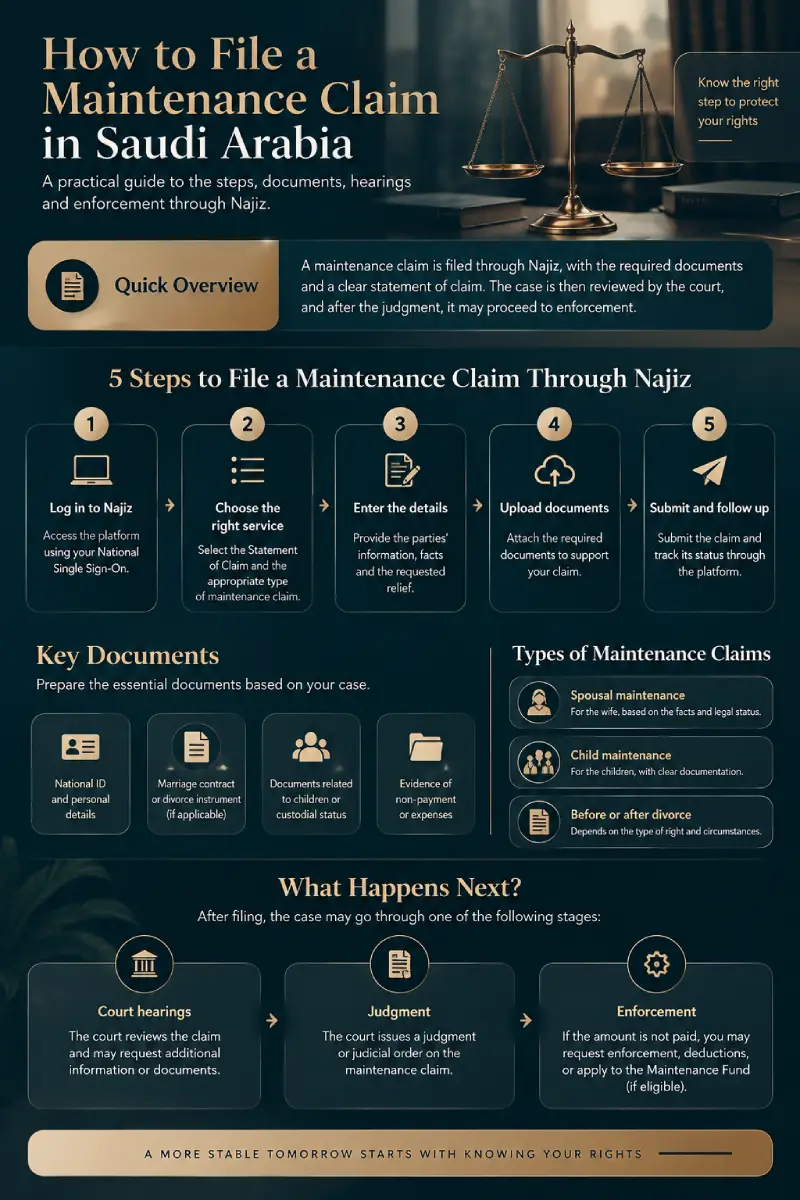
Filing Through Najiz: Step by Step
Najiz allows maintenance claims to be initiated electronically, but the quality of the filing still depends on selecting the correct service and preparing the claim accurately.
- Access the relevant service: Sign in to Najiz through the National Single Sign-On service and navigate to the judicial services section to access the Statement of Claim service. Make sure you are initiating a claim rather than selecting an enforcement service or another procedure that does not correspond to the current stage of the matter.
- Select the correct type of claim: Identify the relevant classification and the nature of the maintenance request. The filing should clarify whether the claim concerns a wife, children, temporary maintenance, or an earlier unpaid period. Incorrect classification can complicate the case and may result in delays.
- Enter the information accurately: Provide the parties’ details, legal capacity, contact information, relevant facts, and the relief requested. The requested orders should be stated clearly. Vague drafting can lead to requests for clarification or completion.
- Upload the supporting documents: Attachments are not merely administrative formalities. They may help establish identity, the family relationship, legal capacity, and the facts supporting the maintenance claim. The documents should therefore be selected according to the circumstances of the particular case.
- Submit and monitor the application: After reviewing the information and attachments, submit the claim and monitor its status through the platform. Court notifications and requests for additional information should be followed carefully, as failure to respond may delay the proceedings.
If the case involves an actual refusal to provide maintenance and you need to review the appropriate type of claim before filing, consulting a maintenance lawyer in Jeddah may help clarify the drafting, procedural route, and supporting documentation before the claim is submitted.
Drafting the Statement of Claim
A spousal maintenance claim template should not be treated as a fixed text that can be copied into every case.
It is better understood as a structure that must be adapted to the specific facts.
What should be included when preparing a maintenance statement of claim?
| Section | What to Include | Important Note |
|---|---|---|
| Parties’ details | Name, identification details, legal capacity, and contact information | Details should correspond with the supporting documents |
| Facts | Relationship between the parties and the reason for the claim | Keep the description clear and relevant |
| Relief sought | The specific orders requested from the court | Specific requests are preferable to broad wording |
| Grounds and attachments | Documents and facts supporting the claim | Present them briefly and in an organized manner |
A simplified maintenance statement of claim may be structured as follows:
Claimant: [Full Name]
Defendant: [Full Name]
Capacity: Acting on her own behalf / in her capacity as custodian of the children, as applicable.
Subject of the Claim:
A claim seeking maintenance on the basis that the defendant has failed to provide financial support, with a request that the court award the maintenance due according to the facts and supporting documents.
Facts:
The claimant should explain the nature of the relationship, whether there are children, the relevant period or circumstances of non-payment, and the impact on essential living needs.
The facts should be written in an organized and direct manner, avoiding repetition, unnecessary detail, or general statements that do not support the claim.
Relief Requested:
- An order requiring the defendant to pay the maintenance due according to the nature of the claim.
- An award of ongoing maintenance from the applicable date of entitlement.
- Inclusion of maintenance relating to an earlier period where the circumstances and applicable rules allow such a claim.
- Any other related relief supported by the facts and documents submitted in the case.
Grounds and Supporting Documents:
- Evidence of the relevant family relationship.
- Evidence establishing the claimant’s legal capacity where required.
- Documents supporting the maintenance request.
- Evidence relevant to non-payment, expenses, or financial need.
Documents, Hearings, and Special Situations
Knowing which documents to prepare is just as important as knowing how to file a maintenance claim in Saudi Arabia.
Some cases are delayed not because the underlying claim lacks merit, but because essential documents are missing, poorly organized, or not clearly connected to the relief requested.
Common supporting documents may include:
| Document Type | Examples | Why It Matters |
|---|---|---|
| Identification and basic information | National ID, family record | Establishes identity and basic personal information |
| Relationship documents | Marriage contract or divorce instrument, depending on the case | Helps establish the nature of the legal relationship |
| Evidence of legal capacity | Documents relating to children or custodial status where relevant | May be important in child maintenance claims |
| Supporting evidence | Documents showing non-payment, need, or relevant expenses | Helps explain and support the financial claim |
Once the claim has been filed, the case may proceed to hearings. This often gives rise to practical questions such as what happens at the first hearing and what happens if a party does not attend a maintenance hearing.
The consequences of non-attendance cannot be reduced to one fixed rule applicable to every case.
They may depend on the procedural stage, whether valid notice has been served, the circumstances of the case, and whether additional information or evidence is required.
A dispute may also move into another procedural stage if a judgment is issued and one of the parties seeks to challenge it. This is where terms such as an objection to a maintenance judgment or an appellate memorandum in a maintenance case may become relevant.
Saudi Personal Status Law also addresses particular issues relating to maintenance, including certain circumstances involving temporary maintenance. It also contains rules relevant to some forms of a wife’s claim for maintenance relating to an earlier period.
For that reason, these issues should be assessed according to the particular facts rather than treated as identical in every case.
After Judgment: Enforcement, Deductions, and the Maintenance Fund
Once a judgment or judicial order has been issued, the central question changes.
The issue is no longer whether maintenance is legally due, but whether the awarded amount is actually paid when required.
Where there is a refusal to pay maintenance, the focus may shift from establishing the right to enforcing the judgment, arranging applicable deductions, and following the enforcement process.
These procedures are not interchangeable, and they do not necessarily begin in the same way or apply automatically to every case.
The Ministry of Justice provides a separate service for filing enforcement requests. There is also a service relating to deductions for future maintenance, while the Maintenance Fund operates under its own conditions and procedures.
It would therefore be inaccurate to present the Maintenance Fund as the automatic first step for every new maintenance claim.
Once a judgment has already been obtained, the question is no longer simply how to file a maintenance claim in Saudi Arabia. Instead, the relevant issue becomes which post-judgment procedure applies to the case.
Does the judgment need to be enforced directly? Is the case eligible for a maintenance deduction mechanism? Do the requirements of the Maintenance Fund apply to the beneficiary?
Where a case is already ongoing, reviewing the procedural stage before taking further action can help determine whether a new claim is necessary or whether an enforcement request is the correct next step.
Reviewing the statement of claim before filing can also reduce the risk of confusing the original maintenance proceedings with post-judgment enforcement.
This content has been prepared and legally reviewed to explain
how to file a maintenance claim in Saudi Arabia
and the main procedural stages through Najiz.
The appropriate procedure may vary depending on the claimant’s legal capacity,
whether the claim concerns spousal or child maintenance, whether current or
past maintenance is sought, the available supporting documents, and whether
a judgment or enforceable order already exists. The procedural stage should
therefore be reviewed before choosing between filing a new claim and starting
enforcement proceedings.
Frequently Asked Questions About Filing a Maintenance Claim
1. How do I file a maintenance claim in Saudi Arabia?
A maintenance claim is generally filed through Najiz using the Statement of Claim service after identifying the claim type and preparing the required documents.
2. What is the difference between filing a maintenance claim and enforcing a judgment?
Filing a claim seeks to establish the right to maintenance, while enforcement begins after a judgment or judicial order has been issued.
3. What is a maintenance statement of claim?
It is the document used to initiate the case and usually includes the parties’ details, relevant facts, requested relief, and supporting attachments.
4. Is there one standard spousal maintenance claim template for every case?
No. The basic elements are similar, but the wording should be adapted to the facts, documents, and type of maintenance being claimed.
Understanding how to file a maintenance claim in Saudi Arabia in 5 steps through Najiz is not merely about locating an online service or using a ready-made template. The process begins by identifying the correct type of claim before any electronic filing is made.
The practical approach is to establish the claimant’s legal capacity, identify the specific maintenance right involved, organize the supporting documents, and state the requested orders clearly.
When the claim is correctly classified and supported by properly arranged documents, the proceedings become easier to understand and there is less risk of delay, procedural confusion, or the need to change course later.
Official References: