
Child custody in Saudi Arabia is not decided simply by determining whether the father or mother has a stronger claim. Custody is determined according to the child’s best interests, the custodian’s eligibility, and the circumstances of the dispute. As a result, one case may require custody documentation through Najiz, while another may require a custody claim before the competent court.
The issue often becomes particularly important after divorce or a family dispute, when practical questions arise: Where will the child live? Who will oversee the child’s education and medical care? Does the other parent have visitation rights? When may custody be challenged or transferred?
The Saudi Personal Status Law regulates custody as a responsibility involving the care of a person who cannot independently care for themselves. Custody is not treated as leverage between parents. Rather, the legal framework is intended to protect the child and provide a stable environment.
This guide explains the main aspects of child custody in Saudi Arabia, including its meaning, eligibility requirements, order of custodians, custody age, loss of custody, custody claims, custody documentation, visitation, travel with the child, and enforcement of custody judgments.
Child Custody in Saudi Arabia: When Should You Document Custody?
Child custody in Saudi Arabia is a legal responsibility involving the care, protection, and essential interests of the child. Requesting custody alone is not enough. The proposed custodian must meet the applicable legal requirements, and the outcome must serve the child’s best interests.
A court may consider several interconnected factors, including the custodian’s ability to provide care, the child’s stability, housing conditions, education, medical treatment, and the child’s relationship with each parent. In practice, the factual circumstances of the child’s life may influence the outcome more than the theoretical order of custodians alone.
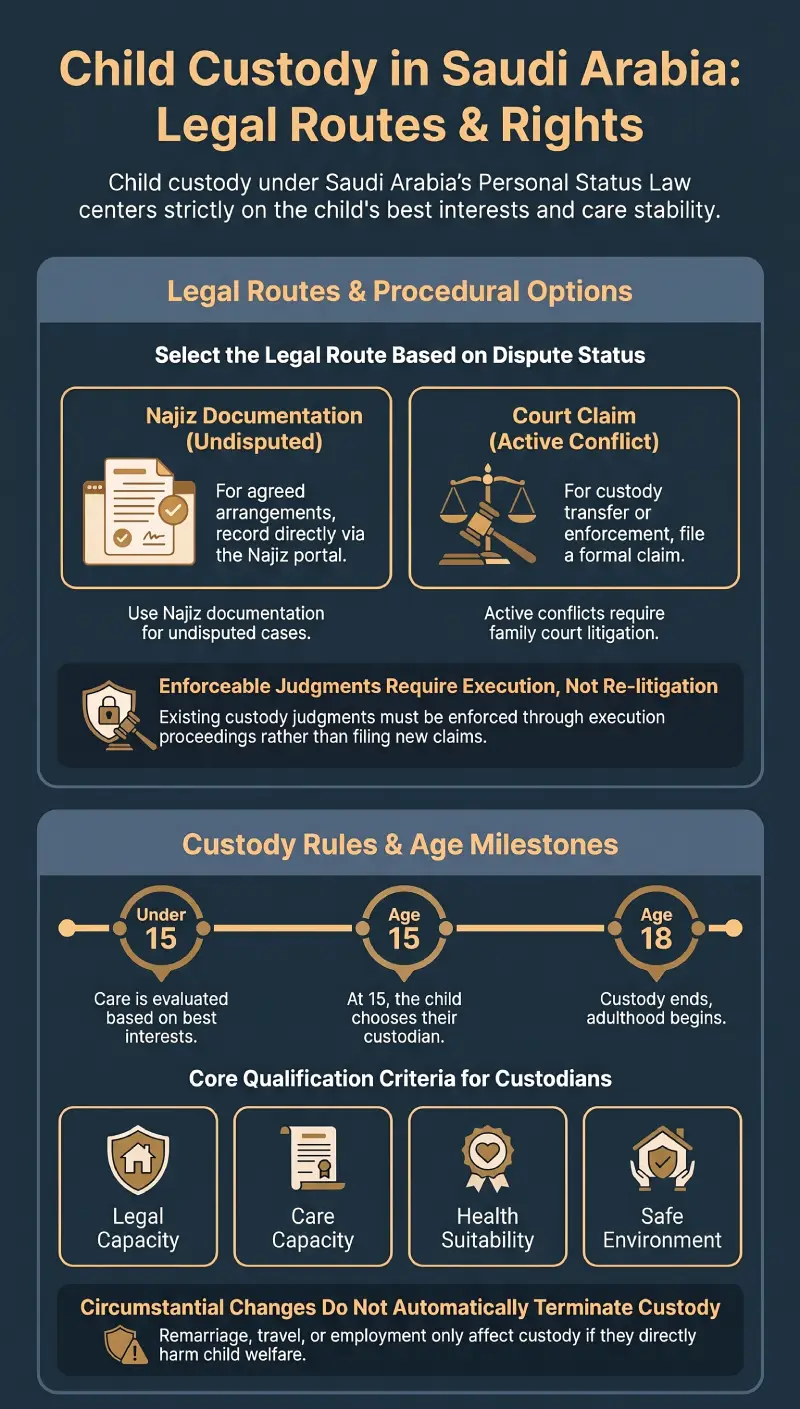
Where there is no custody dispute, the appropriate route may be custody documentation through Najiz. Where there is a dispute over entitlement to custody, a request to terminate or transfer custody, denial of visitation, or another contested issue, court proceedings or enforcement measures may be required.
Which route is more appropriate for your situation?
| Situation | Likely Route |
|---|---|
| There is no dispute over custody | Custody documentation through Najiz |
| The parents disagree over who should have custody | Custody claim |
| Circumstances changed after a judgment or agreement | Custody transfer claim |
| Harm or loss of an important custody condition is alleged | Request to terminate or transfer custody |
| An existing custody judgment has not been complied with | Enforcement of the custody judgment |
Before starting any procedure, identify the exact nature of your situation:
- Do you need to formally document an existing custody arrangement?
- Is there an actual dispute over custody?
- Do you already have a judgment that has not been enforced?
- Have the circumstances of the father, mother, or child changed?
- Is the actual issue visitation or travel rather than custody itself?
Making this distinction at the outset can prevent filing the wrong application through Najiz or before the court.
What Does Child Custody Mean in Saudi Arabia?
Child custody in Saudi Arabia refers to caring for a person who cannot independently care for themselves, protecting them from harm, and attending to their daily needs and interests. These responsibilities include education, healthcare, housing, supervision, and the ordinary care required in the child’s daily life.
Custody should not be understood as simply having the child reside with one parent. The custodian is responsible for the child’s day-to-day physical, psychological, educational, and general welfare.
Custody also differs from guardianship and visitation. Custody concerns daily care, while guardianship generally relates to broader decisions or legal representation in particular matters. Visitation is a separate right of the non-custodial parent, and granting custody to one parent does not automatically deprive the other parent of contact with the child.
These concepts should not be confused because each has a different legal effect. A mother may have custody while other matters remain connected to guardianship, maintenance, or visitation. Likewise, a father may retain visitation and other parental rights even if he is not the child’s day-to-day custodian.
| Point of Comparison | Custody | Guardianship | Visitation |
|---|---|---|---|
| Purpose | Daily care and protection of the child | Supervision or legal authority in specified matters | Maintaining the child’s relationship with the non-custodial parent |
| Scope | Housing, upbringing, education, healthcare | Legal or financial decisions depending on the circumstances | Visits, hosting, or accompanying the child |
| Main dispute | Who should care for the child? | Who has authority to make a particular decision? | When and how should visitation take place? |
Child Custody After Divorce in Saudi Arabia: Who Is Entitled to Custody?
Child custody after divorce in Saudi Arabia does not produce a single automatic outcome for every family. The law provides an order of priority for custody, but the court remains concerned with the child’s best interests where the circumstances indicate that another arrangement may be more appropriate.
In many cases, the mother has priority in the custody of children after divorce if the statutory conditions are satisfied. In practical terms, the mother is often the person most closely involved in daily care, particularly for younger children, unless there is a significant reason preventing custody from remaining with her.
This does not mean that a mother’s custody is guaranteed in every case. A father may seek custody where there is a substantial basis, such as the loss of an essential custody condition, serious neglect, or a material change in the child’s circumstances. The court will consider the evidence relating to the child’s best interests rather than the parent’s preference alone.
Likewise, transferring custody to the father is not necessarily automatic whenever a particular issue arises. The court considers the statutory order of custody together with the factual circumstances, the child’s living environment, and any relevant documents or evidence.
Where a dispute involves custody, visitation, and living arrangements, it may also be necessary to understand spousal and child maintenance after divorce in Saudi Arabia so that financial rights are not confused with the legal custody process.
When custody is combined with disputes involving visitation, travel with the child, or an existing judgment, reviewing the case with a family lawyer may help determine whether the appropriate route is a new claim or enforcement of an existing decision.
Child Custody Conditions in Saudi Arabia
Child custody conditions in Saudi Arabia are intended to ensure that the custodian is able to care for and protect the child. Being closely related to the child is therefore not sufficient on its own. The custodian must have the legal and practical capacity to meet the child’s needs.
General requirements include full legal capacity, the ability to raise, protect, and care for the child, and freedom from serious contagious diseases. These requirements are substantive because they directly affect the child’s safety and stability.
When assessing custody conditions, focus on the factors that actually affect the child’s interests:
- The custodian’s legal capacity.
- The ability to provide day-to-day care.
- Supervision of education and medical treatment.
- Suitable and stable housing.
- The absence of a medical condition or circumstance that harms the child.
- Avoiding unjustified interference with the child’s relationship with the other parent.
Conditions affecting a mother’s custody often become relevant where the other parent challenges the existing arrangement. An objection may relate to remarriage, travel, employment, or the ability to provide care. Merely stating one of these circumstances is generally not enough; its actual effect on the child should be demonstrated.
Conditions affecting a father’s custody likewise concern his ability to provide an appropriate environment for the child, particularly where the child is young or the child is a girl. Financial capacity alone does not establish suitability. The practical ability to provide stable and genuine care also matters.
It is therefore important to distinguish between wanting custody and having a substantive basis for transferring it. A father’s claim is not based merely on an objection to the existing arrangement. The conditions under which a father may become entitled to custody are connected to evidence of changed circumstances or facts showing that transferring custody would better serve the child.
| Condition | Practical Meaning | Possible Effect if Not Met |
|---|---|---|
| Full legal capacity | The custodian must legally be capable of acting for themselves | May provide grounds for challenging custody |
| Ability to provide care | Ability to supervise education, healthcare, and housing | May support a request to transfer or terminate custody |
| Health suitability | Absence of a serious contagious disease | May affect whether the child can remain with the custodian |
| Suitable environment | Providing genuine care and stability | Considered when assessing the child’s best interests |
Custody conditions should not be applied mechanically. A circumstance may be significant in one case but have little effect in another. The court’s assessment therefore depends on how the particular circumstance affects the child, rather than merely whether it exists on paper.
Where a custody dispute overlaps with care requirements, maintenance, or guardianship, reviewing the circumstances with a family lawyer in Jeddah may help clarify the legal effect of each issue before choosing a procedural route.
Child Custody Age in Saudi Arabia for Boys and Girls
The new custody rules in Saudi Arabia address the age of custody more clearly than many commonly repeated assumptions. The issue is not limited to whether custody belongs to the mother or father. The child’s age, their ability to choose where to live, and their best interests also matter.
Under Article 135 of the Saudi Personal Status Law, once a child reaches the age of 15, the child may choose to reside with either parent unless the child’s best interests require otherwise. The child’s preference at that age is therefore relevant, but it is not necessarily binding where the chosen arrangement would adversely affect stability, education, care, or other interests.
Custody generally ends when the child reaches the age of 18. At that stage, custody in its ordinary legal sense no longer continues because the person has reached an age at which they can exercise greater independence over residence and personal affairs, subject to other applicable laws.
The provision does not distinguish between boys and girls for these purposes because it refers generally to the child in custody. The rules on choosing residence and the ordinary end of custody therefore apply to both, while the child’s best interests remain relevant in each case.
There is an important exception where the person in custody has a mental condition or a disabling illness that prevents independent living. In such circumstances, custody may continue according to the order established by law because the person remains unable to care independently for themselves even after reaching the usual age at which custody ends.
| Stage | Legal Age | Practical Effect |
|---|---|---|
| Before the age of choice | Under 15 | The court assesses care and the child’s best interests without an independent choice by the child |
| Age of choice | Upon reaching 15 | The child may choose to reside with either parent unless this conflicts with the child’s best interests |
| Ordinary end of custody | Upon reaching 18 | Custody ends in its ordinary legal sense |
| Inability to live independently | After 18 where a relevant condition exists | Custody may continue under the statutory order if the person cannot live independently |
The practical point is not to rely on age alone. Once a child reaches 15, their preference is relevant but remains connected to their best interests. Once the child reaches 18, custody generally ends unless a mental or serious medical condition prevents independent living.
When Can Child Custody Be Lost in Saudi Arabia?
Loss of custody in Saudi Arabia should not be understood as an automatic consequence of every mistake or disagreement between parents. Termination or transfer of custody generally relates to the loss of an important eligibility condition, proven harm to the child, or circumstances making the existing custody arrangement unsuitable.
Loss of legal capacity or an inability to provide adequate care may support an application concerning custody. Serious contagious illness, substantial neglect, failure to provide education or medical treatment, and similar circumstances may also be relevant where they are shown to harm the child’s interests.
A mother’s remarriage should not automatically be treated as ending her custody in every case. Marriage to a person who is not related to the child within the relevant degree may be a factor, but the final assessment depends on the child’s circumstances, best interests, and whether actual harm exists.
A mother’s employment does not by itself terminate custody. Employment generally becomes relevant only where it materially interferes with the child’s care or leaves the child without appropriate supervision. A claim should therefore not be based merely on a general statement that “a working mother loses custody.”
Travel with the child or relocating to another city may affect custody where it substantially interferes with visitation, disrupts the child’s stability, or conflicts with applicable travel requirements. The key question becomes whether the travel serves or harms the child’s interests.
Similarly, preventing visitation does not necessarily lead directly to loss of custody. It may, however, justify judicial or enforcement action. Where denial of visitation is repeated and causes harm to the child or the other parent’s court-recognised rights, it may become one of the facts relied on in a request to transfer custody or regulate visitation.
Custody may therefore be challenged where there is a material issue such as:
- Loss of an essential custody condition.
- Clear neglect of the child’s education or medical treatment.
- Travel with the child that harms visitation or stability.
- Repeated denial of visitation without a valid reason.
- An unsuitable environment for the child.
- A prolonged failure to claim custody without a clear excuse.
If your case involves the mother’s remarriage, travel with the child, denial of visitation, or a request to transfer custody, you may present the facts confidentially to the family law team at BMS Legal to identify the appropriate route before filing an application.
Transferring Custody from the Mother to the Father or Vice Versa
Transferring custody is different from terminating custody. A court may transfer custody because circumstances have changed without necessarily concluding that the previous custodian committed serious misconduct. The primary consideration remains the child’s welfare and stability.
A custody transfer claim will generally depend on a new circumstance or another material factor. Examples may include a change in the custodian’s living environment, proven neglect of education or medical treatment, an obstacle preventing adequate care, or relocation that materially interferes with visitation.
A father may seek transfer of custody where he considers that the child’s continued residence with the mother is no longer appropriate. Similarly, a mother may seek to recover custody where a previous impediment has ended, the other parent’s circumstances have changed, or new facts support returning the child to her care.
Simply stating that the other parent is unsuitable is not sufficient. A custody transfer claim should be supported by evidence showing changed circumstances, such as school records, medical reports, messages, official records, or other practical evidence relevant to the application.
An objection or appeal against a custody judgment should begin with a careful review of the court’s reasoning. The challenge may concern the court’s assessment of the facts, missing evidence, or an important element of the child’s best interests that was not adequately considered.
Child Custody Claim Procedures in Saudi Arabia
A custody claim in Saudi Arabia is generally filed where there is an actual dispute over entitlement to custody, delivery of the child, or transfer of custody. Where no dispute exists, custody documentation through Najiz may instead be the more appropriate route.
The first step is to identify the application correctly. Are you seeking to establish custody, transfer custody, terminate an existing custody arrangement, or enforce an existing custody judgment? This distinction matters because filing the wrong application may delay proceedings and weaken the organisation of the case.
Personal Status Courts generally hear custody disputes and related issues involving visitation, maintenance, and other family matters. Reconciliation or settlement procedures may also be available before or during the dispute depending on the nature of the application and the judicial services available.
When preparing a custody case, begin with these steps:
- Identify the application: custody, transfer, termination, or enforcement.
- Gather the essential documents.
- Arrange the facts chronologically and without exaggeration.
- Connect each material fact to the child’s best interests.
- Avoid unsupported general allegations.
- Review the application before submitting it through Najiz.
Important documents in a custody case may include:
- The applicant’s national identification.
- The divorce instrument or evidence of the previous marital relationship.
- The children’s birth certificates or other evidence of parentage.
- Evidence concerning residence, school, or daily care.
- Evidence supporting allegations of harm or neglect.
- A valid power of attorney where the application is submitted by an authorised representative.
There is no single fixed duration for a custody case. The timeframe may vary depending on service of process, attendance of the parties, completeness of the documents, an appeal, or the need to examine additional facts.
Before submitting an application through Najiz, make sure you have selected the correct service. Your case may involve custody documentation, a custody claim, a custody transfer application, or enforcement of an existing judgment. The Ministry of Justice custody documentation service applies to specified situations where no custody dispute exists, while an application for a custody enforcement order concerns the enforcement stage where an enforceable instrument already exists.
Where there is an actual dispute, choosing a general online service or filing a short application without properly arranging the facts may not be sufficient. A stronger starting point is to understand how to obtain custody documentation and then identify the required legal route: establishing custody, transferring custody, terminating custody, or enforcing an existing judgment.
Custody Documentation and Custody Certificates Through Najiz
A custody certificate or custody document records the existing custody status and may be used before authorities that need evidence of the custodian’s legal capacity in relation to the child. This may include educational institutions, healthcare providers, or government bodies dealing with the child’s affairs.
It is important to distinguish between custody documentation and a custody lawsuit. Documentation is suited to situations where no dispute exists and the purpose is to formally establish the existing arrangement. A lawsuit is required where there is disagreement over entitlement, transfer, termination, or delivery of the child.
Najiz provides electronic services relating to personal status matters, including custody documentation where the applicable requirements are satisfied. The service allows the custodian or an authorised representative to document custody of children where there is no existing dispute over custody.
An application for the issuance of a custody order, by contrast, generally concerns the enforcement stage where an enforcement application or enforceable instrument already exists. Custody documentation should therefore not be confused with enforcement of a custody judgment.
| Route | When Is It Used? | Practical Point |
|---|---|---|
| Custody documentation | Where there is no dispute | Suitable for formally recording the existing custody arrangement |
| Custody claim | Where there is a dispute | Requires a properly framed application and supporting documents |
| Custody transfer | Where circumstances have changed | Requires evidence of the changed circumstances |
| Enforcement of a custody judgment | Where an enforceable instrument already exists | Generally proceeds through the enforcement process or Najiz |
When Does a Custody Case Move to Enforcement?
A custody matter moves into enforcement when a judgment or other enforceable instrument already exists but the other party does not comply with it. The issue is then no longer merely proving entitlement to custody; it becomes a question of compelling compliance with the existing decision.
Enforcement may concern delivery of the child, enabling the custodian to exercise custody, implementing visitation arrangements, or carrying out other obligations contained in the enforceable instrument. It is therefore important to distinguish between filing a new custody claim and seeking enforcement of an existing judgment.
The Enforcement Court becomes relevant where the custody dispute has already resulted in a judgment or enforceable instrument but compliance is delayed or refused. The appropriate enforcement application should be identified and supported by the judgment or other document capable of enforcement.
A common mistake is to file a new claim despite already having an enforceable judgment. This can cause unnecessary delay where the correct route is a clear enforcement application through the competent platform.
Custody, Visitation, and Guardianship
Custody does not prevent the other parent from exercising visitation rights, nor does it terminate the child’s relationship with that parent. Custody, visitation, and guardianship should therefore be treated as distinct legal concepts even where they arise within the same family dispute.
Visitation allows the non-custodial parent to see and spend time with the child under an appropriate arrangement. Depending on the agreement, judgment, or decision of the competent authority, this may include visits, hosting the child, or accompanying the child for an agreed period.
Guardianship concerns broader authority in certain matters and may differ from day-to-day care. Custody may therefore rest with one parent while some issues involving guardianship continue to be regulated separately.
Where visitation is denied, seeking immediate termination of custody is not necessarily the appropriate first step. Depending on the circumstances, it may be more appropriate to seek a visitation arrangement, enforce an existing visitation judgment, or formally document repeated obstruction where it has an ongoing effect on the child.
Maintenance should not be individually linked to visitation or custody. how to obtain custody documentation follows its own legal process even where it is practically connected to custody and visitation.
Travelling with a Child Within or Outside Saudi Arabia
Travel with a child is one of the more sensitive issues in child custody cases in Saudi Arabia because it may affect stability, visitation, and the other parent’s ability to remain involved in the child’s life. It should therefore not be treated as an unrestricted personal decision of the custodian without considering the rights and interests involved.
If you intend to travel with children after divorce, consider the nature, duration, and destination of the trip and its effect on visitation, education, and medical treatment. A short trip is different from long-term relocation or travel that significantly restricts the other parent’s contact with the child.
The other parent may object to travel where there is a genuine concern that it would harm the child’s best interests or interfere with visitation rights. An objection should likewise be supported by a clear reason rather than being used merely to restrict the custodian.
Relocating from one city to another within Saudi Arabia may be acceptable in many circumstances, but it can become disputed where it makes visitation substantially more difficult or negatively affects the child’s education or care. Each case therefore depends on its own facts.
Before travelling or relocating, consider:
- Is there a judgment or agreement regulating visitation?
- Is the travel temporary or a long-term relocation?
- Will the child’s education or medical treatment be affected?
- Can visitation continue without material harm?
- Is consent or a court procedure required?
Travel does not automatically terminate custody. It may, however, become a significant factor where legal requirements are breached or the child’s best interests are adversely affected. A legal assessment before travelling may prevent consequences that are difficult to address later.
When Do You Need a Lawyer in a Child Custody Case?
You may need a custody lawyer when the matter develops from a general question into an actual dispute. General information can help you understand the framework, but it may not be sufficient to determine the correct procedure or draft the application required for your particular circumstances.
Legal assistance may become relevant where there is a request to terminate or transfer custody, an appeal against a custody judgment, enforcement of a custody decision, repeated denial of visitation, or travel with the child without a clear agreement.
Advice may also be useful where the facts overlap between custody, maintenance, and visitation. The correct route may be a custody claim, enforcement of a visitation order, a maintenance application, or modification of an existing arrangement.
Early review of the documents can also prevent procedural mistakes. Some cases become difficult not because the underlying right is absent, but because the wrong application was filed, allegations were presented without evidence, or relevant documents were overlooked.
Early legal assessment may be particularly useful where the case involves:
- A request to terminate custody.
- A request to transfer custody.
- Repeated denial of visitation.
- Travel with the child without agreement.
- An unenforced custody judgment.
- An objection to an application filed by the other parent.
- Overlapping issues involving custody, maintenance, and visitation.
If the custody matter is connected to divorce, denied visitation, travel with the child, or enforcement of an existing judgment, you may consider consulting a child custody lawyer in Jeddah to identify the appropriate legal route before filing an application.
Common Mistakes in Child Custody Cases
Many mistakes in custody cases arise from acting too quickly or relying on general information. One of the most common is confusing custody, maintenance, and visitation even though each follows a different legal route and has a different effect.
For example, visitation should not be denied merely because there is a dispute over maintenance. Likewise, a party’s refusal to cooperate does not justify every action taken in response. The appropriate route is documentation, litigation, or enforcement rather than unilateral action.
Another common mistake is selecting the wrong Najiz service. A person may apply for custody documentation despite the existence of a dispute, or file a new custody claim despite already having an enforceable judgment. Either mistake can unnecessarily delay the case.
Failing to organise supporting documents can also weaken a custody application. General allegations of neglect or harm are usually less useful than documents, evidence, and clearly arranged facts supporting the claim.
Before starting any procedure, avoid:
- Confusing custody with maintenance or visitation.
- Applying for custody documentation where a dispute already exists.
- Filing a new claim where an enforceable judgment already exists.
- Making broad allegations without supporting evidence.
- Treating the mother’s remarriage, employment, or travel as an automatic reason for loss of custody.
- Preventing visitation because of a financial or family dispute.
Frequently Asked Questions About Child Custody in Saudi Arabia
What is child custody in Saudi Arabia?
Child custody is the daily care and protection of a child, including housing, education, healthcare, and supervision in the child’s best interests.
Who gets child custody after divorce in Saudi Arabia?
Custody follows the statutory order and the child’s best interests. The mother commonly has priority if she meets the legal conditions and no significant impediment exists.
What are the conditions for child custody in Saudi Arabia?
Key conditions include legal capacity, the ability to provide proper care, freedom from serious contagious disease, and a suitable environment for the child.
At what age does child custody end in Saudi Arabia?
A child may choose to live with either parent at age 15, subject to the child’s best interests. Custody generally ends at age 18.
Child custody in Saudi Arabia involves seven key areas concerning eligibility conditions, age, and custody proceedings, with the child’s best interests taking priority over the preferences of either parent. A court may consider eligibility requirements, age, ability to provide care, the child’s stability, and whether there is an existing dispute or previous judgment.
Where there is no dispute, custody documentation through Najiz may be the appropriate route. Where there is disagreement over entitlement, a request to transfer or terminate custody, denial of visitation, or another contested issue, a custody claim or enforcement procedure may be necessary.
Before escalating the dispute, the practical starting point is to identify the correct legal route, organise the supporting documents, and avoid actions that could adversely affect your legal position. For an existing case, you may contact BMS Legal to present the circumstances confidentially and determine the appropriate procedure before proceeding.
Official references:
- Saudi Personal Status Law – Bureau of Experts at the Council of Ministers.
- Najiz Portal – Custody Documentation Service.
ملاحظة واحدة مهمة للنشر: أبقيت Child custody is the daily care and protection of a child, including housing, education, healthcare, and supervision in the child’s best interests. Custody follows the statutory order and the child’s best interests. The mother commonly has priority if she meets the legal conditions and no significant impediment exists. Key conditions include legal capacity, the ability to provide proper care, freedom from serious contagious disease, and a suitable environment for the child. A child may choose to live with either parent at age 15, subject to the child’s best interests. Custody generally ends at age 18.What is child custody in Saudi Arabia?
Who gets child custody after divorce in Saudi Arabia?
What are the conditions for child custody in Saudi Arabia?
At what age does child custody end in Saudi Arabia?
إذا أردت تطبيق نفس الخطوة التالية المعتادة، فالأنسب لهذا المقال هو تجهيز تقرير الإنفوغرافيك الإنكليزي، اسم الصورة الداخلية ووصفها، ثم صندوق الثقة الإنكليزي.